


Search results
Search for "aluminum oxide" in Full Text gives 60 result(s) in Beilstein Journal of Nanotechnology.
Synthesis of boron nitride nanotubes from unprocessed colemanite
Beilstein J. Nanotechnol. 2013, 4, 843–851, doi:10.3762/bjnano.4.95
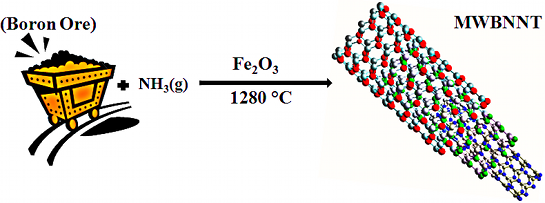
- , hydrogen storage, and the improvement of the mechanical as well as the chemical durability of polymer composites. Experimental Material and methods Colemanite (Ca2B6O11·5H2O) was a gift from Eti Mine Works General Management (Turkey). Iron (III) oxide, iron (II, III) oxide, aluminum oxide, zinc oxide


Ellipsometry and XPS comparative studies of thermal and plasma enhanced atomic layer deposited Al2O3-films
Beilstein J. Nanotechnol. 2013, 4, 732–742, doi:10.3762/bjnano.4.83
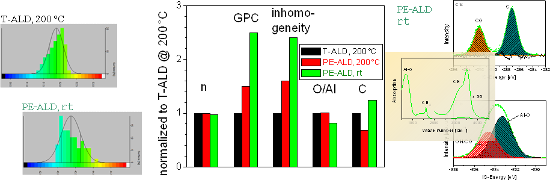
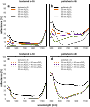
- , Germany 10.3762/bjnano.4.83 Abstract We report on results on the preparation of thin (<100 nm) aluminum oxide (Al2O3) films on silicon substrates using thermal atomic layer deposition (T-ALD) and plasma enhanced atomic layer deposition (PE-ALD) in the SENTECH SI ALD LL system. The T-ALD Al2O3 layers were
- not influenced significantly. Initial state energy shifts in all PE-ALD samples are observed which we attribute to a net negative charge within the films. Keywords: Al2O3; ALD; ellipsometry; PE-ALD; XPS; Introduction Thin aluminum oxide (Al2O3) layers deposited by atomic layer deposition (ALD) have


Surface passivation and optical characterization of Al2O3/a-SiCx stacks on c-Si substrates
Beilstein J. Nanotechnol. 2013, 4, 726–731, doi:10.3762/bjnano.4.82
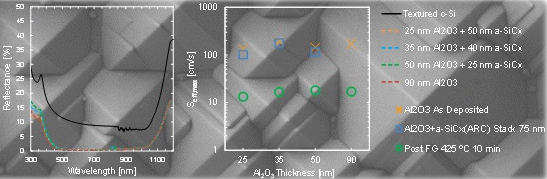
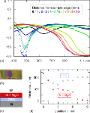
- study the surface passivation of aluminum oxide/amorphous silicon carbide (Al2O3/a-SiCx) stacks on both p-type and n-type crystalline silicon (c-Si) substrates as well as the optical characterization of these stacks. Al2O3 films of different thicknesses were deposited by thermal atomic layer deposition
- ) was evaluated at a carrier injection level corresponding to 1-sun illumination, which led to values below 10 cm/s. Reflectance values below 2% were measured on textured samples over the wavelength range of 450–1000 nm. Keywords: aluminum oxide (Al2O3); antireflection coating; atomic layer deposition
- ; silicon carbide (SiCx); surface passivation; Introduction Surface passivation has become a relevant issue in high efficiency crystalline silicon (c-Si) solar cells. The importance is even increasing as thinner wafers are used to reduce the cost for photovoltaic applications [1]. Aluminum oxide (Al2O3

Preparation of electrochemically active silicon nanotubes in highly ordered arrays
Beilstein J. Nanotechnol. 2013, 4, 655–664, doi:10.3762/bjnano.4.73
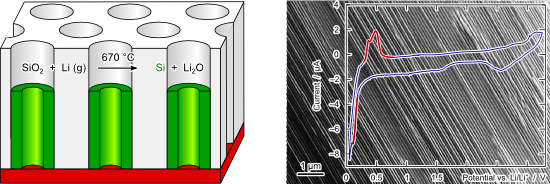
- standard procedure [11]: after the first anodization, the disordered porous aluminum oxide layer obtained is removed in chromic acid, then the ordered porous layer is obtained by a second anodization in the same conditions. The length of the pores is defined by the duration of this second anodization
- /O2, 150 °C (ALD); (d) CuCl2/HCl/H2O, 20 °C; (e) H3PO4/H2O, 45 °C; (f) Li, 670 °C; (g) HCl/H2O, 20 °C; (h) Au sputter, 20 °C. Note that despite the impression which may emanate from this cross-section representation, the aluminum oxide framework remains reticulated and continuous throughout (see





Functionalization of vertically aligned carbon nanotubes
Beilstein J. Nanotechnol. 2013, 4, 129–152, doi:10.3762/bjnano.4.14
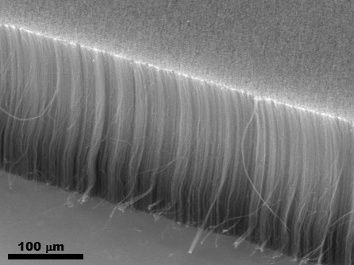
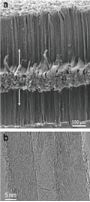
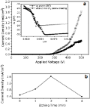
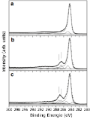
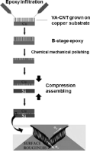
- deposited within the pores of nanoporous templates (for example, anodic aluminum oxide (AAO) membranes) allows design of a wide range of nanostructures with particular geometries, including aligned and monodispersed CNTs [40]. After the catalyst preparation, the next step is the synthesis of the VA-CNTs








Macromolecular shape and interactions in layer-by-layer assemblies within cylindrical nanopores
Beilstein J. Nanotechnol. 2012, 3, 475–484, doi:10.3762/bjnano.3.54
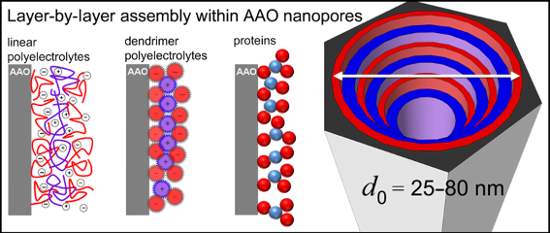
- of Technology, Donau City Str. 1, 1220 Vienna, Austria, Institute of Physical Chemistry, Tammannstr. 6, 37077 Göttingen, Germany 10.3762/bjnano.3.54 Abstract Layer-by-layer (LbL) deposition of polyelectrolytes and proteins within the cylindrical nanopores of anodic aluminum oxide (AAO) membranes was
- , obtained by the sequential adsorption of macromolecules within the nanopores of porous anodic aluminum oxide (AAO). The shape and the nature of the interactions between macromolecules were varied. AAO is widely used due to its self-organized, predictable structure, which is composed of nonintersecting
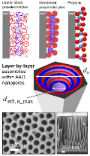
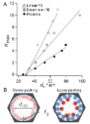
- . Results and Discussion For our studies on LbL deposition of globular proteins and linear-PE multilayers, we used the nanopores of anodic aluminum oxide (AAO). Scheme 1 (top) shows the general expected internal structure after LbL deposition in AAO nanopores. A two-step anodization process of the AAO




Ultraviolet photodetection of flexible ZnO nanowire sheets in polydimethylsiloxane polymer
Beilstein J. Nanotechnol. 2012, 3, 353–359, doi:10.3762/bjnano.3.41
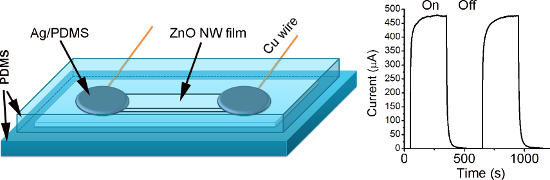
- suspension was vacuum filtered through a porous anode aluminum oxide (AAO) membrane, diameter of 4.3 cm and pore size of 200 nm, purchased from Whatman Co. Then the network film of ZnO nanowires on an AAO membrane was dried in air at 100 °C for 1 h. Finally, the thin sheet of ZnO nanowires was detached from


Improvement of the oxidation stability of cobalt nanoparticles
Beilstein J. Nanotechnol. 2012, 3, 75–81, doi:10.3762/bjnano.3.9
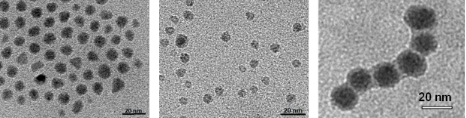
- developed in order to improve the long-term oxidation stability, including the establishment of a passivating aluminum oxide shell [8] or a protective silica [9] or gold layer [10] on the particle surface. However, these postmodification methods are often laborious, and the formation of multicore particle


Self-assembled monolayers and titanium dioxide: From surface patterning to potential applications
Beilstein J. Nanotechnol. 2011, 2, 845–861, doi:10.3762/bjnano.2.94
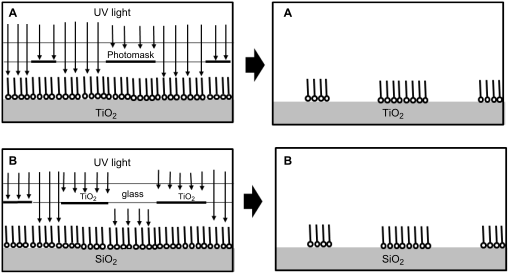
- ) heterojunction nanowires by a “bottom-up” approach [96]. Here, Au–TiO2–Au nanowires were prepared within nanoholes of anodic aluminum oxide templates. The preparation procedure included the deposition of gold by electroplating, chemisorption of 1,8-octanedithiol (HS–(CH2)8–SH), oxidation of the terminal thiol



Defects in oxide surfaces studied by atomic force and scanning tunneling microscopy
Beilstein J. Nanotechnol. 2011, 2, 1–14, doi:10.3762/bjnano.2.1
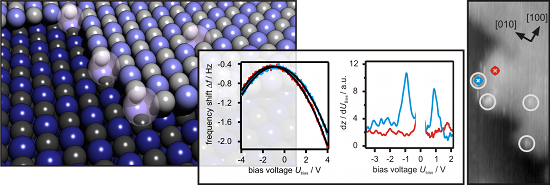
- surface termination by NC-AFM with atomic resolution, point defects in magnesium oxide on Ag(001) and line defects in aluminum oxide on NiAl(110), respectively, were thoroughly studied. The contact potential was determined by Kelvin probe force microscopy (KPFM) and the electronic structure by scanning
- aluminum oxide. At these domain boundaries, STS and KPFM verify F2+-like centers, which have been predicted by density functional theory calculations. Thus, by determining the contact potential and the electronic structure with a spatial resolution in the nanometer range, NC-AFM and STM can be successfully
- applied on thin oxide films beyond imaging the topography of the surface atoms. Keywords: aluminum oxide; charge state; contact potential; defects; domain boundaries; dynamic force microscopy; frequency modulation atomic force microscopy; Kelvin probe force microscopy; magnesium oxide; non-contact atomic





