


Search results
Search for "branching" in Full Text gives 58 result(s) in Beilstein Journal of Nanotechnology.
Influence of stabilising agents and pH on the size of SnO2 nanoparticles
Beilstein J. Nanotechnol. 2014, 5, 2192–2201, doi:10.3762/bjnano.5.228
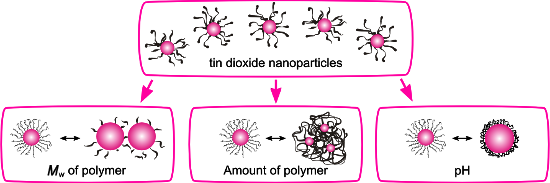
- be present in the form of molecules with different degrees of branching and molecular weight varying over a wide range. With regard to structure, in its linear form, it contains secondary amino groups, and in its branched form, primary, secondary and tertiary amino groups are present [22]. PEI is a


Carbon-based smart nanomaterials in biomedicine and neuroengineering
Beilstein J. Nanotechnol. 2014, 5, 1849–1863, doi:10.3762/bjnano.5.196
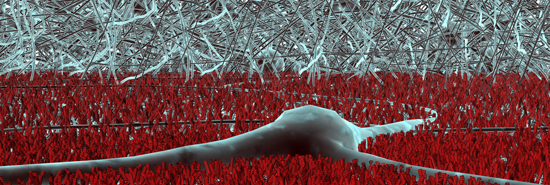
- neuronal growth substrates [105]. Mattson and colleagues reported that MWCNTs favoured neuronal adhesion although neurite branching was reduced, with respect to control conditions. This pioneering work laid the foundations for subsequent studies aimed at establishing the ability of CNTs to support neural


Self-organization of mesoscopic silver wires by electrochemical deposition
Beilstein J. Nanotechnol. 2014, 5, 1285–1290, doi:10.3762/bjnano.5.142
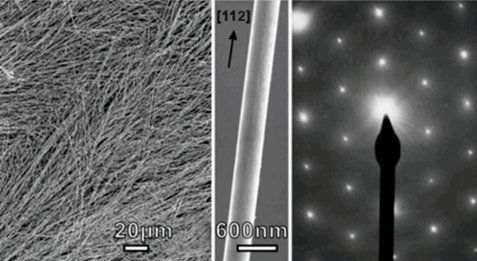
- the direction of local concentration gradient, to develop into homogeneous, non-branching wires, as shown in Figure 2b,c. However, if the axis of the wire deviates from the local concentration gradient, e.g., if in the initial direction of the axis of the wire is not perpendicular to the cathode
- the cation supply. Indeed such comb-like structures were observed in our experiments, too. As illustrated in Figure 5, side branching takes place only on one side of the wire and forms a 60 degree angle with respect to the main stem. Electron diffraction indicates that the side branches maintain the
- same crystallographic direction. These observations confirm our understanding of the silver wire growth and support the nutrient-supply-flux induced side branching mechanism in silver wire growth. This branching mechanism is valid when the wire growth has very strong anisotropy and the side faces of




Fibrillar adhesion with no clusterisation: Functional significance of material gradient along adhesive setae of insects
Beilstein J. Nanotechnol. 2014, 5, 837–845, doi:10.3762/bjnano.5.95
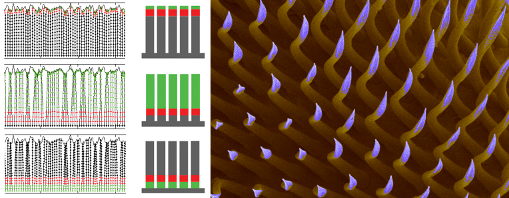
- roughness of the substrate and resistance to the environment. The opposite directionality of gradients can be well explained by difference in pad architecture. Smooth pads consist of branching rods or cellular foams, which in combination with fluid-filled spaces between solid structures hold the shape of


Directed deposition of silicon nanowires using neopentasilane as precursor and gold as catalyst
Beilstein J. Nanotechnol. 2012, 3, 535–545, doi:10.3762/bjnano.3.62
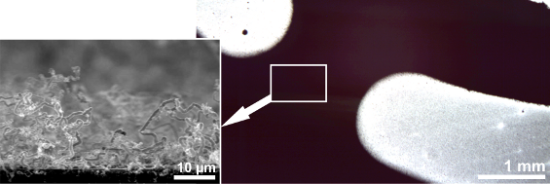
- with smaller structures indicating that the NWs may still contain gold atoms, which catalyze the “branching” (Figure 1, insert in center image). Shortening the reaction time to 30 min resulted in a loosely packed layer of shorter NWs (Figure 1, right). Backscattered-electron images and EDX mapping of
- twice the size of the nanoparticles. The NWs on sample 3a, on which no nanoparticles had been formed during the annealing step, were even bulkier than the ones on the other samples, with a diameter of around 800 nm or more (Figure 6, right). Remarkably, these NWs showed significant branching. Since NW
- Nanolab 600), TEM (FEI Tecnai Spirit) and light microscopy (Reichert, Univar) measurements. SEM images of NWs grown on gold-sputtered Si[111] exposed to NPS vapor at 375 °C for 1 h (left: side view; center: top view) and 30 min (right: top view). In the insert of the center view, the smaller, branching


X-ray spectroscopy characterization of self-assembled monolayers of nitrile-substituted oligo(phenylene ethynylene)s with variable chain length
Beilstein J. Nanotechnol. 2012, 3, 12–24, doi:10.3762/bjnano.3.2
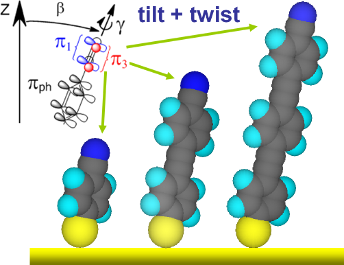
- maximum (fwhm) of the photoemission peaks of the S 2p, C 1s, and N 1s spectra. HRXPS spectra were fitted by symmetric Voigt functions and either a Shirley-type or linear background. To fit the S 2p3/2,1/2 doublets we used a pair of such peaks with the same fwhm, a branching ratio of 2 (2p3/2/2p1/2), and



Surface induced self-organization of comb-like macromolecules
Beilstein J. Nanotechnol. 2011, 2, 569–584, doi:10.3762/bjnano.2.61
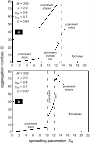
- . The spinodals were constructed for two types of branching point distributions: Regular and random [74]. The authors found that spinodals of microphase separation for different distributions converge to different limiting curves while having the same chemical composition. A theory of microphase




Functional morphology, biomechanics and biomimetic potential of stem–branch connections in Dracaena reflexa and Freycinetia insignis
Beilstein J. Nanotechnol. 2011, 2, 173–185, doi:10.3762/bjnano.2.21
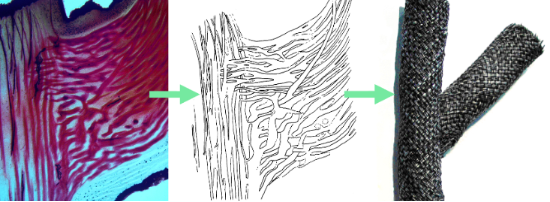
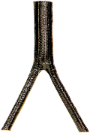
- Tom Masselter Sandra Eckert Thomas Speck Plant Biomechanics Group Freiburg, Botanic Garden, Faculty of Biology, University of Freiburg, Schänzlestraße 1, 79104 Freiburg, Germany Competence Network Biomimetics and Bionics Competence Network BIOKON e.V 10.3762/bjnano.2.21 Abstract Branching in
- plants is one of the most important assets for developing large arborescent growth forms with complex crowns. While the form and development of branching in gymnosperms and dicotyledonous trees is widely understood, very little is known about branching patterns and the structure of branch–stem-junctions
- using solutions inspired by plant ramifications, e.g., in automotive and aerospace engineering, architecture, sports equipment and prosthetic manufacturing. Keywords: Biomimetics; branching; Dracaena reflexa; Freycinetia insignis; monocotyledons; Introduction One of the most conspicuous features of




Other Beilstein-Institut Open Science Activities



