


Search results
Search for "cell adhesion" in Full Text gives 63 result(s) in Beilstein Journal of Nanotechnology.
Oxygen-plasma-modified biomimetic nanofibrous scaffolds for enhanced compatibility of cardiovascular implants
Beilstein J. Nanotechnol. 2015, 6, 254–262, doi:10.3762/bjnano.6.24
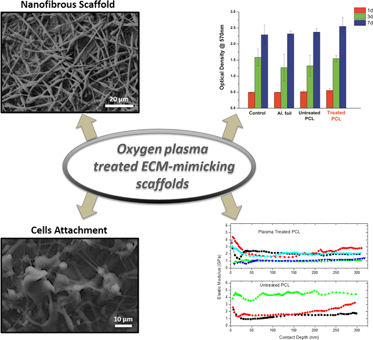
- surface hydrophilicity by forming oxygen-containing groups at the surface and thus to improve cell adhesion and proliferation. The conditions of the plasma modification were properly adjusted in order to induce the desirable chemical surface changes while maintaining surface integrity and morphology. The
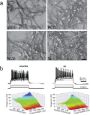
- , which is more apparent in the case of the treated samples indicates the growth and proliferation of the cells in their new microenvironment. Cell adhesion and proliferation According to Figure 4c, fibroblasts seemed to be securely attached and spread on the surface, regardless of the surface treatments
- is clearly observed, covering partially the plasma-treated surface. The enhanced cell adhesion and proliferation observed in the modified systems is attributed to plasma-induced chemical alterations of the surface and is in line with the results obtained from the physicochemical characterization of


Mechanical properties of MDCK II cells exposed to gold nanorods
Beilstein J. Nanotechnol. 2015, 6, 223–231, doi:10.3762/bjnano.6.21
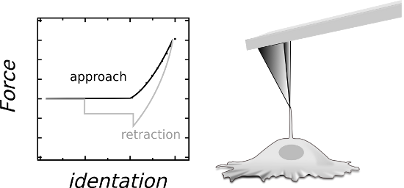
- signaling, for both CTAB spheres and rods, we found within 24 h after treatment a reduction of mitochondrial activity (by MTS or LDH) as well as the activation of reactive oxygen species [13][25]. Cellular mechanics plays an important role in many biological processes comprising cell adhesion, migration


Increasing throughput of AFM-based single cell adhesion measurements through multisubstrate surfaces
Beilstein J. Nanotechnol. 2015, 6, 157–166, doi:10.3762/bjnano.6.15
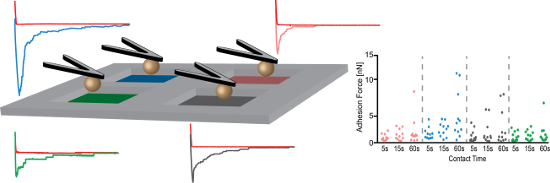
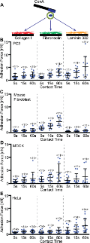
- cells regulate adhesion by expressing and regulating a diverse array of cell adhesion molecules on their cell surfaces. Since different cell types express distinct sets of cell adhesion molecules, substrate-specific adhesion is cell type- and condition-dependent. Single-cell force spectroscopy is used
- to quantify the contribution of cell adhesion molecules to adhesion of cells to specific substrates at both the cell and single molecule level. However, the low throughput of single-cell adhesion experiments greatly limits the number of substrates that can be examined. In order to overcome this
- limitation, segmented polydimethylsiloxane (PDMS) masks were developed, allowing the measurement of cell adhesion to multiple substrates. To verify the utility of the masks, the adhesion of four different cell lines, HeLa (Kyoto), prostate cancer (PC), mouse kidney fibroblast and MDCK, to three extracellular


Mammalian cell growth on gold nanoparticle-decorated substrates is influenced by the nanoparticle coating
Beilstein J. Nanotechnol. 2014, 5, 2479–2488, doi:10.3762/bjnano.5.257
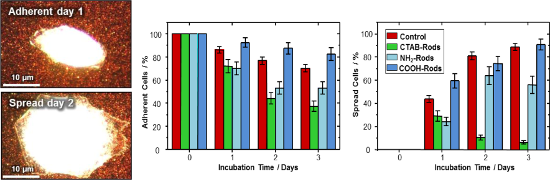
- biocompatible polymer exhibiting one of two different end groups, resulting in a neutral or negative surface charge of the particle. Upon observation of cell growth for three days by live cell imaging using optical dark field microscopy, it was found that all particles supported cell adhesion while no directed
- cell migration and no significant particle internalization occurred. Concerning cell adhesion and spreading as compared to cell growth on bare substrates after 3 days of incubation, a reduction by 45% and 95%, respectively, for the surfactant particle coating was observed, whereas the amino-terminated
- . Live cell imaging was performed over the course of an incubation time of three days using optical dark field microscopy in order to evaluate the cell adhesion and spreading by the cell morphology. We observe an influence of the particle coating on the growth behavior with respect to the cytotoxic


Carbon-based smart nanomaterials in biomedicine and neuroengineering
Beilstein J. Nanotechnol. 2014, 5, 1849–1863, doi:10.3762/bjnano.5.196
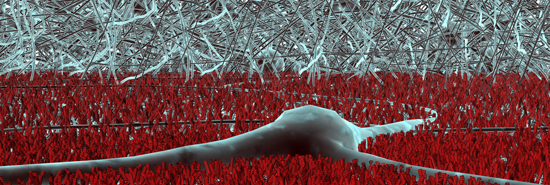
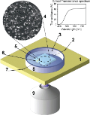
- of consisting of a continuous rough surface, i.e., the CNTs film, which was demonstrated to improve cell adhesion. Patch-clamp electrophysiology: One of the first studies reporting on the electrical activity of in vitro neuronal networks coupled to MWCNT-substrates was that of Lovat and co-workers
- because its nanostructure and its chemical stability render it a good candidate for favouring cell adhesion. In one of the first studies, Li and co-workers [138] studied the biocompatibility of graphene and the contingent changes in the expression of the protein GAP43, which is associated with the growth
- been studied by Park et al. [144]; the results showed not only an improved differentiation but also an enhanced cell adhesion and neurites formation compared to control conditions. Moreover, the expression of laminin-related receptors and of genes involved in the calcium signalling pathway was up


Biocompatibility of cerium dioxide and silicon dioxide nanoparticles with endothelial cells
Beilstein J. Nanotechnol. 2014, 5, 1795–1807, doi:10.3762/bjnano.5.190
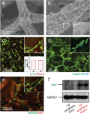
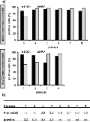
- investigated HUVEC populations presented an endothelial phenotype up to the highest investigated passage number as can be seen in Figure 1. All passages showed mainly CD31+ (platelet endothelial cell adhesion molecule 1 (PECAM-1)) and von Willebrand factor (vWF) positive cells (endothelial cells, Figure 1a
- (platelet endothelial cell adhesion molecule 1 (PECAM-1)). b) Proportion of CD90+ cells [%]. For purity examinations, CD90 as fibroblast cell type specific marker was determined. The investigations were performed on up to 9 passages and on HUVEC from two different suppliers (PromoCell GmbH and provitro GmbH


Near-field photochemical and radiation-induced chemical fabrication of nanopatterns of a self-assembled silane monolayer
Beilstein J. Nanotechnol. 2014, 5, 1441–1449, doi:10.3762/bjnano.5.156
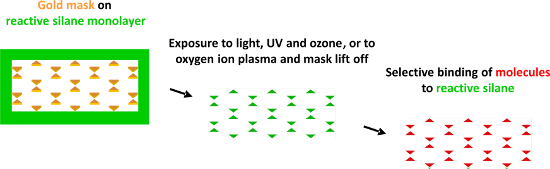
- templates are found in catalysis [9], biochemical surface engineering [10], cell adhesion [11], and biomineralization [12]. It has been shown previously that chemically nanostructured surfaces can be used as platforms for the graphoepitaxial growth of block-copolymer nanostructures [13] and to control the


Influence of the PDMS substrate stiffness on the adhesion of Acanthamoeba castellanii
Beilstein J. Nanotechnol. 2014, 5, 1393–1398, doi:10.3762/bjnano.5.152
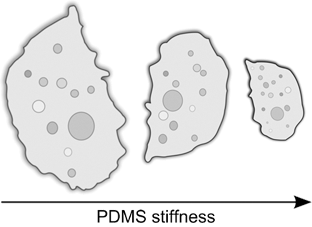
- cell adhesion area of A. castellanii trophozoites on polydimethylsiloxane (PDMS) substrates with different Young’s moduli (4 kPa, 29 kPa, and 128 kPa), we find significant differences in cell adhesion area as a function of substrate stiffness. In particular, the cell adhesion area of A. castellanii
- in the human body are the eye and the brain, i.e., very soft environments. Thus, our study provides first hints towards the relevance of mechanical aspects for the pathogenicity of eukaryotic parasites. Keywords: acanthamoeba; cell adhesion; elastic substrates; mechanosensing; silicones
- stiffness plays a decisive role for controlling cell adhesion on soft substrates, but also the specific mechanical anchorage of adhesion molecules [11]. The mechanosensory function of cells is supposed to be closely linked to the mechanisms of active force generation in cells. Analyzing cellular traction



Model systems for studying cell adhesion and biomimetic actin networks
Beilstein J. Nanotechnol. 2014, 5, 1193–1202, doi:10.3762/bjnano.5.131
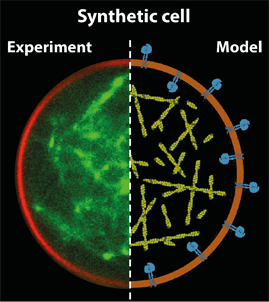
- 10.3762/bjnano.5.131 Abstract Many cellular processes, such as migration, proliferation, wound healing and tumor progression are based on cell adhesion. Amongst different cell adhesion molecules, the integrin receptors play a very significant role. Over the past decades the function and signalling of
- be incorporated into lipid vesicles, too. We here review the mechanisms of integrin-mediated cell adhesion and recent advances in the field of minimal cells towards synthetic adhesion. We focus on reconstituting integrins into lipid structures for mimicking cell adhesion and on the incorporation of
- actin networks and talin into model cells. Keywords: actin network; cell adhesion; giant unilamellar vesicle; integrin; lipid bilayer; synthetic cell; protein reconstitution; talin; Review Introduction Since Hooke first described a biological cell in 1665 tremendous progress has been made in


Controlling mechanical properties of bio-inspired hydrogels by modulating nano-scale, inter-polymeric junctions
Beilstein J. Nanotechnol. 2014, 5, 887–894, doi:10.3762/bjnano.5.101
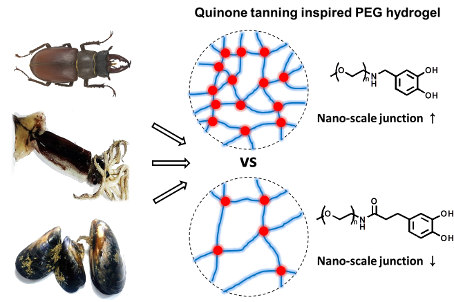
- -immobilization [15], facilitating cell adhesion [16], attenuating in vivo toxicity [17], initiating bio-mineralization [18], graphene nano-composites [19], and bio-inspired adhesives [20][21]. In addition to the interface science and engineering, methods to prepare bulk materials such as poly(ethylene glycol



Site-selective growth of surface-anchored metal-organic frameworks on self-assembled monolayer patterns prepared by AFM nanografting
Beilstein J. Nanotechnol. 2013, 4, 638–648, doi:10.3762/bjnano.4.71
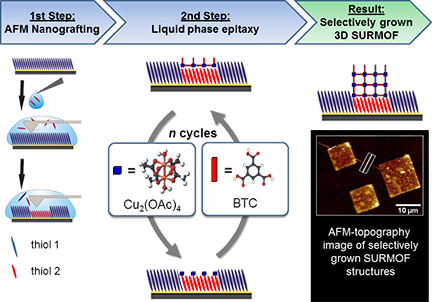
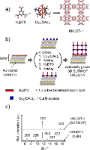
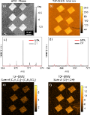
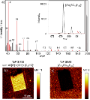
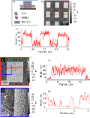
- studies. It is known that cell adhesion depends strongly on both the chemical functionalization of the surface as well as on the distribution of the chemical functionalities [31][32]. In this work we demonstrate the successful growth of micrometer sized HKUST-1 structures on patterns inside thiolate-based





Polymer blend lithography: A versatile method to fabricate nanopatterned self-assembled monolayers
Beilstein J. Nanotechnol. 2012, 3, 620–628, doi:10.3762/bjnano.3.71
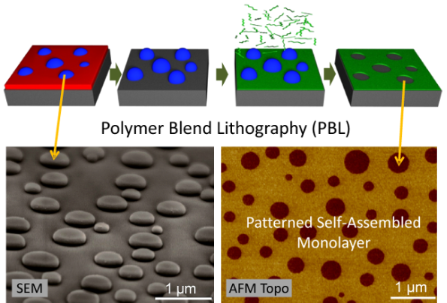
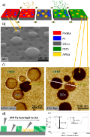
- , partly because of their interesting properties and partly because of interesting perspectives for potential applications as functional, ultrathin coatings [2][3][4][5]. Due to their functionality SAMs play an important role for the construction of sensors [6][7] or, e.g., the controlling of cell adhesion
- platform for constructive lithography [1], cell adhesion studies, or the study of other template-induced phenomena. The FDTS-SAM could be replaced by other silanes, such as octadecyltrichlorosilane (OTS) or polyethylene glycol (PEG) silane, for desired applications [63][64]. The bare silicon surface at the
- applications [65][66][67]. Silane-based follow-up reactions can be used to produce silane multilayers [68], which only grow in the predefined areas. This type of SAM template has also potential applications for the selective growth of titanium oxide or graphene on surfaces [69][70], or in cell-adhesion studies


Fabrication of multi-parametric platforms based on nanocone arrays for determination of cellular response
Beilstein J. Nanotechnol. 2011, 2, 545–551, doi:10.3762/bjnano.2.58
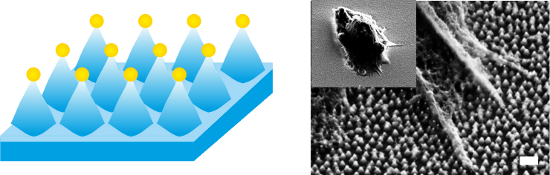
- substrates through a thiol linker system. Improved neural cell adhesion can be obtained and is dependent on the nature of the nanocone surface, thus illustrating the influence of different surface topographies on the nanometer length scale, on a complex cellular behavior such as cell adhesion. Substrate and
- surface functionality are shown to last over several days, leading to the conclusion that the features of our substrates can also be used for longer term experiments. Finally, initial neural cell adhesion is found to be more prominent on substrates with short intercone distances, which is an important
- finding for research dealing with the reactions of neuron-like tissue in the immediate moments after direct contact with an implanted surface. Keywords: block copolymer nanolithography; cell adhesion; nanostructures; surface chemistry; surface topography; Introduction Nanostructured materials for





