


Search results
Search for "chemisorption" in Full Text gives 86 result(s) in Beilstein Journal of Nanotechnology.
Surface-enhanced Raman scattering of self-assembled thiol monolayers and supported lipid membranes on thin anodic porous alumina
Beilstein J. Nanotechnol. 2017, 8, 74–81, doi:10.3762/bjnano.8.8
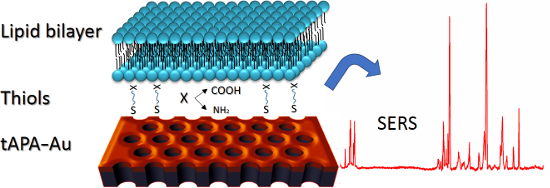
- ), and then with phospholipid vesicles of different composition to form a supported lipid bilayer (SLB). At each step, the SERS substrate functionality was assessed, demonstrating acceptable enhancement (≥100×). The chemisorption of thiols during the first step and the formation of SLB from the vesicles
- , to let the sulfur of the –SH group bind covalently to the Au surface (chemisorption). The substrates were then gently washed with their aqueous solutions and dried under nitrogen flow. All the lipids were dissolved in chloroform/methanol 2:1 vol/vol, dried under a gentle nitrogen flux in a test tube
- used as a control for success of the incubation of the tAPA–Au substrates in the lipid dispersion. In a preliminary step (data not shown) we have monitored the chemisorption of thiols onto the Au-coated QCM-D sensors; the functionalized sensors where then exposed to the lipid vesicles and the process



Scanning probe microscopy studies on the adsorption of selected molecular dyes on titania
Beilstein J. Nanotechnol. 2016, 7, 1642–1653, doi:10.3762/bjnano.7.156
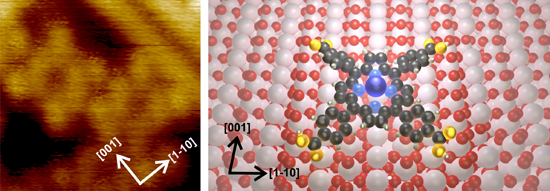
- layers of physisorbed species. Interestingly, an increased density of the molecular adsorbates leads to changes in the adsorption mode from physisorption to chemisorption, leaving the molecules arranged in a well-ordered brick-wall-like structure. In a more recent study, the same authors examined the
- induced through a post-deposition annealing step. As-deposited molecules are extremely mobile and rather weakly interact with the substrate. Thermal treatment of the sample leads to the detachment of hydrogen atoms in the central void of the H2PC molecules. That in turn results in the chemisorption and


Ammonia gas sensors based on In2O3/PANI hetero-nanofibers operating at room temperature
Beilstein J. Nanotechnol. 2016, 7, 1312–1321, doi:10.3762/bjnano.7.122
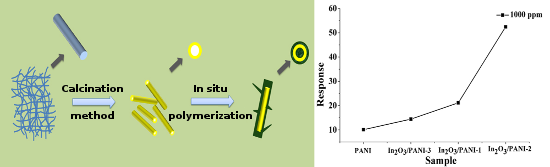
- . According to the test results, it can be concluded that In2O3/PANI-2 nanofibers sensor exhibited unique selectivity to ammonia. A possible mechanism for the selectivity to NH3 is the chemisorption of NH3 on PANI in In2O3/PANI-2 forming ammonium [32]. Besides, the different gases show different electron


Invariance of molecular charge transport upon changes of extended molecule size and several related issues
Beilstein J. Nanotechnol. 2016, 7, 418–431, doi:10.3762/bjnano.7.37
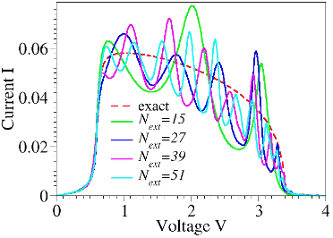
- particularly true in (chemisorption) cases where the anchoring groups form covalent bonds to the electrodes. Within current approaches to molecular charge transport, mostly based on nonequilibrium Keldysh Green’s functions (NEGF) combined with density functional theory (DFT), the molecular device is


Rigid multipodal platforms for metal surfaces
Beilstein J. Nanotechnol. 2016, 7, 374–405, doi:10.3762/bjnano.7.34

- electrical properties [20]. Moreover, transistor-type devices from the same molecule have displayed fundamentally different transport characteristics [21][22]. The organization of the molecules within the junction is usually based on some sort of self-assembly using chemisorption or physisorption methods to
- only prerequisite, in electronic applications also the contact point of the molecule with the substrate, which defines the coupling between molecule and electrode (substrate), must be controlled. One of the most important class of SAMs is based on the strong chemisorption of organosulfur compounds
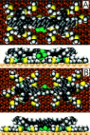
- described and chemisorbed on gold surfaces. In these molecular tripods, which yield a stable and perpendicular chemisorption of molecules, however, little or no attention has been paid to maintaining the functionality of anchored molecules. In order to enable a fast electron transfer a strong and defined













Case studies on the formation of chalcogenide self-assembled monolayers on surfaces and dissociative processes
Beilstein J. Nanotechnol. 2016, 7, 263–277, doi:10.3762/bjnano.7.24
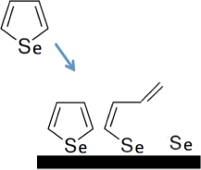
- report examines the assembly of chalcogenide organic molecules on various surfaces, focusing on cases when chemisorption is accompanied by carbon–chalcogen atom-bond scission. In the case of alkane and benzyl chalcogenides, this induces formation of a chalcogenized interface layer. This process can occur


Surface-site reactivity in small-molecule adsorption: A theoretical study of thiol binding on multi-coordinated gold clusters
Beilstein J. Nanotechnol. 2016, 7, 53–61, doi:10.3762/bjnano.7.6
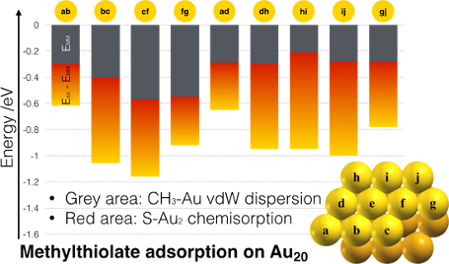
- , from Liu et al. [77]. The addition of the dispersion correction enhanced non-dissociative binding energies in MeSH by 0.2 to 0.7 eV, and moderately increased chemisorption energies (MeS) by 0.2 to 0.5 eV. Non-dissociative adsorption. The binding energy in non-dissociative adsorption was calculated as


Plasma fluorination of vertically aligned carbon nanotubes: functionalization and thermal stability
Beilstein J. Nanotechnol. 2015, 6, 2263–2271, doi:10.3762/bjnano.6.232
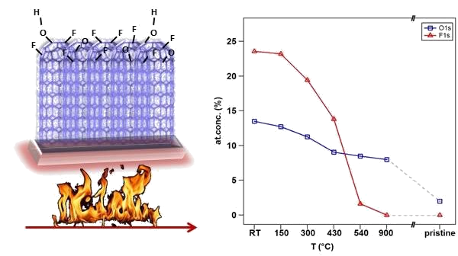
- chemisorption of oxygen leads to binding energy values ranging from 3–5 eV, depending on the chemisorption site [41]. In order to understand the effects of fluorination in valence electronic states of the vCNTs, UPS measurements were performed (Figure 3). First, we analyzed a pristine sample (red curve) after


Continuum models of focused electron beam induced processing
Beilstein J. Nanotechnol. 2015, 6, 1518–1540, doi:10.3762/bjnano.6.157
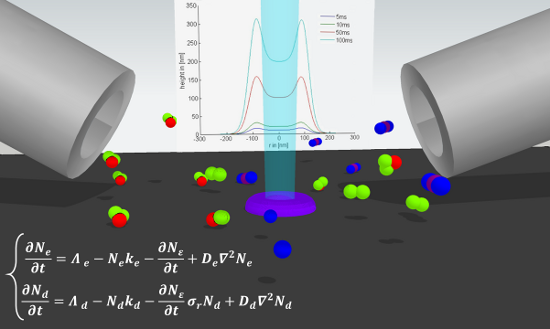
- simulate a wide range of processes reported in the FEBIP literature. These include: (i) etching and deposition performed using precursors that interact with a surface through physisorption and activated chemisorption, (ii) gas mixtures used to perform simultaneous focused electron beam induced etching and
- chemisorption. We also note that most FEBIP models assume that sa is independent of temperature. The thermal desorption rate ka of the physisorbed species ‘a’ is given by: where τa is the adsorption time (i.e., adsorbate residence time), κa is the desorption attempt frequency, Ea the desorption energy, (i.e
- molecules decompose partially via chemisorption upon collisions with unoccupied adsorption sites on the wall. This process is self-limiting after a short transient time during which all wall sites are occupied and the wall is passivated for further molecule decomposition. Nozzle geometries Two nozzle


![[Graphic 37]](/bjnano/content/inline/2190-4286-6-157-i117.png?max-width=637&scale=1.18182) and chemisorbed
and chemisorbed ![[Graphic 38]](/bjnano/content/inline/2190-4286-6-157-i118.png?max-width=637&scale=1.18182) adsorbates versus pressure, calcul...
adsorbates versus pressure, calcul...


Charge carrier mobility and electronic properties of Al(Op)3: impact of excimer formation
Beilstein J. Nanotechnol. 2015, 6, 1107–1115, doi:10.3762/bjnano.6.112
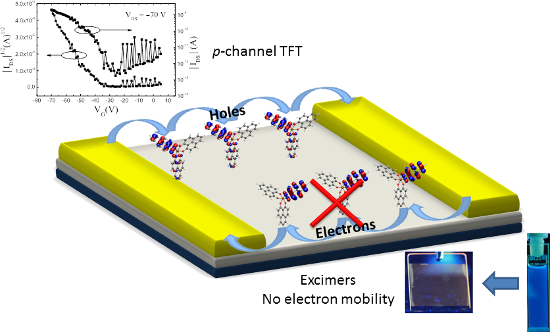
- spectroscopy (NT-PS) [16]. The purpose was to study the spin-dependent properties of the Co/Al(Op)3 hybrid interface in comparison with the Co/Alq3 hybrid interface [17]. Due to the difference in the aromatic structures of Al(Op)3 and Alq3, which influences the chemisorption onto the cobalt substrate, it was


Electron-stimulated purification of platinum nanostructures grown via focused electron beam induced deposition
Beilstein J. Nanotechnol. 2015, 6, 907–918, doi:10.3762/bjnano.6.94
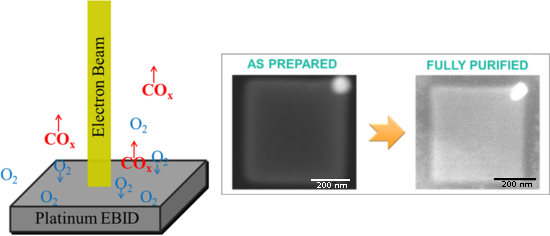
- simulation coupled with (2) an explicit finite difference treatment of oxygen diffusion and the (3) Huen–Euler method to approximate the dissociative chemisorption of atomic oxygen on metal nanoparticle surfaces internal to the deposited solid. Electron energy loss converts bound oxygen into an activated
- calculate the diffusion term in Equation 2. Importantly, the numerical approximation was derived including a variable pixel size which made it possible to “contract” the deposit based on the amount of carbon lost. The second term in Equation 2 describes the chemisorption of mobile oxygen gas as adsorbed



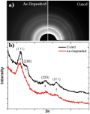

SERS and DFT study of copper surfaces coated with corrosion inhibitor
Beilstein J. Nanotechnol. 2014, 5, 2489–2497, doi:10.3762/bjnano.5.258
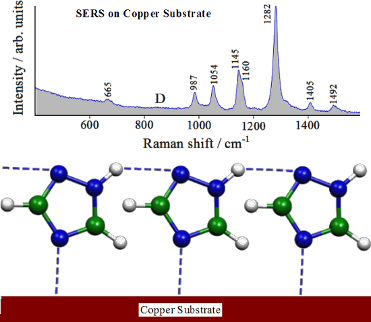
- in high amount in the environment, aqueous solutions or soil. A very efficient way to protect copper surfaces is by creating an anticorrosive thin film by chemisorption of organic inhibitors. Heterocycles containing sulphur or nitrogen atoms, available for bonding with the copper surface, are widely
- SERS activation was ensured by the deposition of silver colloidal nanoparticles on the copper substrate where the organic molecules were already stable and present due to chemisorption [9][10][11]. Regardless, it must be taken into account that the deposited silver particles, in addition to promoting
- oxidation of the copper surface, as was evidenced by the absence of typical bands of Cu(I) oxide in the Raman spectra. Additionally, the observed frequency shifts of the SERS spectral peaks with respect to the corresponding non-SERS Raman spectral peaks of triazole in solution suggest chemisorption of the


Spectroscopic mapping and selective electronic tuning of molecular orbitals in phosphorescent organometallic complexes – a new strategy for OLED materials
Beilstein J. Nanotechnol. 2014, 5, 2248–2258, doi:10.3762/bjnano.5.234
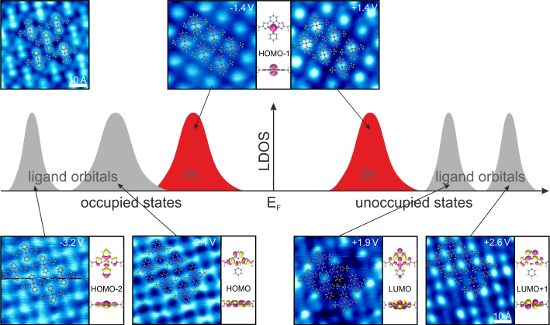
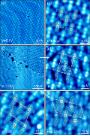
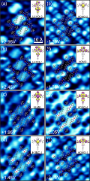
- states in both measurements? For this we have to consider the possibility of strong physisorption (or even chemisorption). While weak physisorption only leads to a broadening of the MO levels (as described above), a strong molecule–substrate hybridization (i.e., strong physisorption or chemisorption) can



Advances in NO2 sensing with individual single-walled carbon nanotube transistors
Beilstein J. Nanotechnol. 2014, 5, 2179–2191, doi:10.3762/bjnano.5.227
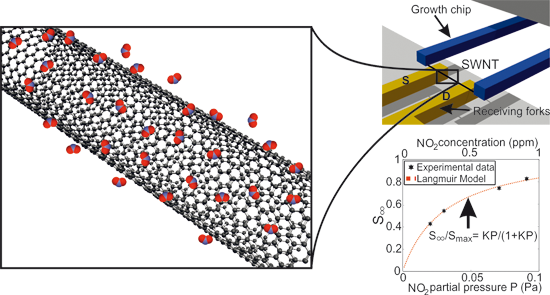
- ][39][40][41][42][43]. Although the first calculations [39][40] suggested a charge transfer upon physisorption, Santucci et al. [43] showed that this charge transfer disappeared when spin-polarized treatment was used in the calculations. Yim et al. [44] have suggested that a pairwise chemisorption of
- NO2 molecules is more favorable than the chemisorption of individual molecules, but the energy of interaction they report is far lower than the observed experimental results as well as theoretical calculations in other reports [41][45]. Another possibility is dissociative adsorption of NO2. Goldoni et
- energy for NO3 on the nanotube. However, it has since been pointed out that the methods used in this paper tend to overestimate the binding energy [41][45] and charge transfer. Dai et al. [41] found that chemisorption of two NO3 molecules, on the other hand, is found to be favorable, with an adsorption


Cathode lens spectromicroscopy: methodology and applications
Beilstein J. Nanotechnol. 2014, 5, 1873–1886, doi:10.3762/bjnano.5.198

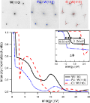
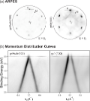
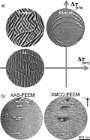
- phase shows a negligible DOS at the K point of the π-band. These results point to the disruption of the Dirac cones and the formation of a metal-like DOS. Surprisingly, the hybridization of the π-band with Ir states is due to the chemisorption of just 11% of the C atoms in the unit cell of the buckled
- chemisorption bonds such as those observed in the buckled graphene phase on Ir(100). In our work, the related variations in C–substrate bonding and the electronic structure of graphene were quantified in μ-XPS and μ-ARPES experiments, taking the pristine graphene/Ir(100) system as reference. Experimentally, Au
- further confirms that, after Au intercalation, graphene is entirely physisorbed and no chemisorption bonds are established between C and the substrate. The C 1s μ-XPS spectrum of the graphene/Ir(100) system exhibits two components. The dominant one, at about 283.95 eV binding energy, has been previously



Purification of ethanol for highly sensitive self-assembly experiments
Beilstein J. Nanotechnol. 2014, 5, 1254–1260, doi:10.3762/bjnano.5.139
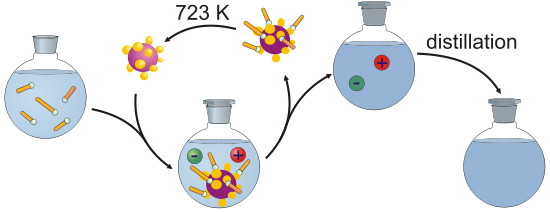
- with the desired thiolates for surface sites. Here we present that gold nanoparticles deposited onto zeolite X can be used to remove these contaminants by chemisorption. This nanoparticle-impregnated zeolite does not only show high capacities for surface-active contaminants, such as thiols, but can be
- thiols and other surface-active impurities from ethanol was tested by varying the gold load at the zeolite as well as the gold-NP preparation temperature. Dodecanethiol was used as test substance for these chemisorption experiments because it binds effectively and fast to gold surfaces [3]. In a typical
- change of thin gold films upon chemisorption of molecular films. For a selected class of compounds, such as alkanethiols, a very good linear correlation between the increase of resistivity and the surface coverage Θ has been established [29][32]. As an initial test, several commercial qualities of

Growth and characterization of CNT–TiO2 heterostructures
Beilstein J. Nanotechnol. 2014, 5, 946–955, doi:10.3762/bjnano.5.108
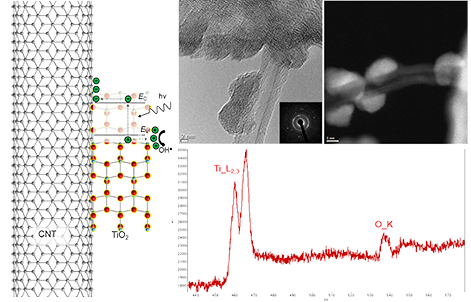
- can be found in the review by Leary [19]. Recently, we have adopted the atomic layer deposition (ALD) technique to deposit TiO2 on CVD-grown MW-CNTs. ALD relies on self-limiting surface reactions (dissociative chemisorption) of gases which are alternately introduced into and purged out of the reaction
- chamber. The surface reaction will establish a chemical bond of the precursor molecule with the substrate through the reaction of an organic ligand to a volatile compound. The remaining organic ligands still bound to the metal atom prevent further chemisorption. This self-limitation has two important
- , e.g., trimethylaluminium for Al2O3, titanium tetraisopropoxide for TiO2, diethylzinc for ZnO, or tetrakis(ethylmethylamido)hafnium for HfO2, need surfaces that are terminated with a functional group, which would allow for their dissociative chemisorption reaction. Hydroxy-(OH)-group terminated


Gas sensing with gold-decorated vertically aligned carbon nanotubes
Beilstein J. Nanotechnol. 2014, 5, 910–918, doi:10.3762/bjnano.5.104
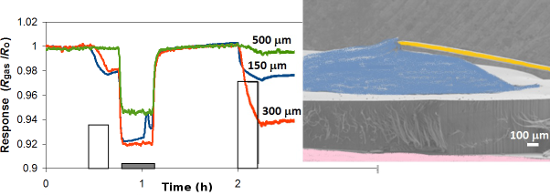
- temperature. However, mild heating at 150 °C was needed to help desorb the species from the surface so the baseline resistance could be fully recovered. This is not surprising because a rather strong interaction (chemisorption) between oxygen plasma treated or gold nanoparticle decorated CNTs and NO2 has been


Injection of ligand-free gold and silver nanoparticles into murine embryos does not impact pre-implantation development
Beilstein J. Nanotechnol. 2014, 5, 677–688, doi:10.3762/bjnano.5.80
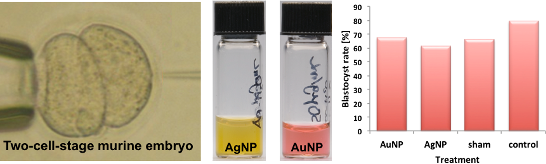
- (physisorption or chemisorption) strongly affects the toxicity of AuNP on human embryonic kidney cells [39]. Another factor which has been shown to influence embryotoxicity is the size of the nanoparticles. For both AuNP and AgNP an increase in toxicity has been shown in conjuction with a decrease in size [13




In vitro toxicity and bioimaging studies of gold nanorods formulations coated with biofunctional thiol-PEG molecules and Pluronic block copolymers
Beilstein J. Nanotechnol. 2014, 5, 546–553, doi:10.3762/bjnano.5.64
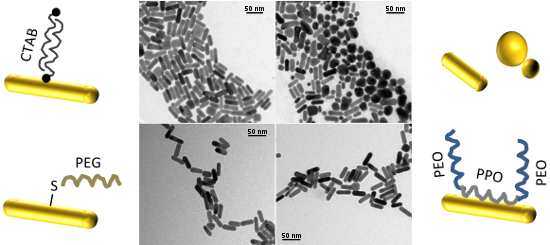
- by means of the chemisorption process between the thiol moiety and the gold particle surface [24][25]. Pluronic is a commercially available triblock copolymer with a hydrophobic segment of poly(propylene oxide) (PPO) polymer sandwiched between two hydrophilic segments of PEO. In our previous study


Neutral and charged boron-doped fullerenes for CO2 adsorption
Beilstein J. Nanotechnol. 2014, 5, 413–418, doi:10.3762/bjnano.5.49
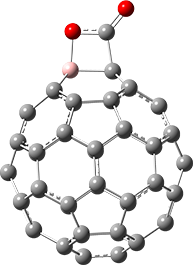
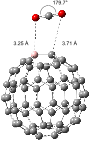
- adsorption the calculated adsorption energy should have a negative value. To provide more accurate results for the chemisorption energy the counterpoise corrected energy [26][27] was also calculated. The transition state was located by using the synchronous transit-guided quasi-Newton (STQN) method [28][29
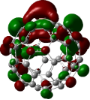
- to undergo significant structural deformations. A stable CO2 adsorption is observed at the HH B–C site. The chemisorption energy of −15.41 kcal/mol (−64.48 kJ/mol) (−13.48 kcal/mol with BSSE correction) agrees well with the ideal range of chemisorption energy (40–80 kJ/mol) for a good CO2 adsorbent
- frequency calculations on the optimized transition structure, which confirms that it is a first order saddle point and hence an actual transition structure. From this figure, the activation barrier for the chemisorption is estimated to be 13.25 kcal/mol (55.43 kJ/mol). The low barrier of the reaction



Modeling and optimization of atomic layer deposition processes on vertically aligned carbon nanotubes
Beilstein J. Nanotechnol. 2014, 5, 234–244, doi:10.3762/bjnano.5.25
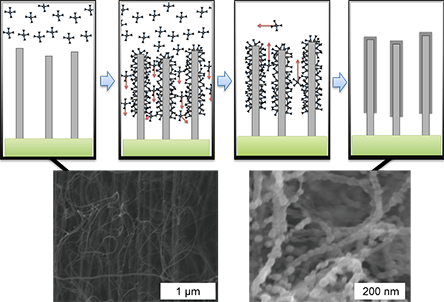
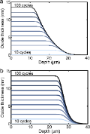
- , and α(x,t) is a loss term that corresponds to the adsorption of precursor molecules onto available bonding sites and their subsequent chemical bond formation (chemisorption). The adsorption rate per unit volume, α, is modeled to be proportional to the number of precursor molecules striking the CNT



Change of the work function of platinum electrodes induced by halide adsorption
Beilstein J. Nanotechnol. 2014, 5, 152–161, doi:10.3762/bjnano.5.15
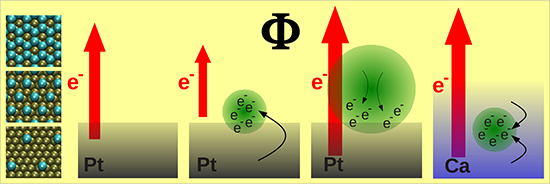
- nitrogen adsorbed on a tungsten (100) surface. They showed that the decrease of the work function depends strongly on the length of the chemisorption bond. If the adatom is located close to the surface, it is in the region of the overspill electron density of the metal. This leads to an area of electron
- shown to give reliable results in terms of atomization energy, chemisorption energies [24][25], work function changes [26], and good estimates of bulk properties of metals [27]. Hybrid functionals are not necessarily improvements to PBE; for example they do not yield a satisfactory description of the
- can be associated with a covalent character of the chemisorption bond. This rearrangement is particularly strong for the adsorption of iodine, and slightly weaker for bromine and chlorine. The character of the chemisorption bond between iodine and platinum was discussed in the past [10][17] and


Influence of the adsorption geometry of PTCDA on Ag(111) on the tip–molecule forces in non-contact atomic force microscopy
Beilstein J. Nanotechnol. 2014, 5, 98–104, doi:10.3762/bjnano.5.9
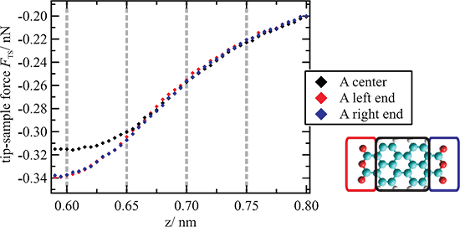
- , could in this case be explained by the different spectral weight of the energetically shifted LUMO state (the hybrid state resulting from the chemisorption) below the Fermi level and corresponding differences in the electron density of the two orientations. A higher electron density would lead to a




Magnetic anisotropy of graphene quantum dots decorated with a ruthenium adatom
Beilstein J. Nanotechnol. 2013, 4, 441–445, doi:10.3762/bjnano.4.51
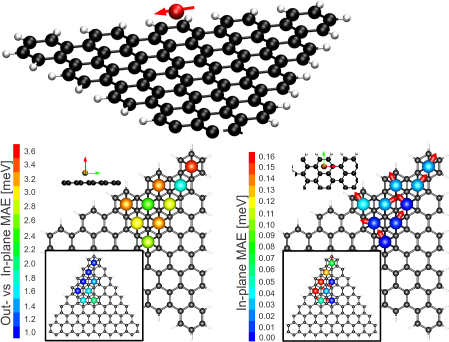
- shall consider the nature of its bonding to the graphene flake. We find the calculated Ru–flake separation to be 1.75 Å, strongly indicating chemisorption, a fact supported by the significant reduction in the Ru moment from the atomic state (we find the moment to be always less than 2 μB while the





