Search results
Search for "critical temperature" in Full Text gives 60 result(s) in Beilstein Journal of Nanotechnology.
Thickness-modulated tungsten–carbon superconducting nanostructures grown by focused ion beam induced deposition for vortex pinning up to high magnetic fields
Beilstein J. Nanotechnol. 2016, 7, 1698–1708, doi:10.3762/bjnano.7.162
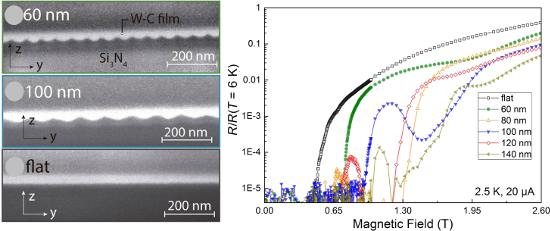
- show a wide variety of functionalities: conductive [5], insulating [6], magnetic [7], optical [8], superconductive [9], etc. In particular, FIBID has been used to grow superconducting W–C nanodeposits with a relatively high critical temperature, Tc, up to 6 K using a W(CO)6 precursor [9][10][11][12][13
- critical temperature of Tc = 4.40 ± 0.15 K and a room temperature resistivity of ρ300K = 213 ± 47 μΩ cm. The flat sample has been made using a 39 nm y-pitch, which is as large as the beam spot size. The SEM images in Figure 2 indicate the achievement of the targeted thickness modulation. In Table 1, the


Thickness dependence of the triplet spin-valve effect in superconductor–ferromagnet–ferromagnet heterostructures
Beilstein J. Nanotechnol. 2016, 7, 957–969, doi:10.3762/bjnano.7.88
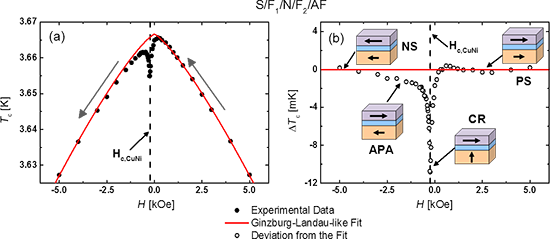
- . We attribute this reduction to the theoretically predicted [15] reduction of the critical temperature by the generation of the long-range, odd-in-frequency, spin-projection one triplet component of superconductivity at non-collinear orientation of the magnetizations of the two ferromagnetic layers
- dependence of the upper critical field (parallel to the film plane) given by Hc(T) = Hc(0)(1 − T/Tc0)α. Here, Tc0 is the critical temperature, i.e., the superconducting transition temperature in the absence of currents and magnetic fields, and α is a parameter given by the effective dimensionality of the
- derived in this regime from the theory of Fominov et al. [15] (see Figure 8 for the calculated data, both in absolute units and normalized to TcS, the critical temperature of a freestanding Nb film of the same thickness as in the present sample series). Since Tc0 decreases, this is also expected for Hc(0





Influence of calcium on ceramide-1-phosphate monolayers
Beilstein J. Nanotechnol. 2016, 7, 236–245, doi:10.3762/bjnano.7.22
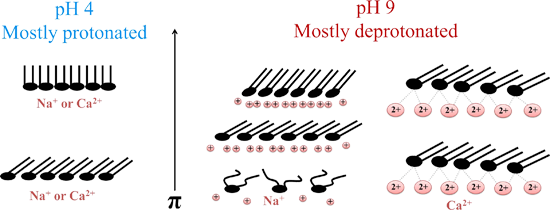
- /LC phase transition (data not shown). The calculated critical temperature Tc (see section 1 in Supporting Information File 1) for this system, i.e., the temperature above which the LC phase cannot be reached anymore upon compression of the monolayer, was found to be about 38 °C, which is slightly


Structural and magnetic properties of iron nanowires and iron nanoparticles fabricated through a reduction reaction
Beilstein J. Nanotechnol. 2015, 6, 1652–1660, doi:10.3762/bjnano.6.167
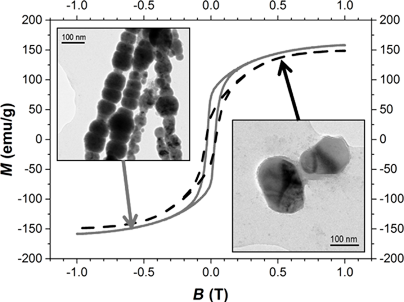
- different models describing the magnetic behaviour around the critical temperature (for instance the most common Heisenberg model). However, the applied formula allows for a very rough estimation of TC and β originating from the extrapolation of fitted plots for both cooling curves. The fitting parameters



Formation of CuxAu1−x phases by cold homogenization of Au/Cu nanocrystalline thin films
Beilstein J. Nanotechnol. 2014, 5, 1491–1500, doi:10.3762/bjnano.5.162
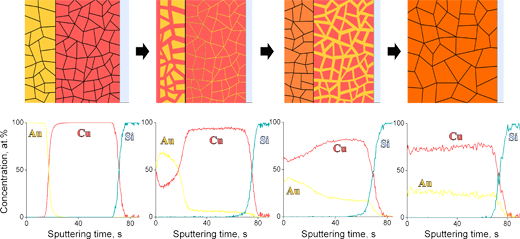
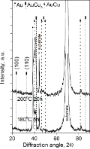
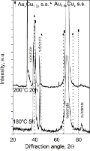
- mainly been investigated in binary systems with a wide mutual solubility range above either the miscibility gap or the critical temperature of ordering (e.g., in Cu/Pd [16], Au/Cu [15], Ag/Pd [7], Ni/Cu [17][18][19], NiPd [20]). Less works have been devoted to systems with reactive diffusion [21]. For






Nanoscale particles in technological processes of beneficiation
Beilstein J. Nanotechnol. 2014, 5, 458–465, doi:10.3762/bjnano.5.53
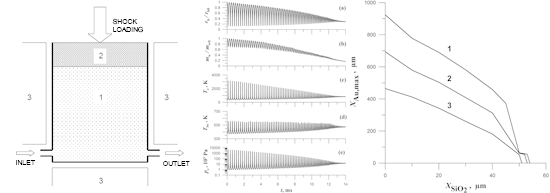
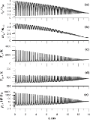
- equation: If the temperature Tlw of the liquid at the edge with the vapor is less than the critical temperature Tcr of the van der Waals gas then the phase transition takes place at the bubble surface. Considering the edge of the bubble as a hydrodynamical discontinuity (a wave of phase transition) we use
- heat. If the liquid temperature at the interface with the vapor is higher than (or equal to) the critical temperature then the phase transition is absent and the relationships in Equation 7 are fulfilled at the interface (ml = mw) under the condition At the surface of the bubble there are two competing


Charge and spin transport in mesoscopic superconductors
Beilstein J. Nanotechnol. 2014, 5, 180–185, doi:10.3762/bjnano.5.18
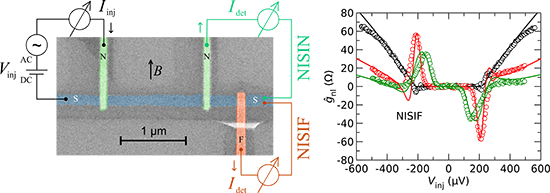
- and 1980s, mostly in the vicinity of the critical temperature. Much less attention has been paid to low temperatures and the role of the quasiparticle spin. Results: We report here on nonlocal transport in superconductor hybrid structures at very low temperatures. By comparing the nonlocal conductance
- but no spin. The quasiparticle excitations, however, may carry both charge and spin. Non-equilibrium charge transport in superconductors has been investigated intensely in the 1970s and 1980s, mostly in the vicinity of the critical temperature [8][9][10] and more recently also in the low-temperature
- , some experiments reported shorter time scales (sometimes by orders of magnitude) under similar conditions [21][22]. In contrast, our results are quantitatively consistent with the “old” knowledge obtained from experiments close to the critical temperature [23][24][25], as well as more recent low


![[Graphic 6]](/bjnano/content/inline/2190-4286-5-18-i9.png?max-width=637&scale=1.18182) at a bias voltage of about 2Δ (a) and spin diffusion length λS (b) for di...
at a bias voltage of about 2Δ (a) and spin diffusion length λS (b) for di...

Size-dependent phase diagrams of metallic alloys: A Monte Carlo simulation study on order–disorder transitions in Pt–Rh nanoparticles
Beilstein J. Nanotechnol. 2012, 3, 1–11, doi:10.3762/bjnano.3.1
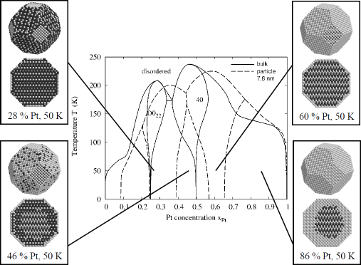
- prove to be useful in order to assign a critical temperature to the smooth phase transitions in this finite system. Method The refined BOS mixing model We use a standard Metropolis Monte Carlo algorithm that implements a simulation model that is closely related to the “Bond Order Simulation” (BOS
- ). Second, we adjusted the composition for each particle size to coincide with the maximum of the critical temperature, i.e., xPt = 0.595, 0.66, 0.69 for the 7.8, 4.3 and 3.1 nm particles (Figure 8). For clarity only the two parameters for 6th and 8th neighbors that show the strongest variation at the
- such that for all particles the phase transition is observed at the maximum critical temperature of the 40-phase. No shift in magnitude of the concentration-averaged parameters is seen as is the case for non-concentration-averaged in Figure 9. Compare also to the core constrained short-range order


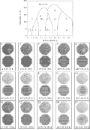


![[Graphic 37]](/bjnano/content/inline/2190-4286-3-1-i43.png?max-width=637&scale=1.18182) up to 8th neighbors for a Pt...
up to 8th neighbors for a Pt...

![[Graphic 28]](/bjnano/content/inline/2190-4286-3-1-i34.png?max-width=637&scale=1.18182) (lower points) and
(lower points) and ![[Graphic 29]](/bjnano/content/inline/2190-4286-3-1-i35.png?max-width=637&scale=1.18182) (upper points) WC-order parameters versus temperature for di...
(upper points) WC-order parameters versus temperature for di...


![[Graphic 31]](/bjnano/content/inline/2190-4286-3-1-i37.png?max-width=637&scale=1.18182) (lower points) and
(lower points) and ![[Graphic 32]](/bjnano/content/inline/2190-4286-3-1-i38.png?max-width=637&scale=1.18182) (upper points). The Pt concentration is ...
(upper points). The Pt concentration is ...

![[Graphic 33]](/bjnano/content/inline/2190-4286-3-1-i39.png?max-width=637&scale=1.18182) (lower points) and
(lower points) and ![[Graphic 34]](/bjnano/content/inline/2190-4286-3-1-i40.png?max-width=637&scale=1.18182) (upper points) constrained to a core region...
(upper points) constrained to a core region...

![[Graphic 39]](/bjnano/content/inline/2190-4286-3-1-i45.png?max-width=637&scale=1.18182) and
and ![[Graphic 38]](/bjnano/content/inline/2190-4286-3-1-i44.png?max-width=637&scale=1.18182) of three different particle sizes and bulk material a...
of three different particle sizes and bulk material a...

Enhancement of the critical current density in FeO-coated MgB2 thin films at high magnetic fields
Beilstein J. Nanotechnol. 2011, 2, 809–813, doi:10.3762/bjnano.2.89
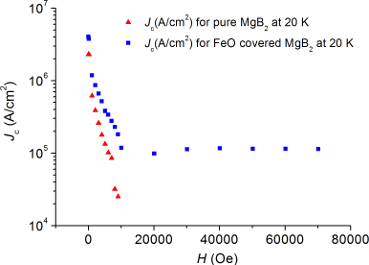
- material, with a hexagonal crystal structure and a critical temperature of Tc = 39 K, raised a lot of questions about its transport properties. This strong type-II superconductor has a fairly high critical current density in zero magnetic field, i.e., up to Jc ~ 1.6 × 10⁷ A/cm2 at 15 K [2]. This
- films, in order to avoid the strong suppression of the critical temperature of the film. The proximity effect of nanoparticles has a very small effect on the superconducting properties of our MgB2 thin films, reducing their critical temperature by about 1 K. Taking into account these ideas, we studied
- , and the other 4.28 × 4.84 mm2 piece remained uncoated for comparison measurements. The Ginzburg–Landau coherence length of our films was obtained from the slope of the upper critical magnetic field measurements, Bc2(T), close to the critical temperature, resulting in ξGL(0) = 3.0 nm [12]. We measured


Magnetic interactions between nanoparticles
Beilstein J. Nanotechnol. 2010, 1, 182–190, doi:10.3762/bjnano.1.22
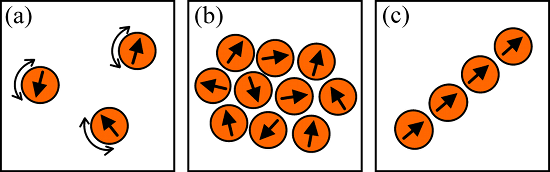
- high concentrations of magnetic nanoparticles, which would be superparamagnetic if they were non-interacting, magnetic dipole interactions can result in ordering of the magnetic moments of the nanoparticles below a critical temperature T0, where [9] Systems of magnetic nanoparticles with only magnetic