


Search results
Search for "damping" in Full Text gives 196 result(s) in Beilstein Journal of Nanotechnology.
Gas-sensing features of nanostructured tellurium thin films
Beilstein J. Nanotechnol. 2020, 11, 1010–1018, doi:10.3762/bjnano.11.85
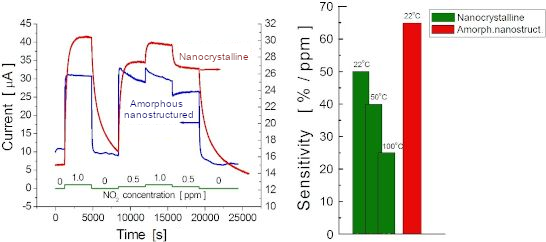
- -induced current upon step-change concentration of the target gas. This can be explained based on the concentration-induced phenomenon that induces sensitivity damping in ultrathin films [34]. It is safe to assume that, given the high rate at which the films are grown (30 nm/s), their thickness remains low


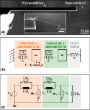
Microwave photon detection by an Al Josephson junction
Beilstein J. Nanotechnol. 2020, 11, 960–965, doi:10.3762/bjnano.11.80
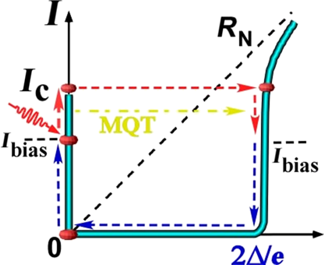
- layered high-temperature superconductors [27]. The significance of this effect depends on the ratio of thermal fluctuations kBT, the damping parameter α and the Josephson energy EJ. Here we will consider a small tunnel junction with the thermal noise intensity of γ = kBT/EJ ≥ 2 × 10⁻² and α > 0.1, and
- the particle at rest in one well of the potential. The exit from this metastable state corresponds to the appearance of a finite voltage at the junction. In the case of low damping (but depending also on the barrier height and noise intensity), the particle, jumping over the barrier, gains enough
- energy to move along the potential in the running state. When the damping α is sufficiently large, the escape due to the thermal or quantum fluctuations does not necessarily lead to the appearance of the running state. After an escape event, the particle can move down the potential for several wells and


Light–matter interactions in two-dimensional layered WSe2 for gauging evolution of phonon dynamics
Beilstein J. Nanotechnol. 2020, 11, 782–797, doi:10.3762/bjnano.11.63
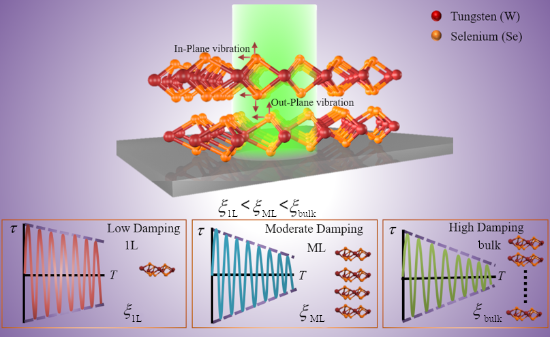
- oscillator model to explain the damping mechanism in WSe2. From this it was determined that the damping coefficient increases with the number of layers. The work reported here sheds fundamental insights into the evolution of phonon dynamics in WSe2 and should help pave the way for designing high-performance
- influenced by damping mechanisms. The FWHM is expected to be infinitesimally small for activated phonons in a dissipationless medium, and the crystal elastic waves of the harmonic oscillator model for the allowable phonon modes would thus yield an exceptionally large τ. However, natural systems inherently
- exhibit damping, and thus the FWHM of the Raman peaks have a finite width, indicating the presence of decay channels that reduce τ. In general, the phonon linewidths contain contributions arising from several scattering mechanisms such as the electron–electron interaction, i.e., Coulombic scattering, or
Stochastic excitation for high-resolution atomic force acoustic microscopy imaging: a system theory approach
Beilstein J. Nanotechnol. 2020, 11, 703–716, doi:10.3762/bjnano.11.58
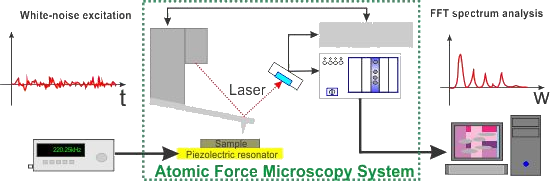
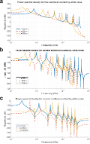
- deflection signal from the photodiodes of the AFM equipment. The classical Euler–Bernoulli beam equation is used, which is expressed by Vázquez et al. as [27][28][29]: where EI is the flexural stiffness, c is the damping due to viscous friction, m is the mass per unit length and z(x,t) is the deflection of



A review of demodulation techniques for multifrequency atomic force microscopy
Beilstein J. Nanotechnol. 2020, 11, 76–91, doi:10.3762/bjnano.11.8

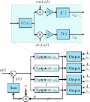
- particularly suited to intermittent-contact AFM [9] when tip–sample contact is gentle. Environmental damping has a large effect on the quality factor (Q) of the cantilever. Values can range from as low as Q ≈ 1 in liquid [10], up to Q ≈ 10,000 in ultra-high vacuum [11]. This affects the mechanical bandwidth of


The effect of heat treatment on the morphology and mobility of Au nanoparticles
Beilstein J. Nanotechnol. 2020, 11, 61–67, doi:10.3762/bjnano.11.6
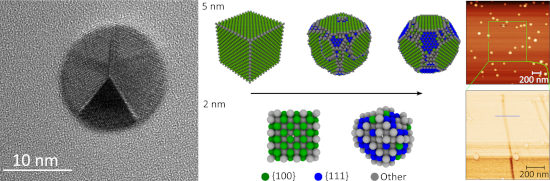
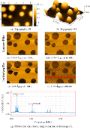
- measure of the mobility of the NPs. The calibration of the cantilevers was performed by the thermal tuning method. The oscillation amplitudes ranged from 0.05 to 0.6 V with a sensitivity of 25 to 31 nm/V. The sensitivity was measured individually for each cantilever by means of damping the AFM tip against


Plasmonic nanosensor based on multiple independently tunable Fano resonances
Beilstein J. Nanotechnol. 2019, 10, 2527–2537, doi:10.3762/bjnano.10.243
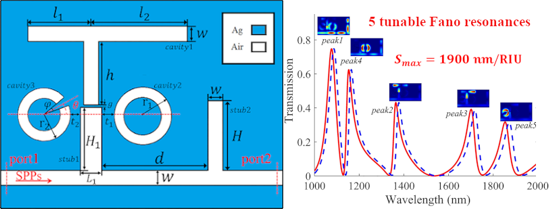
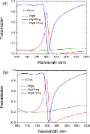
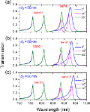
- frequency, the bulk plasma frequency ωp is 1.38 × 10¹⁶ rad/s, ω stands for the angle frequency of the incident wave, and the damping rate γp is 2.73 × 10¹³ rad/s, which characterizes the absorption loss. A TM-polarized plane wave is launched from port1 to excite the SPPs. Here Pin and Pout stand for input


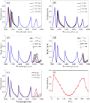


Multiple Fano resonances with flexible tunablity based on symmetry-breaking resonators
Beilstein J. Nanotechnol. 2019, 10, 2459–2467, doi:10.3762/bjnano.10.236
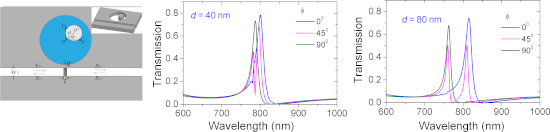
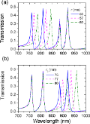
- the incident light. The other parameters are ε∞ = 3.7, bulk plasma frequency ωp = 1.38 × 10¹⁶ Hz, damping frequency γ = 2.73 × 10¹³ Hz. The dielectric in the waveguide is air. The ring resonator is filled with a dielectric with the constant εd. Temporal coupled-mode theory (CMT) is used to analyze the




Integration of sharp silicon nitride tips into high-speed SU8 cantilevers in a batch fabrication process
Beilstein J. Nanotechnol. 2019, 10, 2357–2363, doi:10.3762/bjnano.10.226
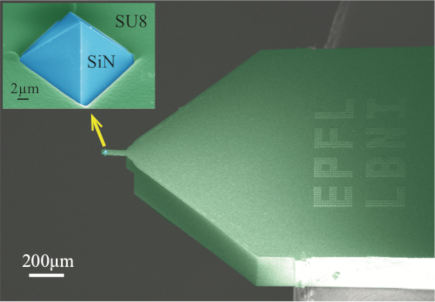
- cantilever material, which are presented as . On the other hand, 1/Q is strongly influenced by the intrinsic damping of the cantilever material. Therefore, optimizing the ratio πf0/Q translates into optimizing the ratio , which has been defined as material bandwidth product [23]. SU8 cantilevers have shown
- a high imaging speed due to the high material bandwidth product, which mainly results from the high intrinsic damping properties of the polymer. Such cantilevers have high resonance frequencies and low Q-factors for a given size and stiffness [23]. However, SU8 tips wear down quickly and become


The role of Ag+, Ca2+, Pb2+ and Al3+ adions in the SERS turn-on effect of anionic analytes
Beilstein J. Nanotechnol. 2019, 10, 2338–2345, doi:10.3762/bjnano.10.224
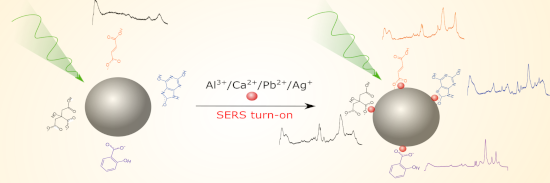
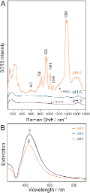
- surface of the AgNPs. Therefore, the observed blue shift and damping of the surface plasmon resonance (SPR) peak, which is observed only after the formation of Ag+ adions, indicates an electronic contact between the AgNPs and citrate (Figure 1B) [28][29][30]. No SERS spectra of citrate were obtained at pH
- solution. The Raman enhancement is not a result of the colloid aggregation since no broadening of the SPR band was observed in the colloid extinction spectra after the SERS activation of the cit-AgNPs/organic acid mixtures with cations. A weak damping of the SPR band is observed only after the addition of
- through the damping of the SPR band. Particularly, the anionic analytes chemisorb to the cit-AgNPs only after the silver surface is activated with cations. This leads to the damping of the SPR indicating a chemical coupling between nanoparticle and adsorbate. Fumaric acid and salicylic acid show the


Dynamics of superparamagnetic nanoparticles in viscous liquids in rotating magnetic fields
Beilstein J. Nanotechnol. 2019, 10, 2294–2303, doi:10.3762/bjnano.10.221
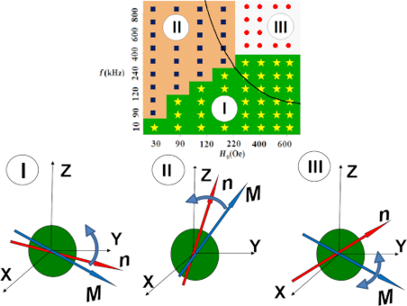
- rotates in the XY-plane of the Cartesian coordinates, so that Neglecting weak magnetic damping and a small moment of inertia of a magnetic nanoparticle, the magneto-dynamic equations of motion of the unit vectors and in a viscous fluid have the form [25] where G = K/3η, η is the liquid viscosity, K is
- ][53][54] where γ1 = |γ|/(1 + κ2), κ is the phenomenological damping parameter, and is the random thermal magnetic field that causes thermal fluctuations of the particle magnetic moment. The stochastic equation for the nanoparticle director is given by [25][54][55] where ξ = 6ηV is the friction
- density ρ = 5 g/cm3, and the viscosity of the liquid η = 0.01 g/(cm·s). The magnetic damping constant is assumed to be κ = 0.1, the medium temperature is T = 300 K. Figure 4 shows that for a dilute assembly of superparamagnetic nanoparticles in RMFs the SAR value monotonously rises with increasing


Ion mobility and material transport on KBr in air as a function of the relative humidity
Beilstein J. Nanotechnol. 2019, 10, 2084–2093, doi:10.3762/bjnano.10.203
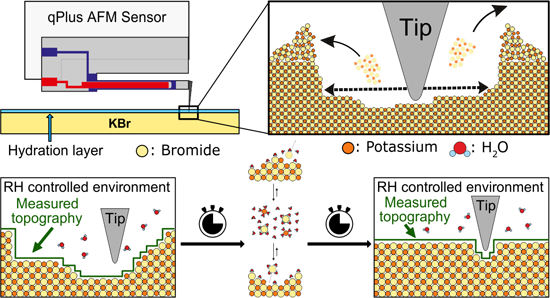
- water film and the water meniscus that forms around the tip–sample contact cause damping forces on the probe, which result in higher noise [7]. The hydrophobicity of sapphire reduces the meniscus effect. The impact that hydrophobicity or hydrophilicity of the tip material can have is demonstrated by


Subsurface imaging of flexible circuits via contact resonance atomic force microscopy
Beilstein J. Nanotechnol. 2019, 10, 1636–1647, doi:10.3762/bjnano.10.159
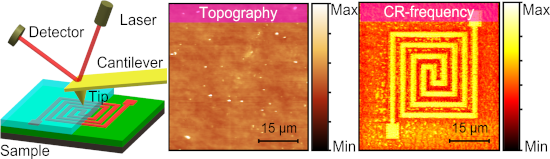
- position, the cantilever tilt caused by mounting and the effect of lateral forces are all considered [14][15][16]. The elastic interactions between the tip and the sample are modeled with contact stiffnesses in the normal and lateral directions. The damping is neglected because it does not have significant



Rapid thermal annealing for high-quality ITO thin films deposited by radio-frequency magnetron sputtering
Beilstein J. Nanotechnol. 2019, 10, 1511–1522, doi:10.3762/bjnano.10.149
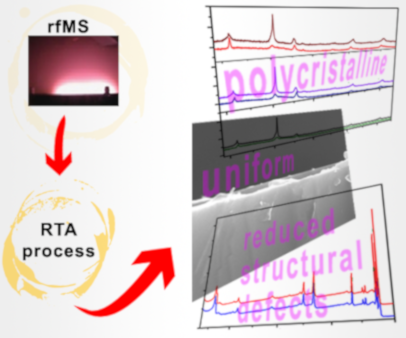
- real and imaginary parts of the dielectric permittivity on the wavelength is illustrated in Figure 8. The increase in thickness of the ITO films influenced the optical constants (i.e., Drude damping coefficient, Drude frequency, complex permittivity, refractive indices, extinction coefficients


Nanoscale spatial mapping of mechanical properties through dynamic atomic force microscopy
Beilstein J. Nanotechnol. 2019, 10, 1332–1347, doi:10.3762/bjnano.10.132
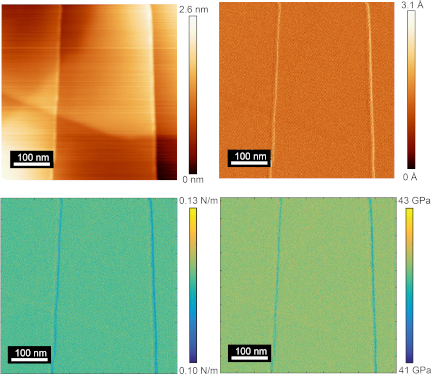
- uncovered step for both directions, as will be shown in Figure 5a. Figure 4d shows a very slight variation in the phase as the tip traversed the uncovered steps, but otherwise no significant change in the phase signal was observed. The lack of any significant variation in phase suggests that damping of the
- series with the contact elements, which are two Kelvin–Voigt linear elements with a spring, accounting for the contact stiffness and a dash pot describing the contact damping. Figure 9 illustrates two elements of a spring and a dash pot in parallel, defining the contact at the tip of the cantilever and




On the relaxation time of interacting superparamagnetic nanoparticles and implications for magnetic fluid hyperthermia
Beilstein J. Nanotechnol. 2019, 10, 1280–1289, doi:10.3762/bjnano.10.127
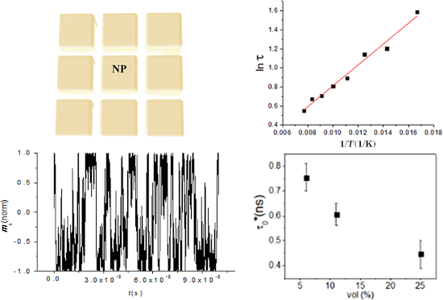
- ]: The values of hfluct at each magnetic moment are provided according to a Gaussian distribution which is characterized by two parameters, the mean and the variance, taking values of 0 and respectively, where γ is the gyro-magnetic ratio and α the damping constant (the usual value of 0.5 was considered



Coexisting spin and Rabi oscillations at intermediate time regimes in electron transport through a photon cavity
Beilstein J. Nanotechnol. 2019, 10, 606–616, doi:10.3762/bjnano.10.61
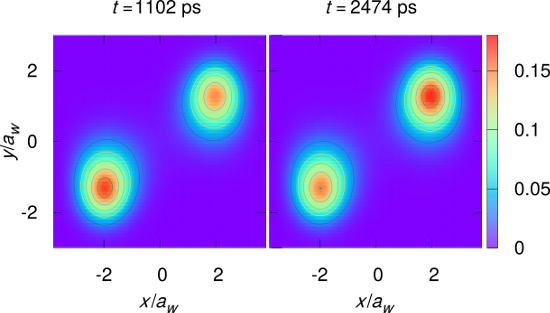
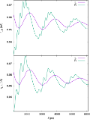
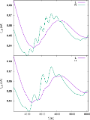
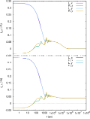
- interaction we assume a rotating wave approximation. Care has to be taken in deriving the corresponding damping terms for the master equation as they have to be transformed from the basis of non-interacting photons to the basis of interacting electrons and photons (the eigenstates of HS (Equation 2)) [24][25


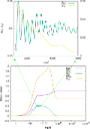
![[Graphic 40]](/bjnano/content/inline/2190-4286-10-61-i49.svg?max-width=637&scale=1.418184) and photon
and photon ![[Graphic 41]](/bjnano/content/inline/2190-4286-10-61-i50.svg?max-width=637&scale=1.418184) content in the open central system as a function of time. In additio...
content in the open central system as a function of time. In additio...
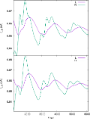

![[Graphic 60]](/bjnano/content/inline/2190-4286-10-61-i69.svg?max-width=637&scale=1.418184)
![[Graphic 61]](/bjnano/content/inline/2190-4286-10-61-i70.svg?max-width=637&scale=1.418184)
![[Graphic 62]](/bjnano/content/inline/2190-4286-10-61-i71.svg?max-width=637&scale=1.418184) and
and ![[Graphic 63]](/bjnano/content/inline/2190-4286-10-61-i72.svg?max-width=637&scale=1.418184) i...
i...
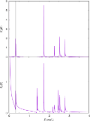
![[Graphic 76]](/bjnano/content/inline/2190-4286-10-61-i85.svg?max-width=637&scale=1.418184) in the steady state. The cavity pho...
in the steady state. The cavity pho...
Heating ability of magnetic nanoparticles with cubic and combined anisotropy
Beilstein J. Nanotechnol. 2019, 10, 305–314, doi:10.3762/bjnano.10.29
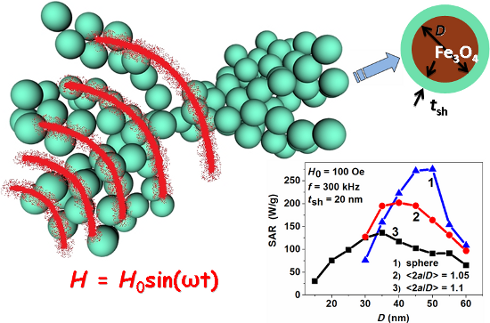
- ][31] governs the dynamics of the unit magnetization vector of the ith single-domain nanoparticle of the cluster where γ is the gyromagnetic ratio, κ is phenomenological damping parameter, γ1 = γ/(1+κ2), is the effective magnetic field and is the thermal field. The effective magnetic field acting on


Magnetic-field sensor with self-reference characteristic based on a magnetic fluid and independent plasmonic dual resonances
Beilstein J. Nanotechnol. 2019, 10, 247–255, doi:10.3762/bjnano.10.23
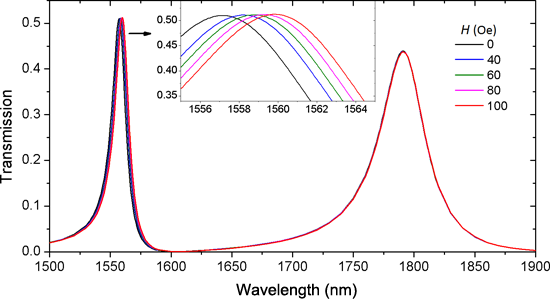
- magnetic fluid. The background metal in the grey part is silver, the complex permittivity of which is characterized by the well-known Drude model: , where ε∞ = 3.7 is the permittivity at infinite angular frequency, the bulk plasma frequency is ωp = 1.38 × 10¹⁶ Hz, the damping frequency of the oscillations



Pull-off and friction forces of micropatterned elastomers on soft substrates: the effects of pattern length scale and stiffness
Beilstein J. Nanotechnol. 2019, 10, 79–94, doi:10.3762/bjnano.10.8
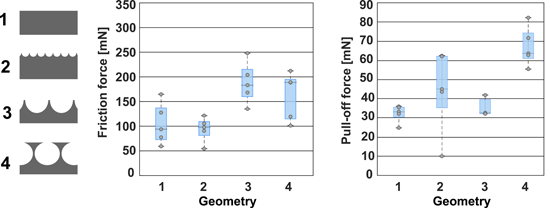
- the micropattern. The PVA substrates have some dissipative properties (dissipation factors of PVA-12: tan δ = 0.05; PVA-18: tan δ = 0.07), which might contribute to the resultant pull-off force as well. Given the low value of these dissipation factors, we doubt whether damping plays a significant role





Polarization-dependent strong coupling between silver nanorods and photochromic molecules
Beilstein J. Nanotechnol. 2018, 9, 2657–2664, doi:10.3762/bjnano.9.247
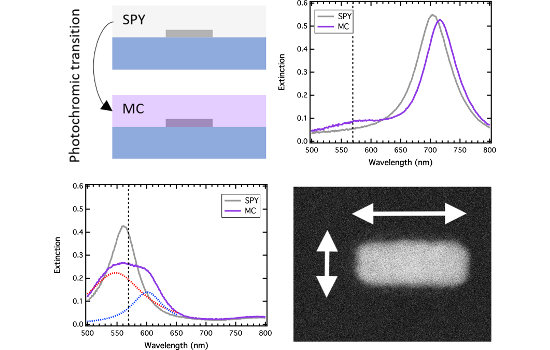
- than the sum of their line widths [19]. This condition implies that the Rabi oscillation period is shorter than the damping time of the plasmon and of the organic exciton. In our case, the fitted decomposition of the curves into two Lorentzian curves (inset of the Figure 2b) leads to an energy
- equal to 132 and 235 nm, leading to linewidths of 655 and 697 meV. This difference in the hybrid mode linewidths has already been observed for a gold nanogroove arrays coated with a J-aggregate dye film [25]. In this work, they observed different damping rates for the hybrid modes attributed to the
- interplay between the coherent dipole coupling between exciton and plasmon and the incoherent exchange of photon energy between both systems. This can happen when the damping of both separate oscillators is different, which is our case with the plasmonic resonance and the MC molecular exciton. The large



Nanoantenna structures for the detection of phonons in nanocrystals
Beilstein J. Nanotechnol. 2018, 9, 2646–2656, doi:10.3762/bjnano.9.246
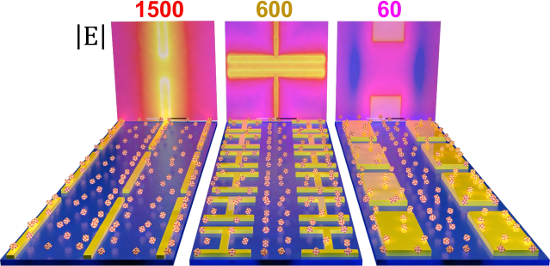
- structure, while a Drude model with linear plasma and damping frequencies of 72,500 cm−1 and 216 cm−1, respectively, was applied to correctly describe the frequency response of gold [12]. To avoid undesirable computational effects arising from wave interference in the Si wafer of finite thickness, the Si


Friction reduction through biologically inspired scale-like laser surface textures
Beilstein J. Nanotechnol. 2018, 9, 2561–2572, doi:10.3762/bjnano.9.238
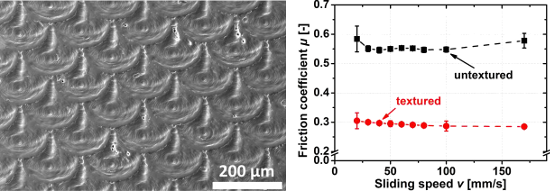
- chosen that resulted in regular, elliptical protrusions, lowering friction compared to an untextured control sample [24]. In an approach resulting in surface textures much closer to the natural example, Baum et al. showed that variations in the effective elastic modulus (therefore allowing for damping


Effective sensor properties and sensitivity considerations of a dynamic co-resonantly coupled cantilever sensor
Beilstein J. Nanotechnol. 2018, 9, 2546–2560, doi:10.3762/bjnano.9.237
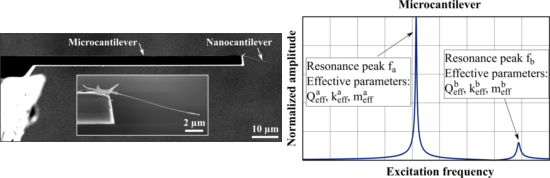
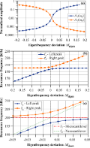
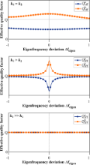
- described as a coupled harmonic oscillator, consisting of a damping element d1,2, spring k1,2 and effective mass m1,2 for each subsystem. Please note that m1,2 still denotes the effective mass but the subscript eff was omitted to keep the descriptions short. The model furthermore allows to study external
- results in a sixth degree polynomial expression that can only be solved numerically. Consequently, for an estimate of the resonance frequencies, we consider the model from Figure 1c without the damping elements d1,2. The validity of this assumption is supported by comparison of simulation results for the
- damped and undamped circuit model which show that the position of the resonance frequencies is only minimally influenced, even for high damping, i.e., low quality factors [14]. This can be understood by following the reasoning of [27]. In case of viscous damping, one has to distinguish between the


![[Graphic 7]](/bjnano/content/inline/2190-4286-9-237-i43.svg?max-width=637&scale=1.18182) ...
...


Evidence of friction reduction in laterally graded materials
Beilstein J. Nanotechnol. 2018, 9, 2443–2456, doi:10.3762/bjnano.9.229
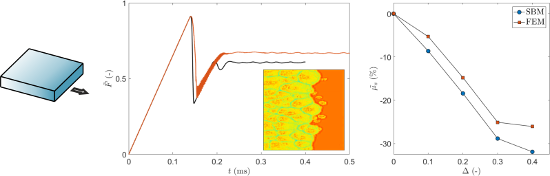
- − ri ), where ri0 is the initial position of the block and ν is the velocity vector of the slider, e.g., ν = (ν,0) when sliding is along the x axis. Therefore, the total driving force acting on the block i is Fmot(i) = Fs(i) + Σj Fint(ij). A damping force is added to avoid artificial block
- oscillations, where γ is the damping coefficient and is the velocity vector of the block. The damping coefficient γ is an arbitrary parameter. The results are independent of its value provided it is fixed in the underdamped regime: [34]. A pressure p is applied on the whole system, so that on each block


![[Graphic 5]](/bjnano/content/inline/2190-4286-9-229-i10.svg?max-width=637&scale=1.18182) as function of time for the non-graded material: SBM solution for dif...
as function of time for the non-graded material: SBM solution for dif...





