


Search results
Search for "dynamics" in Full Text gives 562 result(s) in Beilstein Journal of Nanotechnology. Showing first 200.
Mechanical stability of individual bacterial cells under different osmotic pressure conditions: a nanoindentation study of Pseudomonas aeruginosa
Beilstein J. Nanotechnol. 2025, 16, 1171–1183, doi:10.3762/bjnano.16.86
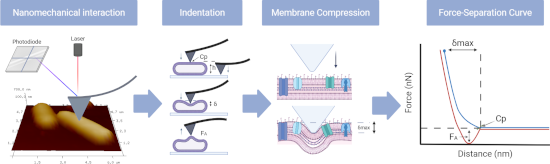
- membrane tension and rigidity are two intertwined physical parameters with a dynamic behavior dictated by the internal turgor pressure of the bacteria during swelling or plasmolysis. Therefore, understanding the dynamics of their mechanical response due to changes in external conditions or exposure to


Time-resolved probing of laser-induced nanostructuring processes in liquids
Beilstein J. Nanotechnol. 2025, 16, 968–1002, doi:10.3762/bjnano.16.74
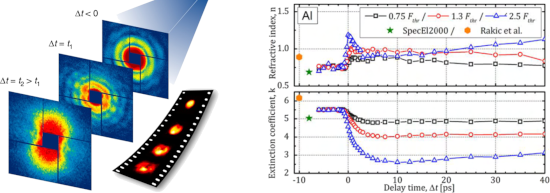
- transitions can be well modeled by classical approaches down to the nanometer scale in a local thermodynamic equilibrium [32][33][34]. A synthesis of the different coevolving phenomena with excitation and dissipation requires more detailed numerical approaches [35] or simulations. Molecular dynamics (MD
- -particle imaging” describes the processes initiated by laser-excitation of an individual NP probed by X-ray scattering up to delay times of a few tens of picoseconds. The second chapter “Structural dynamics in liquids” reports on the application of ultrafast time-resolved electron scattering to investigate
- early-time structural relaxation and chemical bond dynamics in laser-induced ionization of liquid water. In the third chapter “Nanoparticle excitation in an ensemble and energy exchange with medium”, an approach is shown on how reactions of both the excited NPs as well as the interaction with the


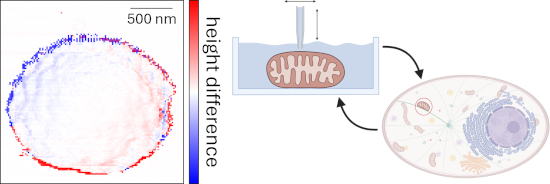
Shape, membrane morphology, and morphodynamic response of metabolically active human mitochondria revealed by scanning ion conductance microscopy
Beilstein J. Nanotechnol. 2025, 16, 951–967, doi:10.3762/bjnano.16.73
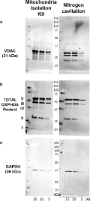
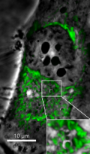
- , Rostock University Medical Center, 18057 Rostock, Germany 10.3762/bjnano.16.73 Abstract Mitochondrial network dynamics play a key role in enabling cells to adapt to environmental changes. Fusion and fission of mitochondria, as well as their contact with other organelles, are central processes
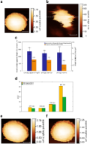
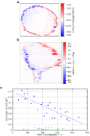
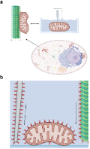
- this work, we employ SICM to investigate the shape, dynamics, and nanomorphology of metabolically active, isolated mitochondria, with a specific focus on the outer mitochondrial membrane. Furthermore, we identify and characterise two distinct dynamic effects observed in time-dependent topography data
- . One of these effects appears to be associated to the dynamics of the mitochondria’s morphology (in the following referred to as morphodynamics, cf. [6]) and their contact with the measurement environment. Finally, we propose hypotheses to explain the observed effects. Results Viability of the



Heat-induced transformation of nickel-coated polycrystalline diamond film studied in situ by XPS and NEXAFS
Beilstein J. Nanotechnol. 2025, 16, 887–898, doi:10.3762/bjnano.16.67
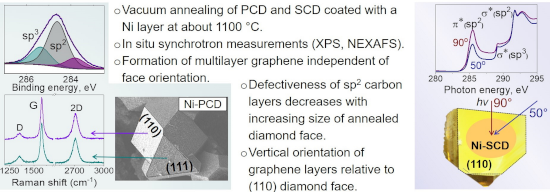
- sp3 hybridization is a metastable material. A significant activation barrier hampers its relaxation into sp2 graphitic carbon, and this transformation occurs during vacuum heating in the temperature range of 1500–1800 °C [9]. According to molecular dynamics simulations, graphitization of nonterminated


Ar+ implantation-induced tailoring of RF-sputtered ZnO films: structural, morphological, and optical properties
Beilstein J. Nanotechnol. 2025, 16, 872–886, doi:10.3762/bjnano.16.66
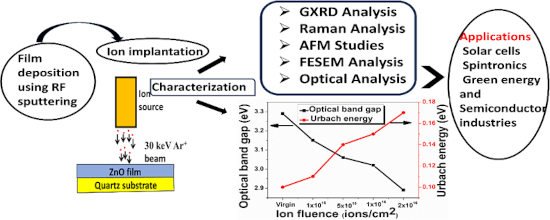
- , defects, and interstitials are induced through the interaction between energetic ions and the host material, resulting in structural modification and thus alteration in lattice dynamics of the host material [10]. The implantation-induced disorder can be qualitatively examined using Raman spectroscopy
- , which is a well-established and non-destructive method to determine crystal structure, lattice defects, and dynamics. Since ZnO is a polar semiconductor, the phonon–electron interaction produces longitudinal optical (LO) phonon modes, whose long-range behavior considerably affects the efficacy of






Insights into the electronic and atomic structures of cerium oxide-based ultrathin films and nanostructures using high-brilliance light sources
Beilstein J. Nanotechnol. 2025, 16, 860–871, doi:10.3762/bjnano.16.65

- Katoch et al. investigated the dynamics of photoexcited electron and hole polarons in a cerium oxide single crystal and in a nanocrystal using FEL-based pump–probe XANES at the Ce M5 and O K edges detected in total electron yield mode [61]. The samples contained a non-negligible concentration of Ce3
- on samples with different defectivity and using techniques with different probing depths suggest that defects can act as polaron trapping and recombination sites and that the excited charge dynamics can be different on the surface and in the bulk of the investigated oxide. The chemical sensitivity of
- written in the framework of the Italian Ministry of Foreign Affairs and International Cooperation (MAECI) funded project “Ultrafast Dynamics in Materials for Energy Conversion (U-DYNAMEC)” under the program 2023 Italy – Germany Science and Technology Cooperation. Funding Financial support from the Italian


Synthesis and magnetic transitions of rare-earth-free Fe–Mn–Ni–Si-based compositionally complex alloys at bulk and nanoscale
Beilstein J. Nanotechnol. 2025, 16, 823–836, doi:10.3762/bjnano.16.62
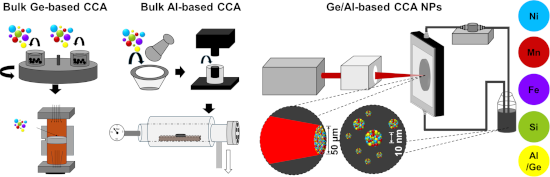
- ). This difference can be attributed to variations in alloy composition and material properties, which influence the ablation plume dynamics and particle formation kinetics during PLAL. Specifically, the thermal properties, such as melting point and heat conductivity, and the volatility of the alloy
- synthesized via PLAL, where separate Mn-rich clusters formed due to elemental evaporation during synthesis. Additionally, the ionization potential influences the ablation plume dynamics. Notably, the Ge variation from the expected composition is lower than for Mn, contrasting with the bulk alloy’s surface
- of differences in particle formation dynamics or the protective role of other alloying elements. Structural characterization of the CCA NPs Figure 5a and Figure 5b show HRTEM bright-field images of the Ge-based CCA NPs and Al-based CCA NPs. The insets reveal the crystallographic structure of the NPs


Supramolecular hydration structure of graphene-based hydrogels: density functional theory, green chemistry and interface application
Beilstein J. Nanotechnol. 2025, 16, 806–822, doi:10.3762/bjnano.16.61
- deoxyribonucleic acid (DNA) [1]. Water molecules and their hydrogen bonding network function as lubricants for biomolecular dynamics. Recent scientific works have analyzed the important role of hydration shells on DNA, proteins, and phospholipid membranes [2][3][4]. The first hydration shell (about 3.5 Å) at the
- interface of biomolecules has considerably slower dynamics than water molecules in the bulk. Besides, the first water layer on the interface is responsible for hydration forces between biomolecular structures [5]. The rearrangement of water molecules through hydrogen bonding on hydrated surfaces generates
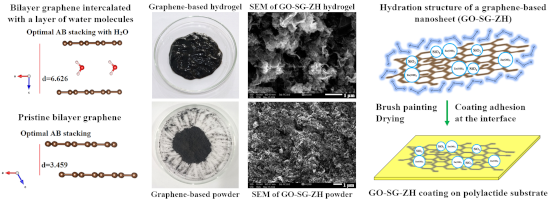
- attraction. In the molecular dynamics simulations by Hasheminejad et al., the interfacial interaction energy between graphene oxide nanosheet and polylactide matrix is assigned to van der Waals forces and hydrogen bonds [62]. The bonding network of GO-SG-ZH nanosheets in the coating is another reason for the


Morphology and properties of pyrite nanoparticles obtained by pulsed laser ablation in liquid and thin films for photodetection
Beilstein J. Nanotechnol. 2025, 16, 785–805, doi:10.3762/bjnano.16.60
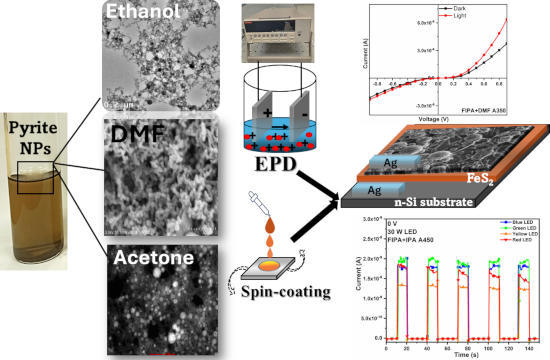
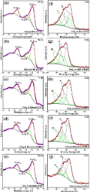
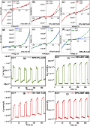
- nanoparticle synthesis by PLAL. For instance, it has been reported that the density and viscosity of the surrounding liquid influence the expansion of the plasma plume. The expansion dynamics of the plume differ due to the larger opposing force induced by the increased viscosity of the solvent, which in turn






High-temperature epitaxial growth of tantalum nitride thin films on MgO: structural evolution and potential for SQUID applications
Beilstein J. Nanotechnol. 2025, 16, 690–699, doi:10.3762/bjnano.16.53
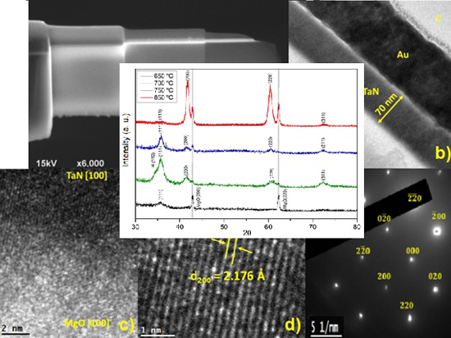
- dynamics and superconducting characteristics of the films. X-ray diffraction (XRD) analysis revealed that the TaN thin films exhibited excellent crystallinity, with sharp diffraction peaks indicating well-defined structural phases. The deposition process was optimized by systematically adjusting substrate


Nanoscale capacitance spectroscopy based on multifrequency electrostatic force microscopy
Beilstein J. Nanotechnol. 2025, 16, 637–651, doi:10.3762/bjnano.16.49

- understanding of material properties, particularly at the nanoscale, where phenomena such as quantum confinement, interface effects, and defect dynamics play a critical role. Innovations in characterization techniques have enabled researchers to explore these properties with unprecedented precision, paving the
- variations influence key properties such as charge transport, polarization dynamics, and defect distributions, directly impacting the performance of microelectronic and energy systems [14][15]. Understanding these effects requires correlating nanoscale dielectric properties with structural and morphological




Nanomaterials in targeting amyloid-β oligomers: current advances and future directions for Alzheimer's disease diagnosis and therapy
Beilstein J. Nanotechnol. 2025, 16, 561–580, doi:10.3762/bjnano.16.44
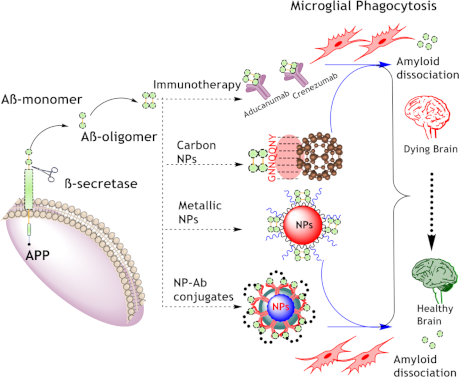
- , particularly those associated with NDs like AD. Research has demonstrated the ability of fullerenes to prevent the aggregation of Aβ peptides. For instance, molecular dynamics simulations have shown that fullerenes inhibit the fibrillation of the hydrophobic KLVFFAE peptide by disrupting the formation of β
- , thereby mitigating their neurotoxic effects [62][72]. In addition to their inhibitory capabilities, SWCNTs can serve as effective sensors for AβOs. Their ability to interfere with β-sheet formation, a hallmark of Aβ aggregation, has been confirmed through comprehensive molecular dynamics simulations
- modalities, including hydrophobic and hydrogen bonding, leading to substantial inhibition of peptide aggregation [79]. In another innovative approach, Javed et al. evaluated the inhibitory potential of casein-coated AuNPs against oligomers through molecular dynamics simulations. Their findings demonstrated


Water in nanoporous hexagonal boron nitride nanosheets: a first-principles study
Beilstein J. Nanotechnol. 2025, 16, 510–519, doi:10.3762/bjnano.16.39
- desalination technology [4][5][6]. Computational methods have been employed to enhance the understanding of nanoscale desalination processes. In this context, the use of molecular dynamics and ab initio calculations allows for the study of the physics involved in nanostructured membrane materials designed to
- as a molecular sieve [22][23][24][25]. Theoretical studies using molecular dynamics simulations analyzed the impact of the partial charge on the h-BN membrane surface on water molecules and salt ion transport [26]. They noted that the Coulomb interaction between water molecules/ions and the channels
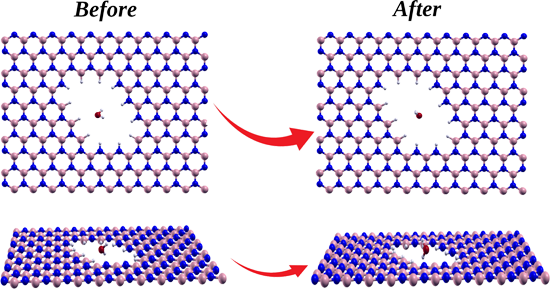
- increase ranges from 0.586 to 1.236 eV, depending on the environment. Thus, the dynamics of pore formation for pores with B–H-terminated edges are expected to differ from those of N–H-terminated pores. Specifically, an additional B–H/B–OH group should migrate to the 60° vertices of pores to improve




Impact of adsorbate–substrate interaction on nanostructured thin films growth during low-pressure condensation
Beilstein J. Nanotechnol. 2025, 16, 473–483, doi:10.3762/bjnano.16.36

- patterns is understanding how adsorbate–substrate interactions influence the growth dynamics of these films [23][24][25]. Mathematical and numerical modeling of the growth processes of nanostructured thin films enables detailed analysis of the dynamics involved. It allows for investigating the impact of
- [35]. We discuss effects of adsorbate–substrate interactions in dynamics of adsorbate structures formation and their statistical properties. It will be shown, that an increase in the strength of adsorbate–substrate interactions can induce adsorbate patterning on the first growing layer and lead to
- interactions in a homogeneous system. Next, we perform stability analysis and define a range of the strength of adsorbate–substrate interaction responsible for pattern formation during deposition. Finally, we present results of numerical simulations and discuss dynamics of surface patterns formation and


Size control of nanoparticles synthesized by pulsed laser ablation in liquids using donut-shaped beams
Beilstein J. Nanotechnol. 2025, 16, 407–417, doi:10.3762/bjnano.16.31
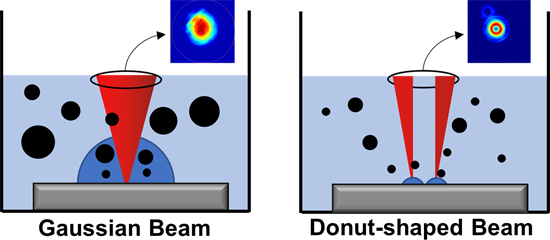
- plumes induced by donut-shaped pulses [44] predicted unusual plume expansion dynamics with the formation of multiple internal shock waves, which strongly increase plume density and temperature. It can be expected that donut-shaped laser pulses can also offer new possibilities for NP production via PLAL
- by affecting plume geometry and dynamics. Thus, the NP formation mechanism and the resulting size distribution are modified compared to a Gaussian beam. However, as far as we know, donut-shaped laser pulses have not yet been investigated under PLAL conditions. In this study, PLAL with donut-shaped
- medicine for gold [9][29], strengthened ceramics and steels for high-temperature applications for Y2O3 [45][46][47], and catalysis and energy storage for HEAs [48][49]. The produced NPs are compared with those obtained with Gaussian beams. The evolution of the PLAL-generated cavitation bubble dynamics was


Vortex lattices of layered HTSCs at different vortex–vortex interaction potentials
Beilstein J. Nanotechnol. 2025, 16, 362–370, doi:10.3762/bjnano.16.27
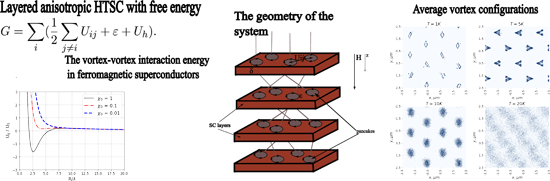
- molecular dynamics simulation of a vortex system in a superconductor with was performed, and a phase B–T diagram was obtained (B is the magnetic field and T is the temperature of the vortex system), which contains regions of a hexagonal vortex lattice, a striped structure, and a lattice of vortex clusters


A review of metal-organic frameworks and polymers in mixed matrix membranes for CO2 capture
Beilstein J. Nanotechnol. 2025, 16, 155–186, doi:10.3762/bjnano.16.14




Advanced atomic force microscopy techniques V
Beilstein J. Nanotechnol. 2025, 16, 54–56, doi:10.3762/bjnano.16.6

- mechanical oscillation of the piezoelectric membrane with highest resolution in real time. In addition to the measurement of surface potentials or photovoltages, Navarro-Rodriguez et al. investigate the dynamics of surface charges and how they couple to the detection system [9]. They describe in detail how
Precursor sticking coefficient determination from indented deposits fabricated by electron beam induced deposition
Beilstein J. Nanotechnol. 2025, 16, 35–43, doi:10.3762/bjnano.16.4

- Fowlkes and Rack [6] where a value of 0.025 was reported for W(CO)6. In this work, a stationary pulsed beam was used to study the adsorption/desorption dynamics. A fit of the results to the continuum model was performed with an estimated value for the energy-integrated dissociation cross section in order
- transitional behavior was found when going from about 100 K to 1000 K. At 100 K the sticking coefficient was found to be close to unity and it dropped to near zero closer to 1000 K. All the aforementioned works report precursor-mediated adsorption dynamics, whereby molecules transiently adsorb after surface
- pumping speed, and gas injection system (GIS) geometry using the GIS nozzle gas dynamics simulation approach described in [22]. The tilt of the GIS in relation to the substrate surface that defines the angle at which molecules hit the surface was 13° for Cr(C6H6)2 and 50° for Me3CpPtMe. Both GIS needles


Bioinspired nanofilament coatings for scale reduction on steel
Beilstein J. Nanotechnol. 2025, 16, 25–34, doi:10.3762/bjnano.16.3

- . This reduction is attributed to altered flow dynamics near the super-hydrophobic surface, inhibiting nucleation and growth of scale. Our findings highlight the potential of bioinspired SNF coatings to enhance the performance and longevity of steel surfaces in industrial environments. Keywords


Mechanistic insights into endosomal escape by sodium oleate-modified liposomes
Beilstein J. Nanotechnol. 2024, 15, 1667–1685, doi:10.3762/bjnano.15.131
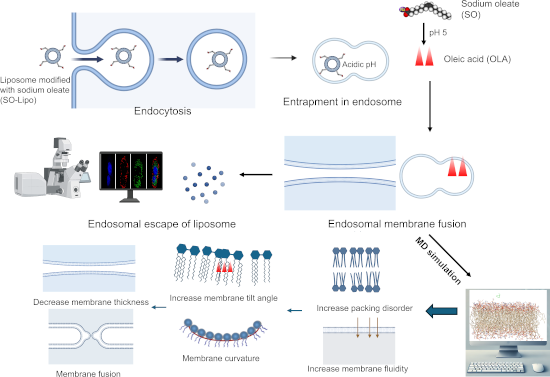
- measuring the colocalization of labeled liposomes with lysosomal markers, quantified using Pearson’s correlation coefficient. Lipid mixing assays assessed the potential fusogenic effect, and molecular dynamics (MD) simulations explored the interactions of protonated sodium oleate (SO) with the endosomal
- mechanism, facilitating cytosolic delivery with reduced cytotoxicity. This approach offers a safer and more effective option for targeted drug delivery applications. Keywords: Aurein 1.2; endosomal escape; fusogenic effect; molecular dynamics simulation; sodium oleate; Introduction The quest for efficient
- complexes with liposomal components, enhancing both liposome stability and drug encapsulation. To gain deeper insight into the mechanisms underpinning SO’s potential as an endosomal escape agent, molecular dynamics (MD) simulations have emerged as an indispensable computational tool. These simulations




Heterogeneous reactions in a HFCVD reactor: simulation using a 2D model
Beilstein J. Nanotechnol. 2024, 15, 1627–1638, doi:10.3762/bjnano.15.128
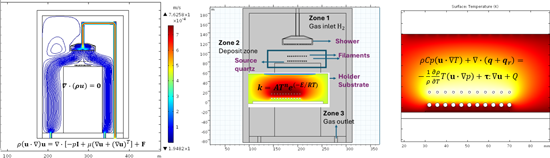
- ; chemical reactions; flow dynamics; HFCVD; hot filament chemical vapor deposition; SiOx films; Introduction The growth of materials such as non-stoichiometric silicon oxide (SiOx) is an important step in semiconductor devices development. Control of deposition parameters determines the success of the
- . Different tools such as ab initio density functional theory [13][14], kinetic Monte Carlo simulations [15][16], and reactive molecular dynamics simulations [17][18] have been used to understand the chemical reactions underlying the growth of the films [19]. Modeling the reaction mechanism in both two
- ]. Also, modeling of CVD microreactors at atmospheric pressure using tetraethyl orthosilicate as a source to obtain SiO2 has been achieved through computational fluid dynamics (CFD) simulations [22]. The gas-phase and surface reactions were analyzed using direct Monte Carlo simulations of a hot wire


Integrating high-performance computing, machine learning, data management workflows, and infrastructures for multiscale simulations and nanomaterials technologies
Beilstein J. Nanotechnol. 2024, 15, 1498–1521, doi:10.3762/bjnano.15.119
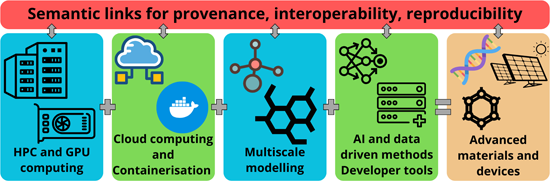
- dynamics and quantum chemistry calculations [23][24]. Even more significant has been the impact of GPU computing on AI. GPUs are inherently designed for parallel processing, making them exceptionally well-suited for the demanding calculations and massive data throughput required in AI tasks. Accordingly
- molecules based on force-field molecular dynamics (MD). While simple, this workflow exhibits the main features of more complex simulations. The consistent representation of this workflow within MAMBO can therefore be instructive of the approach pursued and gives possible hints of the ability to formalize
- within an IATA framework, there are the following: VMD (Visual Molecular Dynamics) is a molecular visualization program that provides a platform for the modelling, visualization, and analysis of molecular and biological systems. It is widely used for the development of materials’ digital twins and the


Effect of radiation-induced vacancy saturation on the first-order phase transformation in nanoparticles: insights from a model
Beilstein J. Nanotechnol. 2024, 15, 1453–1472, doi:10.3762/bjnano.15.117

- effects led to a polymorphic phase change, transforming the high-density fcc structure to a low-density hexagonal close-packed crystallographic phase. The investigation of the radiation stability of nanocrystalline single-phase multicomponent alloys (NiFe, NiCoFe, and NiCoCr) using molecular dynamics
- of all ΔGncl curves correspond to the single β-phase particle (final state on the right in Figure 4). As one can see in Figure 4, nucleation in nanomaterials under irradiation treatment considerably changes the nucleation dynamics. Metastable two-phase configurations may exist due to the nucleation
- II in Figure 2. This correspondence highlights the significant impact of nucleation on the phase transition dynamics. Specifically, the presence of nucleation fundamentally alters the situation, leading to the possibility of phase transition inhibition due to the existence of a very high energy


Lithium niobate on insulator: an emerging nanophotonic crystal for optimized light control
Beilstein J. Nanotechnol. 2024, 15, 1415–1426, doi:10.3762/bjnano.15.114
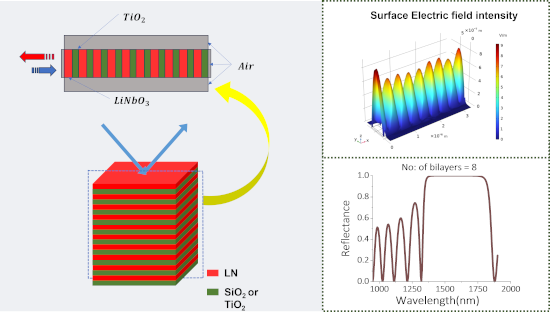
- lower region of the microcavity and an additional eight bilayers in the upper area. The bottom DBR was coated with LFO using the spin-coating technique. Ultrafast transient-absorption spectroscopy was used to measure charging dynamics by exciting the microcavity with a pump pulse and observing the
- evolution of stored energy with a probe pulse. The study demonstrated superextensive charging dynamics, where the rise time decreases as the stored energy density increases. The DBRs in the structure play a crucial role in the experimental setup. Firstly, allowing for the confinement of the optical field
- and driving coherent interactions with the organic semiconductor molecules. Secondly, enabling the measurement of the evolution of stored energy and the differential reflectivity induced by the pump pulse, which is essential for monitoring the charging dynamics at a femtosecond resolution. The





