


Search results
Search for "electronic transport" in Full Text gives 61 result(s) in Beilstein Journal of Nanotechnology.
Sublattice asymmetry of impurity doping in graphene: A review
Beilstein J. Nanotechnol. 2014, 5, 1210–1217, doi:10.3762/bjnano.5.133
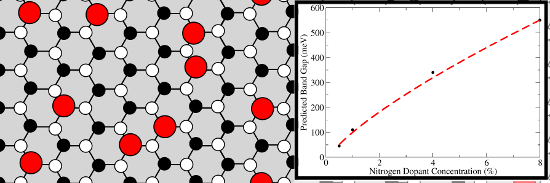
- for synthesis of such graphene monolayers and detail theoretical efforts to explain the mechanisms responsible for the effect, before suggesting future research directions in this nascent field. Keywords: band gap; electronic transport; graphene; nitrogen doping; sublattice asymmetry; Review


Micro- and nanoscale electrical characterization of large-area graphene transferred to functional substrates
Beilstein J. Nanotechnol. 2013, 4, 234–242, doi:10.3762/bjnano.4.24
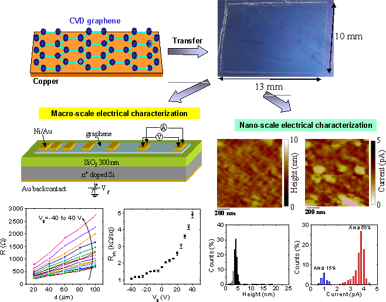
- graphene on SiO2 [22]. Both cracks and corrugations contribute to the degradation of the electronic transport properties in graphene [23]. Graphene transfer onto PEN In contrast to the case of virgin SiO2, which is naturally hydrophilic and requires proper treatments to be converted into a hydrophobic
- between the two materials. Results and Discussion Microscale electrical characterization The electronic transport properties of the large-area graphene transferred onto the two different substrates have been characterized on the macroscopic scale by electrical measurements on transmission line model (TLM



Functionalization of vertically aligned carbon nanotubes
Beilstein J. Nanotechnol. 2013, 4, 129–152, doi:10.3762/bjnano.4.14
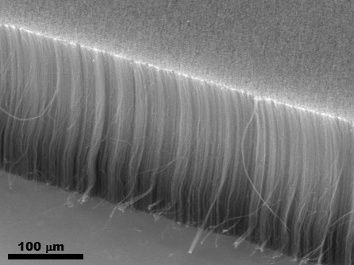
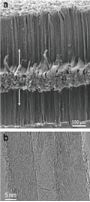
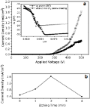
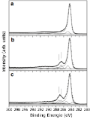
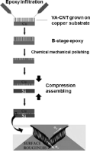
- parallel, they observed an exponential dependence of the resistance. No significant modification of the carrier concentration and tube–tube interaction was noticed. Considering that the electronic transport is driven by the localization mechanism (i.e., a localization of the electron states at the defect








Electronic and transport properties of kinked graphene
Beilstein J. Nanotechnol. 2013, 4, 103–110, doi:10.3762/bjnano.4.12
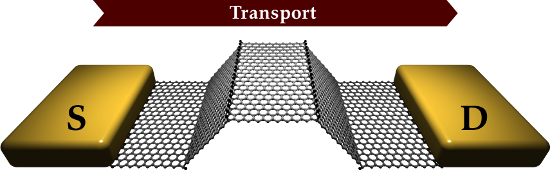
- linear bends in graphene. We find a significant barrier lowering (≈15%) for realistic radii of curvature (≈20 Å) and that adsorption along the linear bend leads to a stable linear kink. We compute the electronic transport properties of individual and multiple kink lines, and demonstrate how these act as
- transport across the kink lines. We finally consider pseudo-ribbon-based heterostructures and propose that such structures present a novel approach for band gap engineering in nanostructured graphene. Keywords: adsorption and reactivity; curvature effects; DFT calculations; electronic transport; graphene
- nanoribbons; graphene nanostructuring; Introduction Nanostructures based on graphene have an enormous potential for applications. Especially in future electronic devices compatible with and extending silicon technology, due to the outstanding electronic transport properties of graphene [1]. However, it is


Revealing thermal effects in the electronic transport through irradiated atomic metal point contacts
Beilstein J. Nanotechnol. 2012, 3, 703–711, doi:10.3762/bjnano.3.80
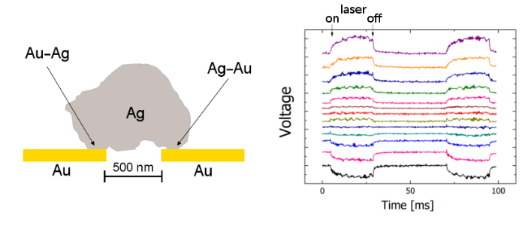
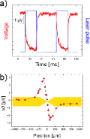
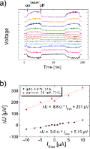
- , Karlsruhe Institute of Technology (KIT), Campus South, Wolfgang-Gaede-Straße 1, 76131 Karlsruhe, Germany Institute of Nanotechnology, Karlsruhe Institute of Technology (KIT), Campus North, 76027 Karlsruhe, Germany 10.3762/bjnano.3.80 Abstract We report on the electronic transport through nanoscopic
- layer are the most prominent effects. Keywords: atom transistor; atomic contacts; cyclic voltammogram; electrochemically closed break junction; electronic transport; (Helmholtz) double layer; light-induced signals; temperature-induced changes; thermovoltage; Introduction Electronic transport on the





Focused electron beam induced deposition: A perspective
Beilstein J. Nanotechnol. 2012, 3, 597–619, doi:10.3762/bjnano.3.70
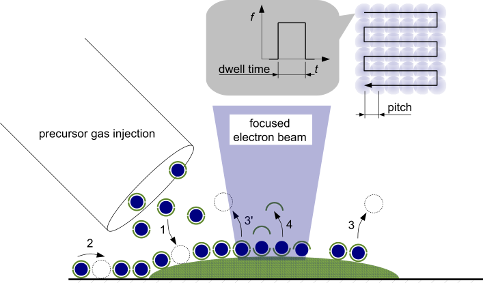
- dissociation. As a matter of fact, post-growth irradiation can be advantageously used for fine-tuning the electronic transport properties of FEBID structures, and this will be discussed in the context of nanogranular structures later in this review. In any case, the energy spectrum of the electrons that can
- molecular flux, keeping the Me3Pt(IV)CpMe molecular flux constant. Details concerning the absolute molecular flux values were not provided. The deposition parameters of 20 nm pitch and 1 μs dwell time were kept constant for all experiments. For the electronic transport measurements the structures were
- answer this question, we turn to some peculiarities observed in the transport-dependent conductivity of the FEBID samples. Electronic transport properties: Figure 7 shows the resistivity as a function of the Si/Pt ratio of the as-grown samples. Apparently, the resistivity drops with increasing Si content


Strong spin-filtering and spin-valve effects in a molecular V–C60–V contact
Beilstein J. Nanotechnol. 2012, 3, 589–596, doi:10.3762/bjnano.3.69
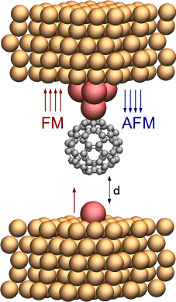
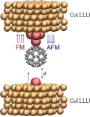
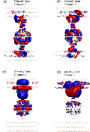
- and magnetic adatom on a Cu(111) surface using first-principles calculations. For the case of a vanadium tip/adatom, we demonstrate how spin coupling between the magnetic V atoms, mediated by the C60, can be observed in the electronic transport, which display a strong spin-filtering effect, allowing
- formation, while the C60 is placed on the tip [7]. Subsequently, it is possible to investigate the interactions between tip and sample via electronic transport measurements as tip and sample are brought into contact. STM also provides a powerful tool for investigating spin-transport in magnetic



Molecular-resolution imaging of pentacene on KCl(001)
Beilstein J. Nanotechnol. 2012, 3, 186–191, doi:10.3762/bjnano.3.20
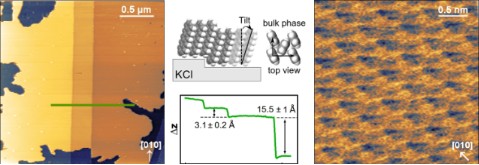
- causes a pronounced anisotropy of the electronic transport properties. Therefore, the electronic properties of pentacene are closely related to its structural order, and a precise control of the molecular packing and the crystalline orientation of thin films is of vital interest for the optimization of


Current-induced forces in mesoscopic systems: A scattering-matrix approach
Beilstein J. Nanotechnol. 2012, 3, 144–162, doi:10.3762/bjnano.3.15
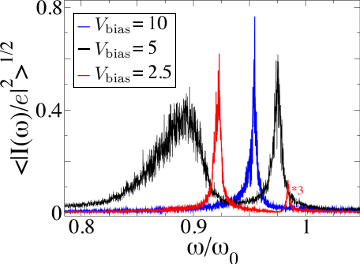
- mechanical vibrations and cause limit-cycle dynamics. Keywords: current-induced forces; electronic transport theory; nanoelectromechanical systems; scattering matrix; S-matrix; Introduction Scattering theory has proved to be a highly successful method for treating coherent transport in mesoscopic systems
- decouple, and which give rise to different experimental phenomena. On one side, when the electronic time scales are slow compared with the mechanical vibrations, drastic consequences can be observed for the electronic transport, such as side bands due to phonon-assisted tunneling [23][24] or the Frank

![[Graphic 55]](/bjnano/content/inline/2190-4286-3-15-i141.png?max-width=637&scale=1.18182) can be tuned by the bias voltage. We consider...
can be tuned by the bias voltage. We consider...


Lifetime analysis of individual-atom contacts and crossover to geometric-shell structures in unstrained silver nanowires
Beilstein J. Nanotechnol. 2011, 2, 740–745, doi:10.3762/bjnano.2.81
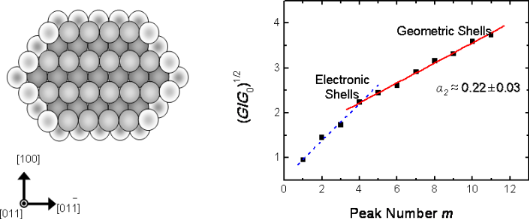
- electronic transport and the atomic structure of the nanocontacts. Results and Discussion Figure 1 shows a conductance histogram for electrochemically deposited silver contacts obtained from 21385 conductance levels in the range between 0.01 G0 and 7 G0 with level each lasting longer than at least 200 ms. In


Charge transport in a zinc–porphyrin single-molecule junction
Beilstein J. Nanotechnol. 2011, 2, 714–719, doi:10.3762/bjnano.2.77
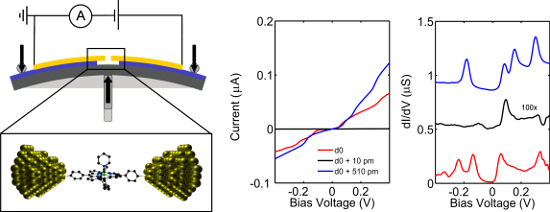
- transport; Introduction The break-junction method represents a popular choice to investigate the electronic transport through metal–molecule–metal junctions [1][2][3][4][5][6]. While repeatedly breaking and fusing two metallic electrodes, the low-bias conductance is monitored as a function of the electrode
- that within a change in the electrode displacement of 10 pm, the number of energy levels involved in the electronic transport as well as their exact energy drastically changed. A major jump of two orders of magnitude in the low-bias conductance was observed as well. This suggests an abrupt change in





