Search results
Search for "fluorescence emission" in Full Text gives 64 result(s) in Beilstein Journal of Nanotechnology.
Synthesis and characterization of fluorescence-labelled silica core-shell and noble metal-decorated ceria nanoparticles
Beilstein J. Nanotechnol. 2014, 5, 2413–2423, doi:10.3762/bjnano.5.251
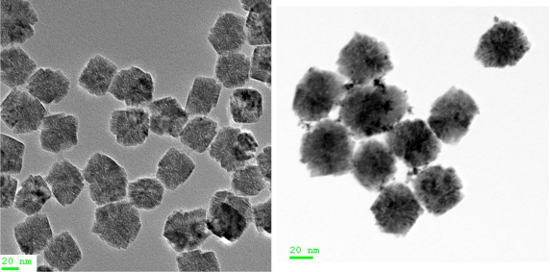
- Figure 1 containing triethoxysilyl groups to ensure easy connections to hydroxy groups at the surface of oxidic nanoparticles (MPD: [5]; BPD: [6][7]). A similar asymmetric dye is reported in [8]. The fluorescence emission spectrum of MPD in ethanol (Figure 2, left) upon excitation at 488 nm shows an
- well as to coated titania [1] and zinc oxide nanoparticles [2]. For experiments where several cell organelles are stained and detected in different ranges of fluorescence emission (channels), dyes with single sharp emission peaks are desirable. We therefore changed the dye for our experiments with
- activated derivatives of dyes [23]. The observed solvent shift of the fluorescence emission of the NP labelled with MPD and BPD clearly demonstrates that the dye molecules are located at the surface and only in a negligible amount in the interior of the NP [5], although the dye is present in the reaction


Nanobioarchitectures based on chlorophyll photopigment, artificial lipid bilayers and carbon nanotubes
Beilstein J. Nanotechnol. 2014, 5, 2316–2325, doi:10.3762/bjnano.5.240
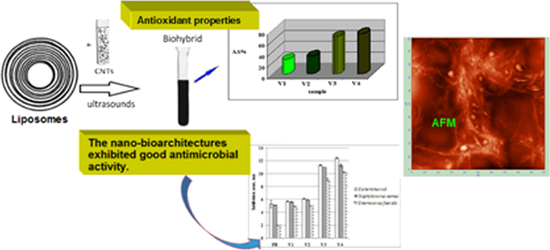
- 0.3 nm/s scan rate. Fluorescence analysis The fluorescence emission spectra of Chla in liposomes and hybrid structures were collected on a Perkin-Elmer, LS55 fluorescence spectrometer. The samples were excited with 430 nm excitation light. Fluorescence anisotropy measurements were carried out on the
- biomimetic membranes (above 41 °C) exhibits low anisotropy and high fluorescence emission intensity due to an increase in the lipid bilayer mobility and hence the chlorophyll has the possibility to move and to minimize the energy transfer leading to fluorescence quenching. In the gel phase of the artificial
- successfully used as a spectral marker to obtain information at the molecular level in the artificial lipid bilayers. This enabled spectral monitoring of the bio-based composites by exploiting the fluorescence emission properties and strong visible absorption of the porphyrin macrocycle. The procedure for


Effects of surface functionalization on the adsorption of human serum albumin onto nanoparticles – a fluorescence correlation spectroscopy study
Beilstein J. Nanotechnol. 2014, 5, 2036–2047, doi:10.3762/bjnano.5.212
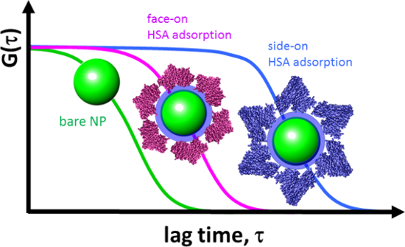
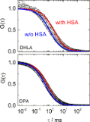
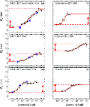
- presence of free protein [38][39]. FCS experiments were performed on fluorophores dissolved at nanomolar concentrations, which were freely diffusing through the detection volume (~1 fL) of a confocal microscope [40][41][42][43]. The fluorescence emission fluctuations were analyzed by autocorrelation to



Carbon nano-onions (multi-layer fullerenes): chemistry and applications
Beilstein J. Nanotechnol. 2014, 5, 1980–1998, doi:10.3762/bjnano.5.207
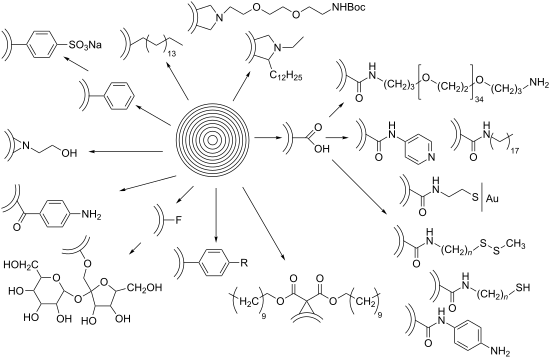
- of graphite in liquids such as liquid nitrogen or water [14][15]. A recent novel method for the preparation of large CNOs (30 nm diameter) includes the use of inorganic starting material, such as CuCl2·2H2O and CaC [16]. Large CNOs with distinct fluorescence emission were produced from wood wool, a
- . Interestingly, the CNO-OH showed distinct fluorescence emission with an emission maximum at 453 nm in aqueous solution, while CNO-Br did not fluoresce. Based on these two CNO derivatives, the authors reported different polymerization reactions, where the CNOs served as macroinitiators. Firstly, CNO-OHs were
- carboxylate functional groups, together with the defective nature of the CNOs, also led to the observed fluorescence emission in the visible and NIR, which was imposed by spontaneous surface passivation and quantum confinement and allowed for multicolor biological imaging. The specimens were fed with


Donor–acceptor graphene-based hybrid materials facilitating photo-induced electron-transfer reactions
Beilstein J. Nanotechnol. 2014, 5, 1580–1589, doi:10.3762/bjnano.5.170
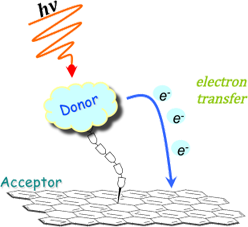
- -metallated porphyrin was observed, with a simultaneous decrease on the fluorescence emission lifetimes. These observations are indicative of intrahybrid interactions in the excited state through energy- and/or electron-transfer between graphene and the covalently bound porphyrin moieties. It is noteworthy
- 7). Interestingly, due to the strong electron-withdrawing effect of the sulfonyl units, the particular phthalocyanine component acts as electron acceptor in the graphene–ZnPc hybrid material [61]. Complementary electrochemical measurements and photophysical assays, based on fluorescence emission and


Nano-rings with a handle – Synthesis of substituted cycloparaphenylenes
Beilstein J. Nanotechnol. 2014, 5, 1320–1333, doi:10.3762/bjnano.5.145
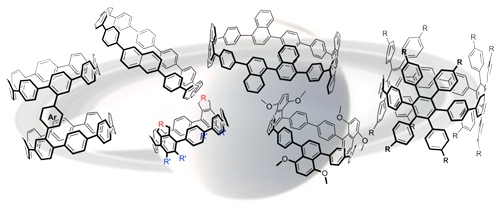
- the extension of the π-system. Fluorescence emission occurs at 491 nm which is similar to the corresponding CPP however with a quantum yield lowered by a factor of two [15]. Another naphthalene CPP has been synthesized by Batson and Swager [55], who used a similar strategy as the Itami group. They


Fullerenes as adhesive layers for mechanical peeling of metallic, molecular and polymer thin films
Beilstein J. Nanotechnol. 2014, 5, 394–401, doi:10.3762/bjnano.5.46
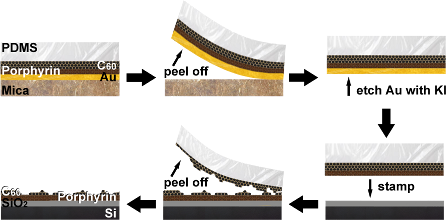
- −1 correspond to the Si substrate, the peak at 720 cm−1 and the region between 1400 and 1600 cm−1 with the relatively sharp line at around 1470 cm−1 are characteristic for C60; [31][32] insert: fluorescence emission spectrum (excitation wavelength = 532 nm) of the same samples with the characteristic
- broadened emission band at about 740 nm from excited singlet and triplet states of C60 [33][34]. Normalised fluorescence emission spectra (excitation wavelength = 532 nm) of sublimed and transferred porphyrin on SiO2/Si substrates with C60 cover layers of varying thickness; the characteristic double peak at
- ); schematic: structure of a TBPP monomer and the resulting polymeric structure. Fluorescence emission spectroscopy maps over 0.25 mm2 (excitation wavelength = 532 nm) and selected spectra of transferred polymerised TBPP-Zn networks before (a–c) and after (d–f) thermal desorption of the fullerene layer




One pot synthesis of silver nanoparticles using a cyclodextrin containing polymer as reductant and stabilizer
Beilstein J. Nanotechnol. 2014, 5, 380–385, doi:10.3762/bjnano.5.44
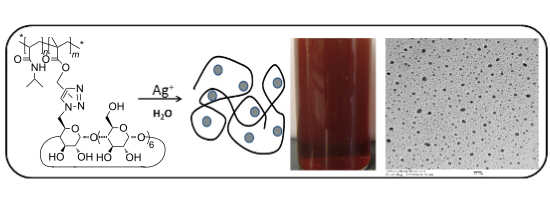
- stabled nanoparticles were characterized by fluorescence spectroscopy. The fluorescence spectra with a excitation wavelengths λex = 225 nm show a emission peakt at λmax = 460 nm in water assigned to fluorescence emission of silver nanoparticles. Additionally the thermoresponsive optical and solution


Controlled synthesis and tunable properties of ultrathin silica nanotubes through spontaneous polycondensation on polyamine fibrils
Beilstein J. Nanotechnol. 2013, 4, 793–804, doi:10.3762/bjnano.4.90
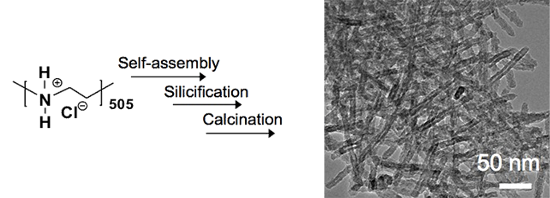
- nanostructure were obtained with Hitachi F-4500 fluorescence spectrophotometer, in which the fluorescence emission was cut off electrically. SEM (A, B, D and E) and TEM (C and F) images of silica nanotubes synthesized by alkali-induced room-temperature self-assembly of protonated LPEI (A–C) and silica


Apertureless scanning near-field optical microscopy of sparsely labeled tobacco mosaic viruses and the intermediate filament desmin
Beilstein J. Nanotechnol. 2013, 4, 510–516, doi:10.3762/bjnano.4.60
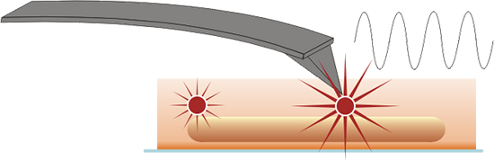
- , apertureless SNOM probes appear favorable [3][4][5][6][7]. Commonly, metallic and metallized probes expose a strong field enhancement and dipolar coupling between fluorophore and tip, which result in a remarkable increase of the observable fluorescence emission. However, the interaction between dye and tip
- apex can be manifold and depend crucially on the experimental setup and the sample. As a result the fluorescence emission rate can be both significantly enhanced or reduced at distances up to some 10 nm [6][8][9][10][11], and single-molecule images can show complex fluorescence patterns [3][12][13
- ]. Silicon probes expose only a moderate field enhancement and the dipolar coupling between probe and dye is less pronounced [4]. Even though, silicon tips can quench the fluorescence emission at close proximity [14]. Moreover, the elaborate probe design of custom-made tips demand complex fabrication


Diamond nanophotonics
Beilstein J. Nanotechnol. 2012, 3, 895–908, doi:10.3762/bjnano.3.100
- likely that localized defect states are present in the forbidden band. Not surprisingly over 500 such “deep trap” centers are meanwhile known in diamond [15][16]. Their fluorescence emission covers a broad spectral range reaching from the UV to the far IR. Admittedly, origin and composition of many color
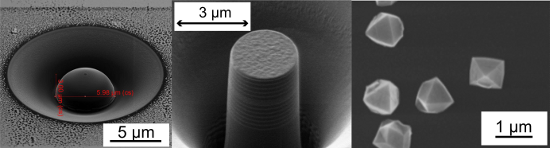
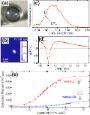
- ) Photograph of a single crystalline diamond hemisphere. (b) Confocal fluorescence image of the focus plane. The bright spot in the center corresponds to a single nitrogen–vacancy defect. (c) Fluorescence emission spectrum. The peak at a wavelength of 637 nm (ZPL) corresponds to the resonant optical emission





Distance dependence of near-field fluorescence enhancement and quenching of single quantum dots
Beilstein J. Nanotechnol. 2011, 2, 645–652, doi:10.3762/bjnano.2.68
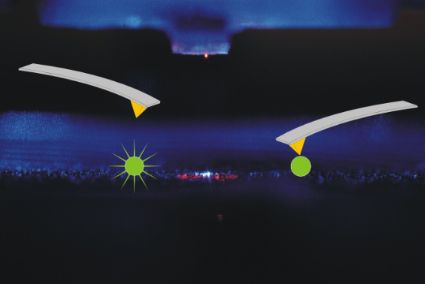
- effects. In the presented work we used a combined total internal reflection fluorescence microscopy (TIRFM)–AFM setup to elucidate this issue. We measured the fluorescence emission emanating from single quantum dots as a function of distance from the apex of a gold-coated cantilever tip. As well as
- fluorescence quenching at close proximity to the tip, we found a nonlinear and nonmonotonic distance dependence of the fluorescence emission. To confirm and interpret our findings we performed calculations on the basis of a simplified multiple multipole (MMP) approach, which successfully supports our
- transfer, resonant coupling or shifted angular distribution of fluorescence emission [12][13][14][15][16]. Even though these processes are short ranged, as they predominantly originate from dipole–dipole coupling (R−6), they can significantly affect the observable fluorescence emission. Therefore, a


Towards multiple readout application of plasmonic arrays
Beilstein J. Nanotechnol. 2011, 2, 501–508, doi:10.3762/bjnano.2.54
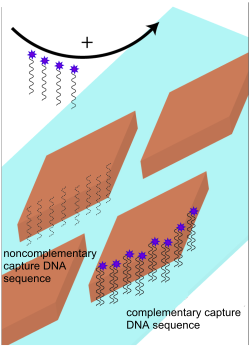
- among others factors to the fluorescence emission of the dye, was subtracted from all SERS spectra for better visibility. An intense SERS signal of the reporter molecule Cy3.5 was detected due to the double helix formation in the complementary case. By insertion of mismatches within the DNA strand, the


Room temperature synthesis of indium tin oxide nanotubes with high precision wall thickness by electroless deposition
Beilstein J. Nanotechnol. 2011, 2, 119–126, doi:10.3762/bjnano.2.14
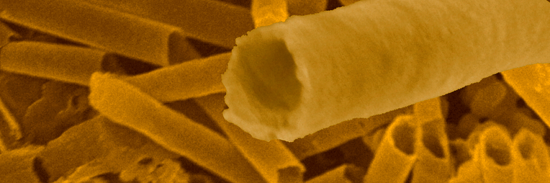
- used to prove that the nanotubes consisted of ITO. The ITO-NTs fluorescence emission at room temperature was observed with a fluorescence spectrophotometer (Cary Eclipse, Varian) at an excitation wavelength of 431 nm. Additionally, to obtain more details of the composition of the nanotubes, the