Search results
Search for "insect" in Full Text gives 63 result(s) in Beilstein Journal of Nanotechnology.
Aquatic versus terrestrial attachment: Water makes a difference
Beilstein J. Nanotechnol. 2014, 5, 2424–2439, doi:10.3762/bjnano.5.252
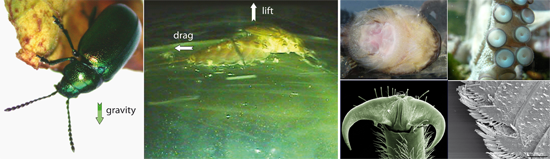
- surrounding and separating the two surfaces brought into contact. Some unusual immersed attachment examples might be an insect stepping into a droplet of water sitting on a branch. The size scale of the droplet is such that the entire attachment process is occurring underwater. However, in this very example
- we can see a gray area in that the foot has recently been dry, so the tendency of air to surround the attachment organ as it penetrates the droplet may be important. Our generalizations about aquatic environments apply when the foot of the insect brings none of the terrestrial environment with it
- to an underwater substrate just to keep from floating to the surface. Inertial forces For an animal sitting on a leaf moving in the wind, an insect landing on a substrate, a clingfish attaching to kelp moving in the current, or simply during walking on a substrate, inertial forces contribute to


From sticky to slippery: Biological and biologically-inspired adhesion and friction
Beilstein J. Nanotechnol. 2014, 5, 1450–1451, doi:10.3762/bjnano.5.157

- of cells, insect feet, snake skin, plant traps, and bird wings are just a few striking examples of a tremendous diversity of biological surfaces and systems with remarkable contact behavior about many of which our knowledge is limited compared to medically relevant biotribosystems. Since the 90s a
- theoretical studies which range from insect adhesion, bacterial adhesion and skin friction to artificial biomimetic systems, e.g., snake-skin inspired polymer patterns or gecko tape. The Thematic Series does not attempt to give a comprehensive overview of the emerging field of biological contact mechanics

Physical principles of fluid-mediated insect attachment - Shouldn’t insects slip?
Beilstein J. Nanotechnol. 2014, 5, 1160–1166, doi:10.3762/bjnano.5.127
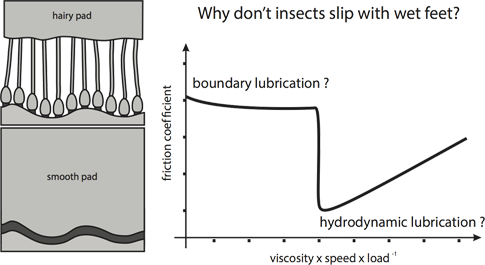
- morphologically different, they both form contact with the substrate via a thin layer of adhesive fluid. To model adhesion and friction forces generated by insect footpads often a simple “wet adhesion” model is used, in which two flat undeformable substrates are separated by a continuous layer of fluid. This
- review summarizes the key physical and tribological principles that determine the adhesion and friction in such a model. Interestingly, such a simple wet-adhesion model falls short in explaining several features of insect adhesion. For example, it cannot predict the observed high static friction forces
- these assumptions are not valid in many cases of insect adhesion. Future tribological models for insect adhesion thus need to incorporate deformable adhesive pads, non-Newtonian properties of the adhesive fluid and/or partially “dry” or solid-like contact between the pad and the substrate. Keywords


Insect attachment on crystalline bioinspired wax surfaces formed by alkanes of varying chain lengths
Beilstein J. Nanotechnol. 2014, 5, 1031–1041, doi:10.3762/bjnano.5.116
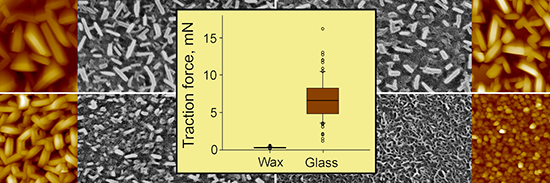
- experimental studies. The aim of this study was to examine the effect of different parameters of crystalline wax coverage on insect attachment. We performed traction experiments with the beetle Coccinella septempunctata and pull-off force measurements with artificial adhesive systems (tacky
- 30 fold, reduction of insect attachment forces on the wax surfaces when compared with the reference glass sample. Attachment of the beetles to the wax substrates probably relied solely on the performance of adhesive pads. We found no influence of the wax coatings on the subsequent attachment ability
- of beetles. The obtained data are explained by the reduction of the real contact between the setal tips of the insect adhesive pads and the wax surfaces due to the micro- and nanoscopic roughness introduced by wax crystals. Experiments with polydimethylsiloxane semi-spheres showed much higher forces


Controlling mechanical properties of bio-inspired hydrogels by modulating nano-scale, inter-polymeric junctions
Beilstein J. Nanotechnol. 2014, 5, 887–894, doi:10.3762/bjnano.5.101
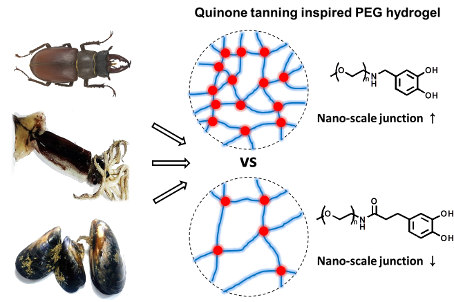
- ][8][9]. For insect cuticles, the quinone tanning (i.e., sclerotization) occurs via crosslinking of cuticular proteins in which primary amines, secondary amines, and phenols from the proteins react with N-acetylcatecholamines [9][10][11]. For squid beaks, the reaction between the imidazole of
- amine-involved quinone tanning reactions for the formation of stiff insect cuticles [7][8][9][10][11][27] by a reaction between imidazole (side-chain of histidine) and catechol. So far, the majority of research was focused on catechol–catechol crosslinking [25][30][31], accidentally ignoring the
- . Biomaterials formed by quinone tanning processes found in (a) squid beaks, (b) insect cuticles, and (c) mussel adhesives. Representative chemical reactions were shown for each biomaterials (a,b,c top). Synthetic PEG derivatives that can mimic the natural catecholamine-involved quinone tanning due to the



Fibrillar adhesion with no clusterisation: Functional significance of material gradient along adhesive setae of insects
Beilstein J. Nanotechnol. 2014, 5, 837–845, doi:10.3762/bjnano.5.95
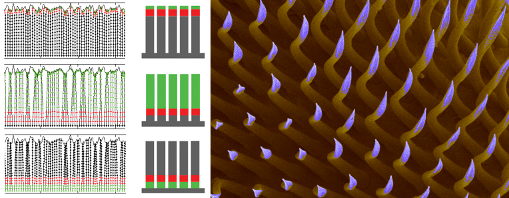
- various lineages of arthropods. Keywords: adhesion; attachment; biomechanics; computer modelling; cuticle; locomotion; material; surface; Introduction The contact formation of insect adhesive pads on various substrates depends on the pad ability to adapt to different surface topographies. The quality of
- contact may be increased due to the presence of specific micro- and nanostructures [1][2][3][4][5]. Crack trapping mechanisms in adhesive systems with multiple contacts provide advantages in attachment on rough substrates [6]. Also hierarchical organization of insect pad structures enables formation of
- stability [9]: insect setae made of too soft material can buckle and collapse resulting in so called clusterisation/condensation [10][11]. Due to such clusterisation, functional advantage from multiple adhesive contacts may strongly decrease. That is why, material properties of insect adhesive setae


Biocalcite, a multifunctional inorganic polymer: Building block for calcareous sponge spicules and bioseed for the synthesis of calcium phosphate-based bone
Beilstein J. Nanotechnol. 2014, 5, 610–621, doi:10.3762/bjnano.5.72
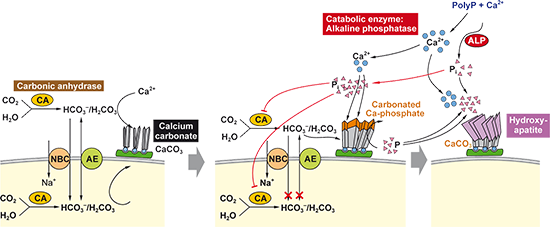
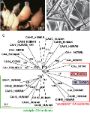
- Squalus acanthias (CA4_SQUAAC; AAZ03744.1), the fish Oreochromis niloticus (CA4_ORENI; XP_003456174.1), and the insect enzyme from Drosophila melanogaster (CAr_DROME; NP_572407.3) are included. The CAs, belonging to the "acatalytic" CA isoforms and of the catalytic CA isoforms, are surrounded. Partially



Grain boundaries and coincidence site lattices in the corneal nanonipple structure of the Mourning Cloak butterfly
Beilstein J. Nanotechnol. 2013, 4, 292–299, doi:10.3762/bjnano.4.32
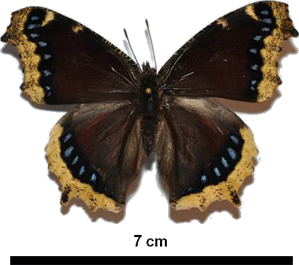
- there are similarities between inorganic materials and living structure patterns that should be further explored, as suggested earlier [32]. Experimental The Mourning Cloak butterfly used in the current study was received from Thorne’s Insect Shoppe Ltd, London, Ontario. It was collected in July 2008 at


Impact of cell shape in hierarchically structured plant surfaces on the attachment of male Colorado potato beetles (Leptinotarsa decemlineata)
Beilstein J. Nanotechnol. 2012, 3, 57–64, doi:10.3762/bjnano.3.7
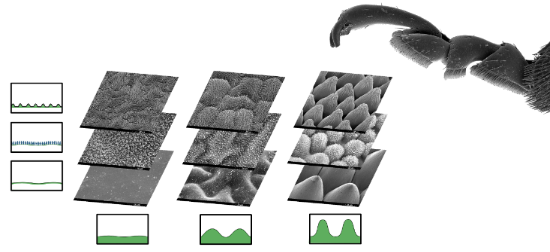
- , leading to hierarchical surfaces if both levels are present. While it has been shown that epicuticular wax crystals and cuticular folds strongly reduce insect attachment, and that smooth papillate epidermal cells in petals improve the grip of pollinators, the impact of hierarchical surface structuring of
- plant surfaces possessing convex or papillate cells on insect attachment remains unclear. We performed traction experiments with male Colorado potato beetles on nine different plant surfaces with different structures. The selected plant surfaces showed epidermal cells with either tabular, convex or
- or papillate cells enhancing attachment and both wax crystals or cuticular folds reducing attachment. However, the overall magnitude of traction force mainly depends on the presence or absence of superimposed microstructuring. Keywords: cuticular folds; epicuticular wax crystals; insect–plant


The effect of surface anisotropy in the slippery zone of Nepenthes alata pitchers on beetle attachment
Beilstein J. Nanotechnol. 2011, 2, 302–310, doi:10.3762/bjnano.2.35
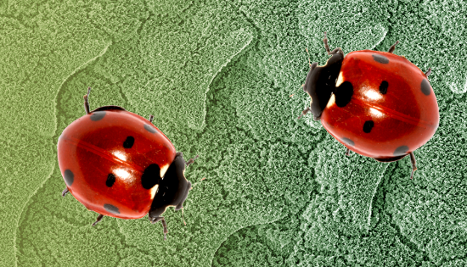
- prominent lunate cells and displays continuous epicuticular crystalline wax coverage. The aim of this study was to examine the influence of the surface anisotropy, caused by the shape of lunate cells, on insect attachment ability. Traction tests with ladybird beetles Coccinella septempunctata were performed
- contributions, from claw interlocking and pad adhesion, to insect attachment on the pitcher surfaces, intact versus claw-ablated beetles were used in the second type of experiment. On both de-waxed plant samples and their replicas, intact insects generated much higher forces in the downward direction compared
- to the upward one, whereas clawless insects did not. These results led to the conclusion that, (i) due to the particular shape of lunate cells, the pitcher surface has anisotropic properties in terms of insect attachment, and (ii) claws were mainly responsible for attachment enhancement in the


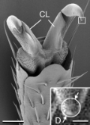

Infrared receptors in pyrophilous (“fire loving”) insects as model for new un-cooled infrared sensors
Beilstein J. Nanotechnol. 2011, 2, 186–197, doi:10.3762/bjnano.2.22
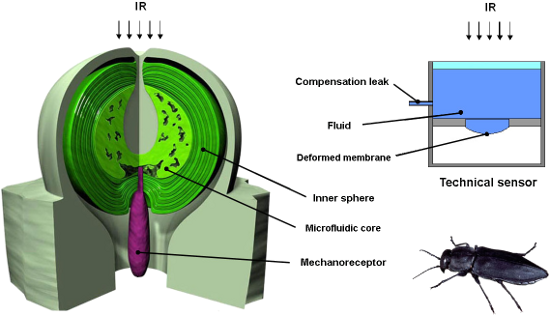
- developed from common hair mechanoreceptors. Thus, this type of insect IR receptor has been termed photomechanic and shows the following two special features: (i) The formation of a complex cuticular sphere consisting of an outer exocuticular shell as well as of a cavernous microfluidic core and (ii) the
- Aradus (Heteroptera, Aradidae) [12]. With respect to morphology and function, the IR receptors of Aradus bugs are very similar to those described for Melanophila beetles. Fire detection is obviously an important requirement for the survival of all of the pyrophilous insect species noted above. However
- beetles and bugs Structure and material properties of photomechanic IR receptors Structure and function of photomechanic insect IR sensillae have been most studied in Melanophila beetles. As a special behavioural feature, beetles of both sexes approach forest fires because their brood depends on burnt
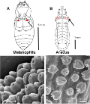


Superhydrophobicity in perfection: the outstanding properties of the lotus leaf
Beilstein J. Nanotechnol. 2011, 2, 152–161, doi:10.3762/bjnano.2.19
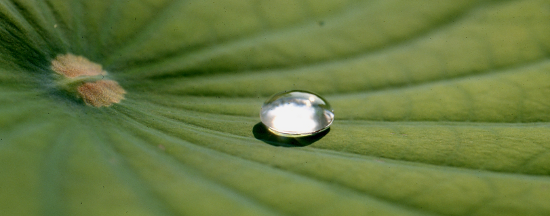
- ]. Superhydrophobic surfaces which feature permanent air retention under water are found on animals (some birds, spiders and insects). An outstanding air-retention capability is found, for example, for the aquatic insect Notonecta glauca (‘backswimmer’) [26][27]. Here the water repellency is created by a two-level





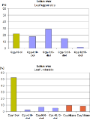


Superhydrophobic surfaces of the water bug Notonecta glauca: a model for friction reduction and air retention
Beilstein J. Nanotechnol. 2011, 2, 137–144, doi:10.3762/bjnano.2.17
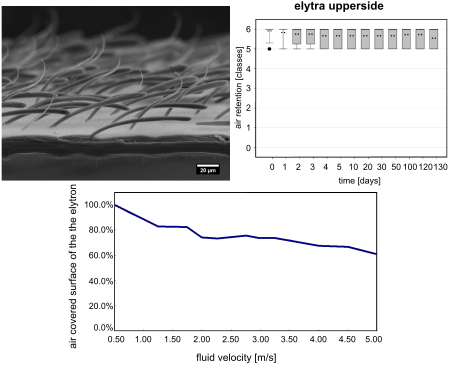
- dissected and the air retaining surfaces were processed immediately after taxidermy. Scanning electron microscopy. Isolated body parts were glued on insect pins, sputter-coated with 20 nm gold on the upper and underside (Balzers Union SCD 040 Sputter-Coater, Baltec AG, Liechtenstein) and screwed to a custom
- drops to each of ten individuals. Measurement of air film persistence under hydrostatic conditions. For this experiment, three different body parts of Notonecta glauca with different surface structures were selected. Ten samples of each surface were fixed on insect pins glued onto thin plates of
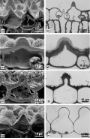
- with a hierarchical double structure of microtrichia and setae. Two different types of setae occur. In all pictures the caudal direction of the insect is on the right side. Submerged body parts of Notonecta glauca in the course of time. All surfaces were treated with a hydrophobic coating. Left side