


Search results
Search for "oxygen reduction" in Full Text gives 58 result(s) in Beilstein Journal of Nanotechnology.
Design criteria for stable Pt/C fuel cell catalysts
Beilstein J. Nanotechnol. 2014, 5, 44–67, doi:10.3762/bjnano.5.5
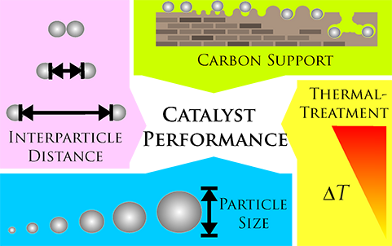
- facile hydrogen oxidation reaction (HOR) at the anode side as well as the more sluggish oxygen reduction reaction (ORR) at the cathode side of the fuel cell [2]. The state of the art electrocatalyst for both electrodes are Pt or Pt-alloys dispersed in the form of nanoparticles on a carbon support, in





Some reflections on the understanding of the oxygen reduction reaction at Pt(111)
Beilstein J. Nanotechnol. 2013, 4, 956–967, doi:10.3762/bjnano.4.108
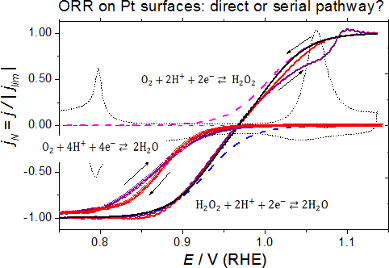
- Ana M. Gomez-Marin Ruben Rizo Juan M. Feliu Instituto de Electroquímica, Universidad de Alicante, Apt. 99, Alicante, E-03080, Spain 10.3762/bjnano.4.108 Abstract The oxygen reduction reaction (ORR) is a pivotal process in electrochemistry. Unfortunately, after decades of intensive research, a
- electrocatalysts for fuel-cell cathodes is only possible through a cooperative approach between theory and experiments. Keywords: hydrogen peroxide oxidation; hydrogen peroxide reduction; oxygen reduction; Pt(111); stepped surfaces; Introduction Nowadays, the oxygen reduction reaction (ORR) is arguably one of
- higher PtO coverages that could further produce more oxidized forms. In these latter cases, however, the surface will start to disorder and would no longer be a flat, well-ordered Pt(111) surface. Oxygen reduction reaction (ORR) on Pt(111) The cyclic voltammetric profile (CV) for the ORR on Pt(111), in


Lithium peroxide crystal clusters as a natural growth feature of discharge products in Li–O2 cells
Beilstein J. Nanotechnol. 2013, 4, 758–762, doi:10.3762/bjnano.4.86
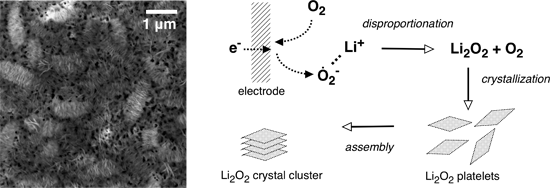
- oxygen reduction reaction (ORR). This feature limits the rechargeability of Li–O2 cells, but at the same time it can be beneficial for both capacity improvement and gain in recharge rate if a proper liquid phase mediator can be found. Keywords: lithium–air batteries; lithium peroxide; oxygen reduction


Electrochemical and electron microscopic characterization of Super-P based cathodes for Li–O2 batteries
Beilstein J. Nanotechnol. 2013, 4, 665–670, doi:10.3762/bjnano.4.74
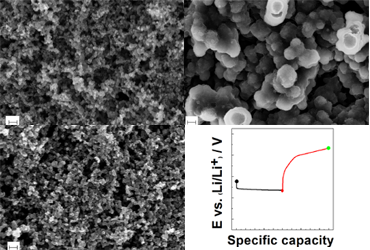
- products during the operation of a typical Li–O2 battery. In this context, recently published literature [1][2][3] gives new insights about the mechanism through which the reduction and the oxidation of oxygen occur in aprotic environments. During discharge, the oxygen reduction reaction (ORR) proceeds in


Novel composite Zr/PBI-O-PhT membranes for HT-PEFC applications
Beilstein J. Nanotechnol. 2013, 4, 481–492, doi:10.3762/bjnano.4.57
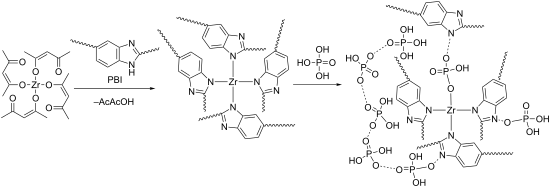
- of the AL and models the following processes: charge-transfer during the oxygen reduction reaction, double layer charging and ohmic losses due to finite proton conductivity of the AL. The following parameters were obtained as a result of the impedance spectra approximation: the undistributed ohmic


Hydrogen-plasma-induced magnetocrystalline anisotropy ordering in self-assembled magnetic nanoparticle monolayers
Beilstein J. Nanotechnol. 2013, 4, 164–172, doi:10.3762/bjnano.4.16
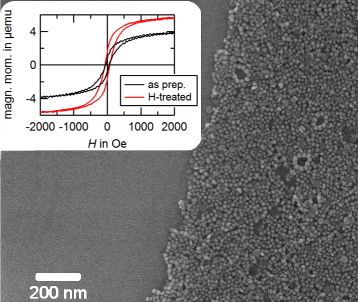
- reported, which can be divided in two time scales: oxygen reduction increases the particle magnetization during the first 20 min, which is followed by an alteration of the magnetic response shape. The latter depends on the respective particle species. Based on the Landau–Lifshitz equations for a discrete
- sample I and II, Ir and Pt were chosen as the respective layer materials; the layer thickness was set to 10 nm in both cases. Different materials were employed to ease the evaluation of the X-ray diffraction (XRD) measurements (see below). On short time scales of approximately 20 min, an oxygen reduction




Functionalization of vertically aligned carbon nanotubes
Beilstein J. Nanotechnol. 2013, 4, 129–152, doi:10.3762/bjnano.4.14
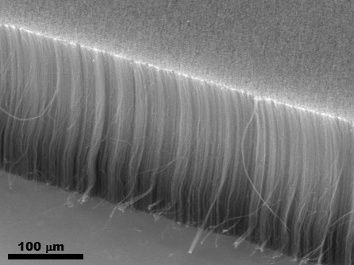
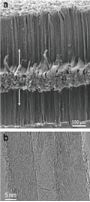
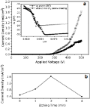
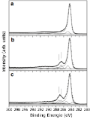
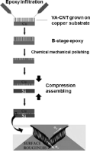
- their structural defects [110]. The fuel cell [111], discovered in 1839 by Sir William Grove [112], is a device in which the production of electricity is due to oxidation on a fuel reducer electrode coupled to the reduction of an oxidant on the other electrode. The oxygen reduction reaction plays a key








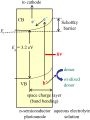
Schottky junction/ohmic contact behavior of a nanoporous TiO2 thin film photoanode in contact with redox electrolyte solutions
Beilstein J. Nanotechnol. 2011, 2, 127–134, doi:10.3762/bjnano.2.15
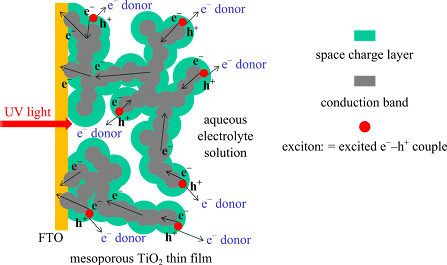
- nanostructure. It was reported that cathodic photocurrents were obtained at a nanocrystalline TiO2 film electrode due to oxygen reduction in alkaline solutions [7]. Visible light sensitization of TiO2 by surface complexation with [Fe(CN)6]4− has also been reported [8]. In such a case it was suggested that the




Other Beilstein-Institut Open Science Activities



