


Search results
Search for "photodetectors" in Full Text gives 55 result(s) in Beilstein Journal of Nanotechnology.
Observation of a photoinduced, resonant tunneling effect in a carbon nanotube–silicon heterojunction
Beilstein J. Nanotechnol. 2015, 6, 704–710, doi:10.3762/bjnano.6.71
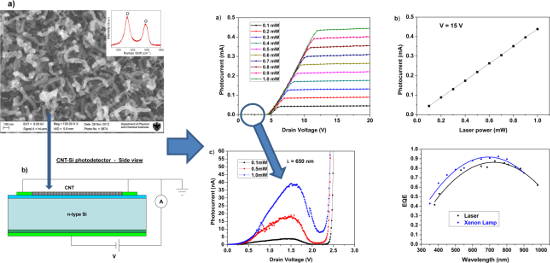
- the efficiency of the detector for near-ultraviolet radiation is well above that of the Si photodetectors. This effect was observed in several similar devices as reported in [13][15][16][17]. However, in this report, there are some relevant, new aspects to be noted. The first one is that the EQE of


Photodetectors based on carbon nanotubes deposited by using a spray technique on semi-insulating gallium arsenide
Beilstein J. Nanotechnol. 2014, 5, 1999–2006, doi:10.3762/bjnano.5.208
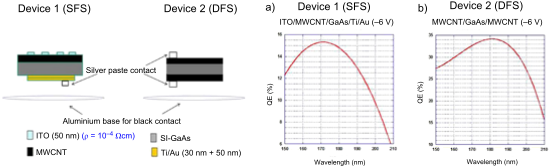
- light in the range from ultraviolet to near infrared. The device spectral efficiency obtained from the electrical characterization is finally reported and an improvement of the photodetector behavior due to the nanotubes is presented and discussed. Keywords: multi-wall carbon nanotubes; photodetectors
- (CNTs) in this field have shown interesting results, in particular in new technologically advanced nanoelectronic devices [4][5]. Photodetectors based on films of CNTs (both bundle and carpet distribution) on silicon, have been previously analyzed in the visible and IR spectral regions [6][7]. Moreover
- deposition technique for depositing CNTs on silicon, starting from a powder, at low temperatures, without catalyst and an intermediate layer [7]. By using this spray technique, CNT films on silicon-based photodetectors were prepared, achieving quantum efficiency (QE) values in the visible light range


Room temperature, ppb-level NO2 gas sensing of multiple-networked ZnSe nanowire sensors under UV illumination
Beilstein J. Nanotechnol. 2014, 5, 1836–1841, doi:10.3762/bjnano.5.194
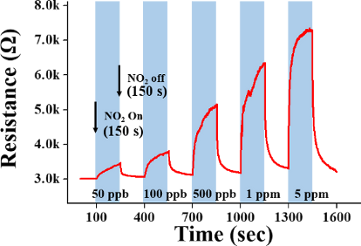
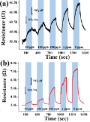
- diodes [5] and UV photodetectors [6]. On the other hand, there are almost no reports on the gas sensing properties of ZnSe. This might be due to the decomposition and oxidation of ZnSe at temperatures above 200 °C [7] and a lack of good sensing performance at room temperature. In recent years, one
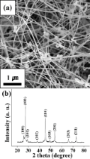



Surface processes during purification of InP quantum dots
Beilstein J. Nanotechnol. 2014, 5, 1220–1225, doi:10.3762/bjnano.5.135
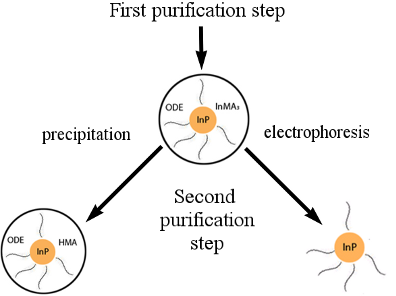
- last two decades due to their unique size-dependent optical properties and their potential applications in the areas of photoluminescent devices, light-emitting diodes, displays, photodetectors, photovoltaic devices, solar cells and biological imaging [1][2]. III–V Nanocrystals are of increasing



Ultraviolet photodetection of flexible ZnO nanowire sheets in polydimethylsiloxane polymer
Beilstein J. Nanotechnol. 2012, 3, 353–359, doi:10.3762/bjnano.3.41
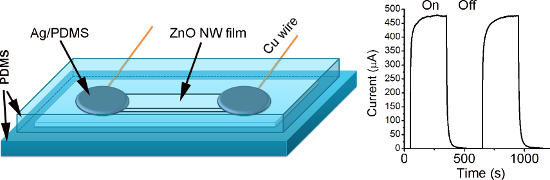
- , including light-emitting diodes, laser diodes, and photodetectors for the ultraviolet (UV) spectral range [1][2]. ZnO nanostructures are particularly interesting as they bear superior properties compared to the bulk crystal. UV-light detection is one of the major applications of ZnO, and various UV
- photodetectors based on ZnO films or nanocrystals have been reported. It has been demonstrated that ZnO nanowires have high internal photoconduction gain and much stronger responsivity under UV-light illumination compared to the bulk film [3]. The UV photoresponse mechanism of ZnO nanowires is dominated by the
- block the UV light. Moreover, carbon-based polymers undergo oxidation with ageing, and the degradation could be expedited by the absorption of UV light. In this paper, we report results of experiments on UV photodetectors based on a thin sheet of ZnO nanowires embedded in polydimethylsiloxane (PDMS


Other Beilstein-Institut Open Science Activities



