Search results
Search for "plastic deformation" in Full Text gives 64 result(s) in Beilstein Journal of Nanotechnology.
On the structure of grain/interphase boundaries and interfaces
Beilstein J. Nanotechnol. 2014, 5, 1603–1615, doi:10.3762/bjnano.5.172
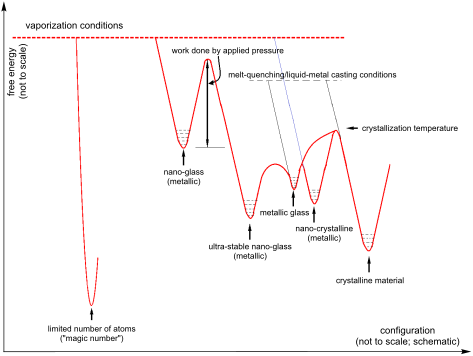
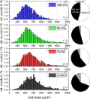
- defect density, as found, for example, in nano-crystalline materials produced by plastic deformation [28]. This increases only the interatomic distances in the boundary region compared with the grain interior to a limited extent, without changing the nature of the bonds. (Then, the boundaries become


Influence of the PDMS substrate stiffness on the adhesion of Acanthamoeba castellanii
Beilstein J. Nanotechnol. 2014, 5, 1393–1398, doi:10.3762/bjnano.5.152
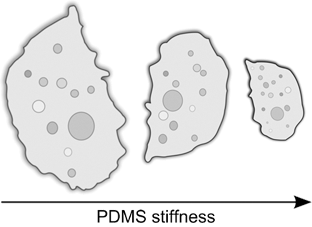
- . For all substrates, elastic moduli were determined from the unloading part of the curve to consider only the elastic behavior and not the plastic deformation of the sample. The measurements were performed under ambient conditions (25–26 °C temperature and 40–50% relative humidity). Analysis of the



Surface topography and contact mechanics of dry and wet human skin
Beilstein J. Nanotechnol. 2014, 5, 1341–1348, doi:10.3762/bjnano.5.147
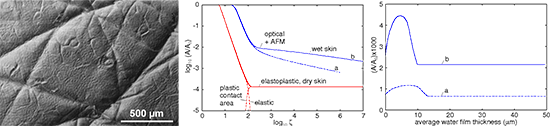
- layer of stratum corneum has a Young’s modulus of E0 = 7 MPa in the wet state and of E0 = 1 GPa in the dry state with a Poisson ratio of ν0 = 0.5. Plastic deformation must be taken into account for the dry skin, because of the the high contact pressure. In the following calculations the plastic yield
- /A0 = σN/σY = 1.37 × 10⁻⁴. Plastic deformation starts at q ≥ 105 m−1 corresponding to a wavelength of λ ≤ 2π/q ≈ 60 μm. The values of the friction coefficients, μ ≈ 0.25 for dry skin and μ ≈ 1.4 for wet skin, could be explained by frictional shear stresses of about 13 MPa for the dry surface and of


Nanoforging – Innovation in three-dimensional processing and shaping of nanoscaled structures
Beilstein J. Nanotechnol. 2014, 5, 1066–1070, doi:10.3762/bjnano.5.118
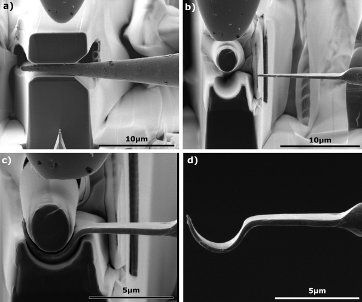
- . Conclusion: Compared with other forming techniques in the reduced scale, nanoforging represents a beneficial approach in forming freestanding metallic structures, due to its simplicity, and supplements other forming techniques. Keywords: forging; manipulation; nanoforging; plastic deformation; tungsten


Scale effects of nanomechanical properties and deformation behavior of Au nanoparticle and thin film using depth sensing nanoindentation
Beilstein J. Nanotechnol. 2014, 5, 822–836, doi:10.3762/bjnano.5.94
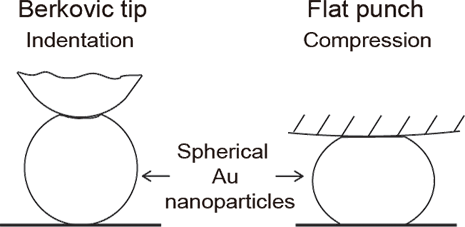
- understanding of materials behavior during contact. Mechanical properties of interest comprise hardness, Young’s modulus of elasticity, bulk modulus, elastic–plastic deformation, scratch resistance, residual stresses, time-dependent creep and relaxation properties, fracture toughness, fatigue and yield strength
- allow for plastic deformation to occur. Similar to thin films, for indentation of micro and nano-objects, there is also a contribution to hardening due to the occurrence of large strain gradients at shallow depths for both single and polycrystalline materials. Details of the mechanisms which lead to
- from geometrically necessary dislocations (GNDs) generated to accommodate strain gradient in nanoindentation at low penetration depths. Movement of dislocations by slip allows for plastic deformation to occur [27]. After an initial slip, as more dislocations are generated there is an increase in yield






Dynamic nanoindentation by instrumented nanoindentation and force microscopy: a comparative review
Beilstein J. Nanotechnol. 2013, 4, 815–833, doi:10.3762/bjnano.4.93
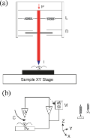
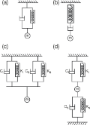
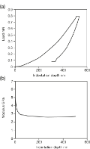
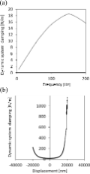
- well as the adhesive force Padh can be found by curve fitting. Typically unloading curves are preferably taken for analysis to avoid the plastic deformation that is present during loading. In AFM this procedure may lead to erroneous results: Since the AFM experiment does not control the load, but
- viscoelastic/plastic deformation, as well as capillary and adhesive forces. The analysis of AFM force–distance curves of polydimethylsiloxane (PDMS) showed a strong influence of the measurement conditions such as the loading–unloading rate and the dwell time, as well as intrinsic material properties like the




Deformation-induced grain growth and twinning in nanocrystalline palladium thin films
Beilstein J. Nanotechnol. 2013, 4, 554–566, doi:10.3762/bjnano.4.64
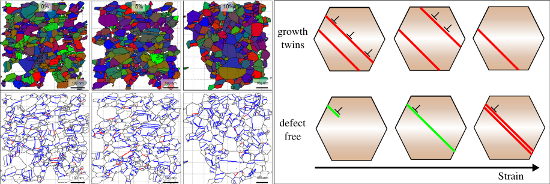
- . Bulk nc metals are typically produced by severe plastic deformation [8][9][10][11], inert gas condensation [4][12] or electrochemical deposition [13]. The different approaches result in significant differences in dislocation and twin density, porosity and impurity levels of the nc metals, where, e.g
- parts of the tensile samples after 12 weeks, which did not exhibit a significant change in grain size. Twinning is a possible mode for plastic deformation that is mainly observed in fcc metals with low stacking fault energy, but also in fcc metals with high stacking fault energy if deformed under


Plasticity of nanocrystalline alloys with chemical order: on the strength and ductility of nanocrystalline Ni–Fe
Beilstein J. Nanotechnol. 2013, 4, 542–553, doi:10.3762/bjnano.4.63
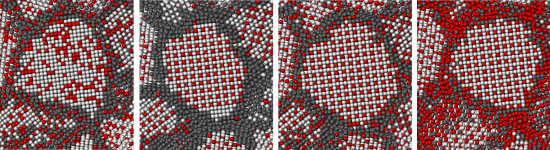
- Jonathan Schafer Karsten Albe Technische Universität Darmstadt, Fachbereich Material- und Geowissenschaften, Fachgebiet Materialmodellierung, Petersenstr. 32, D-64287 Darmstadt, Germany 10.3762/bjnano.4.63 Abstract Plastic deformation and alloying of nanocrystalline Ni–Fe is studied by means of
- is also found for ordered structures (L12), where dislocation activity is suppressed. Keywords: nanocrystalline materials; grain boundary structure; grain boundary segregation; plastic deformation; molecular dynamics; Introduction In intermetallics grain refinement to the nanometer scale has been
- state was found after rolling at liquid nitrogen temperature to obtain a nanometer grain size [6]. In nanostructured Ni3Al processed by ball milling [7] or high pressure torsion [8], on the contrary, a complete loss of order is observed during preparation. Grain refinement by severe plastic deformation



Nanoglasses: a new kind of noncrystalline materials
Beilstein J. Nanotechnol. 2013, 4, 517–533, doi:10.3762/bjnano.4.61
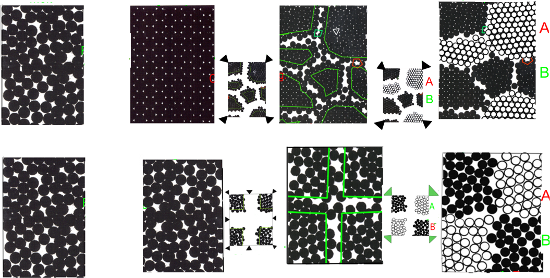
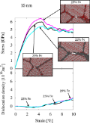
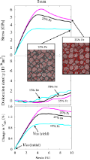
- with an average size of about 30 nm. Recent studies of the structure and the properties of nanoglasses produced by magnetron sputtering [7][8] suggest that their structure and properties are comparable to the ones of nanoglasses produced by inert gas condensation. Severe plastic deformation Due to the
- enhanced free volume in shear bands [9][10], the average free volume content of a glass was found to increase [10][11] with increasing plastic deformation. However, despite the similarity between the microstructural features of a nanoglass produced by consolidating nanometer-sized glassy spheres and a
- crystallites were revealed in the low temperature Mössbauer spectra [17]. These crystallites are superparamagnetic at ambient temperature. Plastic deformation of nanoglasses Experimental observations: By using microcompression experiments [43], the deformation behaviors of the following two kinds of glasses






Effect of normal load and roughness on the nanoscale friction coefficient in the elastic and plastic contact regime
Beilstein J. Nanotechnol. 2013, 4, 66–71, doi:10.3762/bjnano.4.7
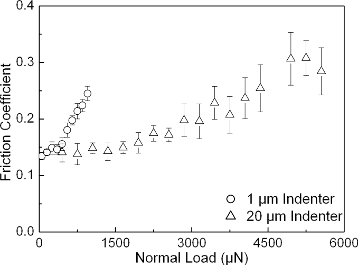
- , at increased normal loads the contact involves plastic deformation and the friction coefficient increases with increasing normal load. The critical load range for a transition from predominantly elastic to plastic contact, between the indenter and sample surface, increases with increasing size of
- of friction in the low load region of elastic deformation is less than that detected in the high load region of plastic deformation. Despite being based on physical and chemical principles as well as the huge amount of experimental work that has been carried out, up to now no complete understanding


Characterization and properties of micro- and nanowires of controlled size, composition, and geometry fabricated by electrodeposition and ion-track technology
Beilstein J. Nanotechnol. 2012, 3, 860–883, doi:10.3762/bjnano.3.97
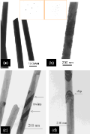
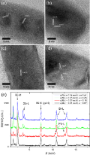
- ] and is evident by the reduced brightness in Figure 7c. Twins can be created during the growth process but may also result from plastic deformation when handling the samples. Also slips are frequently observed, not only in Cu wires (Figure 7d) but also in other materials such as Au and Bi2Te3. Planar








Growth behaviour and mechanical properties of PLL/HA multilayer films studied by AFM
Beilstein J. Nanotechnol. 2012, 3, 778–788, doi:10.3762/bjnano.3.87
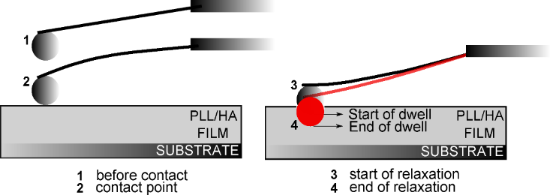
- measurements show that PLL/HA films have a viscoelastic behaviour, regardless of their thickness. If indentation is performed several times at the same lateral position on the film, a viscous/plastic deformation takes place. Keywords: atomic force microscopy; polyelectrolyte multilayers; stress relaxation
- undergoes an irreversible viscous [41] or plastic deformation [42], leading to a thinner film and a softer structure. In order to avoid any irreversible deformation effects, in the following sections the lateral position of the measurement was changed each time after an indentation process. Indentation
- to analyse the AFM force data. Multiple indentations at a fixed lateral film position can trigger a viscous or plastic deformation, continuously softening the structure. Regardless of their thickness, PLL/HA films show a viscoelastic liquid behaviour. This is evidenced by the fact that the apparent


Effect of large mechanical stress on the magnetic properties of embedded Fe nanoparticles
Beilstein J. Nanotechnol. 2011, 2, 268–275, doi:10.3762/bjnano.2.31
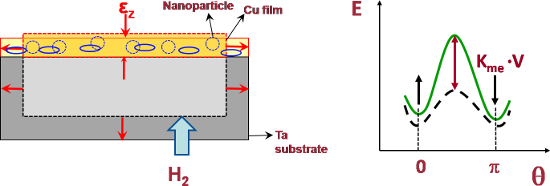
- earth alloys. To be comparable with the other contributions to the effective anisotropy, stresses in the GPa (109 Pa) range would be required. However, in thin films and other nanostructured materials plastic deformation by dislocation glide is constrained by the presence of surfaces and interfaces
- 3%. The actual stress generated in the films depends on the transfer of the elastic strain in the substrate to the particle embedding film. This transfer depends crucially on the interface properties and is also limited by the onset of plastic deformation. Previous computer simulations of Co
- in the Cu film is lower than the strain in the Ta substrate. This can be a result of plastic deformation inside the Cu film, or of some sliding processes at the Ta/Cu interface leading to incomplete transfer of strain from the Ta to the Cu film. Magnetic properties Since the H remains in the Ta


Infrared receptors in pyrophilous (“fire loving”) insects as model for new un-cooled infrared sensors
Beilstein J. Nanotechnol. 2011, 2, 186–197, doi:10.3762/bjnano.2.22
- load during indentation was 1,000 µN with loading and unloading rates of 100 µN/s, and a 10 s hold time at peak load to compensate for material creeping and to make sure that most of the plastic deformation was completed. It was repeatedly checked to ensure that longer holding times did not result in