


Search results
Search for "polynomial" in Full Text gives 58 result(s) in Beilstein Journal of Nanotechnology.
Topological edge properties of C60+12n fullerenes
Beilstein J. Nanotechnol. 2013, 4, 400–405, doi:10.3762/bjnano.4.47
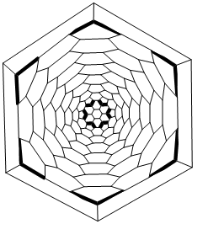
- graph. In this work, the topological properties of a class of fullerenes were given by edge contributions of its molecular graph. Our calculations with this and other classes of fullerenes suggest that the edge PI index can be computed by a polynomial of degree 2, whereas edge Szeged and edge revised


Polynomial force approximations and multifrequency atomic force microscopy
Beilstein J. Nanotechnol. 2013, 4, 352–360, doi:10.3762/bjnano.4.41
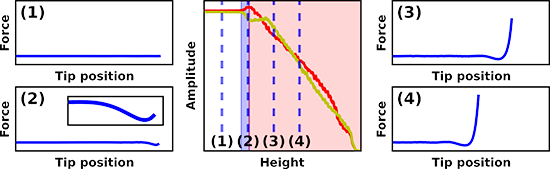
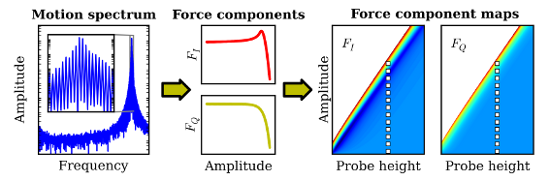
- polynomial force reconstruction from experimental intermodulation atomic force microscopy (ImAFM) data. We study the tip–surface force during a slow surface approach and compare the results with amplitude-dependence force spectroscopy (ADFS). Based on polynomial force reconstruction we generate high
- -resolution surface-property maps of polymer blend samples. The polynomial method is described as a special example of a more general approximative force reconstruction, where the aim is to determine model parameters that best approximate the measured force spectrum. This approximative approach is not limited
- to spectral data, and we demonstrate how it can be adapted to a force quadrature picture. Keywords: AFM; atomic force microscopy; force spectroscopy; multifrequency; intermodulation; polynomial; Introduction The combination of high-resolution imaging [1][2][3][4] and high-accuracy force

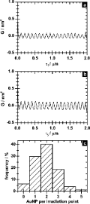
![[Graphic 19]](/bjnano/content/inline/2190-4286-4-41-i45.png?max-width=637&scale=1.18182) matrix (a) and its pseudo-inverse (b). Only rows with non-zero elements are d...
matrix (a) and its pseudo-inverse (b). Only rows with non-zero elements are d...


Guided immobilisation of single gold nanoparticles by chemical electron beam lithography
Beilstein J. Nanotechnol. 2013, 4, 336–344, doi:10.3762/bjnano.4.39
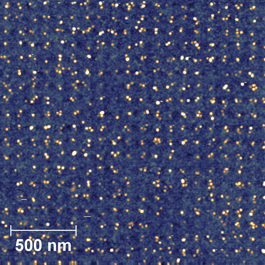
- ” and “Correct horizontal scars (strokes)”. In addition, measurements with an edge length greater than 5 µm or distinct curvature were also corrected with “Remove polynomial background (degree: 2)”. Calculation of primary electron paths Paths of primary electrons in solid substrates were calculated with


Interpreting motion and force for narrow-band intermodulation atomic force microscopy
Beilstein J. Nanotechnol. 2013, 4, 45–56, doi:10.3762/bjnano.4.5
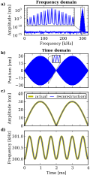
- possible. We have previously shown how the individual amplitudes [26] and phases [30] of the IMPs in the narrow band around the first flexural resonance can be used for imaging. Furthermore, a polynomial reconstruction of the tip–surface force [31][32] and a numerical fit of the parameters of a force model




Large-scale analysis of high-speed atomic force microscopy data sets using adaptive image processing
Beilstein J. Nanotechnol. 2012, 3, 747–758, doi:10.3762/bjnano.3.84
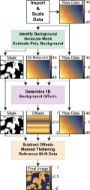
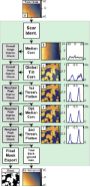
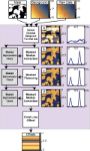
- ) also generate inherent distortions in the image, creating an additional bow in the apparent topography [13]. Some of the early work in the field addresses the need to correct these background distortions appropriately by fitting only the background regions to a polynomial of the correct order [35]. 1-D
- (less than 10 nm over 3 µm in either direction, which is very good for most samples). The background peak has been broadened so far as to be nearly indistinguishable. Figure 1D adds a second-order polynomial distortion to simulate scanner bow (less than 10 nm over the scan range, which is well within
- fitting, are 2-D polynomial fits. 2-D polynomial fits can be performed by using either the whole figure for the fit, or only certain regions of the image determined by using thresholds. Figure 2 shows a comparison of different processing methods on a standard calibration grating as well as on a lipid




Distance dependence of near-field fluorescence enhancement and quenching of single quantum dots
Beilstein J. Nanotechnol. 2011, 2, 645–652, doi:10.3762/bjnano.2.68
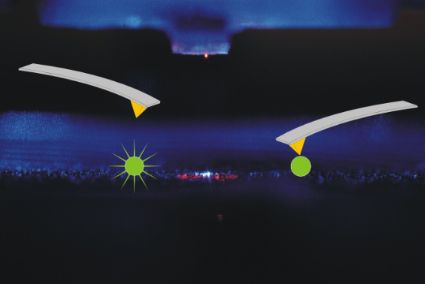
- second order polynomial was appended continuously. The angle of sample illumination was set to 45°, which is well above the critical angle of total reflection (approx. 43°) at an air–glass interface. Corresponding to the experiment, the wave lengths for illumination and fluorescence emission were set to


Towards a scalable and accurate quantum approach for describing vibrations of molecule–metal interfaces
Beilstein J. Nanotechnol. 2011, 2, 427–447, doi:10.3762/bjnano.2.48
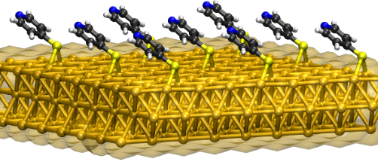
- terms, two-dimensional couplings, three-dimensional couplings, etc. This expansion guarantees convergence, as a 3Na − 6 dimensional expansion describes the complete PES for a problem consisting of Na atoms in the case of an isolated molecule. Note that other representations, such as polynomial


Structural and magnetic properties of ternary Fe1–xMnxPt nanoalloys from first principles
Beilstein J. Nanotechnol. 2011, 2, 162–172, doi:10.3762/bjnano.2.20
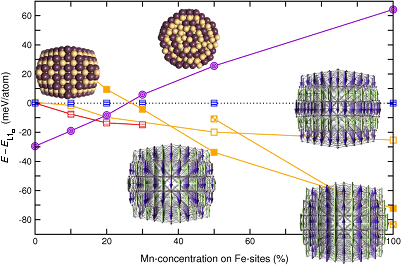
- individual twins in the particle. The evolution of multiply twinned morphologies has been traced back to a competition between surface and volume energy contributions, which vary with particle size. This can be understood by means of a phenomenological third order polynomial law which expresses the binding


Other Beilstein-Institut Open Science Activities



