


Search results
Search for "strong absorption" in Full Text gives 54 result(s) in Beilstein Journal of Nanotechnology.
Effects of the preparation method on the structure and the visible-light photocatalytic activity of Ag2CrO4
Beilstein J. Nanotechnol. 2014, 5, 658–666, doi:10.3762/bjnano.5.77
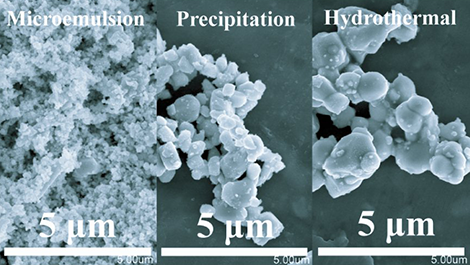
- contaminants both in air and aqueous solution. However, Ag2CrO4 is neglected although it has been explored as cathode for lithium cells in early years [37][38][39]. Actually, the band gap of Ag2CrO4 is narrow enough (about 1.75 eV) to obtain strong absorption in visible-light region [40], and thus may enable


Femtosecond-resolved ablation dynamics of Si in the near field of a small dielectric particle
Beilstein J. Nanotechnol. 2013, 4, 501–509, doi:10.3762/bjnano.4.59
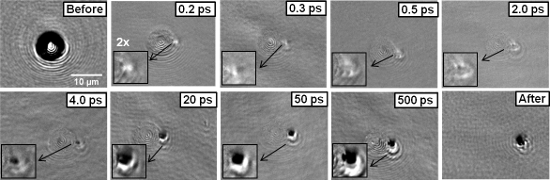
- be observable for delays up to 100 ps. This reflectivity decrease is indicative of the ablation of the surface. The emission of ions and neutral species in the ablating region leads to a strong absorption of the illumination probe beam. The ablation onset occurs at about 2 ps, although strong


How to remove the influence of trace water from the absorption spectra of SWNTs dispersed in ionic liquids
Beilstein J. Nanotechnol. 2011, 2, 653–658, doi:10.3762/bjnano.2.69
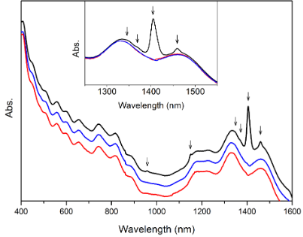
- to their chiralities is of great importance in the quantitative analysis of bulk SWNT samples. However, because water has strong absorption bands in the near-infrared (NIR) region where the E11 of semiconducting SWNTs lies, even a trace amount of water dissolved in an IL may introduce notable peaks




Fabrication and spectroscopic studies on highly luminescent CdSe/CdS nanorod polymer composites
Beilstein J. Nanotechnol. 2010, 1, 94–100, doi:10.3762/bjnano.1.11
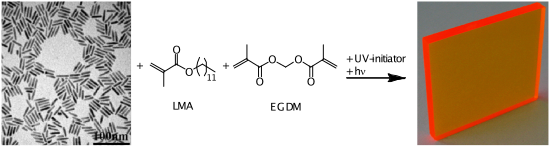
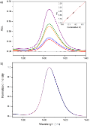
- NRs with aspect ratio 6 can be found using the scaling ~3 µM per 0.1 wt % whilst for NRs with aspect ratio 3 this is lower at ~2 µM per 0.1wt %. The absorption spectra of the P(LMA-co-EGDM) nanocomposites with NRs (aspect ratio 3) at different NR concentrations depicted in Figure 6a reveal strong
- absorption at shorter wavelengths (400–500 nm) and the first exciton peak at 619 nm. The nanorods are well dispersed in the polymer matrix, as shown by the lack of scattering in the absorption spectra at wavelengths much larger than that of the first exciton peak (Figure 6a). Figure 5c illustrates that we


Other Beilstein-Institut Open Science Activities



