Search results
Search for "surface interactions" in Full Text gives 68 result(s) in Beilstein Journal of Nanotechnology.
Dynamic force microscopy simulator (dForce): A tool for planning and understanding tapping and bimodal AFM experiments
Beilstein J. Nanotechnol. 2015, 6, 369–379, doi:10.3762/bjnano.6.36
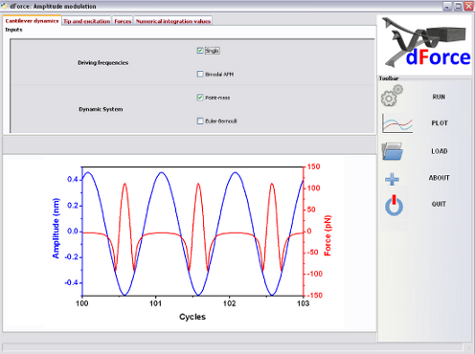
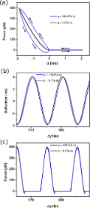
- of AFM configuration (AM-AFM versus bimodal AFM) or the model to describe the tip–surface forces. By activating any of the tabs a new panel will show the available options. Figure 1b shows the options available to model the tip–surface interactions. An example of force data panel is shown in Figure
- first two flexural modes are excited and an amplitude modulation feedback controls the amplitude of the first mode [33]. The parameters used in the bimodal AM simulations are presented in Table 4. Figure 6 shows the tip response under the influence of excitation and the tip–surface interactions. The




Boosting the local anodic oxidation of silicon through carbon nanofiber atomic force microscopy probes
Beilstein J. Nanotechnol. 2015, 6, 215–222, doi:10.3762/bjnano.6.20
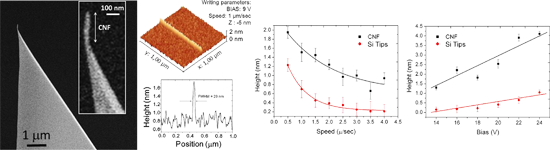
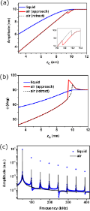
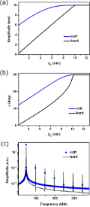
- the latter, AFM, it excels in versatility, as its working principle allows AFM to be applied conveniently onto any surface and in a variety of atmospheres [2][3][4]. Nonetheless, SPL based on AFM can rely on a number of tip–surface interactions (chemical, electrical, thermal, etc.), including tip


In situ metalation of free base phthalocyanine covalently bonded to silicon surfaces
Beilstein J. Nanotechnol. 2014, 5, 2222–2229, doi:10.3762/bjnano.5.231
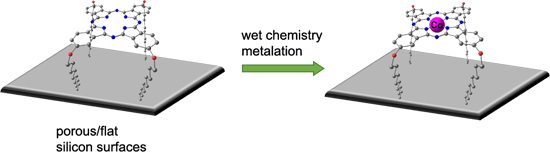
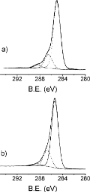
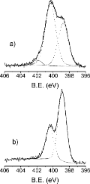
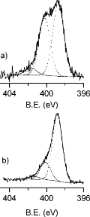
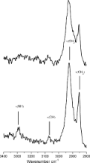
- relevant information on the interactions occurring between the anchored molecules and the substrates. The spectra suggest that the phthalocyanine ring interacts significantly with the flat Si surface, whilst ring–surface interactions are less relevant on porous Si. The surface-bonded molecules were then
- surface interactions. Results and Discussion Synthesis of 1-Pc Phthalocyanine 1-Pc was prepared according to a slightly modified literature procedure [22] starting from the 4-(ω-undecenyloxy)phthalonitrile in refluxing 1-pentanol in presence of a catalytic amount of 1,8- diazabicyclo[5.4.0]undec-7-ene
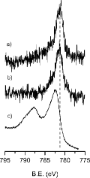
- ruled out since the reverse trend was observed for PSi-1-Pc. Overall the metalation appears more efficient in the case of the porous silicon substrate compared to flat Si(100). This behavior is likely to be associated to the different surface interactions observed for Si-1-Pc and PSi-1-Pc. In the case

Dissipation signals due to lateral tip oscillations in FM-AFM
Beilstein J. Nanotechnol. 2014, 5, 2048–2057, doi:10.3762/bjnano.5.213
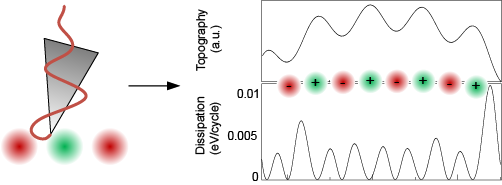
- ). Parameter choice The experimentally observed dissipation rate due to tip–surface interactions in FM-AFM is at least 0.01 eV per cycle. We will now consider the question, what fraction of the observed dissipation rate may be accounted for by the excitation of lateral tip oscillations. Monte-Carlo study of


Effects of surface functionalization on the adsorption of human serum albumin onto nanoparticles – a fluorescence correlation spectroscopy study
Beilstein J. Nanotechnol. 2014, 5, 2036–2047, doi:10.3762/bjnano.5.212
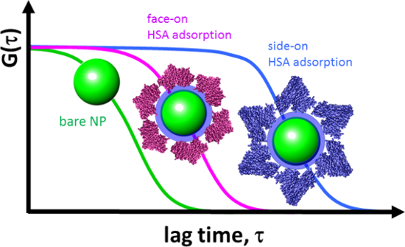
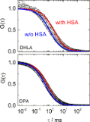
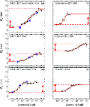
- NP surfaces. For both planar and NP surfaces, still more knowledge about the detailed physicochemical processes at the molecular level would be highly desirable. In our view, studying protein–surface interactions by using NPs rather than planar surfaces has significant technical advantages, provided



Dynamic calibration of higher eigenmode parameters of a cantilever in atomic force microscopy by using tip–surface interactions
Beilstein J. Nanotechnol. 2014, 5, 1899–1904, doi:10.3762/bjnano.5.200
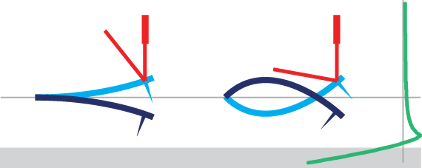
- , an enhanced force sensitivity is achieved due to multiplication by the sharply peaked cantilever transfer function. Measurement of response at multiple eigenmodes can provide additional information about the tip–surface interactions [4][5][6][7][8][9][10][11]. The optical detection system [12] common


![[Graphic 25]](/bjnano/content/inline/2190-4286-5-200-i35.png?max-width=637&scale=1.18182) , using Equation 9 for two different cantilevers: ...
, using Equation 9 for two different cantilevers: ...
Real-time monitoring of calcium carbonate and cationic peptide deposition on carboxylate-SAM using a microfluidic SAW biosensor
Beilstein J. Nanotechnol. 2014, 5, 1823–1835, doi:10.3762/bjnano.5.193
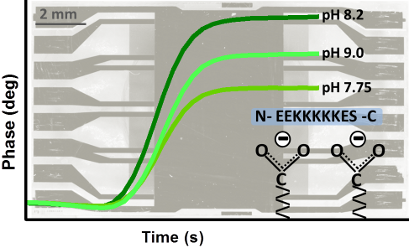
- the interaction of calcium carbonate with standard carboxylate self-assembled monolayer sensor chips. Different fluids, with and without biomolecular components, were investigated. The pH-dependent surface interactions of two bio-inspired cationic peptides, AS8 and ES9, which are similar to an
- carbonate surface interactions seem to be less well controlled at flow rates higher than 50 µL/min. One can assume that, at higher flow rates, the interaction of calcium and/or (bi)carbonate does not reach the maximum capacity of the sensor surface. Calcium carbonate and citric acid interactions In order to


Single-asperity contact mechanics with positive and negative work of adhesion: Influence of finite-range interactions and a continuum description for the squeeze-out of wetting fluids
Beilstein J. Nanotechnol. 2014, 5, 419–437, doi:10.3762/bjnano.5.50
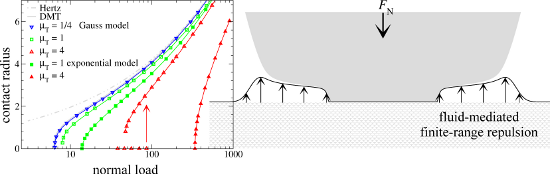
- , I want to investigate to what degree such an inversion is possible by studying the sensitivity of the functions d(FN) and ac(FN) to the functional form of the surface interactions. Figure 11 shows the contact radius as a function of the normal load. One can see that the exponential model and the MD
- coefficients. Figure 12 reveals that it is possible to adjust the free parameters of the MD model to fit d(FN) curves for a broad variety of surface interactions. However, one should abstain from deducing contact areas based on such fits, as this can result in non-negligible errors. For example, if we only
- for μT = 1. This is demonstrated in Figure 18. It reveals that information on the (effective) near-range surface interactions at small separation are difficult to obtain from experimentally measured load-displacement curves. I conclude this section with an analysis of the gap profile for repulsive


Photoactivation of luminescence in CdS nanocrystals
Beilstein J. Nanotechnol. 2014, 5, 355–359, doi:10.3762/bjnano.5.40
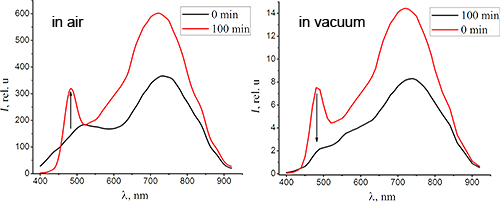
- fluorescence enhancement (PFE) [1][2][3][4][5], intermittency or blinking of photoluminescence [6][7][8], and a blue- or red-shift of the exciton PL of nanocrystals [5][9]. Despite the large number of works devoted to the surface interactions in II–IV QDs [2][3][4][5][10] the mechanisms responsible for the


The role of surface corrugation and tip oscillation in single-molecule manipulation with a non-contact atomic force microscope
Beilstein J. Nanotechnol. 2014, 5, 202–209, doi:10.3762/bjnano.5.22
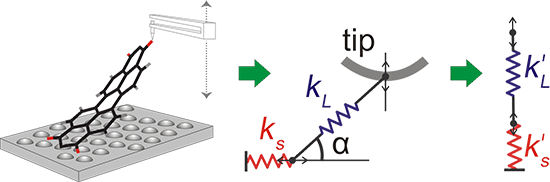
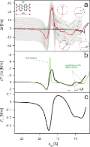
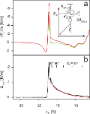
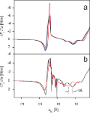
- rapid development of scanning probe microscopy (SPM) techniques, investigations of adsorbate–surface interactions on a single-molecule level have become possible [2][3][4][5][6][7][8][9][10][11][12][13][14][15][16][17][18]. Especially interesting is the possibility of probing the molecule–surface
- carboxylic oxygen atoms. The interaction potentials of the carboxylic oxygen and the backbone atoms are described via two separate parameter sets that amount to a total of five free parameters (if additional chemical molecule–surface interactions are absent). These five parameters, which describe the

Structural development and energy dissipation in simulated silicon apices
Beilstein J. Nanotechnol. 2013, 4, 941–948, doi:10.3762/bjnano.4.106
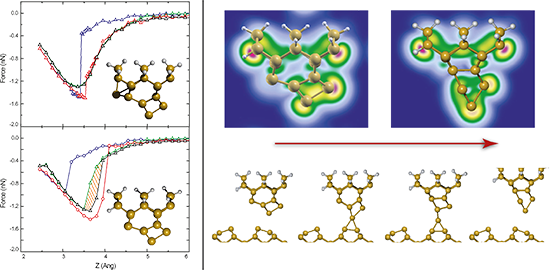
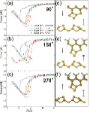
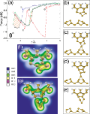
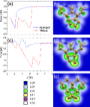
- single rotational degree of freedom, the difference in tip–surface interactions can be as significant as for a completely different tip structure. Simulation details Our investigation is performed with ab initio density functional theory (DFT) simulations carried out by using the SIESTA code [41], which


Influence of the solvent on the stability of bis(terpyridine) structures on graphite
Beilstein J. Nanotechnol. 2013, 4, 269–277, doi:10.3762/bjnano.4.29
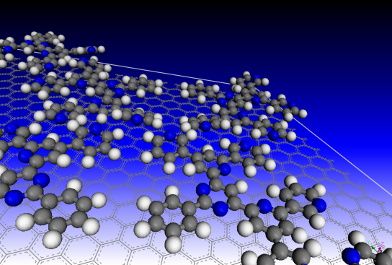
- properties of water quite satisfactorily [19][20]. However, here we need general-purpose force fields that are able to describe different solvents, solvent–molecule and molecule–surface interactions equally well. Hence, we use the Universal (UFF) [21], Compass (condensed-phase optimized molecular potentials


Mapping mechanical properties of organic thin films by force-modulation microscopy in aqueous media
Beilstein J. Nanotechnol. 2012, 3, 464–474, doi:10.3762/bjnano.3.53
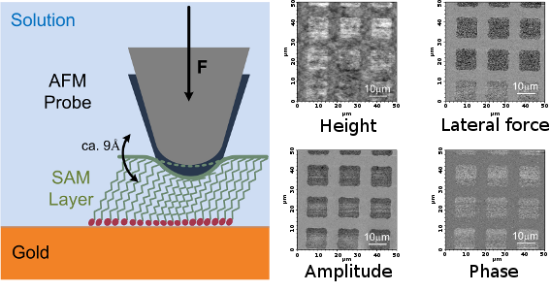
- below the free resonance frequency, and the actuation amplitude is selected to yield a small cantilever amplitude in contact. Furthermore, as shown in Figure 2, AFM tip–surface interactions should be kept in regime D to obtain a linear contact response. This demand needs to be balanced by the need for

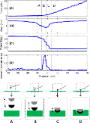


Models of the interaction of metal tips with insulating surfaces
Beilstein J. Nanotechnol. 2012, 3, 329–335, doi:10.3762/bjnano.3.37
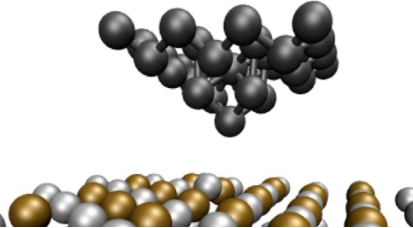
- . Keywords: atomic force microscopy; density functional theory; ionic surfaces; metallic asperities; surface interactions; Introduction The noncontact atomic force microscope (NC-AFM) is capable of imaging both conducting and insulating systems with true atomic resolution and has provided extraordinary


Modeling noncontact atomic force microscopy resolution on corrugated surfaces
Beilstein J. Nanotechnol. 2012, 3, 230–237, doi:10.3762/bjnano.3.26
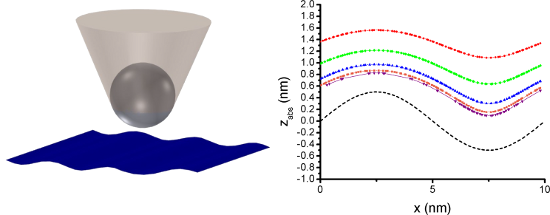
- modeling of tip–surface interactions for the case of a corrugated surface. We discuss the issues that arise when the surface is corrugated on relatively small length scales (our best measurements on SiO2 yield a correlation length of 8–10 nm). We develop a continuum model that explicitly accounts for a


Self-assembly of octadecyltrichlorosilane: Surface structures formed using different protocols of particle lithography
Beilstein J. Nanotechnol. 2012, 3, 114–122, doi:10.3762/bjnano.3.12
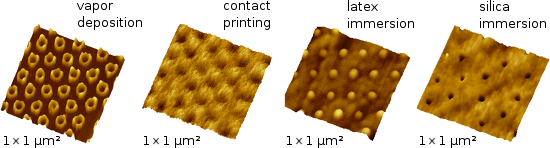
- images indicate differences in tip–surface interactions, but were not normalized for the comparison of friction changes between different tips or experiments. The tips were silicon nitride probes. Tips used with tapping-mode AFM were rectangular shaped ultrasharp silicon tips that have an aluminium




Fabrication of multi-parametric platforms based on nanocone arrays for determination of cellular response
Beilstein J. Nanotechnol. 2011, 2, 545–551, doi:10.3762/bjnano.2.58
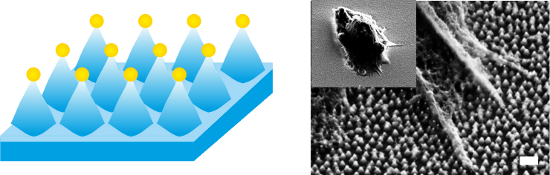
- grooves, ridges and wells, the research focus has shifted to the investigation of the potential of nanostructured materials for controlling cell–surface interactions [8]. For several years experimental studies on the influence of nanoscale topography on cell behavior have been largely obstructed by the
- study cell–surface interactions through topographical and chemical gradients have been reported to date [18]. Representative review articles on neuronal cell response to nanostructured surfaces have been published [19][20]. Despite the enormous effort made in this research area, intelligently designed


Manipulation of gold colloidal nanoparticles with atomic force microscopy in dynamic mode: influence of particle–substrate chemistry and morphology, and of operating conditions
Beilstein J. Nanotechnol. 2011, 2, 85–98, doi:10.3762/bjnano.2.10
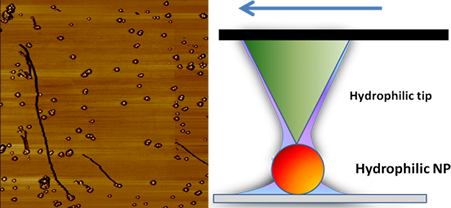
- nanoparticles during their manipulation using AFM in tapping mode has been investigated. In particular, the effects of the size, shape and coating of the nanoparticles, the lateral scan velocity, the particle-surface interactions and the environmental conditions, especially temperature T and relative humidity
- the particle (chemistry, size, shape) and the substrate (chemistry and topography) have been investigated. It has been shown that the mobility of the particles was significantly affected by the nature of intermolecular tip–particle and particle–surface interactions, the particle shape and size, the