


Search results
Search for "SQUID" in Full Text gives 84 result(s) in Beilstein Journal of Nanotechnology.
Enhancement of the critical current density in FeO-coated MgB2 thin films at high magnetic fields
Beilstein J. Nanotechnol. 2011, 2, 809–813, doi:10.3762/bjnano.2.89
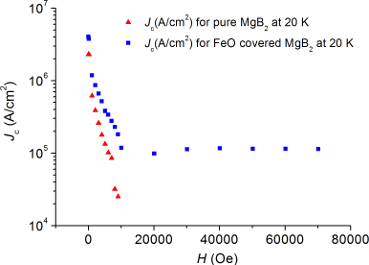
- the magnetization hysteresis (M–H) curves of the FeO-covered and uncovered MgB2 films at H perpendicular to the sample surface at various temperatures from 4.2 K to 20 K. All the magnetization measurements were performed in a superconducting quantum interference device (SQUID) magnetometer (Quantum
- Design, Magnetic Property Measurement System, MPMS-XL). The SQUID magnetometer has a sensitivity of l0−8 emu and operates in the temperature range 1.9–400 K, with magnetic fields up to 7 T; it has a high field uniformity of 0.01% over 4 cm. Pd was used as a standard for the SQUID magnetometer. The


Nanoscaled alloy formation from self-assembled elemental Co nanoparticles on top of Pt films
Beilstein J. Nanotechnol. 2011, 2, 473–485, doi:10.3762/bjnano.2.51
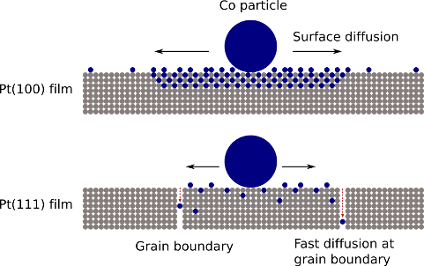
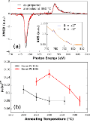
- alloy formation by X-ray absorption spectroscopy and SQUID magnetometry. The excellent sensitivity of SQUID magnetometers can be exploited, at suitably selected temperatures, to detect the magnetic response corresponding to the Co particles and nanoscale alloys. X-ray magnetic circular dichroism (XMCD
- ) derives its sensitivity from being both element specific and surface sensitive. It is therefore ideally suited for the kind of specimens studied here. In addition to the information contained in (both, SQUID and XMCD) hysteresis loops, we obtain spectroscopic signatures of the average magnetocrystalline
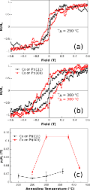
- additionally confirms the lateral spread of Co atoms. Additional in-plane hysteresis loops were measured by SQUID magnetometry for 7 nm Co NPs on Pt(111) films after different annealing steps. Note that each hysteresis loop was measured on a separate sample to exclude any effect of the thin SiO cover layer




Effect of large mechanical stress on the magnetic properties of embedded Fe nanoparticles
Beilstein J. Nanotechnol. 2011, 2, 268–275, doi:10.3762/bjnano.2.31
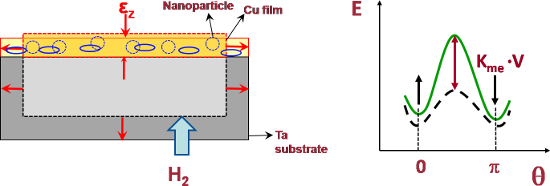
- first introduce the experimental method for applying stress and provide evidence for the presence of large biaxial stresses. Then we present results from SQUID magnetometry of Fe nanoparticles in the stressed and stress-free state for the same sample over a range of temperatures. Results and Discussion
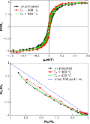
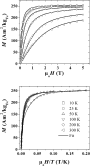
- SQUID magnetometer were performed over a range of temperatures. Figure 5 shows the magnetization curves of the 13 nm embedded Fe nanoparticles at a temperature T = 10 K; the magnetic field was applied parallel to the plane of the film (in-plane). The paramagnetic signal of the Ta substrate was fitted
- be noted that in the as-prepared state the Fe nanoparticles show a superparamagnetic behaviour in our SQUID measurements at 300 K. A direct comparison of the identical sample before and after hydrogen loading showed an almost identical coercivity, but a significant increase of the Mr/Ms ratio (Mr is


Extended X-ray absorption fine structure of bimetallic nanoparticles
Beilstein J. Nanotechnol. 2011, 2, 237–251, doi:10.3762/bjnano.2.28
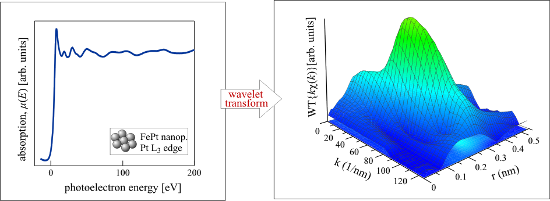
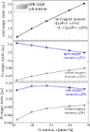
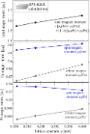
- 2.75 μB at x = 68 atom %. However, the total magnetic moment averaged over the different lattice sites increased almost linearly with increasing Fe content as is also known from experimental data using conventional magnetometry such as SQUID or VSM magnetometry [92]. Compared to experimental data on



Magnetic nanoparticles for biomedical NMR-based diagnostics
Beilstein J. Nanotechnol. 2010, 1, 142–154, doi:10.3762/bjnano.1.17
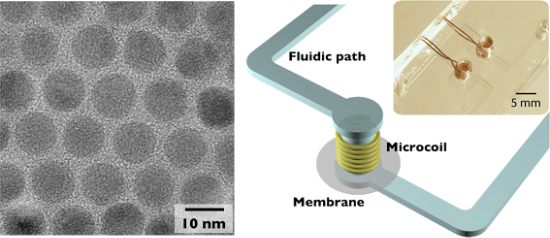
- technologies have been developed [1]. These include techniques that use magnetometers, such as superconducting quantum interference device (SQUID) [2][3][4], magnetoresistive sensors [5][6][7][8][9][10][11], and Hall sensors [12], which directly measure the magnetic fields from magnetically-labeled biological


Ultrafine metallic Fe nanoparticles: synthesis, structure and magnetism
Beilstein J. Nanotechnol. 2010, 1, 108–118, doi:10.3762/bjnano.1.13
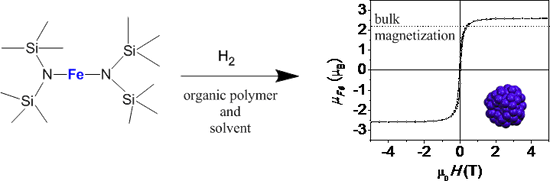
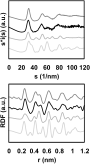
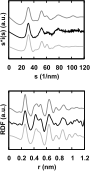
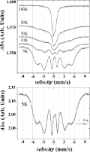
- have already been published [19]. Here a more detailed study of the magnetic properties is presented including Mössbauer spectrometry, ferromagnetic resonance (FMR) and superconducting quantum interference device (SQUID) measurements (static and AC susceptibility). Results and Discussion Synthesis and
- surface atoms. B. Magnetization Magnetization measurements have been carried out with a commercial Quantum design SQUID magnetometer. Figure 6 shows the static zero-field-cooling field-cooling (ZFC-FC) magnetization curve versus temperature (T) in a low magnetic field of 1 mT. It exhibits a classical
- effect as a consequence of the size reduction. The value of the effective anisotropy Keff in the range of (3.7–5.0)·105 J/m3 is much higher than the bulk value, and larger than that deduced with micro-SQUID techniques from the magnetization curve of a single α-Fe NP containing 800 atoms embedded in a Nb





Magnetic coupling mechanisms in particle/thin film composite systems
Beilstein J. Nanotechnol. 2010, 1, 101–107, doi:10.3762/bjnano.1.12
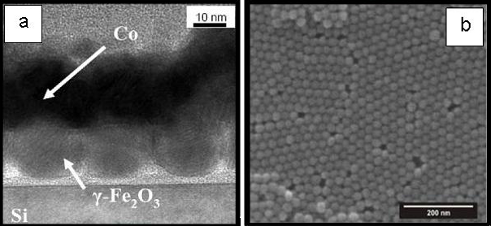
- sample had to be coated with an approximately 3 µm thick layer of tungsten. Magnetic measurements were performed by means of superconducting quantum interference device (SQUID) magnetometry (Quantum Design, MPMS) on sample areas of 7 × 7 mm2, in a temperature range between 15 and 380 K, with the field


Flash laser annealing for controlling size and shape of magnetic alloy nanoparticles
Beilstein J. Nanotechnol. 2010, 1, 55–59, doi:10.3762/bjnano.1.7
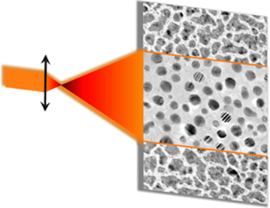
- their polydispersity varies from 30% to 60% with cluster size. This broad size distribution makes the study of the structural and magnetic properties of NPs complicated, because it drastically influences the results of commonly used analysis techniques, such as X-ray diffraction and SQUID. For that


Preparation and characterization of supported magnetic nanoparticles prepared by reverse micelles
Beilstein J. Nanotechnol. 2010, 1, 24–47, doi:10.3762/bjnano.1.5
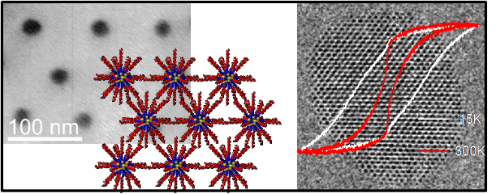
- interparticle distances of 100 nm on a 5 × 5 mm2 substrate produce a total magnetic moment of only 10–9 Am2 (10–6 emu). Although state-of-the-art SQUID-magnetometry is able to detect the related small signals, the response of the diamagnetic substrate has to be taken into account as well delivering for the
- . Consequently, SQUID-magnetometry on supported micelle-based NPs is strongly hampered and often not reproducible. Moreover, prior to an ex situ characterization, the as-prepared particles have to be in situ coated, e.g., by SiO2 to avoid oxidation under ambient conditions. Even then, further sample processing
- such as the annealing of the covered NPs appears unfavorable due to the possible occurrence of chemical reactions. If, however, all these problems are carefully considered, SQUID-magnetometry can provide valuable information. The drawback of a strong diamagnetic substrate contribution in SQUID






Other Beilstein-Institut Open Science Activities



