


Search results
Search for "Si(100)" in Full Text gives 83 result(s) in Beilstein Journal of Nanotechnology.
Spontaneous dissociation of Co2(CO)8 and autocatalytic growth of Co on SiO2: A combined experimental and theoretical investigation
Beilstein J. Nanotechnol. 2012, 3, 546–555, doi:10.3762/bjnano.3.63
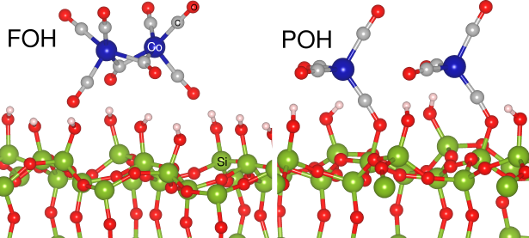
- electron emitter. A plasma source using ambient air at a chamber pressure of 1 × 10⁻⁴ to 5 × 10⁻⁴ mbar was used for the surface-activation experiment (GV10x Downstream Asher, ibss Group). Electron pregrowth irradiation experiments were carried out at 5 kV beam voltage and 1.6 nA beam current. Si(100) (p


Electron-beam patterned self-assembled monolayers as templates for Cu electrodeposition and lift-off
Beilstein J. Nanotechnol. 2012, 3, 101–113, doi:10.3762/bjnano.3.11
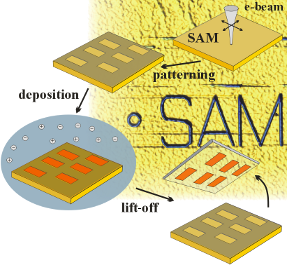
- ) 100 nm of Au evaporated onto a Si(100) wafer with a 5 nm titanium interlayer; (ii) 300 nm of Au on 300 nm of silver on mica slides. Both Ti and Ag served as adhesion promoters. Substrates were cut into 3–5 cm2 pieces. SAMs were prepared by immersion of the substrate into a 100 µM solution of ω-(4

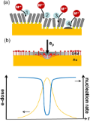




Substrate-mediated effects in photothermal patterning of alkanethiol self-assembled monolayers with microfocused continuous-wave lasers
Beilstein J. Nanotechnol. 2012, 3, 65–74, doi:10.3762/bjnano.3.8
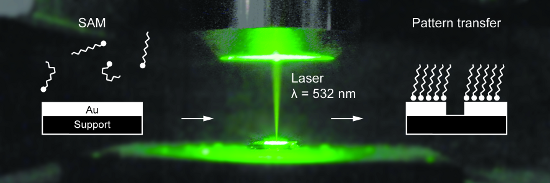
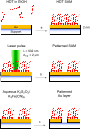
- parallel laser processing, e.g., by using micromirror displays, appears to be feasible. Experimental Au-coated Si and glass supports from commercial suppliers were used as substrates (Albert PVD, Phasis). Si (100) wafers and borosilicate glass slides were chosen as the support materials. A thin Ti film




Direct-write polymer nanolithography in ultra-high vacuum
Beilstein J. Nanotechnol. 2012, 3, 52–56, doi:10.3762/bjnano.3.6
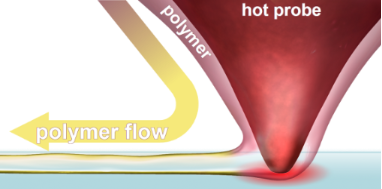
- 0.24 ± 0.04 nm [19]. In contrast, Terada et al. [20] reported poly(3-hexylthiophene) (P3HT) on H-terminated Si(100) in UHV to be 0.5 nm thick. Our measured value is closer to the 0.4 nm intermolecular spacing measured for thick films of PDDT [14]. In the prior STM measurements, the measured thickness


Effect of the tip state during qPlus noncontact atomic force microscopy of Si(100) at 5 K: Probing the probe
Beilstein J. Nanotechnol. 2012, 3, 25–32, doi:10.3762/bjnano.3.3
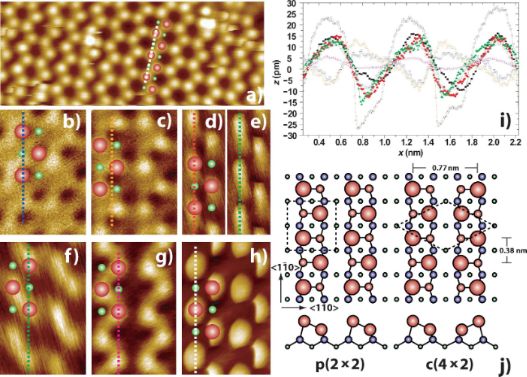
- functionalised tips has provided additional impetus to elucidating the role of the tip apex in the observed contrast. Results: We present an analysis of the influence of the tip apex during imaging of the Si(100) substrate in ultra-high vacuum (UHV) at 5 K using a qPlus sensor for noncontact atomic force
- excitation of silicon dimers, which is a key issue in scanning probe studies of Si(100). Conclusion: A wide range of novel imaging mechanisms are demonstrated on the Si(100) surface, which can only be explained by variations in the precise structural configuration at the apex of the tip. Such images provide
- ; noncontact AFM; qPlus; Si(001); Si(100); tip (apex) structure; Introduction It is now generally accepted that atomic resolution in NC-AFM imaging on semiconducting surfaces is due to the chemical force between the atoms of the surface and the last few atoms of the tip apex [1][2][3][4]. Even with well


Nanostructured, mesoporous Au/TiO2 model catalysts – structure, stability and catalytic properties
Beilstein J. Nanotechnol. 2011, 2, 593–606, doi:10.3762/bjnano.2.63
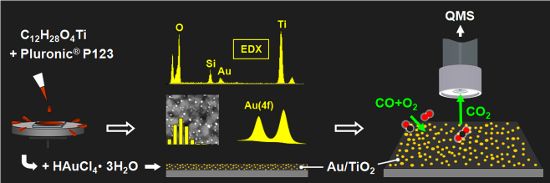
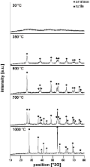
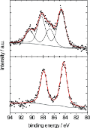
- tetraisopropoxide and Pluronic P123 on planar Si(100) substrates, calcination at 350 °C and subsequent Au loading by a deposition–precipitation procedure, followed by a final calcination step for catalyst activation. The structural and chemical properties of these model systems were characterized by X-ray
- and catalytic properties of ultra-thin Au/TiO2 catalyst films, which were prepared by spin-coating a thin film of mesoporous TiO2 of 200–400 nm thickness on a flat Si(100) substrate and subsequent loading with Au nanoparticles. After describing the experimental procedures, we first present
- , spinning speeds of 2000 rpm (for 420 nm thickness) and 6000 rpm (for 190 nm thickness) were used instead for 30 s. The Si(100) wafer was cut into small pieces (9 mm × 9 mm) prior to the coating procedure. To remove possible organic contaminants, the wafer was cleaned with acetone, rinsed with distilled






Tip-enhanced Raman spectroscopic imaging of patterned thiol monolayers
Beilstein J. Nanotechnol. 2011, 2, 509–515, doi:10.3762/bjnano.2.55
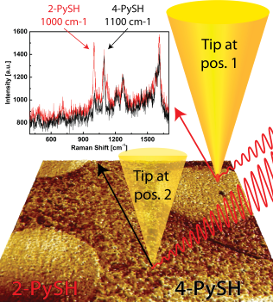
- [30]. Template-stripped gold films were created using a similar method to that described in [35], by coating polished Si(100) wafers (Si-Mat, Landsberg, Germany) in a Bal-Tec Med 020 coating chamber at pressures below 1 × 10⁻⁵ mbar, with gold (99.99%, Leica, Wetzlar, Germany) evaporated by resistive




Magnetic coupling mechanisms in particle/thin film composite systems
Beilstein J. Nanotechnol. 2010, 1, 101–107, doi:10.3762/bjnano.1.12
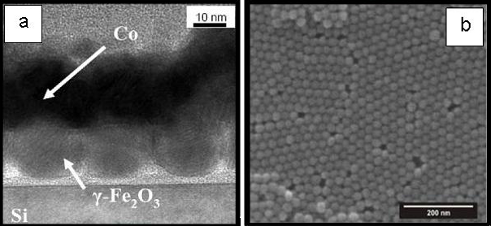
- mg of NPs per 5 ml of toluene, was spin-coated at 3000 rpm for 30 s on top of a Si(100) substrate with a natural oxide layer. As a result of the spin-coating process, approximately one monolayer of self-organized particles was formed having hexagonal closed-packed lateral order (see Figure 1). The


Other Beilstein-Institut Open Science Activities



