


Search results
Search for "Young’s modulus" in Full Text gives 155 result(s) in Beilstein Journal of Nanotechnology.
Hierarchically structured nanoporous carbon tubes for high pressure carbon dioxide adsorption
Beilstein J. Nanotechnol. 2017, 8, 1135–1144, doi:10.3762/bjnano.8.115
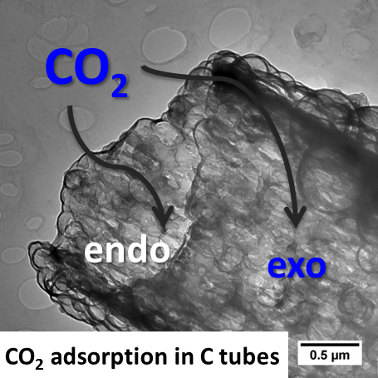
- show outstanding elasticity and mechanical strength. A Young’s modulus of 600 GPa was measured for SiC wires [18][19]. Different templating methods were used for structuring such as the two-step synthesis using preceramic polymers as precursors (e.g., polycarbosilanes) [13][20][21], carbo-thermal


Assembly of metallic nanoparticle arrays on glass via nanoimprinting and thin-film dewetting
Beilstein J. Nanotechnol. 2017, 8, 1049–1055, doi:10.3762/bjnano.8.106
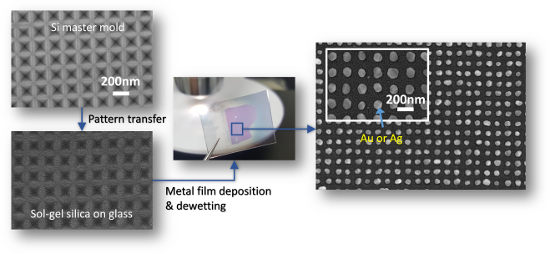
- function of the indentation depth (h). The Young’s modulus rapidly decreased as the indentation depth increased to ≈20 nm. In the nanoindentation measurements, the Young's modulus (Er) is given by Er = (√π/2β)(dP/dh)/√A where β is a constant, (dP/dh) is the slope of the load–displacement curve at the


Scaling law to determine peak forces in tapping-mode AFM experiments on finite elastic soft matter systems
Beilstein J. Nanotechnol. 2017, 8, 968–974, doi:10.3762/bjnano.8.98
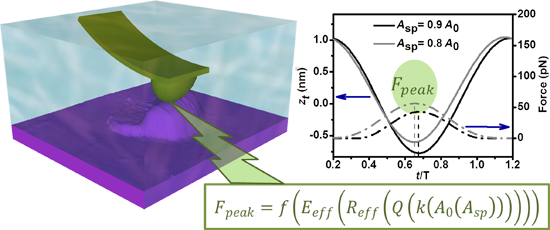
- variables and where the indexes “t” and “s” stand for tip and sample, respectively, in the above equations, δ is the indentation, ν is the Poisson coefficient (νt = 0.3 and νs = 0.4) and E is the Young’s modulus with Et = 170 GPa. The effective Young’s modulus Eeff and radius Reff are described elsewhere
- lower Young’s modulus values of the material. Figure 1b shows the comparison of the parametrical equation and numerical simulations for the whole range of Young moduli between 30 and 300 MPa for Asp = 0.9A0. Figure 1b and Figure 2 compare the parametrical equation of Equation 8 and the corresponding
- nm (Figure 2). The peak force increases monotonically with the Young’s modulus of the sample. These results are consistent with previous numerical simulations [28][29]. In Figure 1b, the agreement between the parametrical equation and the numerical simulations in the explored range remains close to a


Functional dependence of resonant harmonics on nanomechanical parameters in dynamic mode atomic force microscopy
Beilstein J. Nanotechnol. 2017, 8, 883–891, doi:10.3762/bjnano.8.90
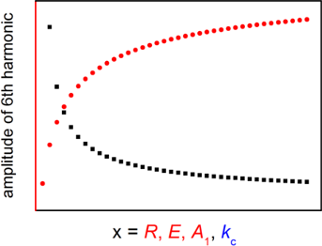
- experiments confirm the predicted dependence in the explored 3–45 N/m force constant range and 2–345 GPa sample’s stiffness range. For force constants around 25 N/m, the amplitude of the 6th harmonic exhibits the largest sensitivity for ultrasharp tips (tip radius below 10 nm) and polymers (Young’s modulus
- experimental parameters, such as the tip radius (R) and the Young’s modulus of the sample (E). A list of well-accepted models can be found in the literature, including the most widely used Hertz, Derjaguin–Muller–Toporov (DMT) and Johnson–Kendall–Roberts (JKR) models, describing the analytical dependence on
- tip radius, free oscillation amplitude, cantilever stiffness and sample Young’s modulus. Because of the low amplitudes of the involved harmonics (well below 1 nm), we concentrate on the repulsive regime of the tip–sample interaction and on those harmonics close to flexural eigenmodes of rectangular


Relationships between chemical structure, mechanical properties and materials processing in nanopatterned organosilicate fins
Beilstein J. Nanotechnol. 2017, 8, 863–871, doi:10.3762/bjnano.8.88

- curing to create a 33% nanoporous organosilicate material with a nominal Young’s modulus of 5 GPa [36]. The pitch quarter patterning process consisted of first depositing on the nanoporous organosilicate a quad-layer film stack consisting of a backbone layer, an anti-reflection coating, a second backbone
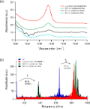
- spectra at 60 nN applied force of the first two eigenmodes from the same unpatterned film, 500 nm fins, and 90 nm fins that were measured in (a). The arrows indicate the frequency shifts of the two eigenmodes from air to contact. SiC–H3 absorbance (AFM-IR) and Young’s modulus (CR-AFM) as functions of the
- feature size for unpatterned and patterned nanoporous organosilicates. Note: the error bars for the AFM-IR SiC–H3 absorbance represents the maximum variability observed from spectra acquired at different sites with the same feature size. The details of the errors associated with the CR-AFM Young’s modulus



Vapor deposition routes to conformal polymer thin films
Beilstein J. Nanotechnol. 2017, 8, 723–735, doi:10.3762/bjnano.8.76
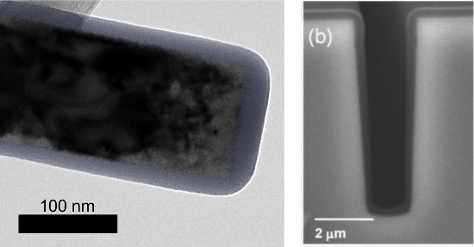
- times the Young’s Modulus of a bare CNT sheet [40]. Emerging applications for ultrathin polymer films on nanostructured high aspect ratio structures include various energy storage devices and soft electronics. For instance, silicon based anodes are of interest for lithium ion batteries since Li–Si


Synthesis of graphene–transition metal oxide hybrid nanoparticles and their application in various fields
Beilstein J. Nanotechnol. 2017, 8, 688–714, doi:10.3762/bjnano.8.74
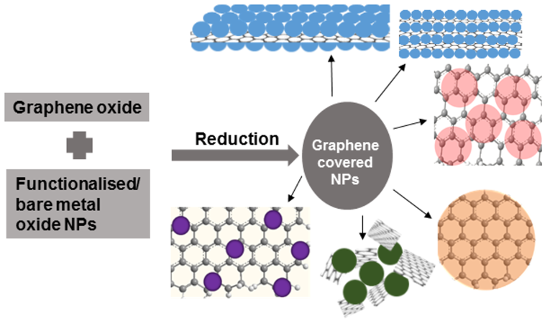
- flexibility, and extraordinary electronic quality, and its superior thermal and mechanical properties [2][3]. Graphene exhibits high mechanical strength (>1060 GPa) and an exceptional Young’s modulus of 1 TPa [4]. Furthermore, single layer graphene is the strongest material ever tested [5]. It also exhibits






Optimizing qPlus sensor assemblies for simultaneous scanning tunneling and noncontact atomic force microscopy operation based on finite element method analysis
Beilstein J. Nanotechnol. 2017, 8, 657–666, doi:10.3762/bjnano.8.70
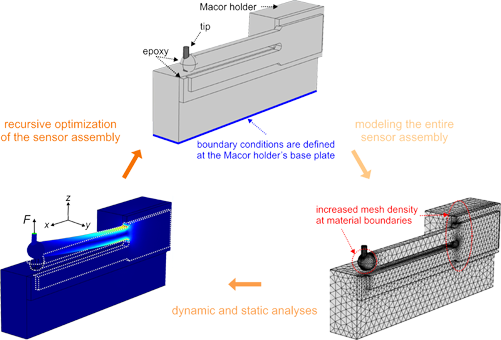
- values used for Young’s modulus E, the density ρ, Poisson’s ratio υ, and the damping coefficient η for all materials considered in the modeling, with values for quartz, epoxy glue, and Macor chosen as in [26] while the ones for gold and tungsten were taken from the material library of the simulation


Advances in the fabrication of graphene transistors on flexible substrates
Beilstein J. Nanotechnol. 2017, 8, 467–474, doi:10.3762/bjnano.8.50
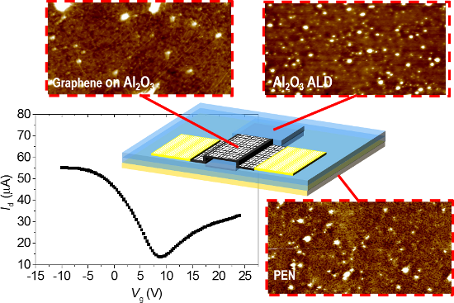
- , from consumer devices [3] to biomedical in vivo applications [4][5]. Among all the two-dimensional materials, graphene is one of the most appealing to be used as a flexible, conductive membrane, given its Young’s modulus on the order of TPa and large spring constant (1–5 N/m) [6]. Besides its high



Graphene–polymer coating for the realization of strain sensors
Beilstein J. Nanotechnol. 2017, 8, 21–27, doi:10.3762/bjnano.8.3
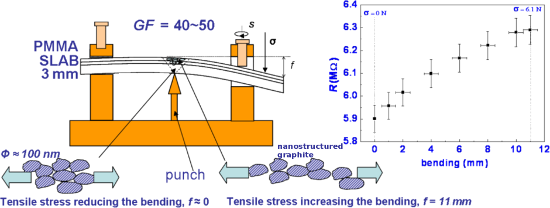
- corresponds to the maximum bending of the slat during the experiment. The force F was estimated by assuming E = 3.8 GPa for the Young’s modulus value of PMMA [12], and a moment of inertia Ics = wh3/12, where w = 0.02 m and h = 3 × 10 −3 m are the width and thickness of PMMA/graphene sample, respectively, and


When the going gets rough – studying the effect of surface roughness on the adhesive abilities of tree frogs
Beilstein J. Nanotechnol. 2016, 7, 2116–2131, doi:10.3762/bjnano.7.201
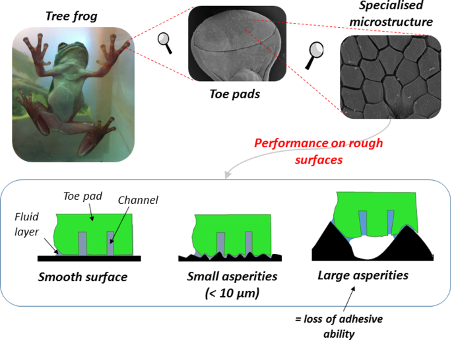
- difficult. The pads of tree frogs are very soft and so should deform to mould around rough surfaces, as is seen in smooth padded insects [17]. The Young’s modulus of the toe pads has been measured in several studies, an elastic modulus of 40–55 kPa based on AFM indentation being the most recent estimate [18
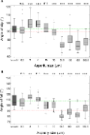
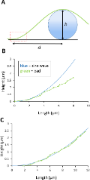
- known size, which can lead to estimates of the Young’s modulus of tree frog toe pads. A similar analysis was used by Lorenz et al. [35], who studied the influence of contamination particles on the adhesion of viscoelastic materials. Using interference reflection microscopy, which allows one to estimate




Effective intercalation of zein into Na-montmorillonite: role of the protein components and use of the developed biointerfaces
Beilstein J. Nanotechnol. 2016, 7, 1772–1782, doi:10.3762/bjnano.7.170
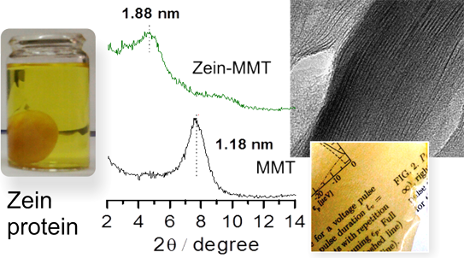
- . Similar results were observed in the STH/Z-MMT_S2 film, showing a Young’s modulus of 0.5 GPa, around twice that of the pristine starch film (0.2 GPa). This value is slightly higher than those reported for thermoplastic starch matrices reinforced by cationic starch-modified montmorillonite [27], probably
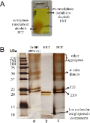
- separation in absolute ethanol, while the PCT phase was firstly solubilized in 80% (v/v) ethanol/water. The polyacrylamide gels at 20% were silver-stained for band visualization. Mechanical properties The mechanical properties, Young’s modulus (E) and elongation at break, of the bionanocomposite film samples




Nano- and microstructured materials for in vitro studies of the physiology of vascular cells
Beilstein J. Nanotechnol. 2016, 7, 1620–1641, doi:10.3762/bjnano.7.155
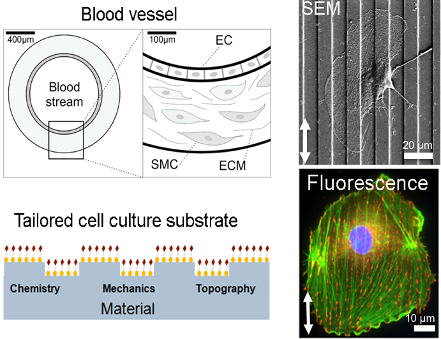
- and water content of the gel [114]. In the elastomer polymer, only the cross-linking density is varied. The stiffness of PDMS is modified by altering the ratio between monomer and curing agent, curing temperature, and curing time [114][115][166]. The Young’s modulus of PDMS can vary from 0.1 kPa [114



Biomechanics of selected arborescent and shrubby monocotyledons
Beilstein J. Nanotechnol. 2016, 7, 1602–1619, doi:10.3762/bjnano.7.154
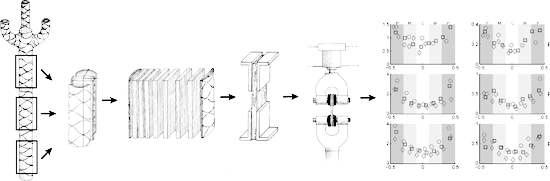
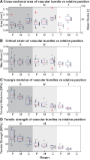
- , Young’s modulus and tensile strength of the vascular bundles in Dracaena marginata. These analyses allowed for generating a model for the mechanical interaction of tissues and vascular bundles of the stem in D. marginata as well as filling major “white spots” in property charts for biological materials
- (see below), the variations of the axial Young’s modulus and the tissue densities at different radial and axial positions are assessed (Figure 2B). On a second hierarchical level, the Young’s moduli and the tensile strengths of individual fibrous vascular bundles of D. marginata are investigated
- . marginata, secondary vessels (Figure 1C) are formed at the border between the central cylinder and the surrounding cortex. Results 1 Young’s modulus of five different monocotyledons Results for the Young’s modulus from experimental setup one (see paragraph 1 in section ’Experimental’) after measurements in



Fracture behaviors of pre-cracked monolayer molybdenum disulfide: A molecular dynamics study
Beilstein J. Nanotechnol. 2016, 7, 1411–1420, doi:10.3762/bjnano.7.132
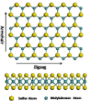
- ][12][13][14]. Jiang et al. [15] presented a parameterization of the Stillinger–Weber (SW) potential to describe the interatomic interactions within single-layer MoS2 (SLMoS2). And based on this potential, they studied chirality, size, and strain effects on the Young’s modulus and the thermal
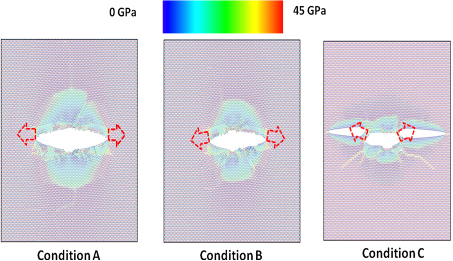
- fracture strength of pre-cracked MoS2 sheet is where E is Young’s modulus, γs is the surface energy and F(w,a,a) is a function depending on the geometry parameters as defined in Equation 2. In Equation 2 a denotes a half of crack length, w is a half of MoS2 sheet width, and α is the kink angle of crack tip
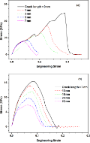
- . However, due to the significant difference between the fracture surface of different simulations, the surface energy varies dramatically (0.5–10 J/m2). With Young’s modulus calculated above and taking the surface energy of MoS2 sheet to be 5 J/m2 for calculating, the results obtained from three continuum




Influence of ambient humidity on the attachment ability of ladybird beetles (Coccinella septempunctata)
Beilstein J. Nanotechnol. 2016, 7, 1322–1329, doi:10.3762/bjnano.7.123
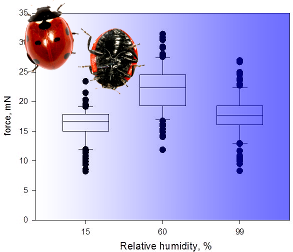
- high amounts of water [47]. Peisker et al. [46] showed a 6000-fold increase in the Young’s modulus of the setal tips after drying. Consequently, the degree of hydration should also significantly affect the mechanical properties of the setae of the beetles in the present study and may also explain our


On the pathway of cellular uptake: new insight into the interaction between the cell membrane and very small nanoparticles
Beilstein J. Nanotechnol. 2016, 7, 1296–1311, doi:10.3762/bjnano.7.121
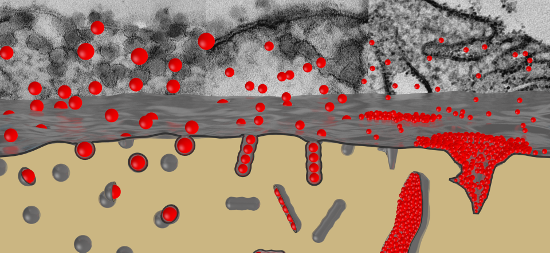
- with the membrane. It has also been observed lately in an experimental setup for polymersomes and silica NPs [15][34]. Here notably the diameter of the particles was larger but also other parameters differ from our investigation in live cells like, i.e., the Young’s modulus of the polymersomes was much




Functional diversity of resilin in Arthropoda
Beilstein J. Nanotechnol. 2016, 7, 1241–1259, doi:10.3762/bjnano.7.115
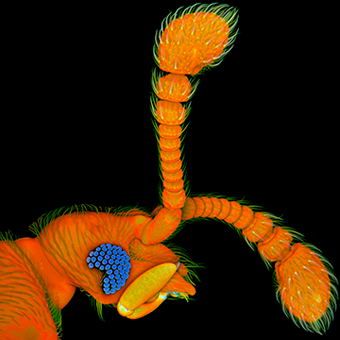
- polybutadiene [13][14]. Fully hydrated resilin has a rather low stiffness. In the elastic tendons of dragonflies and locust ligaments mentioned above, it was found to have a Young’s modulus of 0.6–0.7 MPa and 0.9 MPa, respectively [11]. In addition, fully hydrated resilin can be stretched to more than three
- reflected by gradients of the mechanical properties of the respective resilin-containing composites. The material composition of adhesive tarsal setae of beetles (Figure 2B) represents a good example for such gradients. Recently, the Young’s modulus of such setae was measured along the longitudinal axis of
- the setae (Figure 2C). The measurements revealed that the Young’s modulus of the material in the most distal section of each seta is relatively low (1.2 ± 0.3 MPa), whereas it is considerably higher at the setal base (6.8 ± 1.2 GPa). The differences in the Young’s modulus between different regions


Reasons and remedies for the agglomeration of multilayered graphene and carbon nanotubes in polymers
Beilstein J. Nanotechnol. 2016, 7, 1174–1196, doi:10.3762/bjnano.7.109
- ][49]. Loos et al. used different concentrations of acetone (0, 7, 10, 13 wt %) to produce epoxy samples [50]. They observed that fracture strain, tensile strength, and Young’s modulus significantly dropped, which was attributed to residual acetone. The degradation in mechanical properties was in


Generalized Hertz model for bimodal nanomechanical mapping
Beilstein J. Nanotechnol. 2016, 7, 970–982, doi:10.3762/bjnano.7.89
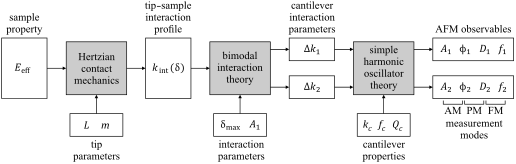
- theory presented in the following three sections. Methods Hertzian contact mechanics The Hertzian contact model involves the interaction stiffness kint versus indentation depth δ between a paraboloidal tip of radius R and a flat sample as where the effective Young’s modulus Eeff combines deformation of


![[Graphic 4]](/bjnano/content/inline/2190-4286-7-89-i40.png?max-width=637&scale=1.18182) approximation applied to Equation 6 i...
approximation applied to Equation 6 i...


Cantilever bending based on humidity-actuated mesoporous silica/silicon bilayers
Beilstein J. Nanotechnol. 2016, 7, 637–644, doi:10.3762/bjnano.7.56
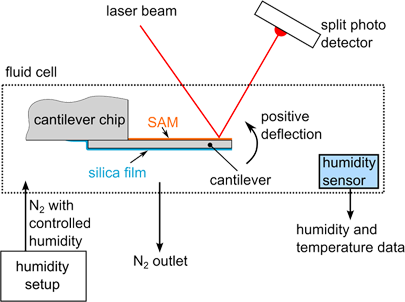
- strain and the cantilever deflection. If we have a reliable estimate for the Young’s modulus EF of the film, the expected deflection can be predicted from the experimentally measured strain (see Figure 4). However, EF is not known experimentally for our film. On the other hand, if we know both, the
- cantilever deflection and the sorption-induced strain from experiment, Equation 2 can be used to estimate the Young’s modulus of the porous film. Inserting the experimental values of δ and ε together with the other known parameters (Table 1) we obtain EF ≈ 5.0 GPa. Literature reports values of the order of
- 30–40 GPa for the bulk Young’s modulus in nanostructured amorphous silica systems [32][33]. If we assume quadratic scaling of the Young’s modulus with density [34], EF would be expected to be of the order of 12–16 GPa, which is higher by a factor of 2–3 than the value obtained from Equation 2. This


Correlative infrared nanospectroscopic and nanomechanical imaging of block copolymer microdomains
Beilstein J. Nanotechnol. 2016, 7, 605–612, doi:10.3762/bjnano.7.53
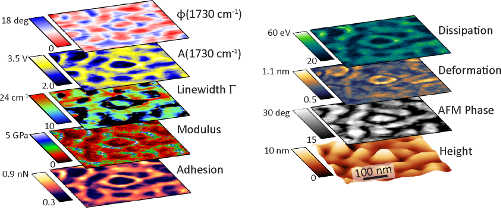
- regions, and 3–4 GPa in PS regions. These values of the DMT modulus [24] are closely related to the Young’s modulus, an intrinsic bulk material property of the sample. Measurements of Young’s modulus in polymers often exhibit considerable variation and nonlinearity [25]. However, our values generally
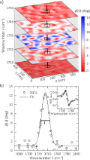
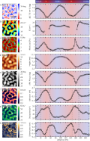


![[Graphic 9]](/bjnano/content/inline/2190-4286-7-53-i10.png?max-width=637&scale=1.18182) (1730 ...
(1730 ...
Nanoscale effects in the characterization of viscoelastic materials with atomic force microscopy: coupling of a quasi-three-dimensional standard linear solid model with in-plane surface interactions
Beilstein J. Nanotechnol. 2016, 7, 554–571, doi:10.3762/bjnano.7.49
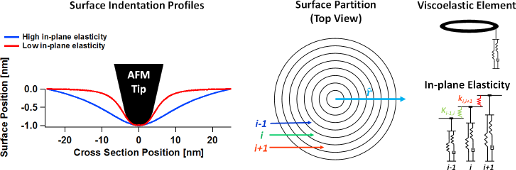
- -solid viscoelastic elements. The enhanced model introduces in-plane surface elastic forces that can be approximately related to a two-dimensional (2D) Young’s modulus. Relevant cases are discussed for single- and multifrequency intermittent-contact AFM imaging, with focus on the calculated surface
- ]. In these methods, the surface is modeled as a continuum material with a well-defined Young’s modulus, which interacts with a spherical AFM probe and is assumed to dissipate energy in proportion to the probe’s instantaneous velocity and depth of indentation. Here, an analytical description of the
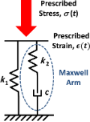
- techniques such as AFM. In contrast, the Young’s modulus is not an appropriate measure because it is not well defined in a dynamic measurement (especially as the strain oscillation frequency is increased), and because in the case of viscoelastic materials, the stress and strain are not related by a simple


Free vibration of functionally graded carbon-nanotube-reinforced composite plates with cutout
Beilstein J. Nanotechnol. 2016, 7, 511–523, doi:10.3762/bjnano.7.45
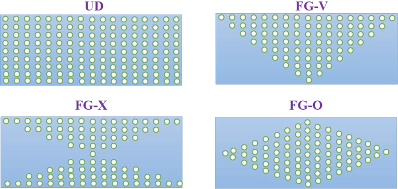
- approach may be modified with the introduction of the efficiency parameters. Under such modification, Young’s modulus and the shear modulus of the composite media take the form: In this formula, the properties of the CNT are denoted by a superscript CN and that those belong to matrix are denoted by a
- is free of CNTs and the top has the maximum volume fraction of CNTs. Unlike these three types, in the UD case, each surface of the plate has the same volume fraction of CNTs. Similar to the shear modulus and Young’s modulus, Poisson’s ratio and the mass density of the composite media may be written
- obtained in terms of strain components according to the following generalized Hook law as where the plane-stress stiffnesses of the plate are denote by Qij components (i,j = 1,2,4,5,6). These constants may be obtained in terms of the Poisson’s ratio, shear modulus and Young’s modulus of the composite plate


High-bandwidth multimode self-sensing in bimodal atomic force microscopy
Beilstein J. Nanotechnol. 2016, 7, 284–295, doi:10.3762/bjnano.7.26
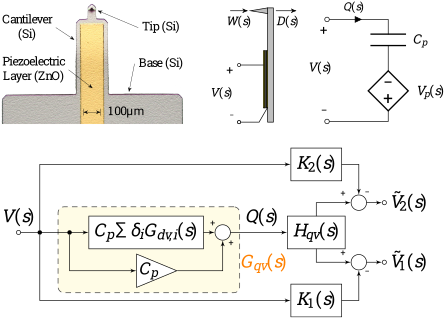
- the (3)-direction causes normal stress in the (1)-direction [21]. Then, the constitutive equations reduce to two scalar equations with Young’s modulus Y [N/m2], piezoelectric d [m/V] and dielectric ξ [F/m] material constants. The superscripts E and σ indicate that these constants are measured during
- ] where Ib and Yb are the moment of inertia and Young’s modulus of the beam and α(V) contains geometrical constants of the beam and the piezoelectric layer and is linear in the applied voltage. Thus, a voltage applied to the electrodes results in a bending moment causing the cantilever to deflect
- Young’s modulus, area moment of inertia, mass density and cross section of the beam respectively. A common approach to solve Equation 11 is the modal analysis approach. Here, it is assumed that the solution can be represented by separable space and time functions representing the mode shape Zk(x) and





