


Search results
Search for "antibacterial activity" in Full Text gives 81 result(s) in Beilstein Journal of Nanotechnology.
Effect of silver nanoparticles on human mesenchymal stem cell differentiation
Beilstein J. Nanotechnol. 2014, 5, 2058–2069, doi:10.3762/bjnano.5.214
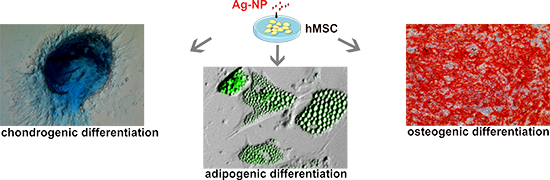
- of Duisburg-Essen, Universitaetsstr. 5-7, 45117 Essen, Germany 10.3762/bjnano.5.214 Abstract Background: Silver nanoparticles (Ag-NP) are one of the fastest growing products in nano-medicine due to their enhanced antibacterial activity at the nanoscale level. In biomedicine, hundreds of products


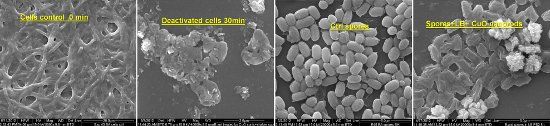
Antimicrobial properties of CuO nanorods and multi-armed nanoparticles against B. anthracis vegetative cells and endospores
Beilstein J. Nanotechnol. 2014, 5, 789–800, doi:10.3762/bjnano.5.91
- , generated on copper foil as effective antibacterial against E. coli bacteria when the bacterial suspension drop was tested on these surfaces. Perelshtein et al. [19] have reported antibacterial CuO-cotton textile against E. coli and S. aureus. Gao et al. [20] reported strong antibacterial activity of CuO
- nanostructures comparable to established antibiotics as well as their photocatalytic potential. However, we have not come across any report on bactericidal potential of CuO nanoparticles against B. anthracis cells and spores. The earlier findings inspired us to evaluate antibacterial activity of noncorrosive CuO
- the graph that PS2 NPs show higher a bactericidal action against non-sporogenic bacteria E. coli in comparison to B. anthracis vegetative cells. The probable reason is discussed later. Figure 3 represents the antibacterial activity of electrochemically synthesized CuO multi-armed NPs (P5) at two


An ultrasonic technology for production of antibacterial nanomaterials and their coating on textiles
Beilstein J. Nanotechnol. 2014, 5, 532–536, doi:10.3762/bjnano.5.62
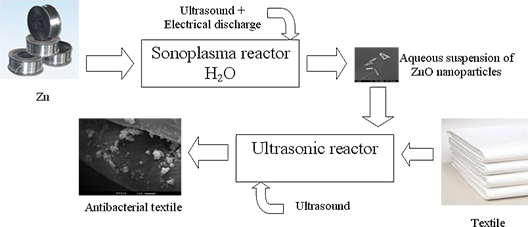
- the surface of textile at very high velocities. Fabrics coated with ZnO nanoparticles by using the developed method showed good antibacterial activity against E. coli. Keywords: antibacterial textile; cavitation; electrical discharge in liquid; nanoparticle; ultrasound; Introduction Currently, the
- analyse the antibacterial properties of the samples comparing their antibacterial activity and the antibacterial activity of samples coated with industrially produced NPs. In the research described in this paper we produced a suspension of zinc oxide NPs in water by using a sonoplasma discharge between
- treatment of textiles in a roll-to-roll mode [7] of operation was used to coat cotton fabrics with ZnO NPs. The testing results of the antibacterial activity of the coated fabric samples are reported and compared with the antibacterial activity of the fabric coated by using the same ultrasonic method [2][7


Photocatalytic antibacterial performance of TiO2 and Ag-doped TiO2 against S. aureus. P. aeruginosa and E. coli
Beilstein J. Nanotechnol. 2013, 4, 345–351, doi:10.3762/bjnano.4.40
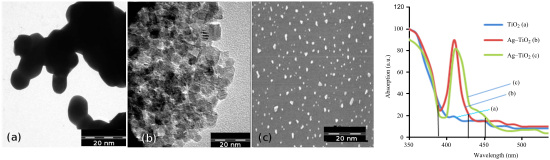
- indirect optical band gap of 3.2 eV, while the rutile phase has a direct band gap of 3.06 eV and an indirect one of 3.10 eV [7]. However, crude nanoparticles are amorphous in nature, with decreased surface area, and show a fast recombination rate of electrons and holes. Finally the antibacterial activity
- acid-catalyzed sol–gel technique. The prepared particles were characterized by X-ray diffraction (XRD), transmission electron microscopy (TEM), ultraviolet visible spectroscopy (UV–vis) and photoluminescence (PL). Furthermore, the antibacterial activity of the TiO2 and Ag-TiO2 nanoparticles were
- killing of the bacteria investigated here. The antibacterial activity of annealed samples is slightly more than crude TiO2, because after annealing at 450 °C the amorphous phase of the nanoparticle is converted to both anatase and rutile phases, and shows an indirect band gap of 3.2 eV, which is similar


Electrospinning preparation and electrical and biological properties of ferrocene/poly(vinylpyrrolidone) composite nanofibers
Beilstein J. Nanotechnol. 2013, 4, 189–197, doi:10.3762/bjnano.4.19

- model organisms. The nanofibers fabricated by this method showed obvious antibacterial activity. Electrochemical properties were characterized based on cyclic voltammetry measurements. The CV results showed redox peaks corresponding to the Fc+/Fc couple, which suggested that Fc molecules encapsulated
- a polymer provides different properties compared with applying Fc alone. The incorporation of Fc in a polymeric matrix can improve the dispersion of Fc, increasing the catalyst effect and antibacterial activity of hybrid nanofibers. However, the current reports mainly focus on the preparation and
- fibers became porous and the diameter obviously increased with the distribution ranging from 100 to 200 nm (Figure 1d). The high surface-to-volume ratio improved the antibacterial activity of the composite Fc/PVP nanofiber membrane. As seen from the presented SEM micrographs (Figure 1d), no Fc crystals


Paper modified with ZnO nanorods – antimicrobial studies
Beilstein J. Nanotechnol. 2012, 3, 684–691, doi:10.3762/bjnano.3.78
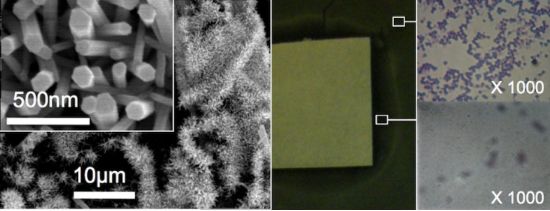
- and H2O2 are harmful to the cells of living organisms and are the major contributors to antibacterial activity [11][12][13]. ZnO nanoparticles are reported to have significant antifungal properties against B. cinerea and P. expansum, and the inhibitory effects were found to increase with an increase


Other Beilstein-Institut Open Science Activities



