


Search results
Search for "damping" in Full Text gives 196 result(s) in Beilstein Journal of Nanotechnology.
Influence of the thickness of an antiferromagnetic IrMn layer on the static and dynamic magnetization of weakly coupled CoFeB/IrMn/CoFeB trilayers
Beilstein J. Nanotechnol. 2018, 9, 2198–2208, doi:10.3762/bjnano.9.206
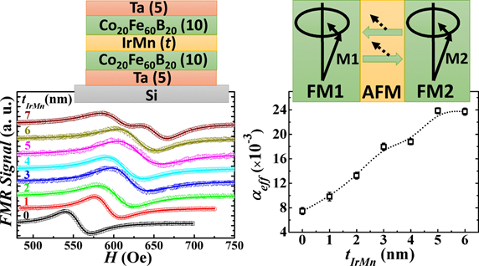
- that with the increase in IrMn layer thickness a nearly linear enhancement of the effective magnetic damping constant occurs, which is associated with the simultaneous influence of spin pumping and interlayer exchange coupling effects. An extrinsic contribution to the linewidth originating from the two
- -magnon scattering is also discussed. The AF-induced interfacial damping parameter is derived by studying the evolution of damping with inverse CoFeB thickness. The static magnetic measurements also reveal the interlayer exchange coupling across the IrMn layer both at room temperature and low temperature
- . Keywords: ferromagnetic resonance; interlayer exchange coupling; magnetic damping; magnetic thin films; spin pumping; Introduction Traditionally, antiferromagnets (AF) are known to play only a static role by pinning adjacent ferromagnetic (FM) layers via exchange bias in spin-valve devices [1]. Recently


Recent highlights in nanoscale and mesoscale friction
Beilstein J. Nanotechnol. 2018, 9, 1995–2014, doi:10.3762/bjnano.9.190
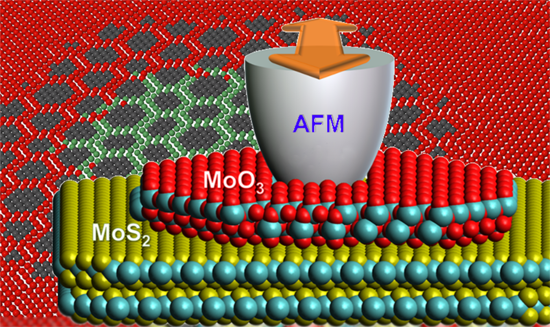
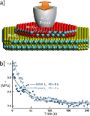
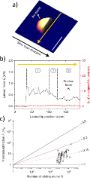
- devices in which wear is a critical issue. At separations of several nanometers one talks about the phenomenon of non-contact friction. At first sight, this type of dissipation appears rather academic. However, the fundamental damping mechanisms of friction, which relate the energy released after
- voltage and/or the distance [188][189][190][191][192]. An example of particular interest is that of charge-density waves (CDW) where a superstructure is formed by a charge redistribution. Langer et al. have observed that the damping coefficient can be drastically changed on NbSe2, when the probing tip is


Tailoring polarization and magnetization of absorbing terahertz metamaterials using a cut-wire sandwich structure
Beilstein J. Nanotechnol. 2018, 9, 1437–1447, doi:10.3762/bjnano.9.136
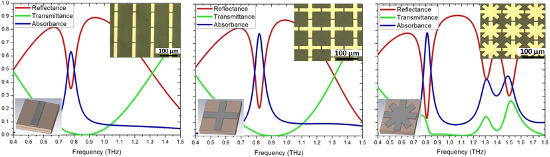
- × 1015 s−1. ω, ωp,Au and ΓAu are the angular frequency, angular plasma frequency of gold, and damping constant of gold, respectively. Figure 3 presents the reflectance–transmittance–absorbance (RTA) simulation result of cut-wire (Figure 3a), cross-shaped (Figure 3b) and star-shaped sandwich structures






Electrostatically actuated encased cantilevers
Beilstein J. Nanotechnol. 2018, 9, 1381–1389, doi:10.3762/bjnano.9.130
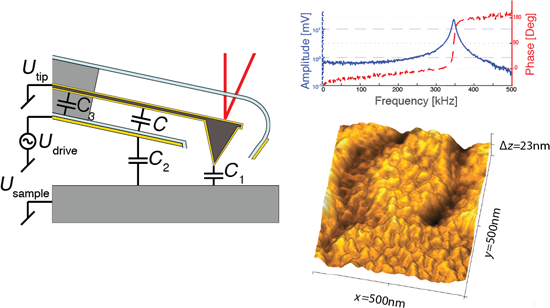
- Background: Encased cantilevers are novel force sensors that overcome major limitations of liquid scanning probe microscopy. By trapping air inside an encasement around the cantilever, they provide low damping and maintain high resonance frequencies for exquisitely low tip–sample interaction forces even when
- peaks include adding damping elements [5][6] or using alternative excitation methods such as resistive thermal [7][8], piezoelectric [9], electrostriction [10], or quartz-crystal tuning forks [11][12] that all solely excite the cantilever without inducing motion of the entire chip or the surrounding
- path remains very challenging. If the excitation electrode is approached too closely to the resonator, squeeze film damping or snap-in of the cantilever become another concern [24]. In our implementation with encased cantilevers these issues are solved by integrating the excitation electrode into the




Atomic-level characterization and cilostazol affinity of poly(lactic acid) nanoparticles conjugated with differentially charged hydrophilic molecules
Beilstein J. Nanotechnol. 2018, 9, 1328–1338, doi:10.3762/bjnano.9.126
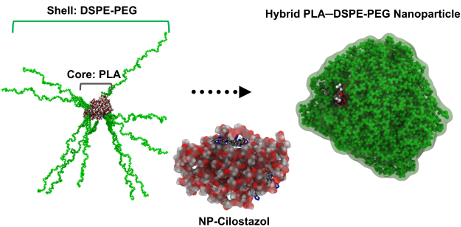
- the temperature with a damping of 100 timesteps. To corroborate the correct assembling methodology, several MD simulations of 100 ps were performed for 20, 40 and 80 PLA chains (Figure 1C). Data collected along the trajectories were used to calculate molecular properties such as a radius of gyration


Field-controlled ultrafast magnetization dynamics in two-dimensional nanoscale ferromagnetic antidot arrays
Beilstein J. Nanotechnol. 2018, 9, 1123–1134, doi:10.3762/bjnano.9.104
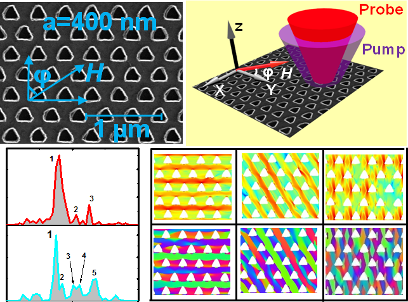
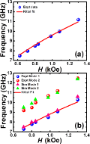
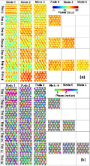
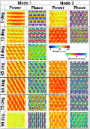
- Kittel formula, The exchange stiffness constant A is obtained from literature [39]. A pulsed field of peak value of 30 Oe, 10 ps rise/fall time and 20 ps pulse duration is used perpendicular to the sample plane, while a damping coefficient α = 0.008 is used during dynamic simulations. The experimentally



Scanning speed phenomenon in contact-resonance atomic force microscopy
Beilstein J. Nanotechnol. 2018, 9, 945–952, doi:10.3762/bjnano.9.87
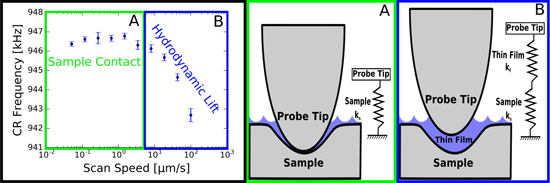
- stiffness is now a series combination of the fluid film stiffness kf and the material stiffness ks. There may also be additional damping effects introduced by the fluid film, which we would like to address in future research studies. For instance, it is known that the modulation of the tip–sample contact
- has an effect on the friction [18][19]. Furthermore, this effect depends on the scan speed and can bring the system from a stick–slip state to a “steady sliding” state above a critical velocity [18]. It is noted that “a small viscous damping contribution in the tip–sample contact is sufficient enough
- to suppress stick–slip oscillations” [18]. It may be possible that the thin film acts as a source of viscous damping that allows the system to achieve a “steady sliding” state, above a critical velocity, which may have an effect on the CR measurements. The hydrodynamic lift force F varies


Combined pulsed laser deposition and non-contact atomic force microscopy system for studies of insulator metal oxide thin films
Beilstein J. Nanotechnol. 2018, 9, 686–692, doi:10.3762/bjnano.9.63
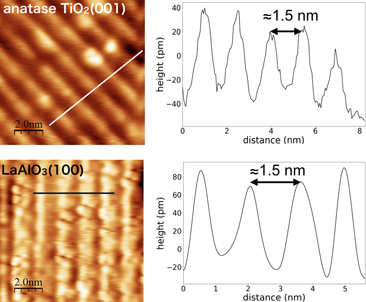
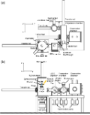
- same as in our previous studies [29][37][41][44][45][46][47][48]. To perform stable atomic resolution imaging in this chamber, a mechanism to fix the unit by double spring vibration isolation and eddy current damping [49] is provided, to prevent vibration noise. Therefore, it is possible to obtain


Review: Electrostatically actuated nanobeam-based nanoelectromechanical switches – materials solutions and operational conditions
Beilstein J. Nanotechnol. 2018, 9, 271–300, doi:10.3762/bjnano.9.29


Beyond Moore’s technologies: operation principles of a superconductor alternative
Beilstein J. Nanotechnol. 2017, 8, 2689–2710, doi:10.3762/bjnano.8.269

- quite analogous to the one for a mechanical pendulum with the moment of inertia (capacitance here is analogous to mass), the viscosity factor 1/ωc (resistance determines damping), and the applied torque I/Ic. This simple analogy allows to consider a superconducting digital circuit as a net of coupled


Patterning of supported gold monolayers via chemical lift-off lithography
Beilstein J. Nanotechnol. 2017, 8, 2648–2661, doi:10.3762/bjnano.8.265
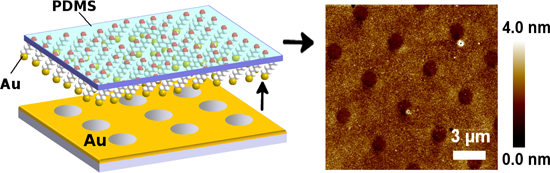
- energy of the system damping to the energy added due to pulling. Core-level shifts were calculated for the Au atoms in the modeled structures that were removed from surfaces in the simulations. The density functional theory with the PBE functional was used again via GPAW to calculate the energies of the


Laser-assisted fabrication of gold nanoparticle-composed structures embedded in borosilicate glass
Beilstein J. Nanotechnol. 2017, 8, 2454–2463, doi:10.3762/bjnano.8.244
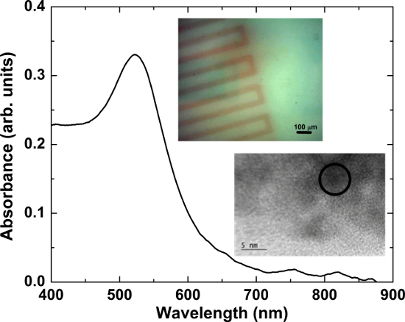
- influence of the particle size can be taken into account by a damping parameter modification [33] included in the expression of the dielectric function. Here γ is the damping parameter, and νF is the Fermi velocity. The values for γ0, and A are taken from [33]. The dielectric function and the corresponding


Material property analytical relations for the case of an AFM probe tapping a viscoelastic surface containing multiple characteristic times
Beilstein J. Nanotechnol. 2017, 8, 2230–2244, doi:10.3762/bjnano.8.223
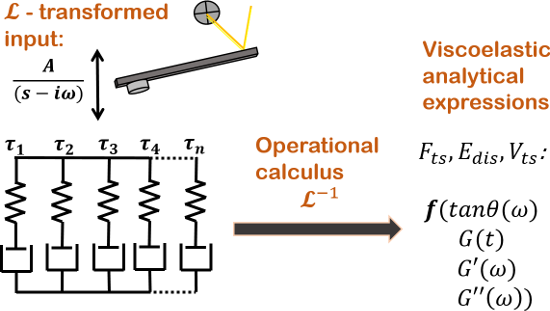
- negligible, but errors are expected in high-damping environments. Finally, we have not explored in detail the success of the analytical equations in terms of dynamic parameters (such as free amplitude and amplitude setpoint) but we have found in this exploratory study that typical tapping amplitudes (ca. 100


Velocity dependence of sliding friction on a crystalline surface
Beilstein J. Nanotechnol. 2017, 8, 2186–2199, doi:10.3762/bjnano.8.218
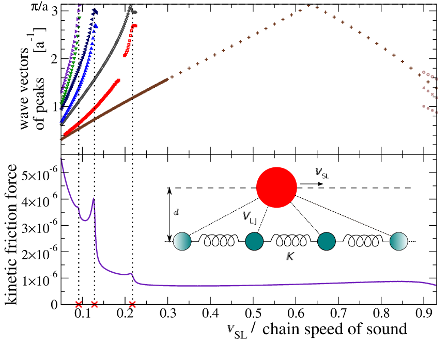
- damping term acting on the physical degrees of freedom of the model. Moreover, such damping terms, beside affecting the dynamics, are characterized by a damping rate γ whose value is left to the arbitrary choice of the researcher. Finite-temperature is often simulated in the standard Langevin scheme
- , where to the viscous term one adds suitable Gaussian-distributed random forces, whose amplitude, via the fluctuation–dissipation theorem, is also affected by the value of γ [19]. A few approaches try to get rid of the arbitrariness of damping terms, describing dissipation explicitly. Microcanonical
- conservative simulations, for example, can describe the energy transfer into internal vibrational energy omitting all unphysical damping terms altogether [20][21][22][23][24][25]. The disadvantage of this approach is that, due to the finite and relatively small number of degrees of freedom available in a


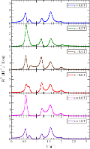

![[Graphic 31]](/bjnano/content/inline/2190-4286-8-218-i50.svg?max-width=637&scale=1.18182) as functions of vSL. Panels (c) and (d): detail ...
as functions of vSL. Panels (c) and (d): detail ...

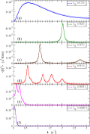
![[Graphic 34]](/bjnano/content/inline/2190-4286-8-218-i53.svg?max-width=637&scale=1.18182) , with the dynamic friction Fd as a function of vSL...
, with the dynamic friction Fd as a function of vSL...


![[Graphic 40]](/bjnano/content/inline/2190-4286-8-218-i59.svg?max-width=637&scale=1.18182) (symbols), compared with the values of k of the phonons who...
(symbols), compared with the values of k of the phonons who...


High-stress study of bioinspired multifunctional PEDOT:PSS/nanoclay nanocomposites using AFM, SEM and numerical simulation
Beilstein J. Nanotechnol. 2017, 8, 2069–2082, doi:10.3762/bjnano.8.207
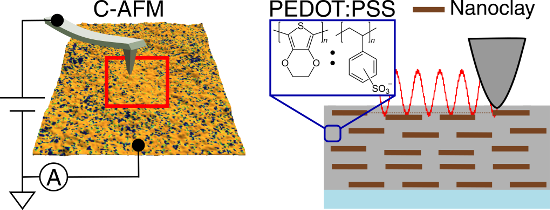
- free cantilever resonance frequency, is directly related to stiffness (larger stiffness leads to larger frequency and vice-versa) [49], while the quality factor maps the sample damping of the cantilever tip oscillation (greater dissipation leads to lower quality factor and vice-versa) [50]. The contact
- thick samples (Figure 2a), it follows the trend of the frequency for PPSS and LAP, but not for MTM. For the measured area, the quality factor for MTM is lower than for the other samples, translating into more damping. The damping comes either from the confined viscoelastic material (the polymer) trapped
- discussed, for thinner films the properties of the thin films are expected to be dominated by the morphology of PEDOT:PSS. In the case of the nanocomposites, the damping mechanisms are also dominated by the polymer (since the clays are comparatively incompressible), and hence the quality factor is very


Adsorbate-driven cooling of carbene-based molecular junctions
Beilstein J. Nanotechnol. 2017, 8, 2060–2068, doi:10.3762/bjnano.8.206
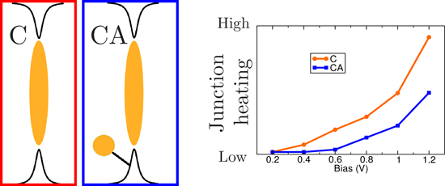
- junctions anchored to Au(100) electrodes [28]. We reported a strong dependence of transport properties on the atomistic structure of the metal/molecule interface and analyzed its implications on the current-induced damping and excitation of localized molecular vibrations [29]. We considered the case of a
- population of vibrational mode λ (excluding anharmonic coupling between vibrational modes) is [36][37][38]: where the coupling of vibrations to tunneling electrons and to bulk phonons are both taken into account. The parameter describes the damping of molecular vibrations with bulk phonons in the left (L
- –vibration couplings and the left and right spectral densities: In our analysis the damping term Jλ in Equation 1 is introduced as an external parameter. We assume a constant damping of vibrational modes into bulk phonons of Jλ/2 = JL = JR = 5 × 10¹⁰ Hz. In the following we thus omit the label λ in the


![[Graphic 14]](/bjnano/content/inline/2190-4286-8-206-i21.png?max-width=637&scale=1.18182) = 176 meV as a function of applied bias for the C and CA junctions, a...
= 176 meV as a function of applied bias for the C and CA junctions, a...

Stick–slip boundary friction mode as a second-order phase transition with an inhomogeneous distribution of elastic stress in the contact area
Beilstein J. Nanotechnol. 2017, 8, 1889–1896, doi:10.3762/bjnano.8.189
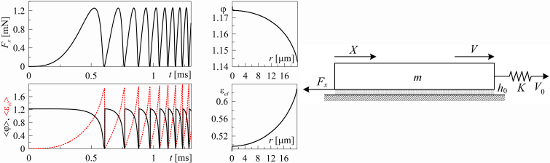
- to the data from Figure 2a and Figure 4a. As it can be seen from Figure 5, Fx(X) is periodical (with damping oscillations in the second case, as the amplitude of the friction force decreases in time due to the heating of the lubricant). The presented dependencies have a regular form in contrast to


![[Graphic 15]](/bjnano/content/inline/2190-4286-8-189-i33.png?max-width=637&scale=1.18182) = 1.0, ...
= 1.0, ...


Scaling law to determine peak forces in tapping-mode AFM experiments on finite elastic soft matter systems
Beilstein J. Nanotechnol. 2017, 8, 968–974, doi:10.3762/bjnano.8.98
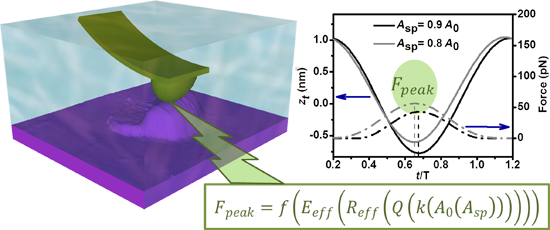
- approximations have not been designed to describe the forces for finite soft-matter systems in highly damping environments. In this article we use the term soft matter to describe polymeric surfaces and/or biological systems (isolated or packed arrays of proteins) with Young moduli in the range of 30–300 MPa [11
- these theoretical approximations have been applied to derive a parametrical equation for determining the peak force based on the addition of repulsive Hertzian and attractive van der Waals interactions in low-damping environments [21]. Here we have conceived a multivariate regression analysis to obtain


Near-field surface plasmon field enhancement induced by rippled surfaces
Beilstein J. Nanotechnol. 2017, 8, 956–967, doi:10.3762/bjnano.8.97
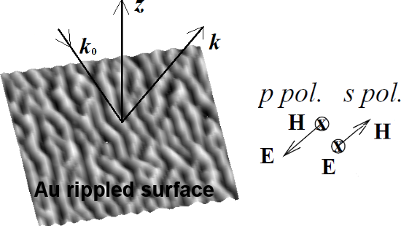
- localized with localization centers on the nanogaps. It is well known that as a surface plasmon approaches a narrow gap, its group velocity decreases and its electric field increases. Let us treat the plasmons as damped harmonic oscillators linearly coupled and with damping rate γ(t) and ω(t) as the
- changes its parameters in space [53], while the QNM frequency is supposed to change monotonically with a decay rate . If both ξ and γ are constants, the time-dependent plasmon amplitude E(r,t) is now proportional to e(ξ−γ)t with a competition between the frequency decay rate ξ and the damping rate γ. If ξ


Bio-inspired micro-to-nanoporous polymers with tunable stiffness
Beilstein J. Nanotechnol. 2017, 8, 906–914, doi:10.3762/bjnano.8.92
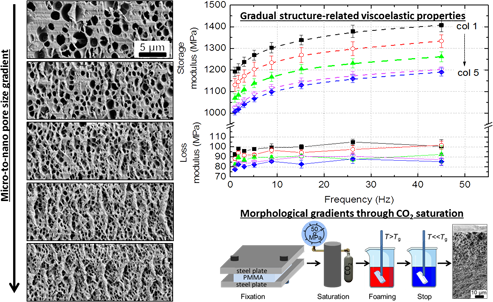
- overall damping capability of the material. All tests were conducted at room temperature (25.5 °C) under ambient conditions. The measurements were performed at 20 different positions arranged in an array of 5 by 4 (see below in Figure 2b). Results and Discussion Porous PMMA films were produced via a
- thickness. The damping capability at room temperature is dominated rather by the material than the structure. Similar findings were reported for nanoporous PMMA with a relative density of 40% and pore sizes of approx. 200 nm and approx. 300 nm [21]. The mechanical properties of a foam usually depend on the
- foam, as can be seen in Figure 5a. This results in a loss factor that does not depend on the pore size, but rather reflects the damping capability of PMMA (Figure 5b). The decreasing storage modulus might also be caused by a partial damage of PMMA material and the shortening of the polymeric chains. In


Optimizing qPlus sensor assemblies for simultaneous scanning tunneling and noncontact atomic force microscopy operation based on finite element method analysis
Beilstein J. Nanotechnol. 2017, 8, 657–666, doi:10.3762/bjnano.8.70
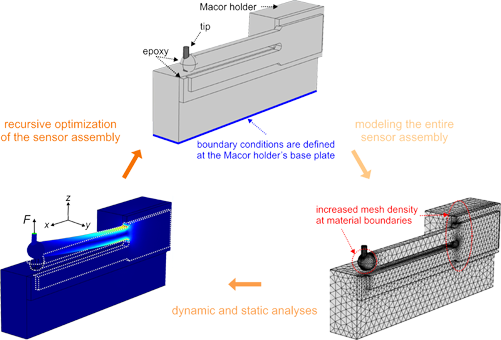
- values used for Young’s modulus E, the density ρ, Poisson’s ratio υ, and the damping coefficient η for all materials considered in the modeling, with values for quartz, epoxy glue, and Macor chosen as in [26] while the ones for gold and tungsten were taken from the material library of the simulation
- software [27]. Also note that (i) due to the comparatively low internal damping occurring inside Macor, gold, and tungsten, we do not assign a damping coefficient to any of these materials to speed up the calculations, and that (ii) the sensor is oscillating in vacuum; for experimentation in air, we would
- have to expect considerable additional viscous damping [28]. The model setup used for the FEM calculations is illustrated in Figure 1a. As in the earlier model of [26], boundary conditions for determining spring constant, quality factor, resonance frequency, and perturbation of the ideal vertical


Multimodal cantilevers with novel piezoelectric layer topology for sensitivity enhancement
Beilstein J. Nanotechnol. 2017, 8, 358–371, doi:10.3762/bjnano.8.38
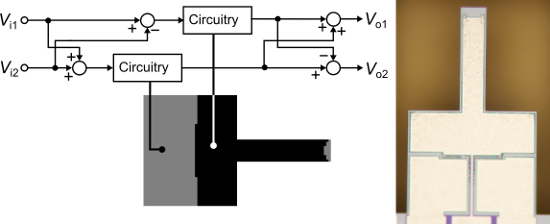
- was shown that these higher modes can be more sensitive to material properties such as elastic modulus and damping coefficients [17][18][19]. Additionally, stiff cantilevers have proven to provide high resolution imaging in ambient and liquid environments using quartz resonators [20][21]. Traditional


Optical and photocatalytic properties of TiO2 nanoplumes
Beilstein J. Nanotechnol. 2017, 8, 190–195, doi:10.3762/bjnano.8.20
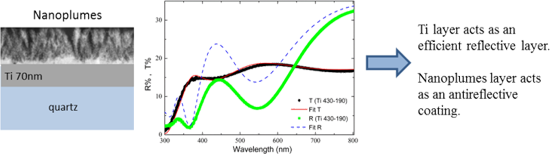
- reflectance spectrum of the titanium layer before the chemical etching. We assumed that the functional form for the dielectric constant of the metallic film is given by the “Drude free carrier” expression [26]: where ω, ωP, γ and ε∞ are, respectively, the light frequency, the plasma frequency, the damping
- using a Forouhi–Bloomer (FB) functional form for amorphous samples [27][28][29]: where and Θ(ω − ωg) is a step function, ωg is the energy gap of the amorphous material, n∞, A, ω0, Γ are the “low-frequency” refractive index, the amplitude, the position, and the damping constant of the FB oscillator


Tunable plasmons in regular planar arrays of graphene nanoribbons with armchair and zigzag-shaped edges
Beilstein J. Nanotechnol. 2017, 8, 172–182, doi:10.3762/bjnano.8.18
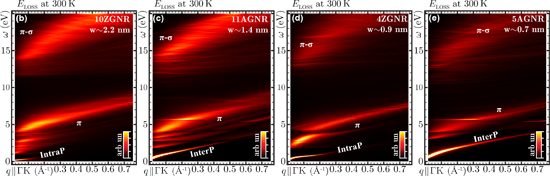
- in energy, with the zeroes of the real permittivity being hidden by the Landau damping mechanism, associated to single-particle excitation processes [25][46][47][48]. In 11AGNR the same modes strongly interfere and largely dominate with respect to single-particle excitations. A similar interplay was
- ). The energy region ω ≤ 1 eV is explored at a fixed incident momentum q = 0.011 Å−1 parallel to ΓX (Figure 2g), with a negative doping level ΔEF of −0.1 eV. The black arrows mark the positions where the real permittivity has a zero value (a–c) or a minimum (d), which reflects a Landau damping mechanism


![[Graphic 8]](/bjnano/content/inline/2190-4286-8-18-i16.png?max-width=637&scale=1.18182) , Equation 6) and EL function (ELOSS, Equation 8) at room temperature for the GNR arrays of Figure 1 ...
, Equation 6) and EL function (ELOSS, Equation 8) at room temperature for the GNR arrays of Figure 1 ...

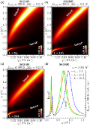
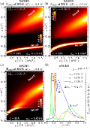
Electron energy relaxation under terahertz excitation in (Cd1−xZnx)3As2 Dirac semimetals
Beilstein J. Nanotechnol. 2017, 8, 167–171, doi:10.3762/bjnano.8.17
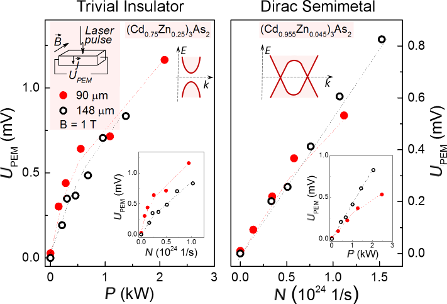
- that such behavior is attributed to a strong damping of the interelectron interaction in the Dirac semimetal phase compared to the trivial semiconductor, which may be due to the formation of surface electron states with a spin texture in Dirac semimetals. Keywords: Dirac semimetal; photo





