


Search results
Search for "grafting" in Full Text gives 106 result(s) in Beilstein Journal of Nanotechnology.
Entropy effects in the collective dynamic behavior of alkyl monolayers tethered to Si(111)
Beilstein J. Nanotechnol. 2015, 6, 583–594, doi:10.3762/bjnano.6.60
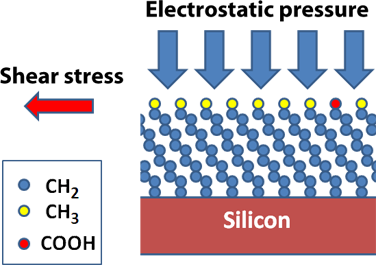
- analysis indicates better short-range order (along with weaker motional constraints) for gauche defects as compared with end-group dipoles. Experimental Covalent immobilization of mixed alkyl/acid OML Covalent OML grafting was performed on hydrogen-terminated Si(111):H surfaces using linear alkene
- Rennes 1) is acknowledged for molecular grafting experiments. The author is also grateful to A.B. Fadjie-Djomkam and S. Ababou-Girard (IPR, University of Rennes 1) for their participation in the admittance measurements. Top: the electrostatic pressure resulting from a dc voltage drop on the insulating




Synthesis of boron nitride nanotubes and their applications
Beilstein J. Nanotechnol. 2015, 6, 84–102, doi:10.3762/bjnano.6.9
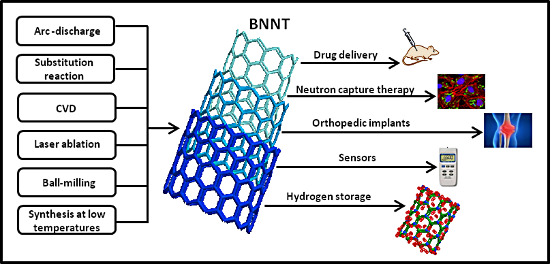
- of nanomedicine. The covalent grafting of BNNTs with human transferrin, linked through a carbamide bond, was reported [67]. The transferrin–BNNTs were tested on primary human umbilical vein endothelial cells (HUVECs) to investigate their cellular uptake. It was concluded that the functionalization of




Formation of stable Si–O–C submonolayers on hydrogen-terminated silicon(111) under low-temperature conditions
Beilstein J. Nanotechnol. 2015, 6, 19–26, doi:10.3762/bjnano.6.3
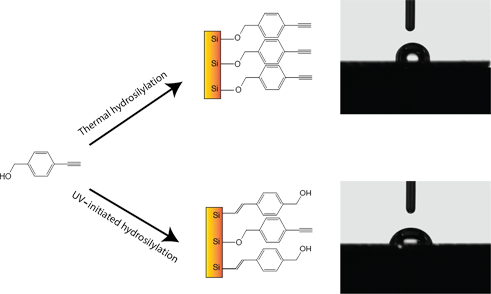
- facilitating the grafting reaction of the molecule through the alkyne end, in turn, forming a stable Si-C linkage. On the other hand, a trifluoroalkyne was also selected to demonstrate the viability of the hydrogen abstraction model by observing the nature of the linkage formed considering that this molecule
- surface via a nucleophilic route from the hydrogen-terminated surface during low-temperature hydrosilylation. It is envisaged that at low temperatures (<150 °C), the Si–C bonds at the surface are not cleaved to form radicals. Thus, in order for surface grafting to form Si–C linkages, it is necessary for
- the hydrogen to be abstracted from the surface via oxygen species present in solution (Figure 1). In our deliberate thermal setup, there is also the possibility of grafting via Si–O–C linkages instead of the nominal Si–C linkages typically associated with thermal hydrosilylation. However, we envisage


Poly(styrene)/oligo(fluorene)-intercalated fluoromica hybrids: synthesis, characterization and self-assembly
Beilstein J. Nanotechnol. 2014, 5, 2450–2458, doi:10.3762/bjnano.5.254
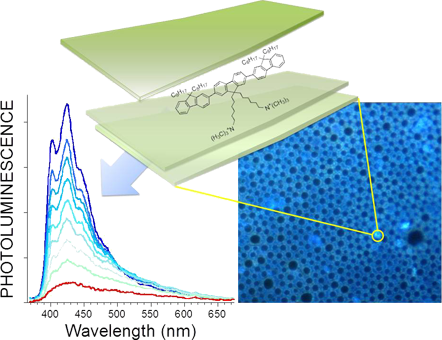
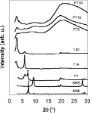
- ) expandable interlayer space. The combination of these features permits the easy tuning of the interaction between the emitting centers by surface chemistry (i.e., ion-exchange and grafting reactions), and a sandwich-type intercalation. In particular, the intercalation of functional molecular species within




Nanoparticle interactions with live cells: Quantitative fluorescence microscopy of nanoparticle size effects
Beilstein J. Nanotechnol. 2014, 5, 2388–2397, doi:10.3762/bjnano.5.248
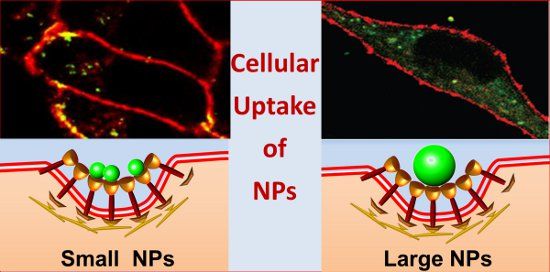
- ) with receptor targets anchored in the cell membrane (Figure 5). The number of available ligands depends on the ligand grafting density on the NP but also on the NP curvature. Receptor-mediated endocytosis is a complicated process that can be facilitated by a variety of proteins such as clathrin or


Inorganic Janus particles for biomedical applications
Beilstein J. Nanotechnol. 2014, 5, 2346–2362, doi:10.3762/bjnano.5.244
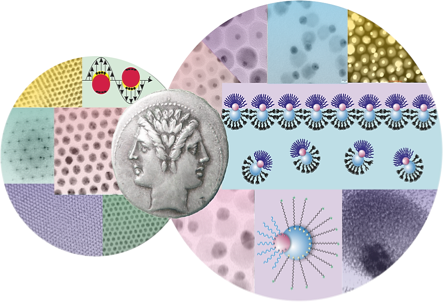
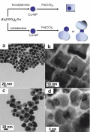
- exchange and covalent grafting of catechol ligands. Up to now, large technical applications of Janus particles are restricted by the lack of accessibility. Therefore, polymer-modified kaolinite provides the enormous advantage as an abundant, ubiquitous, and inexpensive mineral, which can be used as






Anticancer efficacy of a supramolecular complex of a 2-diethylaminoethyl–dextran–MMA graft copolymer and paclitaxel used as an artificial enzyme
Beilstein J. Nanotechnol. 2014, 5, 2293–2307, doi:10.3762/bjnano.5.238
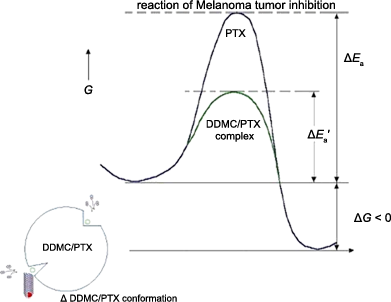
- through grafting MMA onto DEAE–dextran as the backbone polymer by using a tetravalent ceric salt [14]. It generates a polymer micelle that forms a microphase-separated structure with a hydrophilic domain for the DEAE–dextran part and a hydrophobic domain for the graft polymer PMMA. When the transfection
- rate of DEAE–dextran (grafting rate 0%) and DDMC was compared by using a reporter gene (β-galactosidase) in HEK293 cells (Figure 1a), DDMC (grafting rate 130%) exhibited a remarkable increase in the transfection rate [15]. The stabilization effect of DDMC can be understood with respect to the
- nano-level. Infrared absorption spectrum of the supramolecular DDMC/PTX complex The infrared absorption spectra of DDMC (grafting rate: 102%), DDMC/PTX complexes, and PTX in the range of 3200–3700 cm−1 are shown in Figure 3a. The large and broad absorption due to the stretching vibration of N–H, O–H


Influence of the supramolecular architecture on the magnetic properties of a DyIII single-molecule magnet: an ab initio investigation
Beilstein J. Nanotechnol. 2014, 5, 2267–2274, doi:10.3762/bjnano.5.236
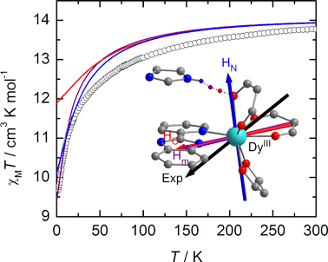
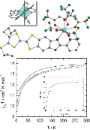
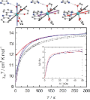
- well-known architecture [23][24] that can be optimized for grafting [25][26] the magnetic properties of the molecular object can be kept at the surface [27][28]. This is a tremendous breakthrough in magnetic molecular science that opens the way to molecular surface magnetometry [29]. However, in a
- “core-shell” picture, where the core is the magnetic ion and the shell its organic surrounding, shell deformation upon grafting can drastically impact the properties of the molecule. A good example is Tb-phthalocyanine molecule, which is one of the most efficient SMM [30]. Depending on the surface and
- the grafting or deposition mode [25][31][32][33], it can show erratic hysteresis and even some depth- dependence of the magnetic behavior when multilayers are considered [34]. In order to overcome these drawbacks and to understand their origin, many studies have been undertaken on single-crystals to


Hybrid spin-crossover nanostructures
Beilstein J. Nanotechnol. 2014, 5, 2230–2239, doi:10.3762/bjnano.5.232
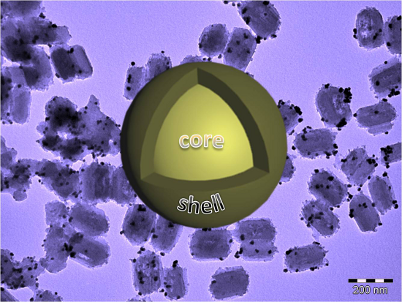
- polymer [Fe(Htrz)2(trz)](BF4) (Htrz = 1,2,4-triazole and trz = 1,2,4-triazolato), known to show a memory effect above room temperature [22], and SiO2 shell grown around it. The use of silica is of great interest because of its high porosity and the possibility of grafting other functionalities onto its
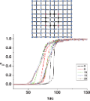
- from magnetic studies. Consequently, the authors affirm that the grafting process did not significantly affect either the morphology or the magnetic properties of the NPs. In this system, the luminescent signal from the dansyl is quenched by the Fe(II) low-spin state (LS) centers of the coordination



In situ metalation of free base phthalocyanine covalently bonded to silicon surfaces
Beilstein J. Nanotechnol. 2014, 5, 2222–2229, doi:10.3762/bjnano.5.231
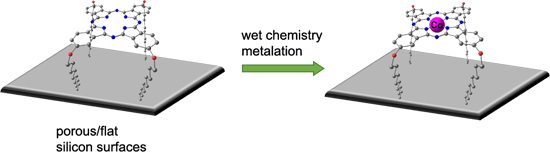
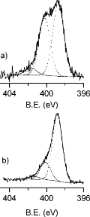
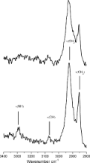
- , covalent grafting on H-terminated silicon through hydrosilylation reaction has the advantage to form robust and highly stable Si–C bonds. For this reason, a device based on silicon-grafted molecules possesses a much greater robustness and reliability compared to van der Waals films or Au-bonded layers
- atoms [19][20]. However, no report of the direct metalation of covalently bonded Pc on inorganic surfaces has been reported, yet. In this work we study the silicon grafting of the tetra-4-(ω-undecenyloxy)phthalocyanine (thereafter 1-Pc) (Figure 1) and its interaction with a silicon surface. 1-Pc was
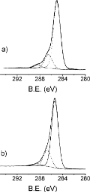
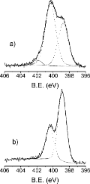
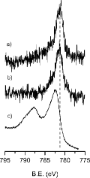
- synthesized to allow for a silicon grafting by functionalization with four undecenyl chains each having a terminal double bond. Phthalocyanine covalent anchoring was performed through thermic hydrosilylation on flat Si(100) and on porous silicon (Si-1-Pc and PSi-1-Pc, respectively). The success of the

Towards bottom-up nanopatterning of Prussian blue analogues
Beilstein J. Nanotechnol. 2014, 5, 1933–1943, doi:10.3762/bjnano.5.204
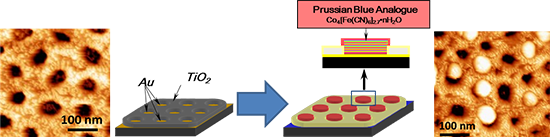
- PBA outside the nanoperforations, the TiO2 surface was passivated by grafting with hydrophobic groups. The sample was placed in a solution of phenylphosphonic acid (3·10−3 M) in an ethanol/water mixture (3:1 EtOH/H2O) for 12 h. The film was rinsed with EtOH and acetone and allowed to dry at 120 °C for
- adsorption of PBA precursors. The phosphonate function allows for the selective grafting of the phenyl group on TiO2 [20][21]. Then, MHA, 4-MPy or 4-ATP are used as coupling agents for anchoring a first layer of Co2+ ions at the bottom of the nanoperforations. To evaluate the efficiency of the TiO2
- still remains. The grafting of the gold surface with MHA therefore was successful. The effect of the functionalized gold layer at the bottom of the perforations on the growth of PBA is nicely illustrated by a SEM image of the film exhibiting areas with and without gold after PBA growth. PBA particles


The surface properties of nanoparticles determine the agglomeration state and the size of the particles under physiological conditions
Beilstein J. Nanotechnol. 2014, 5, 1774–1786, doi:10.3762/bjnano.5.188
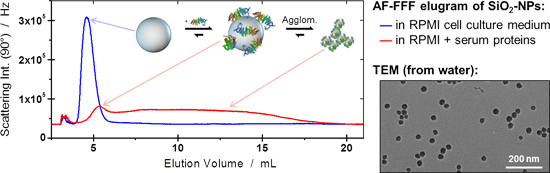
- with ethyl iodide and 2-iodoethanol yielding the quaternized particles POS-NH2Q1 and POS-NH2Q2. Alternatively, the amine groups can be used for grafting reactions with polymers in a “grafting onto” approach leading to a shift of the stabilization mechanism towards steric stabilization. Hence, a carboxy


Non-covalent and reversible functionalization of carbon nanotubes
Beilstein J. Nanotechnol. 2014, 5, 1675–1690, doi:10.3762/bjnano.5.178
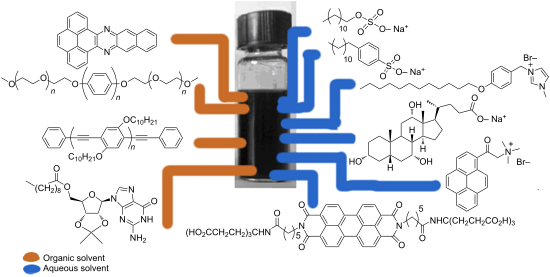
- ] cyclopropanation [29], radical additions via diazonium salts [30][31] grafting of polymers. Nevertheless the creation of novel covalent bonds disrupt the sp2 network of non-derivatized CNTs and may thus alter their inherent properties [30][32]. The prospect of functionalizing CNTs outer surface via non-covalent



Donor–acceptor graphene-based hybrid materials facilitating photo-induced electron-transfer reactions
Beilstein J. Nanotechnol. 2014, 5, 1580–1589, doi:10.3762/bjnano.5.170
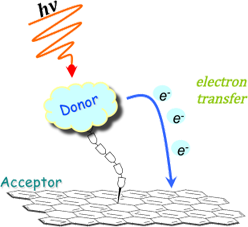
- storage. On similar grounds, rGO was initially modified by phenylacetylene units, which were used to mediate the grafting of zinc–porphyrin (ZnP) and ruthenium–phenanthroline (RuP) chromophores through a copper-catalyzed “click” chemistry reaction [52]. The preparation of the RuP–rGO hybrid material is
- approach, the covalent grafting of (2-aminoethoxy)(tri-tert-butyl)phthalocyanine zinc (ZnPc) to exfoliated graphene sheets via direct nucleophilic addition of primary amines was accomplished (Figure 5) [57]. The ZnPc–graphene hybrid material was extensively characterized by complementary spectroscopic
- important role of the covalent grafting of ZnPc onto the graphene sheet for enhancing the photo-induced electron-transfer phenomena and achieving higher IPCE values as compared to non-covalently interacting ZnPc [58], or ZnPc-functionalized (phenylene vinylene) oligomers [59]. In the second strategy


A sonochemical approach to the direct surface functionalization of superparamagnetic iron oxide nanoparticles with (3-aminopropyl)triethoxysilane
Beilstein J. Nanotechnol. 2014, 5, 1472–1476, doi:10.3762/bjnano.5.160
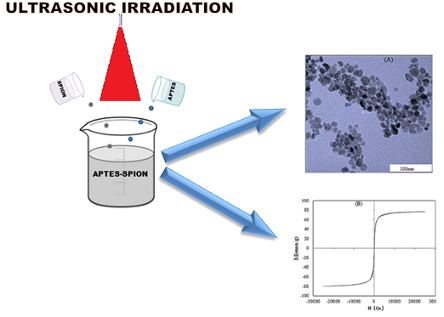
- an acoustic cavitation (sonochemical) process were found to induce a rapid silanization reaction between SPION and APTES. FTIR, XPS and XRD measurements were used to demonstrate the grafting of APTES on SPION. Compared to what was reported in literature, the results showed that the silanization
- silanol groups to form siloxane (Si–O–Si) bonds. The successful grafting of the APTES molecules on the SPION is verified through FTIR analysis (Figure 1). In both spectra, the peaks of the magnetite (Fe–O–Fe) band split into two. The energy absorbed at 628 and 573 cm−1 corresponds to the first band. The
- the SPION. The ionic states of these elements demonstrate the successful grafting of APTES on the SPION. The various curve fitting graphs for the ionic state of each element are presented in Supporting Information File 1. The two peaks in the Si 2p curve fitting (Supporting Information File 1, Figure


Nanoporous composites prepared by a combination of SBA-15 with Mg–Al mixed oxides. Water vapor sorption properties
Beilstein J. Nanotechnol. 2014, 5, 1226–1234, doi:10.3762/bjnano.5.136

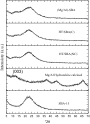
- that preserve the textural SBA-15 properties and also the basic properties. Indeed, Mg–Al precursors are homogenously dispersed mainly on the mesoporous SBA-15 surface. Furthermore, if the SBA-15 still contains surfactant (i.e., not calcined), the grafting through the HT coprecipitation of metal salts



Cyclodextrin-poly(ε-caprolactone) based nanoparticles able to complex phenolphthalein and adamantyl carboxylate
Beilstein J. Nanotechnol. 2014, 5, 651–657, doi:10.3762/bjnano.5.76
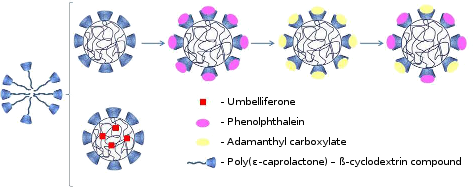
- studied and used is poly(ε-caprolactone), a linear aliphatic polyester, obtained by ring-opening polymerization of ε-caprolactone. Poly(ε-caprolactone) was used in several combinations, including click reaction products. Functionalized polyester was obtained, which was further used for grafting β-CD on it


Chemi- vs physisorption in the radical functionalization of single-walled carbon nanotubes under microwaves
Beilstein J. Nanotechnol. 2014, 5, 537–545, doi:10.3762/bjnano.5.63
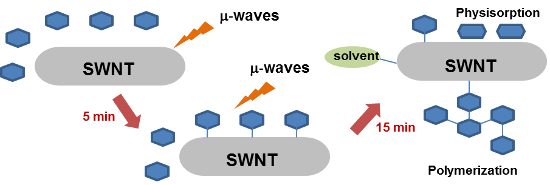
- of reaction under microwaves. Several chemical mechanisms of grafting could be identified, and it was possible to distinguish conditions leading to the desired chemical grafting from those leading to undesired reactions such as physisorption and polymerization. Keywords: carbon nanotubes; covalent
- functionalization; grafting; microwaves; physisorption; Introduction Carbon nanotubes (CNTs) are recognized to have a huge potential in a variety of applications such as electronics, composite materials, energy storage and medicine [1][2][3][4]. From bulk synthesis method, CNTs are often entangled contingent upon
- physisorbed at the sample surface, and ii) the high temperature range (above 200 °C) which typically involves the detachment of covalently functional groups. For the latter, the corresponding functionalization level n considering the exclusive grafting of chlorophenyl groups was determined by using Equation 2




Nanoscale patterning of a self-assembled monolayer by modification of the molecule–substrate bond
Beilstein J. Nanotechnol. 2014, 5, 258–267, doi:10.3762/bjnano.5.28
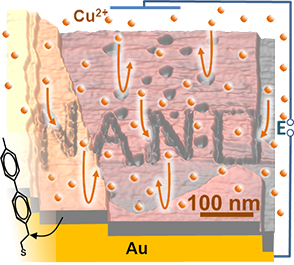
- -controlled reductive desorption of the thiol in areas that are not modified by Cu-UPD followed by the adsorption of a second thiol. As such it is a negative resist technique and, thus, complementary to other lithography based schemes such as grafting [35], in which the replacement takes place in the written


New hybrid materials based on poly(ethyleneoxide)-grafted polysilazane by hydrosilylation and their anti-fouling activities
Beilstein J. Nanotechnol. 2013, 4, 671–677, doi:10.3762/bjnano.4.75
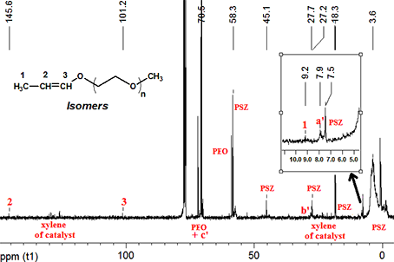
- kinetics and yields of this reaction have been surveyed by 1H and 13C NMR spectroscopy. The PEO grafting-density onto PSZ by hydrosilylation increases with a reduction of the S–H/allyl ratio and a decrease of the PEO chain-length. The PEO-graft-PSZ (PSZ-PEO) hybrid coatings, which can be used to prevent
- anti-fouling activity of the coatings depends on the grafting density and the chain length of PEO. The shortest PEO(350 g/mol)-graft-PSZ with the highest graft density was found to have the best anti-fouling activity. As the density of grafted PEO(750 g/mol) and PEO(2000 g/mol) chains onto the PSZ
- reducing bio-adhesion, i.e., protein adsorption, or the adhesion of bacteria and cells. The environmentally friendly coatings obtained by the grafting of PEO onto PSZ are a promising way to prevent the deposition of marine fouling materials onto the hulls of ships [6]. Several factors have been





Site-selective growth of surface-anchored metal-organic frameworks on self-assembled monolayer patterns prepared by AFM nanografting
Beilstein J. Nanotechnol. 2013, 4, 638–648, doi:10.3762/bjnano.4.71
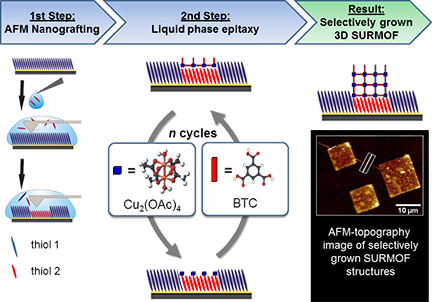
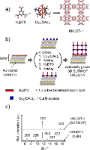
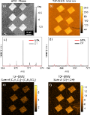
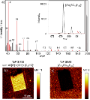
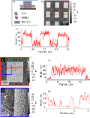
- growth of the SURMOF is observed. In the latter case the roughness of the HKUST-1 is found to be significantly higher than for the 1-mercaptopropionic acid. The successful grafting process was verified by time-of-flight secondary ion mass spectrometry and atomic force microscopy. The SURMOF structures
- two processes: (1) shaving of the original SAM made from the first thiol followed by (2) the refill of the shaved areas with the second thiol, which occurs instantaneously during the shaving as the shaving is carried out in a solution of the second thiol. Before doing the actual grafting, the
- with the theoretical length difference between the two thiols (DT and MPA) of 1.5 nm. In addition, the phase contrast data shown in Figure 3c reveal the presence of two different materials inside and around the grafted areas. These findings directly demonstrate the success of the grafting experiment





Functionalization of vertically aligned carbon nanotubes
Beilstein J. Nanotechnol. 2013, 4, 129–152, doi:10.3762/bjnano.4.14
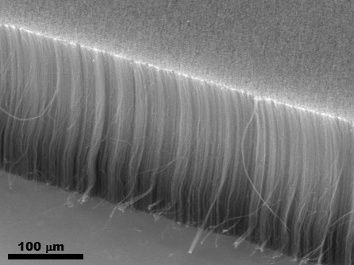
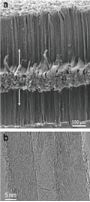
- functionalization (grafting of functional chemical groups, decoration with metal particles or wrapping of polymers) to bring new properties or to improve the interactions between the VA-CNTs and their environment while maintaining the alignment of CNTs. Keywords: aligned; carbon nanotubes; fluorination
- applications is the tuning of the CNT surface properties. In this context, functionalization (i.e., the grafting of chemical groups (molecules or particles) on the surface of the nanomaterial) has been reported to give excellent results, with the drawback that it negatively impacts on the alignment of the VA
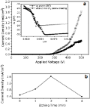
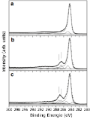
- the functionalization of vertically aligned carbon nanotube samples. First, we describe the grafting of fluorine-, oxygen- and nitrogen-containing chemical groups at the VA-CNT surface. Next, we review the functionalization of CNTs with nanoparticles such as Cu, Ag, Au, Pt, Pd or TiO2. Then, we








Mapping mechanical properties of organic thin films by force-modulation microscopy in aqueous media
Beilstein J. Nanotechnol. 2012, 3, 464–474, doi:10.3762/bjnano.3.53
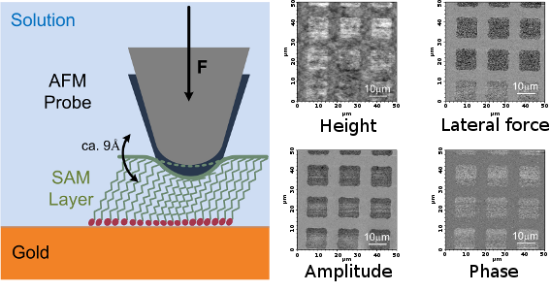
- , including surface plasmon resonance (SPR) [58], quartz-crystal microbalance (QCM) [59][60][61] and ellipsometry [62]. These methods, however, do not resolve differences in the grafting density and packing of the molecules with high spatial resolution (micrometer or less). Here we show that FMM in solution
- illustrate the effect of grafting density and molecular packing on the apparent layer stiffness, but also demonstrate the high sensitivity of FMM in solution for imaging self-assembled monolayers. The third row (Figure 4c) shows images obtained on a sample first patterned by exposure in 10 µM EG3-thiol for 1
- (triethylene glycol mono-11-mercaptoundecyl ether, HO(CH2CH2O)3C11H22SH) in 2% ethanol (Figure 6b), followed by rinsing with copious amounts of DI water and drying in a stream of nitrogen. This treatment produced EG3-thiol patterns with low grafting density. Next, the remaining negative photoresist was



Distribution of functional groups in periodic mesoporous organosilica materials studied by small-angle neutron scattering with in situ adsorption of nitrogen
Beilstein J. Nanotechnol. 2012, 3, 428–437, doi:10.3762/bjnano.3.49
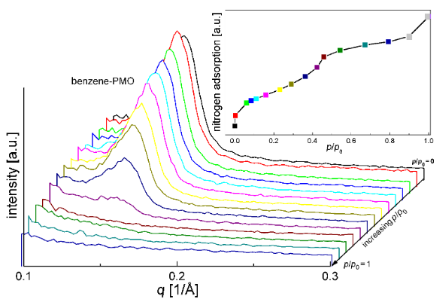
- , confirming the assumption of a crystal-like periodicity within the PMO material walls due to π–π interactions between the organic bridges. The SLD of pristine benzene-PMO was altered by functionalizing the surface with different amounts of SO3H-groups, using the grafting method. For a low degree of
- ; SANS; surface functionalization; Introduction Regarding functionalization with organic groups, Si-MCM-41 often suffers from pore blocking at the pore mouths and inhomogeneous distribution of the functional groups in the case of post-synthetic grafting [1][2][3] or, if the co-condensation route is
- employed, from the loss of the mesoporous structure due to a lack of optimum micelle formation with the increase in the organic/functional loadings [4]. In addition the wide application of grafting for the modification of Si-MCM-41 materials is hindered due to the lack of reactive centers apart from the OH


Surface functionalization of aluminosilicate nanotubes with organic molecules
Beilstein J. Nanotechnol. 2012, 3, 82–100, doi:10.3762/bjnano.3.10
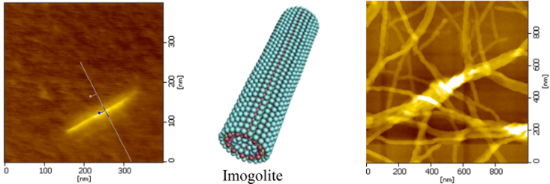
- chemisorption of alkyl phosphonic chains on imogolite surface at the nanotube level from an aqueous solution. However, such low-molecular-weight compounds are insufficient to prevent nanotube aggregation. As a better alternative, the grafting of polymer chains from the nanostructure surface has been developed
- as a powerful technique for homogeneously dispersing nanostructures [34][35][36]. Several strategies can be used to graft polymers from the inorganic surface, including “grafting to”, “grafting through” and “grafting from” approaches [37][38]. In many cases, “grafting from” is preferred, in which the
- polymer chains are in situ grown from the surface by means of surface-initiated polymerization, and the grafting density is higher compared to the “grafting to” and “grafting through” approaches. The “grafting from” process can be performed with various polymerization techniques, from anionic and cationic





