


Search results
Search for "graphene oxide (GO)" in Full Text gives 85 result(s) in Beilstein Journal of Nanotechnology.
Controlled graphene oxide assembly on silver nanocube monolayers for SERS detection: dependence on nanocube packing procedure
Beilstein J. Nanotechnol. 2016, 7, 9–21, doi:10.3762/bjnano.7.2
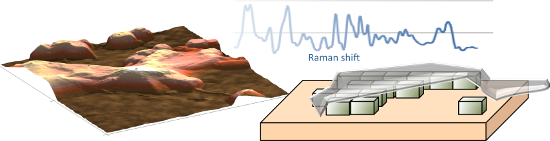
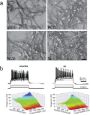
- means of two procedures differing for the method used in the assembly of the silver nanocubes onto the surface: Langmuir–Blodgett (LB) transfer and direct sequential physisorption of silver nanocubes (AgNCs). Adsorption of graphene oxide (GO) flakes on the AgNC assemblies obtained with both procedures
- metal nanoparticle arrays may be further extended by a proper pairing with graphene or graphene derivatives due to their exclusive chemical, electronic and mechanical properties [18]. Graphene oxide (GO) is derived in the form of single-atom sheets of conjugated sp2 carbon atoms with abundant oxygen


Green and energy-efficient methods for the production of metallic nanoparticles
Beilstein J. Nanotechnol. 2015, 6, 2354–2376, doi:10.3762/bjnano.6.243
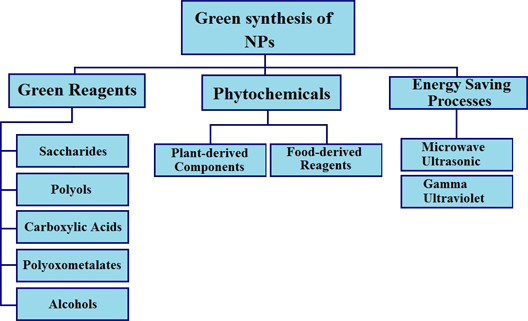
- . They reacted AgNO3 and graphene oxide (GO) with TA simultaneously and observed that GO sheets were impregnated with many Ag NPs with diameters up to 20 nm [73]. Kasthuri et al. synthesized anisotropic Au and quasi-spherical Ag NPs using apiin to reduce AgNO3 and HAuCl4 at room temperature within 60 s
- -isoprene moieties help stabilization of NPs [8]. Li et al. produced bimetallic Pd–Ag NPs from AgNO3, K2PdCl4 using graphene oxide (GO) nanosheets as reducing agent, support and stabilizer. The synthesis process took place at 84 °C for 3 h for reduction of metallic ions and 200 °C for 24 h for reduction of


Fabrication of hybrid graphene oxide/polyelectrolyte capsules by means of layer-by-layer assembly on erythrocyte cell templates
Beilstein J. Nanotechnol. 2015, 6, 2310–2318, doi:10.3762/bjnano.6.237
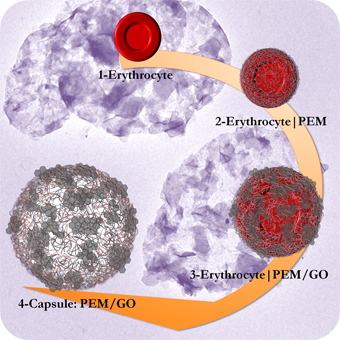
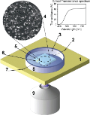
- , Centro de Investigación en Química Aplicada, Blvd. Enrique Reyna Hermosillo No.140 C.P. 25294 Saltillo, Coahuila, México 10.3762/bjnano.6.237 Abstract A novel and facile method was developed to produce hybrid graphene oxide (GO)–polyelectrolyte (PE) capsules using erythrocyte cells as templates. The
- tendency to form multi-layered agglomerates, which begin to acquire the properties of graphite [9][10][11]. Because of these difficulties, most studies of graphene, whether for layered assembly or other investigations, have been performed on graphite oxide or its exfoliated form, graphene oxide (GO), which


Liquid-phase exfoliated graphene: functionalization, characterization, and applications
Beilstein J. Nanotechnol. 2014, 5, 2328–2338, doi:10.3762/bjnano.5.242
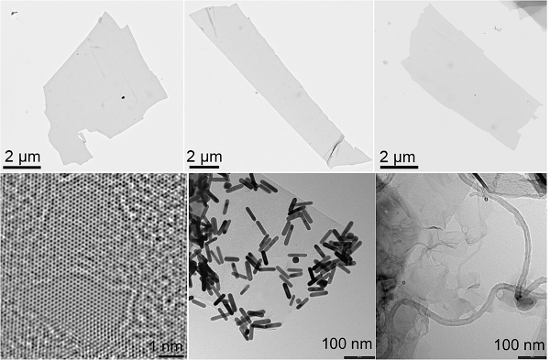
- exfoliate graphite by wet chemistry techniques, it is necessary to decrease the π–π staking interactions between the graphene layers. In achieving this, the sp2 lattice is partially disrupted into layers containing sp2–sp3 carbon atoms. The most drastic example is probably graphene oxide (GO), where the


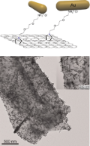


Carbon-based smart nanomaterials in biomedicine and neuroengineering
Beilstein J. Nanotechnol. 2014, 5, 1849–1863, doi:10.3762/bjnano.5.196
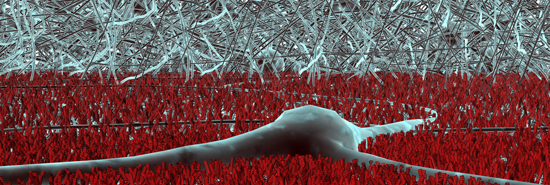
- single-layer graphene [30], and its large surface area [31], make graphene and graphene oxide (GO) one of the most promising materials for technological and biomedical applications. Carbon-based nanomaterials in biomedical applications The peculiar ability of several nanomaterials to functionally
- treatments, but also in a high degree of purity of the recovered proteins, which can be further analysed by mass spectrometry [86]. Graphene: Graphene, graphene oxide (GO) and reduced graphene oxide (r-GO) have been investigated as new biocompatible material by virtue of their unique properties, making them
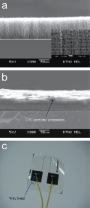


Donor–acceptor graphene-based hybrid materials facilitating photo-induced electron-transfer reactions
Beilstein J. Nanotechnol. 2014, 5, 1580–1589, doi:10.3762/bjnano.5.170
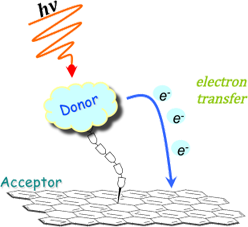
- applications. There are two main routes to overcome this hurdle. Namely, this can be accomplished by starting with water-soluble graphene oxide (GO), which can be reduced to the so-called reduced graphene oxide (rGO), followed by post-modification to acquire functionalized graphene [11]. However, the reduction
- hybrid materials. Tetraphenylporphyrin (TTP) condensed onto graphene oxide (GO) yielding GO–TPP hybrid material [44]. Ferrocene units anchored to graphene oxide (GO) forming a GO–Fc hybrid material [50]. Free and Pd-metallated tetraphenylporphyrin moieties as substituents of pyrrolidine rings covalently
- ) aryl diazonium addition, and (d) azide addition. Iron(II) coordinated on terpyridine (tpy) moieties covalently anchored to graphene oxide (GO) forming GO–tpy–Fe hybrids [51]. “Click” reaction for the grafting of a porphyrin onto reduced graphene oxide sheets that was pre-modified by phenylacetylene


Highly NO2 sensitive caesium doped graphene oxide conductometric sensors
Beilstein J. Nanotechnol. 2014, 5, 1073–1081, doi:10.3762/bjnano.5.120
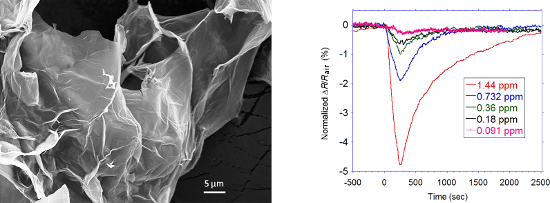
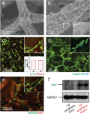
- Institute for Bioengineering and Nanotechnology, Australian National Fabrication Facility - QLD Node, Brisbane, QLD 4072, Australia 10.3762/bjnano.5.120 Abstract Here we report on the synthesis of caesium doped graphene oxide (GO-Cs) and its application to the development of a novel NO2 gas sensor. The GO
- energy, i.e., the gas molecules can absorb more strongly on the doped or defective graphene than the pristine graphene resulting in an enhancement of the sensitivity or selectivity. Recently, graphene oxide (GO), a graphene layer decorated with oxygen functional groups, has been subject to extensive
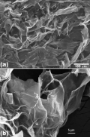
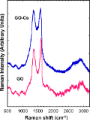
- studied for the first time an NO2 sensor based on caesium-doped graphene oxide (GO-Cs). We demonstrated that caesium doping is an effective technique to reduce the GO, making it a promising material for gas sensing applications. XPS, Raman and KPFM results confirm the successful incorporation of Cs into




Enhancement of photocatalytic H2 evolution of eosin Y-sensitized reduced graphene oxide through a simple photoreaction
Beilstein J. Nanotechnol. 2014, 5, 801–811, doi:10.3762/bjnano.5.92
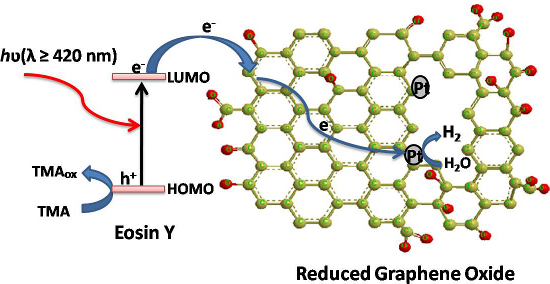
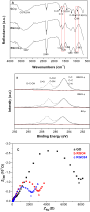
- Weiying Zhang Yuexiang Li Shaoqin Peng Xiang Cai Department of Chemistry, Nanchang University, Nanchang 330031, China 10.3762/bjnano.5.92 Abstract A graphene oxide (GO) solution was irradiated by a Xenon lamp to form reduced graphene oxide (RGO). After irradiation, the epoxy, the carbonyl and the
- ) sheet of sp2-hybrized carbon, has received tremendous research interests based on its extraordinary electronic, thermal, optical and excellent electron transport properties [21][22]. Graphene can be easily obtained by reducing graphene oxide (GO), which is a cheap and scalable preparation method [23][24
- with 5% HCl and water until pH 5 and dried in an oven at 60 °C. 0.5 g of graphite oxide powder was added into 1 L of distilled water, and the dispersion was treated with ultrasound (KQ-800KDB, KunShan Ultrasonic Instrument Co. Ltd) for 2 h until the solution became clear to obtain a graphene oxide (GO





Nanostructure sensitization of transition metal oxides for visible-light photocatalysis
Beilstein J. Nanotechnol. 2014, 5, 696–710, doi:10.3762/bjnano.5.82
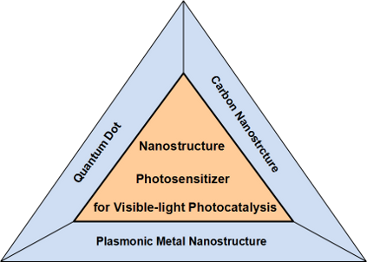
- ) forming an electron–hole puddle in a g-C3N4-supported graphene monolayer [100]. Song and co-workers observed an enhancement of the photoconversion efficiency up to 15 times for a TiO2 nanotube composite electrode decorated by graphene oxide (GO) in comparison with pristine TiO2 nanotube arrays under




A visible-light-driven composite photocatalyst of TiO2 nanotube arrays and graphene quantum dots
Beilstein J. Nanotechnol. 2014, 5, 689–695, doi:10.3762/bjnano.5.81
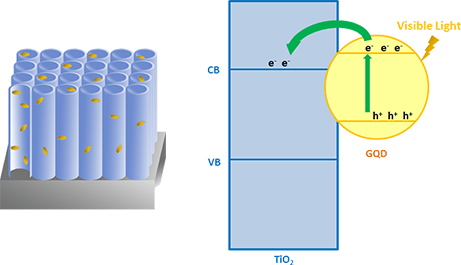
- for 1 h with a temperature increasing rate of 1 °C·min−1 in air was applied to improve crystallization. Synthesis of graphene quantum dots (GQDs): GQDs were synthesized from graphene oxide (GO) by heating with a solution of hydrogen peroxide and ammonia [44]. 20 mg of GO was dispersed into 5 mL of





