


Search results
Search for "macromolecules" in Full Text gives 84 result(s) in Beilstein Journal of Nanotechnology.
Hydrophobic interaction governs unspecific adhesion of staphylococci: a single cell force spectroscopy study
Beilstein J. Nanotechnol. 2014, 5, 1501–1512, doi:10.3762/bjnano.5.163
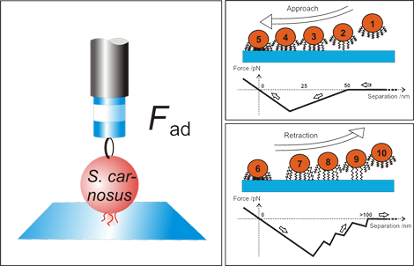
- indication of a reversible fold-and-stretch mechanism of the involved macromolecules. It is known that the bacterial surface is covered by a variety of proteinaceous and non-proteinaceous polymers that can mediate adhesion (adhesins) [28][29]. The form of the retraction part can therefore be explained by a
- other hydrophobic macromolecules may contribute to adhesion. For S. aureus for example, teichoic acids are reported to be strongly hydrophilic [40]. Our model of bacterial adhesion, which will be proposed in the following, however, is not depending on the exact type of adhesive mediator. Figure 8A
- tip velocity probes the rheological properties of the involved group of (stretched) macromolecules, which may also interact collaboratively [41]. Since for the group of cell-wall proteins, no rheological data is available, a prediction for the tip-velocity-dependent behavior is not possible. We find


In vitro interaction of colloidal nanoparticles with mammalian cells: What have we learned thus far?
Beilstein J. Nanotechnol. 2014, 5, 1477–1490, doi:10.3762/bjnano.5.161
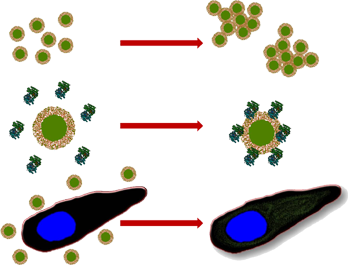
- ][109][110]. By applying existing techniques correctly, the hydrodynamic diameters of NPs can be determined with remarkable accuracy, in particular if relative size changes are determined. Detection can be sensitive enough to resolve size-changes due to the attachment of individual macromolecules to the


Injection of ligand-free gold and silver nanoparticles into murine embryos does not impact pre-implantation development
Beilstein J. Nanotechnol. 2014, 5, 677–688, doi:10.3762/bjnano.5.80
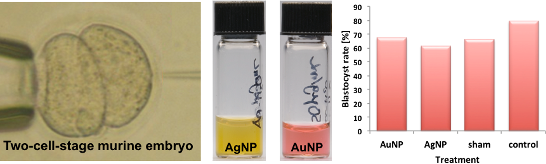
- are displayed in Figure 4. Discussion The embryonic stage is one of the most vulnerable phases for every organism. Nanoparticles, which are comparable in size to biochemical macromolecules, were proven to enter a multitude of cell types [51][58] and to cross various biological barriers [12][59][60][61




Novel composite Zr/PBI-O-PhT membranes for HT-PEFC applications
Beilstein J. Nanotechnol. 2013, 4, 481–492, doi:10.3762/bjnano.4.57
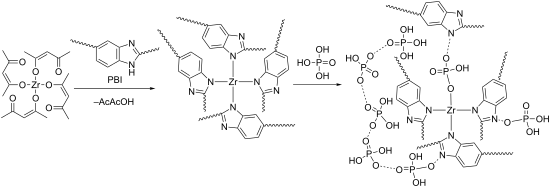
- , 1246 cm−1, and an appearance of several new strong broad peaks at 1561, 1452, 617, 473 cm−1, which can be attributed to the formation of both chemical and coordination bonds of zirconium with BI. According to this data one can conclude that the PBI-O-PhT macromolecules inside the membranes, which have
- crosslinking process of PBI by Zr(acac)4 and further doping with PA is shown in Figure 5. Due to lability of the N–Zr bonds in the excess of PA, one can expect a dynamical behaviour of the Zr-crosslinks. We suggest that zirconium is forming chemical bonds not only with PBI-O-PhT macromolecules but also with PA
- /PBI-O-PhT film. It can be explained by the dynamic nature of the zirconium crosslinks between the macromolecules and the ability of zirconium to form acidic phosphates and act as a coordination centre for PA. As shown in Table 1, the PA uptake of a membrane decreases with an increasing degree of


Physics, chemistry and biology of functional nanostructures
Beilstein J. Nanotechnol. 2012, 3, 843–845, doi:10.3762/bjnano.3.94

- -sized objects and functional systems. Examples are synthesis and controlled positioning of various nanoparticles and macromolecules providing, finally, specific functions if arranged on suitable platforms in an optimized way. In the context of arranging nanoobjects, the exploitation of self-organization
Macromolecular shape and interactions in layer-by-layer assemblies within cylindrical nanopores
Beilstein J. Nanotechnol. 2012, 3, 475–484, doi:10.3762/bjnano.3.54
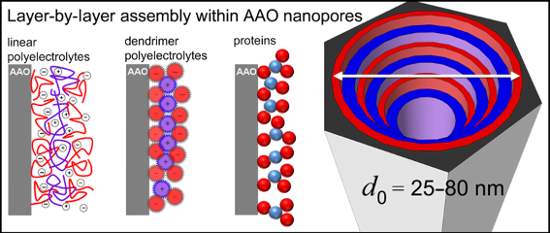
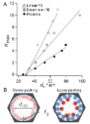
- , obtained by the sequential adsorption of macromolecules within the nanopores of porous anodic aluminum oxide (AAO). The shape and the nature of the interactions between macromolecules were varied. AAO is widely used due to its self-organized, predictable structure, which is composed of nonintersecting
- polyelectrolytes (dendrimer-PEs) [23]. Deposition of these macromolecules in AAO with pore diameters of d0 = 63–66 nm, was initially compared with deposition on a planar, charged gold surface. LbL experiments were then carried out in pores with different diameters d0, ranging from 25 to 80 nm, until the interior
- ). The positively charged macromolecules were deposited first on the self-assembled mercaptohexadecanoic acid monolayer on gold, followed by the negatively charged linear-PEs. For the porous AAO samples, protein multilayers were grown by first adsorbing avidin electrostatically on the untreated AAO




Optical properties of fully conjugated cyclo[n]thiophenes – An experimental and theoretical approach
Beilstein J. Nanotechnol. 2011, 2, 720–726, doi:10.3762/bjnano.2.78
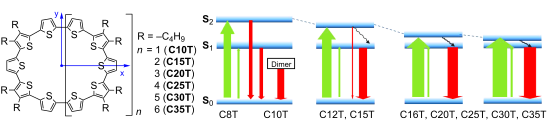
- they correlate the monomer transition energy (ω0), the magnitude of the electronic coupling between the thiophene monomers in the macromolecules (J), and the extent of the delocalized π-conjugated system [17]. Experimental The solutions were freshly prepared with chloroform (Merck, UVASOL). UV–vis


Surface induced self-organization of comb-like macromolecules
Beilstein J. Nanotechnol. 2011, 2, 569–584, doi:10.3762/bjnano.2.61
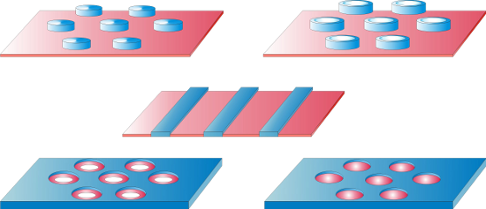
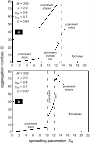
- macromolecules containing two different types (A and B) of incompatible side chains (so-called binary combs). Side chains of the binary combs are strongly adsorbed on a surface and segregated with respect to the backbone. The thickness of surface domains formed by the B side chains is controlled by the
- interaction with the substrate. We predict the stability of direct and inverse disc-, torus- and stripelike nanostructures. Phase diagrams of the film are constructed. Keywords: comb copolymers; macromolecules; adsorption; self-organization; Introduction Recent advances in macromolecular synthesis allow
- precise control over structure and polydispersity of architecturally complex polymers [1][2][3]. Among these polymers are comb or brush copolymers, i.e., macromolecules which consist of a backbone and attached side chains [4][5]. Originally the interest in comb copolymers was motivated by the desire to




Self-organizing bioinspired oligothiophene–oligopeptide hybrids
Beilstein J. Nanotechnol. 2011, 2, 525–544, doi:10.3762/bjnano.2.57
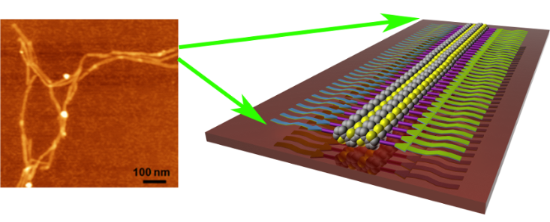
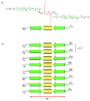
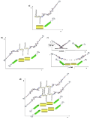
- peptides to other molecular compounds. Conjugates of synthetic and natural macromolecules are of great current interest because of their promising biomedical, microelectronic, and other advanced technological applications [7][8][9][10][14][15]. Covalent attachment of synthetic polymer blocks to




Other Beilstein-Institut Open Science Activities



