


Search results
Search for "manganese" in Full Text gives 83 result(s) in Beilstein Journal of Nanotechnology.
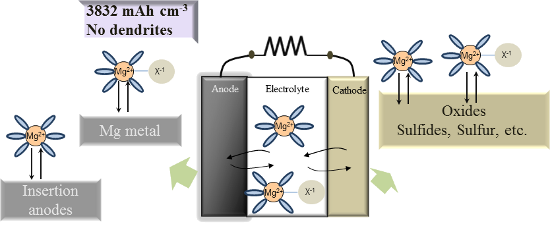
Magnesium batteries: Current state of the art, issues and future perspectives
Beilstein J. Nanotechnol. 2014, 5, 1291–1311, doi:10.3762/bjnano.5.143


Model systems for studying cell adhesion and biomimetic actin networks
Beilstein J. Nanotechnol. 2014, 5, 1193–1202, doi:10.3762/bjnano.5.131
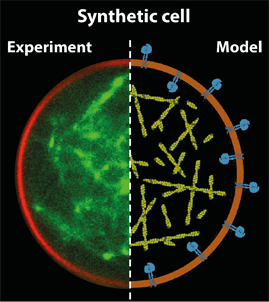
- increased by the presence of divalent ions such as manganese or calcium [16]. Cellular adhesion strength is mostly controlled by the intermolecular spacing of the adhesion receptors rather than by their density [17]. This result was obtained from different studies using highly ordered gold nanoparticles


Carbon dioxide hydrogenation to aromatic hydrocarbons by using an iron/iron oxide nanocatalyst
Beilstein J. Nanotechnol. 2014, 5, 760–769, doi:10.3762/bjnano.5.88
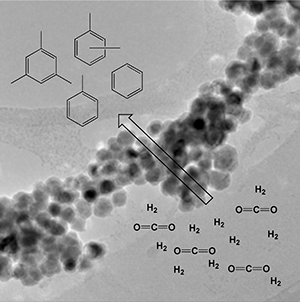
- CO2 hydrogenation reactions. Earlier research showed that bulk iron and iron oxides catalyze CO2 hydrogenation, producing mainly methane. These catalysts were rapidly deactivated due to carbon deposition [11][12]. Doping with promoters such as potassium [13][14][15][16][17][18], manganese [19][20][21


Ferromagnetic behaviour of Fe-doped ZnO nanograined films
Beilstein J. Nanotechnol. 2013, 4, 361–369, doi:10.3762/bjnano.4.42
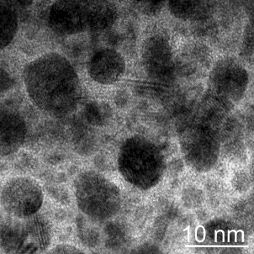
- cobalt demonstrates only one oxidation state Co3+ whereas manganese can possess several oxidation states, namely +2, +3 and +4 [17][18]. Together with cobalt and manganese, iron is one of the most important dopants in ZnO. Similar to manganese, iron has different oxidation states (Fe2+ and Fe3+). This


A facile approach to nanoarchitectured three-dimensional graphene-based Li–Mn–O composite as high-power cathodes for Li-ion batteries
Beilstein J. Nanotechnol. 2012, 3, 513–523, doi:10.3762/bjnano.3.59
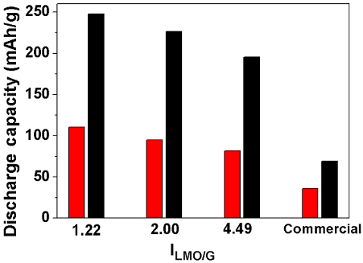
- : chemical doping and microstructure modification. The chemical doping method involves elevating the average manganese ion oxidation state so as to decrease the amount of Mn3+ in LMO, e.g., by replacing manganese with monovalent [6] or multivalent cations [7][8][9]. However, doping into LMO tends to reduce
- excellent cyclability between 3 and 4.3 V but with relatively low capacities <100 mAh·g−1 at 1 C rate (capacity rating) [14]. The silica template used in this synthesis process has to be removed by an additional step, which may introduce impurities to LMO. In order to suppress the dissolution of manganese
- sheets. In this part, the electrostatic force drives the SO42− ions into the spacing between the carbon layers of the graphite electrode and breaks the connection between graphene layers. The second part is the deposition of manganese oxide. In this part, Mn2+ is oxidized and deposited onto the graphene




Surface functionalization of aluminosilicate nanotubes with organic molecules
Beilstein J. Nanotechnol. 2012, 3, 82–100, doi:10.3762/bjnano.3.10
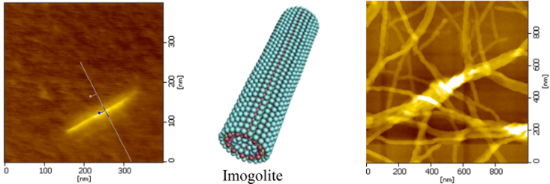
- M H2O2, followed by citrate-bicarbonate (CB) to extract inorganic impurities (iron and manganese oxide). The resulting gel is washed with cold 0.5 M Na2CO3 to remove citrate remnants, and redispersed in weak acidic solution. The final product, cottonlike imogolite, is obtained by freeze-drying of


Magnetic nanoparticles for biomedical NMR-based diagnostics
Beilstein J. Nanotechnol. 2010, 1, 142–154, doi:10.3762/bjnano.1.17
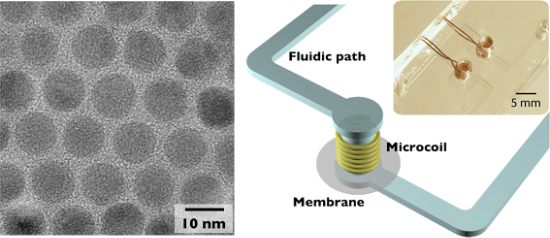
- applications. Doped-ferrite nanoparticles The magnetization of ferrite nanoparticles can be further enhanced by doping the ferrite with ferromagnetic elements such as manganese (Mn), cobalt (Co) or nickel (Ni) [23][27][45]. Among the singly-doped ferrite MNPs, MnFe2O4 nanoparticles were found to exhibit the
- iron(III) acetylacetonate [Fe(acac)3], manganese(II) acetylacetonate [Mn(acac)2] and 1,2-hexadecanediol at high temperature (300 °C). A seed-mediated growth approach was used to increase the size of the magnetic core from 10 nm to 12, 16, or 22 nm. MnFe2O4 nanoparticles with a diameter ≤16 nm were
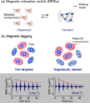
- ensure detection sensitivity of this assay mode. (Reproduced with permission from [13][14]. Copyright 2002, 2008 Nature Publishing Group.) Higher r2-relaxivity MNPs developed to improve detection sensitivity of in vitro diagnostics. (a) Transmission electron micrograph (TEM) images of manganese-doped


Enhanced visible light photocatalysis through fast crystallization of zinc oxide nanorods
Beilstein J. Nanotechnol. 2010, 1, 14–20, doi:10.3762/bjnano.1.3
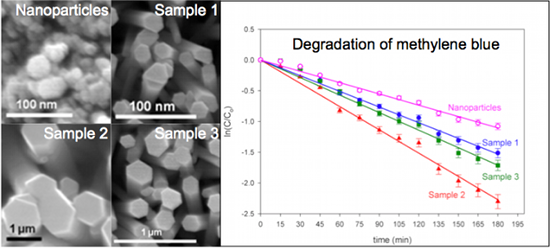
- recombination rate is lower than the rate of electron transfer to adsorbed molecules. There are reports on the enhancement of visible light absorption in ZnO by doping with, e.g., cobalt (Co) [18], manganese (Mn) [19], lead (Pb) and silver (Ag) [16], etc. Photocatalytic activity comparable to doped ZnO was also


Other Beilstein-Institut Open Science Activities



