Search results
Search for "pollutant" in Full Text gives 86 result(s) in Beilstein Journal of Nanotechnology.
Pt- and Pd-decorated MWCNTs for vapour and gas detection at room temperature
Beilstein J. Nanotechnol. 2015, 6, 919–927, doi:10.3762/bjnano.6.95
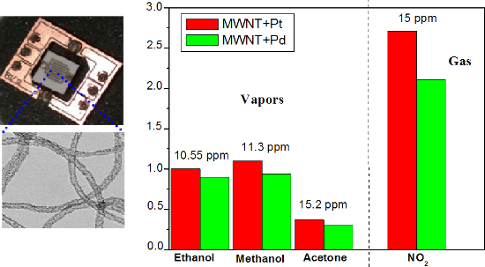
- organic compounds, as well as pollutant gases has been studied. Pt- and Pd-decorated multiwalled carbon nanotubes show a fully reversible response to the non-aromatic volatile organic compounds tested when operated at room temperature. In contrast, these nanomaterials were not responsive to the aromatic
- alert the general population or workers in various industries (e.g., petrochemical, road construction and repair or landfill sites) of the presence of abnormally high levels of a given pollutant [8][9]. Carbon nanotubes have a high potential to become a gas sensitive material in such detectors, given
- non-aromatic (ethanol, methanol and acetone) VOCs together with the response to a pollutant gas (NO2) have been investigated. Experimental Carbon nanotube synthesis, functionalisation and metal decoration The carbon nanotubes used in the experiment were purchased from Nanocyl s.a. (Belgium). They were



Transformation of hydrogen titanate nanoribbons to TiO2 nanoribbons and the influence of the transformation strategies on the photocatalytic performance
Beilstein J. Nanotechnol. 2015, 6, 831–844, doi:10.3762/bjnano.6.86
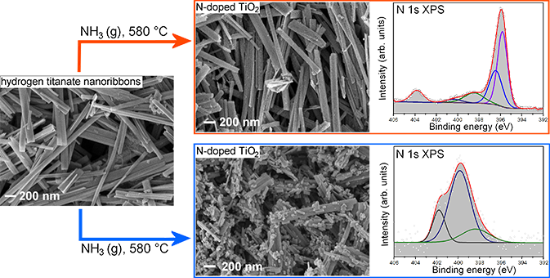
- ) were identical to those used for the TG measurements. Measurements of photochemical performance The photocatalytic performance of the prepared TiO2 NRs was measured in a sealed gas–solid continuous flow reactor system. The concentrations of isopropanol (iPrOH), as the model pollutant, and acetone, the




Advances in NO2 sensing with individual single-walled carbon nanotube transistors
Beilstein J. Nanotechnol. 2014, 5, 2179–2191, doi:10.3762/bjnano.5.227
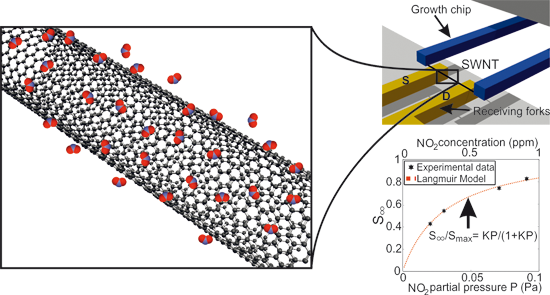
- nanotube lattice is held together by strong sp2 C–C bonds, which provide the necessary chemical stability to the carbon nanotube. The sensitivity of SWNTs towards NO2 at ambient temperatures, as reported by Kong et al. [7] is particularly interesting. NO2 is a well-known toxic gas and air pollutant and


Characterization and photocatalytic study of tantalum oxide nanoparticles prepared by the hydrolysis of tantalum oxo-ethoxide Ta8(μ3-O)2(μ-O)8(μ-OEt)6(OEt)14
Beilstein J. Nanotechnol. 2014, 5, 1082–1090, doi:10.3762/bjnano.5.121
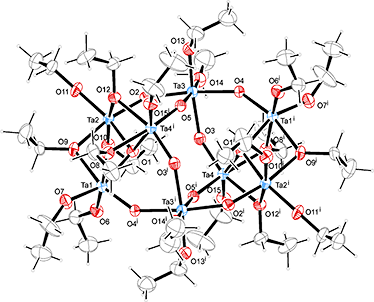
- to its distinct properties such as large ion diffusion coefficient and high electrochromic reversibility, high dielectric constant, high refractive index, high chemical stability, large band gap [13][14][15] and photocatalytic activity for overall water decomposition and organic pollutant degradation


DFT study of binding and electron transfer from colorless aromatic pollutants to a TiO2 nanocluster: Application to photocatalytic degradation under visible light irradiation
Beilstein J. Nanotechnol. 2014, 5, 1016–1030, doi:10.3762/bjnano.5.115

- efficient photocatalytic degradation of pollutants under visible light irradiation has to meet similar requirements to the ones of the dyes in Grätzel cells. In particular, the anchoring mode of the pollutant to the TiO2 surface influences the electron transfer [17]. The most commonly used anchoring group
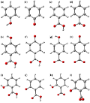
- nanocluster. To answer the questions raised above we determine the electronic structure and the optical spectra of the pollutant itself, and find where the deprotonation is more likely to take place. We also simulate the pollutant–catalyst system to analyze the binding configurations. We discuss the energy
- level alignment between the pollutant and the catalyst as well as the charge transfer between the pollutants and the oxide. We compare our theoretical results with the experimental data available, particularly with the work of Wang et al. [14] on phenol (Ph), benzoic acid (BA), p-hydroxybenzoic acid




Gas sensing with gold-decorated vertically aligned carbon nanotubes
Beilstein J. Nanotechnol. 2014, 5, 910–918, doi:10.3762/bjnano.5.104
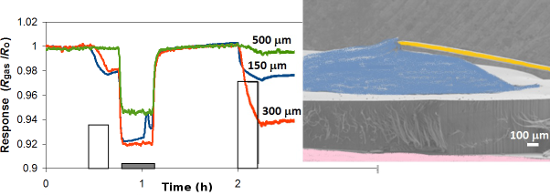
- decorated with gold nanoparticles were investigated as gas sensitive materials for detecting nitrogen dioxide (NO2) at room temperature. Gold nanoparticles of about 6 nm in diameter were sputtered on the top surface of the carbon nanotube forests to enhance the sensitivity to the pollutant gas. We showed


Pyrite nanoparticles as a Fenton-like reagent for in situ remediation of organic pollutants
Beilstein J. Nanotechnol. 2014, 5, 855–864, doi:10.3762/bjnano.5.97
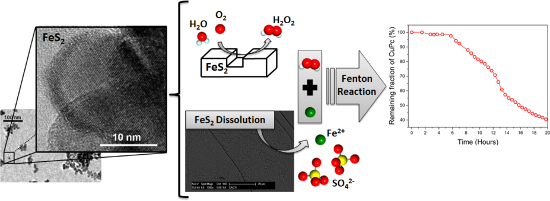
- , dissolution of pyrite in water promotes the recycling of Fe2+ into Fe3+ and vice versa, triggering Fenton production of HO•, the primary species responsible for oxidative degradation of the pollutant. Our results with the synthetic pyrite nanoparticles demonstrate that H2O2 is indeed generated by iron
- disulfide, in the absence of trace compounds founds in natural pyrite. Our kinetics analysis showed that the pyrite nanoparticles enabled a ca. 8 times greater efficiency of pollutant removal than did the microparticles. The use of synthetic pyrite nanoparticles avoids the dangers of heavy metal release
- a cheap alternative to conventional Fenton approaches for the selective oxidation of pollutant dyes. Experimental Chemicals Copper phthalocyanine-3, 4´, 4´´, 4´´´- tetrasulfonic acid tetrasodium salt (85%), oleylamine (OA, 70%), sulfur (99.99%) and toluene (99.8% anhydrous) were purchased from Sigma


Visible light photooxidative performance of a high-nuclearity molecular bismuth vanadium oxide cluster
Beilstein J. Nanotechnol. 2014, 5, 711–716, doi:10.3762/bjnano.5.83

- pollutant dye indigo Compound 1 was tested as a homogeneous, visible-light driven photooxidation catalyst for the oxidative degradation of the model pollutant dye indigo (hereafter: Ind). To this end, aliquots of cluster 1 and the dye were mixed in N,N-dimethylformamide (DMF) solution (typical molar ratio
- photooxidative degradation of the model pollutant indigo as a test reaction. Wavelength-dependent photocatalytic activity is reported and high quantum efficiencies of ca. 15% are observed at the UV–vis border. Practical quantum efficiencies >5% are found up to wavelengths of λ = 450 nm. Recycling studies show


Nanostructure sensitization of transition metal oxides for visible-light photocatalysis
Beilstein J. Nanotechnol. 2014, 5, 696–710, doi:10.3762/bjnano.5.82
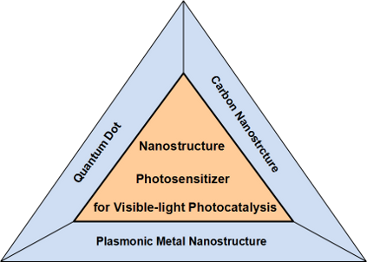
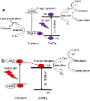
- visible-light photocatalysis is still in an early phase of development, the photocatalysts have played effective roles in many potential applications including solar fuel production, pollutant decomposition, and water/air purification. In the course of, we believe that a fundamental understanding of the




Applicability and costs of nanofiltration in combination with photocatalysis for the treatment of dye house effluents
Beilstein J. Nanotechnol. 2014, 5, 476–484, doi:10.3762/bjnano.5.55
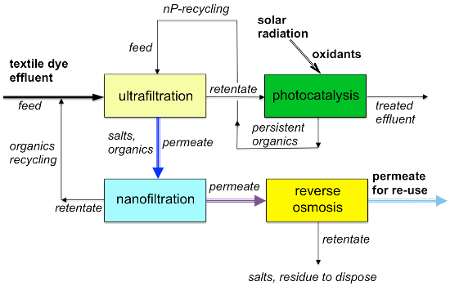
- considered to offer greater contacting surfaces between the photocatalysts and the pollutant molecules than reactors working with immobilized photocatalysts. Immobilized catalysts have a defined specific surface area, which is connected with the supporting surface. Photoreactors with suspended catalysts


Enhanced visible light photocatalysis through fast crystallization of zinc oxide nanorods
Beilstein J. Nanotechnol. 2010, 1, 14–20, doi:10.3762/bjnano.1.3
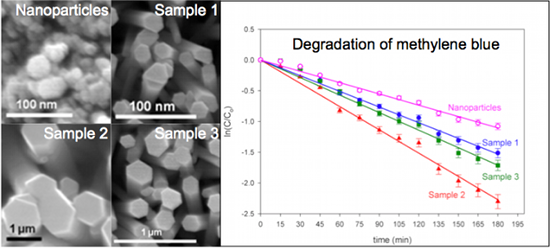
- creation in nanostructured photocatalysts could be an attractive solution for visible light photocatalysis. Keywords: defects; nanoparticle; nanorod; photocatalysis; pollutant; ZnO; Introduction Photocatalysis is a light induced catalytic process whereby photogenerated electron-hole pairs in a