


Search results
Search for "silicon oxide" in Full Text gives 89 result(s) in Beilstein Journal of Nanotechnology.
High-resolution dynamic atomic force microscopy in liquids with different feedback architectures
Beilstein J. Nanotechnol. 2013, 4, 153–163, doi:10.3762/bjnano.4.15
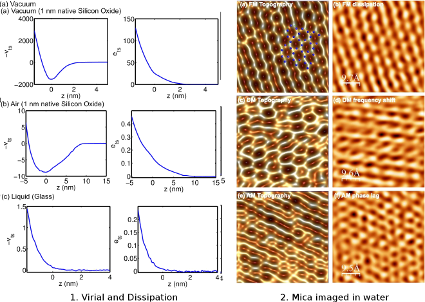
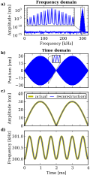
- –sample virial vts(z,asp) and dissipation ets(z,asp). Data acquired in vacuum on a silicon sample with 1 nm native silicon oxide (a) in vacuum and (b) in air. (c) Data acquired in deionized water on a glass substrate. The set-point amplitudes were 8.5 nm, 8.6 nm, and 1.5 nm, respectively. See the Methods
- , which is the typical precursory experiment to imaging with FM. The experimental data consist of F and σ versus z. Reconstruction of ets and vts versus z is achieved by substituting a* = a0 = asp and = π/2 into Equation 6 to yield Measurements were made on a silicon substrate with 1 nm native silicon
- oxide in vacuum with k = 27 N/m, Q0 = 28,000 and asp = 8.5 nm and in ambient air with k = 36 N/m, Q0 = 620 and asp = 8.6 nm. Data were acquired on glass in deionized water with k = 0.6 N/m, Q0 = 1.6 and asp = 1.5 nm. The high-resolution images of freshly cleaved mica in deionized water in Figure 4 were


Functionalization of vertically aligned carbon nanotubes
Beilstein J. Nanotechnol. 2013, 4, 129–152, doi:10.3762/bjnano.4.14
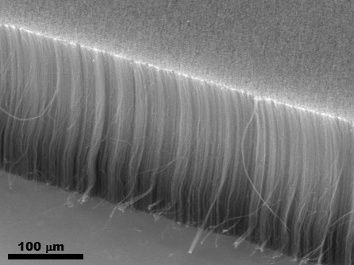
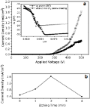
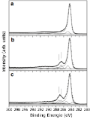
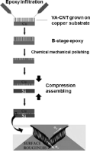
- nanotube patterns [67]. Photolithography followed by dry and/or wet etching can be used to pattern silicon oxide in different shapes and thickness allowing the design of a wide range of organized nanotube structures. An example is the beautiful patterns of multiply oriented, organized, flower-like








Interpreting motion and force for narrow-band intermodulation atomic force microscopy
Beilstein J. Nanotechnol. 2013, 4, 45–56, doi:10.3762/bjnano.4.5
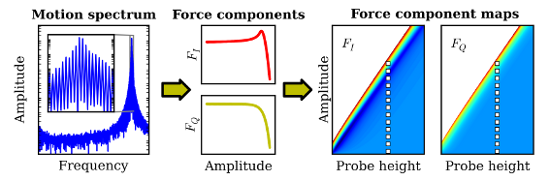
- methods in the future that will take advantage of the high signal-to-noise ratio and the high acquisition speed of ImAFM. Experimental The PS sample was spin cast from toluene solution on a silicon oxide substrate. Both PS (Mw = 280 kDa) and toluene were obtained from Sigma-Aldrich and used as purchased




Pinch-off mechanism in double-lateral-gate junctionless transistors fabricated by scanning probe microscope based lithography
Beilstein J. Nanotechnol. 2012, 3, 817–823, doi:10.3762/bjnano.3.91
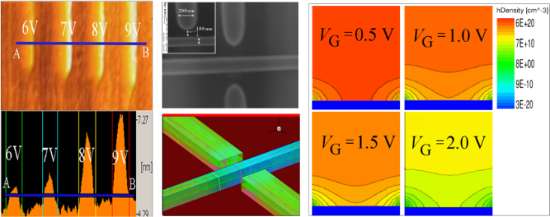
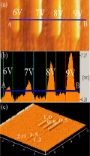
- controllable [17]. This step of device fabrication is very significant and high accuracy and precision is required in order to obtain a smooth and uniform surface. The final step of the device fabrication is the etching of the silicon oxide, which allows the removal of the oxide mask. The silicon oxide etch


Polymer blend lithography: A versatile method to fabricate nanopatterned self-assembled monolayers
Beilstein J. Nanotechnol. 2012, 3, 620–628, doi:10.3762/bjnano.3.71
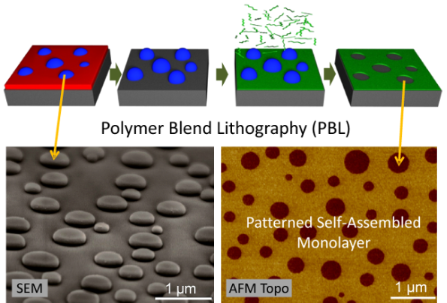
- found that this system decays into a purely lateral phase morphology during spin-casting of the solution at a moderate humidity, which means that both phases extend from the free-air interface down to the silicon oxide substrate. This is by far not the common case. In most cases of polymer-blend
- focus of a forthcoming publication. With the structure generated by using the given recipe it is possible to remove one component (e.g., PMMA) and to deposit a SAM on the completely freed silicon oxide substrate areas with very high reproducibility. After the silane molecules have bonded covalently, the
- -phase SAM template consisting of APTES, FDTS and silicon oxide pattern elements is fabricated with a topographic contrast of approximately 1.3 nm. The roughness of 0.2 nm remaining in the SiOx regions is in the same range as the one of the original Si wafer. The height of the APTES-SAM was found to be


Synthesis and electrical characterization of intrinsic and in situ doped Si nanowires using a novel precursor
Beilstein J. Nanotechnol. 2012, 3, 564–569, doi:10.3762/bjnano.3.65
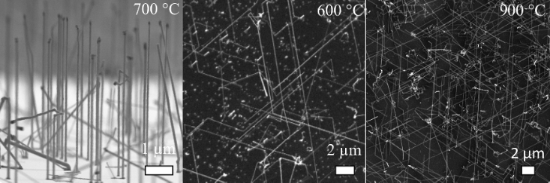
- , nucleates the growth of a Si-NW. In previous work [17] we investigated the crucial importance of substrate preparation in the case of Au-catalysed NWs grown by the VLS mechanism. Removal of silicon oxide shortly before catalyst deposition proved to be decisive for achieving epitaxy and crystallinity. The


Spontaneous dissociation of Co2(CO)8 and autocatalytic growth of Co on SiO2: A combined experimental and theoretical investigation
Beilstein J. Nanotechnol. 2012, 3, 546–555, doi:10.3762/bjnano.3.63
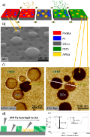
- optical microsocope image of the deposit profile shown in (a). SEM images of Co deposited on the plasma-pretreated silicon oxide and gold. The picture on the top left is an overview of a SiO2 surface prepatterned with Cr/Au contact structures. The labeling A–E indicates regions of different precursor flux


Structural, electronic and photovoltaic characterization of multiwalled carbon nanotubes grown directly on stainless steel
Beilstein J. Nanotechnol. 2012, 3, 360–367, doi:10.3762/bjnano.3.42
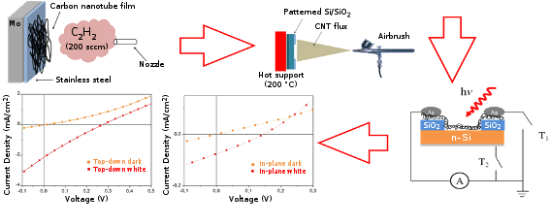
- consider the position of the electrodes through which the current is collected. In the in-plane geometry, the electrodes are in contact only with the CNT film (and the thick silicon oxide underneath), thus collecting carriers coming mainly from the nanostructures, since the majority of the carriers from


Parallel- and serial-contact electrochemical metallization of monolayer nanopatterns: A versatile synthetic tool en route to bottom-up assembly of electric nanocircuits
Beilstein J. Nanotechnol. 2012, 3, 134–143, doi:10.3762/bjnano.3.14
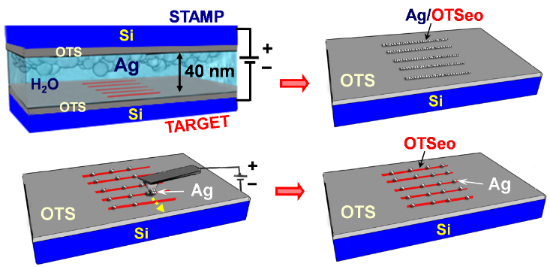
- nanocircuits [56]. This is possible, as the present electrochemical methodology is compatible with low-conductivity substrates [30] and the deposited metal features reside on an extremely robust insulating layer of variable thickness (here the organic silane monolayer plus the native silicon oxide underneath


Surface functionalization of aluminosilicate nanotubes with organic molecules
Beilstein J. Nanotechnol. 2012, 3, 82–100, doi:10.3762/bjnano.3.10
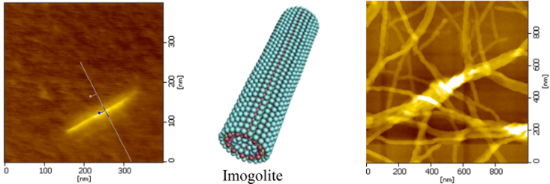
- with alkyl silanes adsorbed on silicon oxide or with thiols adsorbed on noble metals [1][12][13]. A different class of self-assembling agents, namely phosphonic and phosphoric acids, has gained more and more attention due to their ability to bind to a wide range of metal-oxide surfaces [14


Direct-write polymer nanolithography in ultra-high vacuum
Beilstein J. Nanotechnol. 2012, 3, 52–56, doi:10.3762/bjnano.3.6
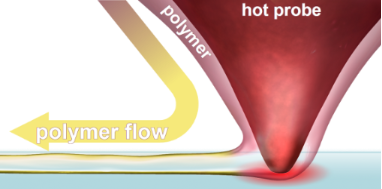
- enabled the control over the number of monolayers of the polymer ink deposited on the surface from a single to tens of monolayers, with higher writing speeds generating thinner polymer nanostructures. Deposition onto silicon oxide-terminated substrates led to polymer chains standing upright on the surface
- observation was more rigorously examined by creating a sample that mimicked the DPN tip surface chemistry: A silicon oxide on a silicon chip that was coated by holding it over ODT in a scintillation vial heated to 65 °C, for 30 min. This procedure produced an ODT film that was 20 nm thick (measured by


Fabrication of multi-parametric platforms based on nanocone arrays for determination of cellular response
Beilstein J. Nanotechnol. 2011, 2, 545–551, doi:10.3762/bjnano.2.58
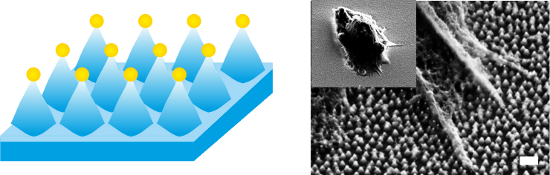
- silicon oxide underneath. Finally, the last row (g–i) displays cross-sectional SEM images. Scanning electron microscopy analysis (45° tilt) of adhering SHSY5Y human neuroblastoma cells. The figure shows a clear adhesion of cellular protrusions to the Au-tipped nanocones. Images were taken at different


Plasmonic nanostructures fabricated using nanosphere-lithography, soft-lithography and plasma etching
Beilstein J. Nanotechnol. 2011, 2, 448–458, doi:10.3762/bjnano.2.49

- casting polymers. Indeed, cured epoxy resin cast directly onto etched quartz could not be removed. One might expect that aliphatic silane molecules would bond covalently to silicon oxide, forming a hydrophobic surface. However, no significant change was observed after dipping the sample in silane solution


A collisional model for AFM manipulation of rigid nanoparticles
Beilstein J. Nanotechnol. 2010, 1, 158–162, doi:10.3762/bjnano.1.19
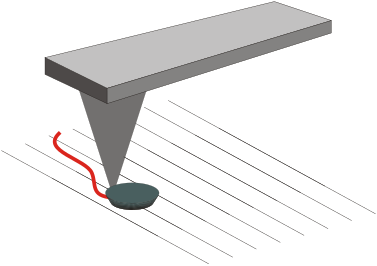
- other hand, when b is small enough, the angular velocity dΦ/dN becomes negligible: Rather than rotating, the islands simply ‘wobble’ like the nanorods. Discussion The predictions of the collisional model have been experimentally verified with gold nanospheres and nanorods manipulated on silicon oxide





