Search results
Search for "surface tension" in Full Text gives 120 result(s) in Beilstein Journal of Nanotechnology.
Surface functionalization of 3D-printed plastics via initiated chemical vapor deposition
Beilstein J. Nanotechnol. 2017, 8, 1629–1636, doi:10.3762/bjnano.8.162
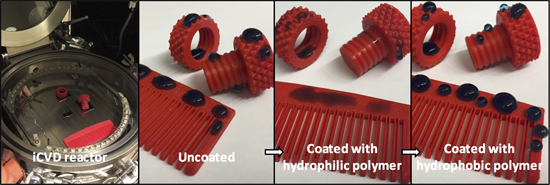
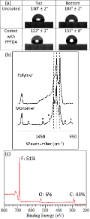
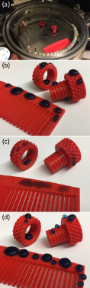
- to substrates on a cooled stage where polymerization occurs. The molecular weight increases with decreasing substrate temperature and typical molecular weights are in the range of 50,000 to 200,000 [23][24]. The iCVD process is solventless and therefore effects of surface tension are avoided



A biofunctionalizable ink platform composed of catechol-modified chitosan and reduced graphene oxide/platinum nanocomposite
Beilstein J. Nanotechnol. 2017, 8, 1508–1514, doi:10.3762/bjnano.8.151
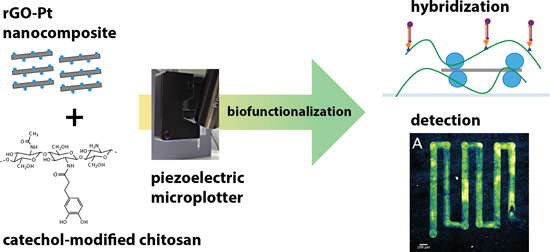
- can estimate the Z parameter (the reciprocal of the Ohnesorge number (Oh), the ratio of the Reynolds number (Re) to the square root of the Webber number (We)), which predicts stable drop formation [14]: where d is the nozzle diameter and ρ, γ, and η represent the density, surface tension, and
- viscosity of the ink, respectively. We were not able to measure directly the viscosity and surface tension of our ink as formulated. However, we were able to estimate the values of the parameters based on the values provided by Jang et al. for EG/water mixtures [14] and the viscosity of the chitosan polymer


Nanotopographical control of surfaces using chemical vapor deposition processes
Beilstein J. Nanotechnol. 2017, 8, 1250–1256, doi:10.3762/bjnano.8.126
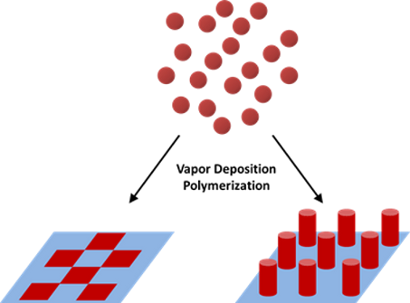
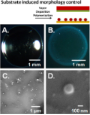
- the elastic modulus of the polymer coating and the substrate. Haller et al. investigated the morphology of vapor-deposited polymers on liquid substrates (Figure 3) [29]. Depending on surface tension, liquid viscosity, deposition rate and deposition time, either film or particle formation was found
- . Particles tend to form if the surface tension interaction between the liquid and the polymer is energetically unfavorable, promoting aggregation of the polymer. If the interaction is ambiguous, particle formation is observed at low deposition rates and times and with low liquid viscosity. Introduction of




Study of the correlation between sensing performance and surface morphology of inkjet-printed aqueous graphene-based chemiresistors for NO2 detection
Beilstein J. Nanotechnol. 2017, 8, 1023–1031, doi:10.3762/bjnano.8.103
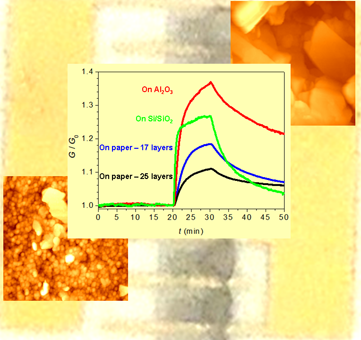
- -printing process and to determine its jettability as ink. Surface tension, dispersion stability and aggregate size have been measured since the ink printability depends on these main parameters, which have to match the operating parameters of the employed printing system. Based on these considerations, the
- . Additionally, by monitoring the dispersion through the DLS analysis, its time-stability has been confirmed over two weeks. The surface tension has been measured and the obtained value is 26.30 mN/m, which falls into the operating range (20–40 mN/m) of the printhead of the inkjet system. As a result, the
- graphene ink-Si/SiO2 system was very poor inducing a not continuous and not controlled deposition. This is expected since the measured surface energy of the substrate (30.95 mN/m) is comparable with the surface tension of the solution (26.30 mN/m). Hence, an UV–ozone treatment of the substrate was


Synthesis of coaxial nanotubes of polyaniline and poly(hydroxyethyl methacrylate) by oxidative/initiated chemical vapor deposition
Beilstein J. Nanotechnol. 2017, 8, 872–882, doi:10.3762/bjnano.8.89
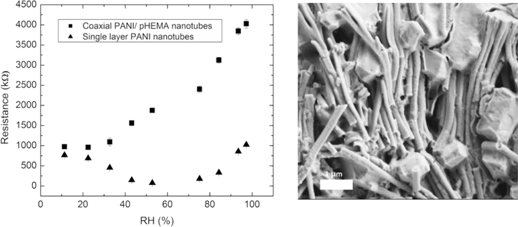
- effect and surface tension. Thus, vapor-phase polymerization techniques have emerged for the deposition of conducting polymers that facilitate the fabrication of conformal polymeric structures [21][22]. Polyaniline (PANI) is one of the well-known conducting polymers with applications in supercapacitors


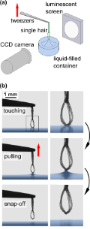
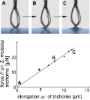
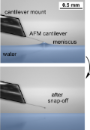
Measuring adhesion on rough surfaces using atomic force microscopy with a liquid probe
Beilstein J. Nanotechnol. 2017, 8, 813–825, doi:10.3762/bjnano.8.84
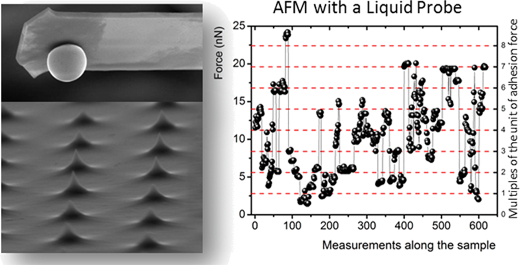
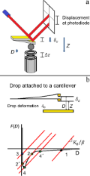
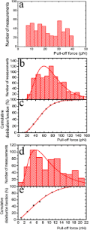
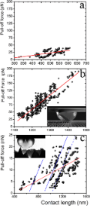
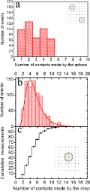
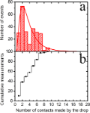
- break during pull-off and results in a small residual water droplet on the surface. In the present study, we choose mercury as the liquid because it presents many advantages. Hg possesses a very high surface tension and negligible evaporation, plus it is relatively easy to attach to a tipless cantilever
- , while the drop deformation will also be considered to be elastic, Fd = −kdδd [10], which is a consequence of the high surface tension of mercury (ca. 486.5 mN/m); kc and kd are the force constants, and δd and δc correspond to the deformation of cantilever and drop, respectively. These relevant distances
- experiments of cylindrical nanofibers dipped in liquids of different γ, where γ is the liquid–vapor surface tension [36]. For contact angles above 50–60°, the spring constants are almost insensible to the contact angle, and although these authors did not explore angles corresponding to hydrophobic surfaces

Nanoscale isoindigo-carriers: self-assembly and tunable properties
Beilstein J. Nanotechnol. 2017, 8, 313–324, doi:10.3762/bjnano.8.34
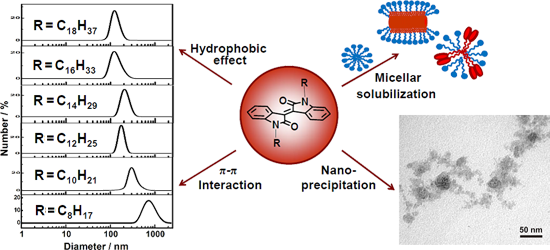
- do not decrease the surface tension of the solvent (52 mN/m). They are surface-inactive compounds (Figure S9, Supporting Information File 1). The study of the entrapment of hydrophobic probes is a generally accepted assay for the potential of soft materials to be used as nanocontainers for
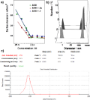
- aggregates can be formed. The surface tension of SDS solutions admixed with 2а and 3 are given in Figure 6. The formation of mixed structures of SDS and isoindigo derivative 2a is observed in a lower concentration range compared to single SDS micelles. This is supported by the left-shift in the surface
- . Chemical shifts (CSs) were calculated by the GIAO method at the same level of theory. All data were referred to TMS (13C) and NH3 (15N) chemical shifts, which were calculated under the same conditions. Surface tension Surface tension measurements were performed using the du Nouy ring detachment method




Structural and tribometric characterization of biomimetically inspired synthetic "insect adhesives"
Beilstein J. Nanotechnol. 2017, 8, 45–63, doi:10.3762/bjnano.8.6
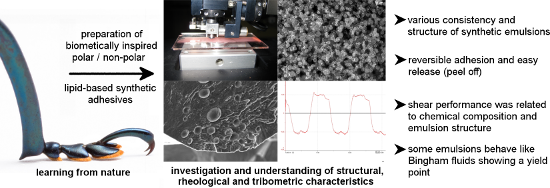
- walls of the outlet ductule [4][20][26]. Moreover, within the lipoid fraction itself, both the specific constitution and the mixing ratio of the various hydrocarbon molecules might also largely influence their adhesive performance possibly via viscosity and surface tension effects, molecular re
- phase. In combination with the use of the ionic surfactant SDS (which lowers the surface tension even further), this probably explains the low friction values of these emulsions. By contrast, two of the oil-in-water (o/w) emulsions (SG2, OG2) showed increased friction values; this can be ascribed to


Photothermal effect of gold nanostar patterns inkjet-printed on coated paper substrates with different permeability
Beilstein J. Nanotechnol. 2016, 7, 1480–1485, doi:10.3762/bjnano.7.140
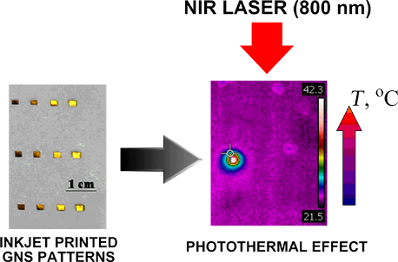
- aqueous PEGylated GNS solution (70 vol %) in order to adjust suitable viscosity and surface tension for inkjet printing (1.92 cP and 40 mN/m, respectively) as reported previously [27][28]. Notably, GNS decorated with PEG-SH become soluble in a variety of solvents, from water to hydrophobic ones, due to


Three-gradient regular solution model for simple liquids wetting complex surface topologies
Beilstein J. Nanotechnol. 2016, 7, 1377–1396, doi:10.3762/bjnano.7.129

- evaluate the surface tension γ, which is given in units kBT/b2, numerically, as discussed in section S1 of Supporting Information File 1. In Figure 3B we prove that near the critical point (i) the surface tension, (ii) the width of the interface and (iii) Δφ as found by our numerical solution accurately
- partial wetting states, where the macroscopically thick film represents the situation under a drop, and the thin film is found far away from the drop where a gas-like film resides on the substrate. As for each solution along the isotherm we have the surface tension accurately available from the self
- interface, the so-called surface of tension, for which a small notional change of the radius does not influence the value of the surface tension. For this special case the Laplace equation simplifies to Equation 3, and the value of the interfacial tension does not deviate much from the planar value. From


![[Graphic 10]](/bjnano/content/inline/2190-4286-7-129-i31.png?max-width=637&scale=1.18182) and standard deviation as a function of the cavity diameter d (in...
and standard deviation as a function of the cavity diameter d (in...

![[Graphic 20]](/bjnano/content/inline/2190-4286-7-129-i41.png?max-width=637&scale=1.18182) and the corresponding fluctuations (measured along the x-direction) indica...
and the corresponding fluctuations (measured along the x-direction) indica...

![[Graphic 28]](/bjnano/content/inline/2190-4286-7-129-i49.png?max-width=637&scale=1.18182) and the corresponding standard deviation as measure of variation in the ...
and the corresponding standard deviation as measure of variation in the ...

![[Graphic 39]](/bjnano/content/inline/2190-4286-7-129-i60.png?max-width=637&scale=1.18182) and standard deviation as function of cut-off fraction c for fixed ...
and standard deviation as function of cut-off fraction c for fixed ...
Improved lithium-ion battery anode capacity with a network of easily fabricated spindle-like carbon nanofibers
Beilstein J. Nanotechnol. 2016, 7, 1289–1295, doi:10.3762/bjnano.7.120
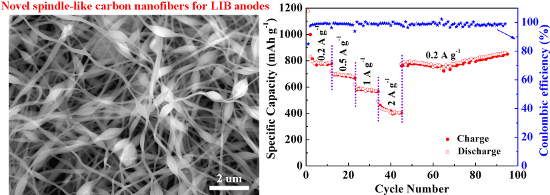
- spindle-like beads on the electrospun nanofibers depends mainly on the viscosity and surface tension of the spinning solution, spinning voltage and receving distance [24][25]. Viewed as a whole, these beaded nanofibers are closely entangled with each other and develop a robust multilayer network, which


Reasons and remedies for the agglomeration of multilayered graphene and carbon nanotubes in polymers
Beilstein J. Nanotechnol. 2016, 7, 1174–1196, doi:10.3762/bjnano.7.109
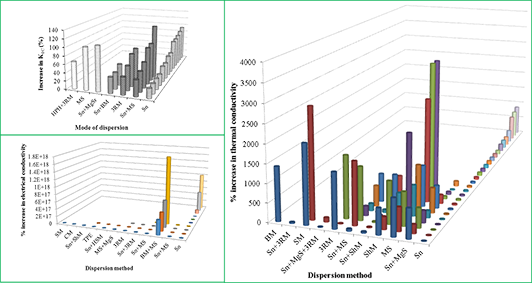
- wrapping the filler with polymers. The wrapping process involves π–π interactions and van der Waals interactions [2][40]. Surfactants have also been used to functionalize MLG and CNTs. Surfactants are physically adsorbed on the surface of CNTs. It lowers the surface tension of MLG and CNTs diminishing the


Characterization of spherical domains at the polystyrene thin film–water interface
Beilstein J. Nanotechnol. 2016, 7, 581–590, doi:10.3762/bjnano.7.51
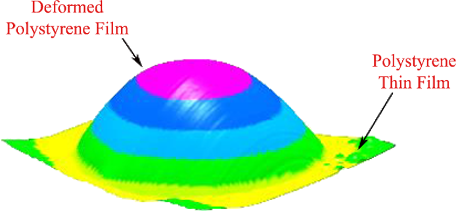
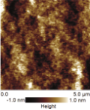
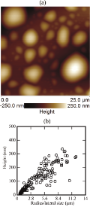
- , θM is the macroscopic contact angle, τ is the line tension, and γlg is the surface tension. The results were plotted against the radius of the spherical objects, as shown in Figure 3b. It was found that the line tension varies linearly with the radius/lateral size. This analysis also showed that the




Influence of calcium on ceramide-1-phosphate monolayers
Beilstein J. Nanotechnol. 2016, 7, 236–245, doi:10.3762/bjnano.7.22
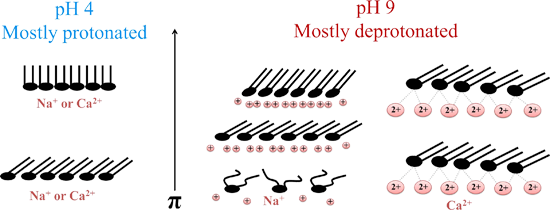
- barrier and a Wilhelmy surface tension sensor. The temperature was kept at 20 °C by a thermostat. During experiments, the trough was kept hermetically sealed and flushed with He. At BW1 (DESY, Hamburg) the synchrotron beam was monochromated through a beryllium(002) crystal to a wavelength of 1.304 Å


Plasticity-mediated collapse and recrystallization in hollow copper nanowires: a molecular dynamics simulation
Beilstein J. Nanotechnol. 2016, 7, 228–235, doi:10.3762/bjnano.7.21
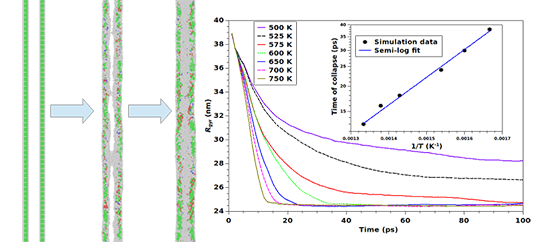
- disordered atoms is much higher as compared to their crystalline counterparts since they access a relatively larger free volume. This causes a radially inward drift of the inner surface driven by surface tension. This inward drift results into large local stresses on the residual crystalline parts of the
- subsequent elimination of stacking faults within the interior of the NW, after the inner surface is eliminated at the end of stage 1. We note that the nucleation of faults and defects is energetically less expensive in the presence of a surface, and that of an effective load generated by the surface tension


Characterisation of thin films of graphene–surfactant composites produced through a novel semi-automated method
Beilstein J. Nanotechnol. 2016, 7, 209–219, doi:10.3762/bjnano.7.19
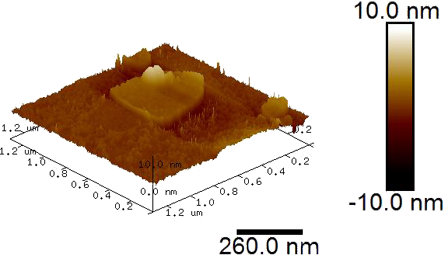
- synthesiser. This solution was then pumped into the reactor during synthesis at a rate of 35 μL·min−1 giving an addition rate of 16.2 mg·min−1 for SDS and 1.74 mg·min−1 for CTAB. The addition rate was crucial to maintain a surface tension of 41 mJ·m−2, which is both the optimum surface tension for graphene
- automation would require the monitoring of surface tension throughout the synthesis as well as automatic adjustments to the surfactant flow rate to maintain this at the required level of 41 mJ·m−2. Figure 1 depicts the assembled apparatus, the function of which is explained here. The aqueous suspension of
- adding surface tension sensors to control the amount of surfactant being added to the reactor, thus maintaining a constant and optimum surface tension. The formation of individual graphene flakes and the interaction of alkyl chains of the surfactants with graphene were, respectively, confirmed with Raman




Synthesis and applications of carbon nanomaterials for energy generation and storage
Beilstein J. Nanotechnol. 2016, 7, 149–196, doi:10.3762/bjnano.7.17















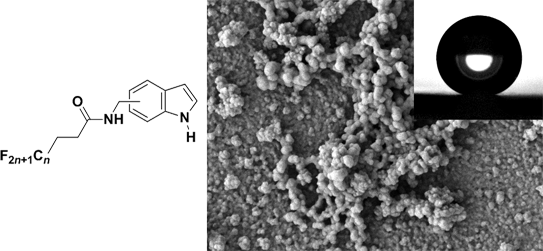
Nanostructured superhydrophobic films synthesized by electrodeposition of fluorinated polyindoles
Beilstein J. Nanotechnol. 2015, 6, 2078–2087, doi:10.3762/bjnano.6.212
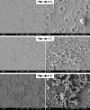
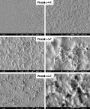
- Interference (PSI) working mode, the objective 50× and the field of view (FOV) 0.5×. The scanning electron microscopy images were obtained by using a 6700F microscope of JEOL. The contact angles were determined by using a DSA30 goniometer of Krüss. Liquids of different surface tension were chosen to




The Kirkendall effect and nanoscience: hollow nanospheres and nanotubes
Beilstein J. Nanotechnol. 2015, 6, 1348–1361, doi:10.3762/bjnano.6.139
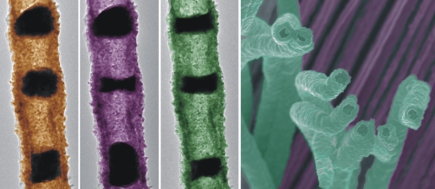
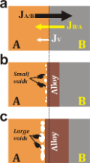
- to the interplay between the surface tension of the metal bismuth present in a liquid phase and the curved inner surface of the oxide shell. It is also believed that the wetting behavior of bismuth on the inner surface of the oxide shell can be influenced by other parameters such as the vapor



Structure and mechanism of the formation of core–shell nanoparticles obtained through a one-step gas-phase synthesis by electron beam evaporation
Beilstein J. Nanotechnol. 2015, 6, 874–880, doi:10.3762/bjnano.6.89
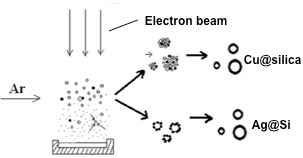
- particles are investigated in order to elucidate their mechanisms of formation and factors affecting the synthesis. It is proposed that the formation of Cu@silica particles is mainly driven by surface tension differences between Cu and Si while the formation of Ag@Si particles is mainly driven by
- system. In many cases, the surface tension of a liquid has a temperature dependence of the form which is valid for a certain temperature range above the melting temperature (Tm) of the material where σ(Tm) is the surface tension at the melting point of the material and dσ/dT is the rate of change of the
- surface tension with temperature [14]. The empirical dependence of the surface tension of copper with temperature is [15]. The surface tension of silicon varies as [16]. Below the melting point, when the materials are solid, the surface energy is the solid equivalent of the surface tension. The surface


Applications of three-dimensional carbon nanotube networks
Beilstein J. Nanotechnol. 2015, 6, 792–798, doi:10.3762/bjnano.6.82

- in contact with water from the equation [19]: where γLV denotes the surface tension of the liquid–vapor (LV) interface for water γLV = 72.5 mN/m, and Θ is the measured contact angle (Θ = 175°). The estimated adhesion force of the water droplet (20 µL) reported in Figure 4b, is about 50 µN. Measuring
- contacting the water droplet, θ* is the apparent contact angle, and θ is the Young’s contact angle of the surface, with cosθ defined as: where γSV, γSL, and γLV denote the surface tension of the solid–vapor (SV), the solid–liquid (SL), and the liquid–vapor (LV) interface, respectively. If we insert in


Nanoparticle shapes by using Wulff constructions and first-principles calculations
Beilstein J. Nanotechnol. 2015, 6, 361–368, doi:10.3762/bjnano.6.35
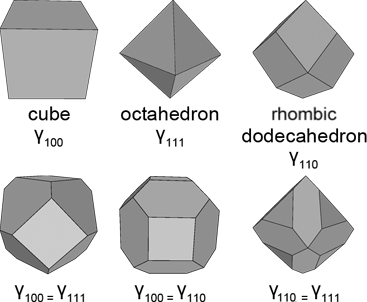
- . The quantity γhkl is the energy required to create a surface of unit area normal to the [hkl] vector, and is the analogous of the surface tension for liquids. This process is repeated for all sets of Miller indexes, (hkl). The space that lies inside all these planes defines the equilibrium shape for
- theorem is a generalization that considers lateral strain [14]. When the material under study is at equilibrium with another gas- or liquid-phase material, the interface tension, , is used in the Wulff construction instead of the surface tension, γhkl. The two are connected by a simple formula that
- , they have a much higher surface tension than low-index faces; (if a high-index surface and a low-index surface have equal surface tensions, the low-index will have a greater area as the high-index face will be steeper and will be hidden in the Wulff construction); does not take into account edge- and



Exploiting the hierarchical morphology of single-walled and multi-walled carbon nanotube films for highly hydrophobic coatings
Beilstein J. Nanotechnol. 2015, 6, 353–360, doi:10.3762/bjnano.6.34
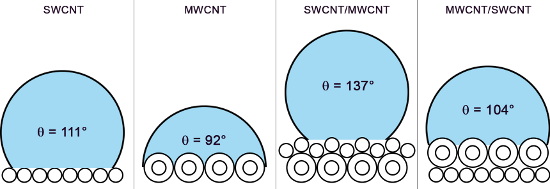
- since ethanol has a lower liquid–vapor surface tension (γLV = 22 mJ·m−2) than water (γLV = 72 mJ·m−2), the higher the ethanol concentration in water, the lower the surface tension of the solution. Furthermore, the contact angle is generally proportional to the liquid surface tension by the Young’s
- relation where γSV and γSL are the solid–vapor and solid–liquid surface tensions, respectively. Therefore, also the contact angles of the carbon nanotube films decrease with the decrease in surface tension of the liquid droplet. This phenomenon is connected to the lipophilicity of the apolar surface of the
- respect to the MWCNT surface. Wetting states are studied changing the liquid surface tension by adding different ethanol concentrations in water. Wenzel regime (green solid line) fit reports a roughness factor r = 1.08 ± 0.01, while lipophilic (blue solid line) and hydrophobic (red solid line) Cassie


Mechanical properties of MDCK II cells exposed to gold nanorods
Beilstein J. Nanotechnol. 2015, 6, 223–231, doi:10.3762/bjnano.6.21
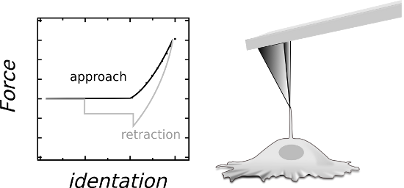
- area at a given indentation depth and A0 the surface area prior to indentation. Static equilibrium can be expressed by the Young–Laplace equation, which describes the pressure difference across the fluid interface as a function of surface tension T and mean curvature. The task is to determine the


The capillary adhesion technique: a versatile method for determining the liquid adhesion force and sample stiffness
Beilstein J. Nanotechnol. 2015, 6, 11–18, doi:10.3762/bjnano.6.2
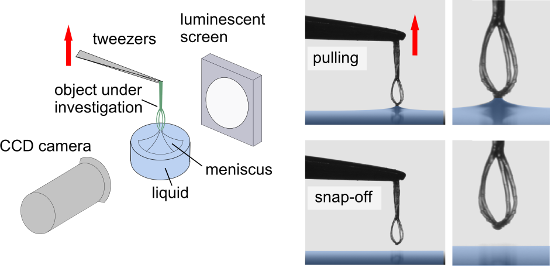
- is required, which consists of the surface energy of the meniscus plus the interface energy of the tip–water contact area minus the surface energy of the original flat air–water interface before formation of the capillary contact. Here, σ = 0.07275 N/m [25] is the surface tension of the liquid (here