


Search results
Search for "wettability" in Full Text gives 127 result(s) in Beilstein Journal of Nanotechnology.
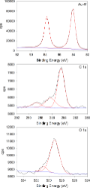
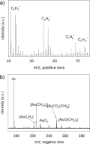
Application of visible-light photosensitization to form alkyl-radical-derived thin films on gold
Beilstein J. Nanotechnol. 2017, 8, 1863–1877, doi:10.3762/bjnano.8.187
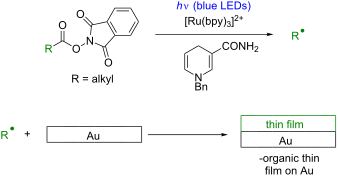
- . Since the film coverage remained the same over a period of 6 months, this suggests that the film is highly robust. Contact angle goniometry. The wettability of both Au–Me and Au–NHBoc thin films on polycrystalline Au slides was investigated by measuring the water contact angles of freshly prepared



Process-specific mechanisms of vertically oriented graphene growth in plasmas
Beilstein J. Nanotechnol. 2017, 8, 1658–1670, doi:10.3762/bjnano.8.166
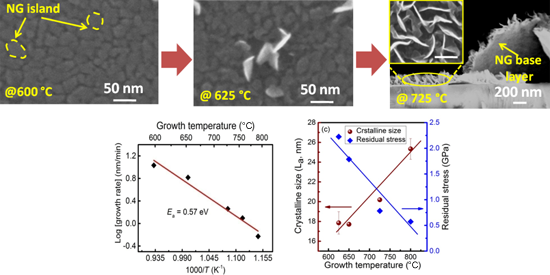
- and the substrate, and (c) increasing the discharge power. The correlation between the wetting characteristics, morphology and structural quality is established. It is also demonstrated that morphology, crystallinity, wettability and sheet resistance of the VGNs can be varied while maintaining the
- , catalysis and energy storage. Keywords: activation energy; plasmas; residual stress; vertical graphene nanosheets; wettability; Introduction Vertical graphene nanosheets (VGNs) consist of interconnected 3D porous networks of vertically oriented graphitic sheets, which are aligned perpendicularly to the


Oxidative stabilization of polyacrylonitrile nanofibers and carbon nanofibers containing graphene oxide (GO): a spectroscopic and electrochemical study
Beilstein J. Nanotechnol. 2017, 8, 1616–1628, doi:10.3762/bjnano.8.161
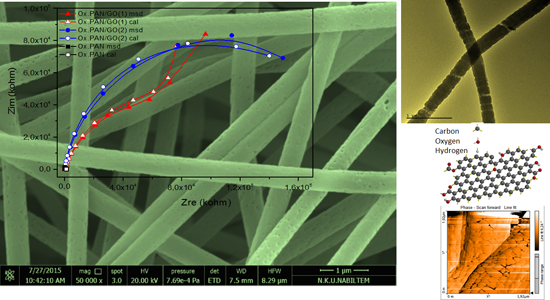
- ]. Graphene oxide has been synthesized from graphite with strong acids and oxidants [24][25]. The oxidation level can be adjusted by modifying reaction conditions and systems, and the type of precursor. Moreover, oxygen functional groups increase wettability and capacitance, but not all of the surface oxygen


Parylene C as a versatile dielectric material for organic field-effect transistors
Beilstein J. Nanotechnol. 2017, 8, 1532–1545, doi:10.3762/bjnano.8.155
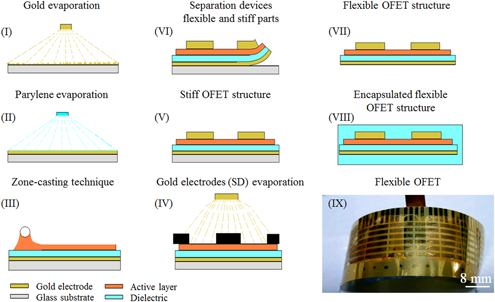
- configuration (0.02 cm2/Vs) [58]. Changes in the surface energy between Parylene C (bottom gate, top contacts) and glass with gold electrodes (top gate, bottom contacts) are the main factor responsible for variations in the organization of semiconductor molecules. Additionally, parameters such as wettability




Micro- and nano-surface structures based on vapor-deposited polymers
Beilstein J. Nanotechnol. 2017, 8, 1366–1374, doi:10.3762/bjnano.8.138
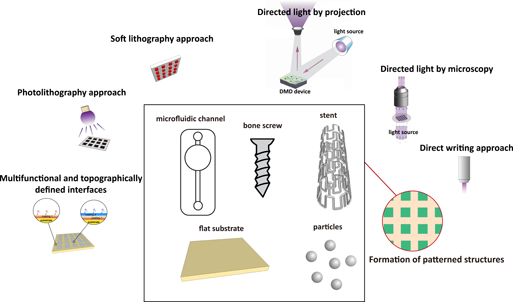
- with μCP or a photomask [49]. Gradient structures Surface gradients represent an advanced surface modification tool to exert gradient activities and/or communicate with the microenvironment using gradually altered cues. Such gradients include physical properties such as the wettability, thickness


Oxidative chemical vapor deposition of polyaniline thin films
Beilstein J. Nanotechnol. 2017, 8, 1266–1276, doi:10.3762/bjnano.8.128
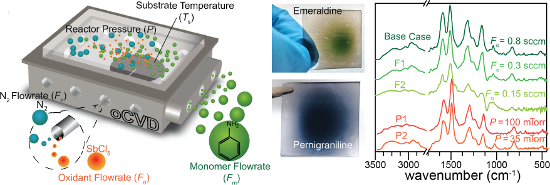
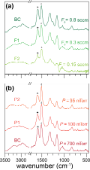
- solvent-based methods becomes considerably more challenging due to the lack of solubility in common commercial solvents, which limits processability and leads to poor wettability. These challenges can be overcome with oxidative chemical vapor deposition (oCVD). oCVD is a single step, solvent-free




Preparation of thick silica coatings on carbon fibers with fine-structured silica nanotubes induced by a self-assembly process
Beilstein J. Nanotechnol. 2017, 8, 1145–1155, doi:10.3762/bjnano.8.116
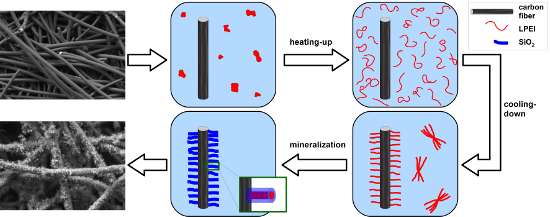
- interactions between substrate and polyamine [28]. The nanograss films on glass were shown to have a potential application for surface wettability design [29][30][31]. In our study we focused on the coating of chopped carbon fibers and carbon fiber felts with silica by polyamine mediation. The polyamine is


Optical response of heterogeneous polymer layers containing silver nanostructures
Beilstein J. Nanotechnol. 2017, 8, 1065–1072, doi:10.3762/bjnano.8.108
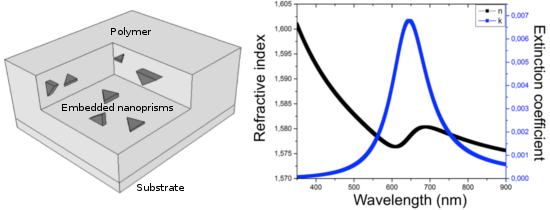
- optical index difference between the substrate and the thin film layer, thus a silicon wafer was chosen. The substrates were cleaned in an ultrasonic bath in acetone and ethanol, dried by nitrogen flow and an oxygen plasma. The latter step also increased the wettability of the substrate. The deposition of


Assembly of metallic nanoparticle arrays on glass via nanoimprinting and thin-film dewetting
Beilstein J. Nanotechnol. 2017, 8, 1049–1055, doi:10.3762/bjnano.8.106
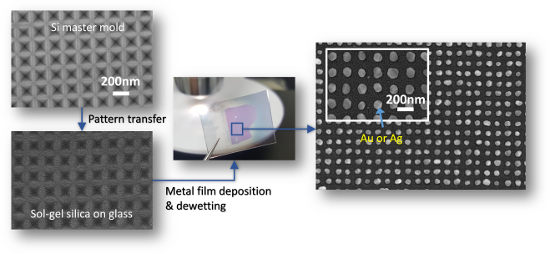
- 184 PDMS. In the next imprinting step, an inorganically cross-linked sol–gel (ICSG) resist with a thickness (tf) of 400 nm was spin-coated on a Pyrex glass substrate. To improve the wettability of the resist, the glass surface was pretreated with a dielectric barrier discharge (DBD) using He and O2


Vapor-phase-synthesized fluoroacrylate polymer thin films: thermal stability and structural properties
Beilstein J. Nanotechnol. 2017, 8, 933–942, doi:10.3762/bjnano.8.95
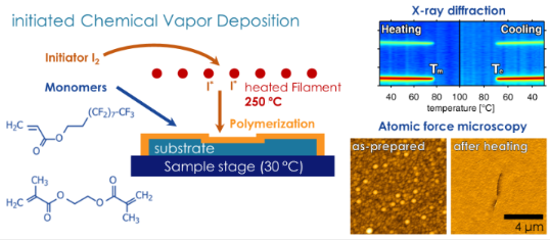
- -PFDA and cross-linked alterations thereof are chemically stable in the investigated temperature range, within the detection limits of the FTIR spectroscopy measurement. Surface morphology and wettability The impact of the cross-linker on the surface morphology of p-PFDA films was investigated by atomic
- , indicating good stability towards temperature variation in the investigated range. Changes in the surface morphology and chemistry also affect the wettability, as evidenced by a decreasing water contact angle (WCA) upon EGDMA addition to the polymer (Figure 4a). While the PFDA homopolymer forms a highly
- PFDA homopolymer. For the EGDMA homopolymer, a WCA of 69 ± 1° was ultimately observed. The change in wettability stems from the (relative) increase of carbonyl groups upon addition of EGDMA, which turns the polymer more hydrophilic. Similar to the morphological changes discussed above, heat treatment


Impact of surface wettability on S-layer recrystallization: a real-time characterization by QCM-D
Beilstein J. Nanotechnol. 2017, 8, 91–98, doi:10.3762/bjnano.8.10
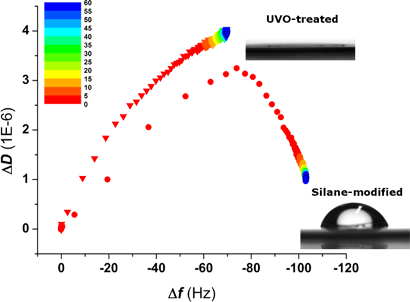
- isolated SbpA bacterial surface proteins onto silicon dioxide substrates of different surface wettability. Surface modification by UV/ozone oxidation or by vapor deposition of 1H,1H,2H,2H-perfluorododecyltrichlorosilane yielded hydrophilic or hydrophobic samples, respectively. Time evolution of frequency
- : bacterial S-layers; Quartz crystal microbalance with dissipation monitoring (QCM-D); recrystallization kinetics; surface wettability; Introduction Crystalline bacterial protein layers (S-layers) are arrays of (glyco)proteins (Mw of 40 to 200 kDa) forming the outermost envelope of prokaryotes, and represent
- yet to be solved about the S-layer recrystallization process under different physico-chemical conditions of the substrate (i.e., wettability or the presence of specific chemical groups and receptors), such as the different adsorption kinetics, crystal domain sizes and lattice symmetry parameters


Morphology of SiO2 films as a key factor in alignment of liquid crystals with negative dielectric anisotropy
Beilstein J. Nanotechnol. 2016, 7, 1743–1748, doi:10.3762/bjnano.7.167
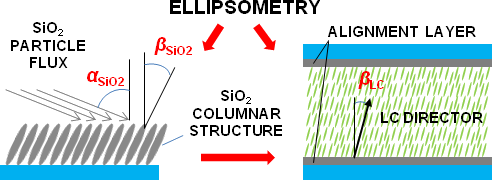
- well-formed columnar structure dominates LC orientation; however, βLC is somewhat larger than βSiO2 which can be caused by good wettability of the orienting surface by the LC [5]. Conclusion To summarize, we investigated the anisotropic optical properties of thin SiO2 layers as a function of the


Surface roughness rather than surface chemistry essentially affects insect adhesion
Beilstein J. Nanotechnol. 2016, 7, 1471–1479, doi:10.3762/bjnano.7.139
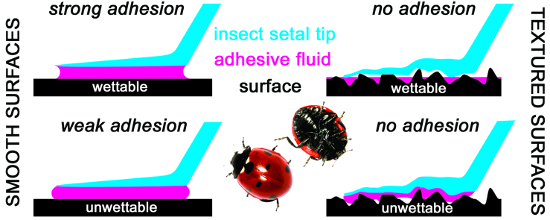
- of surface, each with different chemical and topographical properties. The results of traction force tests clearly demonstrated that chemical surface properties, such as static/dynamic de-wettability of water and oil caused by specific chemical compositions, had no significant effect on the
- surface could move, without pinning, more smoothly than they could on a smooth FAS17 surface (Δθ = 13°). The relationships between surface wettability and chemical composition of our sample surfaces were established using XPS. The surface chemical compositions of each sample are summarized in Table 2. All
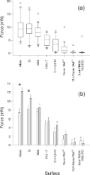
- , rather than C and F concentrations, had the strongest influence upon surface wettability. Based on the surface chemical and physical properties of our samples shown above, we next examined the attachment ability of Coccinella septempunctata beetles by measuring their traction forces on these surfaces



Effect of tetramethylammonium hydroxide/isopropyl alcohol wet etching on geometry and surface roughness of silicon nanowires fabricated by AFM lithography
Beilstein J. Nanotechnol. 2016, 7, 1461–1470, doi:10.3762/bjnano.7.138
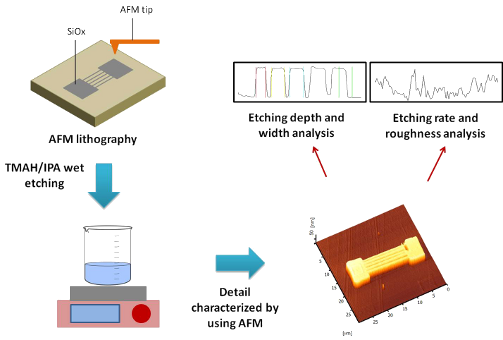
- generated bubbles coming off the near the SOI surface, influencing the surface roughness [7][29]. The density and size of hillocks is influenced by the hydrogen bubble formation during the etching process. The addition of IPA produces a smooth surface (Figure 9) because it promotes the wettability of the




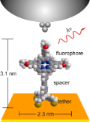
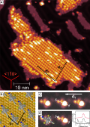
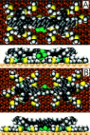
Rigid multipodal platforms for metal surfaces
Beilstein J. Nanotechnol. 2016, 7, 374–405, doi:10.3762/bjnano.7.34











Synthesis and applications of carbon nanomaterials for energy generation and storage
Beilstein J. Nanotechnol. 2016, 7, 149–196, doi:10.3762/bjnano.7.17
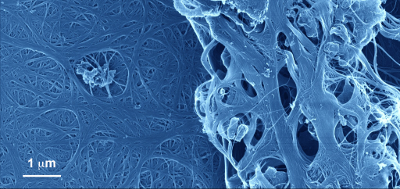
- graphite exfoliation if mixed with particular solvents such as water. Specifically, they can change the wettability and prevent aggregation due to electrostatic repulsion [95]. The main problem with the liquid-phase exfoliation method is that it produces graphene for films that is not completely















Nanostructured surfaces by supramolecular self-assembly of linear oligosilsesquioxanes with biocompatible side groups
Beilstein J. Nanotechnol. 2015, 6, 2377–2387, doi:10.3762/bjnano.6.244
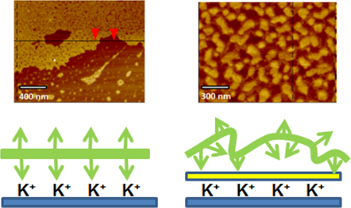
- underlying matrix. For example, surfaces carrying COOH groups were applied for studies on the effect of surface wettability on protein adsorption and adhesion of human umbilical vein endothelial cells (HUVECs) and HeLa cells [3], human fibroblasts [14], human mesenchymal stem cells [15][22], corneal
- Owens–Wendt geometric mean Equation S1 described in Supporting Information File 1 [55]). We have previously reported [37][38] that the very good wettability of mica coated with LPSQ-COOH is a result of the structure of adsorbed nanolayers and the fact that carboxylic groups attached to oligomers of LPSQ
- -COOH adopt a specific conformation at the interface with air. We have analysed the wettability of samples covered with other LPSQ-COOH/X schemes (Figure 2) to find that, in spite of their different morphology, they exhibit almost the same surface energy and the ratio between polar and dispersive forces




Nanostructured superhydrophobic films synthesized by electrodeposition of fluorinated polyindoles
Beilstein J. Nanotechnol. 2015, 6, 2078–2087, doi:10.3762/bjnano.6.212
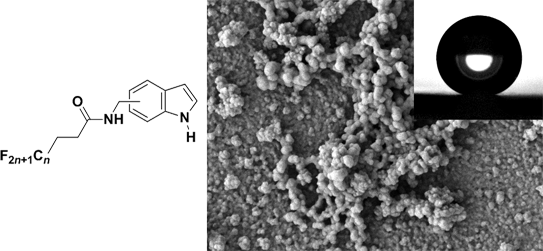
- advantages such as an easiness to functionalize and opto-electronic properties [16] with the possibility to introduce various dopants (smart materials) [17][18]. Conducting polymers are also exceptional materials for the control of surface nanostructures and wettability. First of all, nanostructures of
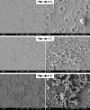
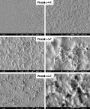
- during the reaction and the polymerization is not favorable. Surface structures and wettability The surface structures were characterized by scanning electron microscopy (SEM) and surface roughness measurements. The SEM images for Qs = 100 mC·cm−2 are given in Figure 3 and Figure 4 and the surface
- first instance [26][34]. Hence, higher roughness of PIndole-6-Fn can be explained by the formation of longer polymer chains. PIndole-5-F4 and PIndole-6-F4 also showed an increase in roughness for normalized charges of 50 and 100 mC·cm−2 without significant changes in the wettability comparing the others




Possibilities and limitations of advanced transmission electron microscopy for carbon-based nanomaterials
Beilstein J. Nanotechnol. 2015, 6, 1541–1557, doi:10.3762/bjnano.6.158
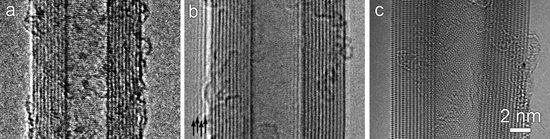
- triangular shaped nanoparticles on CNT walls with an increased area at the contact interface, and Ti forms an amorphous film with continuous coverage around the CNTs. These results are further associated with the wettability of different metals on the CNT surface and explained by electron affinity and
- reported that the deformation of Au-contacted CNT walls is more prominent compared to Pd-contacted CNT walls (not shwon), which could be associated to higher wettability of Pd over Au nanoparticles on one hand. On the other hand, a deformation mechanism through elastic strain relaxation is also proposed


Applications of three-dimensional carbon nanotube networks
Beilstein J. Nanotechnol. 2015, 6, 792–798, doi:10.3762/bjnano.6.82
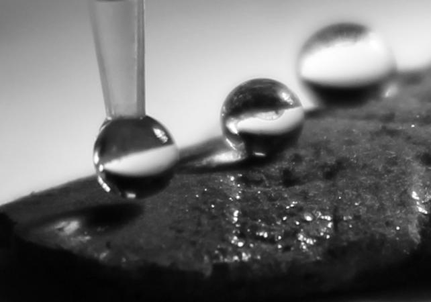
- wettability is well described by a Cassie–Baxter model [20] for which a quite rough surface allows air trapping and ensures the high contact angle measured. In particular, in such a system pores in the random network (i.e., void fraction) favor air trapping due to the strong capillary force that the surface


Self-assembled anchor layers/polysaccharide coatings on titanium surfaces: a study of functionalization and stability
Beilstein J. Nanotechnol. 2015, 6, 617–631, doi:10.3762/bjnano.6.63
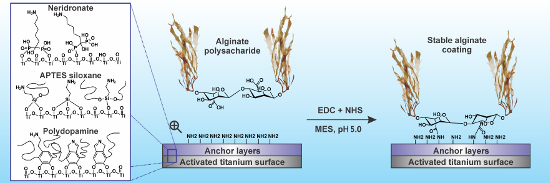
- wettability of the surface, yielding enhanced osteoblast differentiation [19]. The success of these modifications is highly dependent on the chemical state, reactivity and surface concentration of the hydroxy groups, as well as the presence of contaminants [12]. Therefore, one of the main objectives of this
- angle measurement: The wettability of the organic surfaces on flat, titanium reference surfaces was examined by a static sessile water drop method using a DataPhysics OCA 20 contact angle system. Each sample was characterized using four 3 μL drops of material. The data were evaluated using the Young
- –Laplace method. The wettability of the commercially available, rough titanium substrates upon different treatments was estimated by measuring the advancing and receding water contact angles utilizing the dynamic Wilhelmy plate method. The measurements were performed on a Kruss K12 (Germany) tensiometer


Synergic combination of the sol–gel method with dip coating for plasmonic devices
Beilstein J. Nanotechnol. 2015, 6, 500–507, doi:10.3762/bjnano.6.52
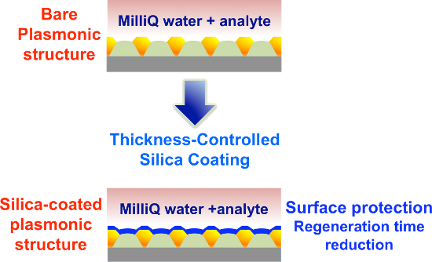
- , which affects film wettability, and the sol dilution. This change in the contact angle is probably due to the modification of the silica microstructure induced by an increase of the ethanol concentration, which is also supported by the decrease of the refractive index values for films prepared from
- , the fresh films deposited on the glass substrate were cut with a scalpel. After 48 h at room temperature, this cut on the film was observed by AFM for the thickness estimation. The evaluation of the surface roughness and thickness was performed by using WSxM 5.0 Develop3.2 software. The wettability of


Conformal SiO2 coating of sub-100 nm diameter channels of polycarbonate etched ion-track channels by atomic layer deposition
Beilstein J. Nanotechnol. 2015, 6, 472–479, doi:10.3762/bjnano.6.48
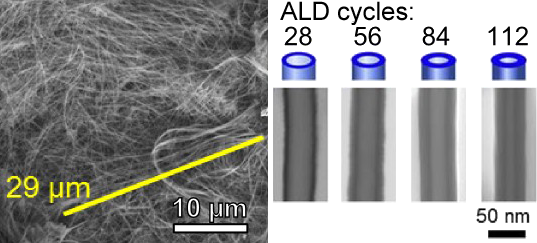
- aspect ratio nanochannels with SiO2 films of a few nanometres thickness in a tailored manner. This information is of great relevance for ALD applications on high-aspect-ratio nanochannels in general as well as for the development of further chemical modifications on the SiO2 coating. Wettability The
- wettability of uncoated and SiO2-coated track-etched membranes was investigated by contact angle measurements. Figure 6 shows the contact angle as a function of the number of ALD cycles. The contact angle decreases with increasing thickness of the SiO2 layer, evidencing that the membrane surface changes its
- character from hydrophobic to hydrophilic. Above a layer thickness of about 7 nm, the surface shows excellent wettability. Conclusion Cylindrical nanochannels in polycarbonate track-etched membranes with diameter of about 50 nm were conformally coated with SiO2 layers of thickness 5, 10, 15, and 18 nm by


In situ scanning tunneling microscopy study of Ca-modified rutile TiO2(110) in bulk water
Beilstein J. Nanotechnol. 2015, 6, 438–443, doi:10.3762/bjnano.6.44
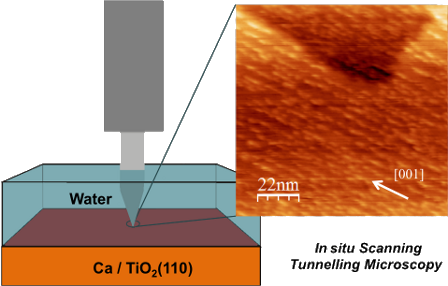
- application of Ti-based biomaterials, since the augmented wettability would enhance the interaction between the implant surface and the biological environment. In this paper we present an in situ STM investigation of a Ca overlayer thermally grown in UHV on the TiO2(110) rutile surface and then immersed in


Exploiting the hierarchical morphology of single-walled and multi-walled carbon nanotube films for highly hydrophobic coatings
Beilstein J. Nanotechnol. 2015, 6, 353–360, doi:10.3762/bjnano.6.34
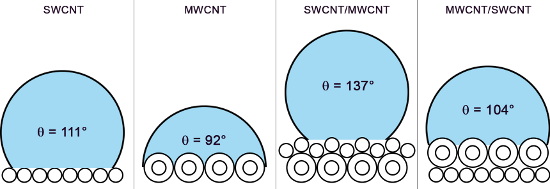
- wettability. It is indeed well-established [12][13] that on composite rough surfaces a hierarchical morphology may induce a wetting transition from Wenzel [1] to Cassie–Baxter [9] state owing to air trapping. Moreover, this transition may occur by passing through thermodynamically metastable states [13][14
- film [44] that enhances the wettability of the carbon nanotube surface, when the interaction with the liquid is lipophilic. Furthermore, we studied the stability of our carbon nanotube films over time by performing suction experiments. Figure 5 reports the variations of the contact angle value as a





