Search results
Search for "Ne" in Full Text gives 111 result(s) in Beilstein Journal of Nanotechnology.
Continuum models of focused electron beam induced processing
Beilstein J. Nanotechnol. 2015, 6, 1518–1540, doi:10.3762/bjnano.6.157
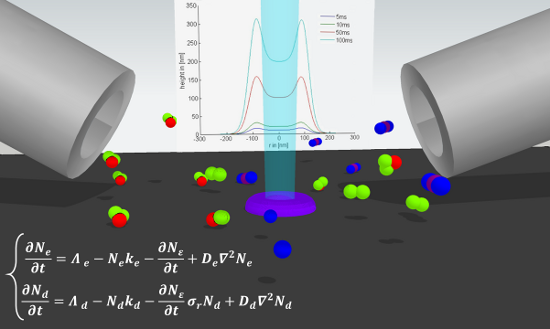
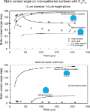
- implemented in Equation 29–Equation 31. This is illustrated in Figure 11a for the case where Pe >> Pd and Ee << Ed. Initially, Ne increases much more rapidly than Nd because Pe >> Pd (and hence Fe >> Fd). However, at times greater than ca. 10−4 s the increase in Nd causes a corresponding decrease in Ne


![[Graphic 37]](/bjnano/content/inline/2190-4286-6-157-i117.png?max-width=637&scale=1.18182) and chemisorbed
and chemisorbed ![[Graphic 38]](/bjnano/content/inline/2190-4286-6-157-i118.png?max-width=637&scale=1.18182) adsorbates versus pressure, calcul...
adsorbates versus pressure, calcul...


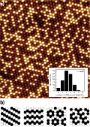
Enhanced fullerene–Au(111) coupling in (2√3 × 2√3)R30° superstructures with intermolecular interactions
Beilstein J. Nanotechnol. 2015, 6, 1421–1431, doi:10.3762/bjnano.6.147
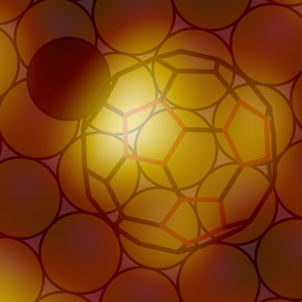
- of the ac tunnelling current achieved by modulating the sample bias after switching off the feedback loop. The single crystal Au(111) substrate (MaTecK, Germany) was cleaned in UHV by cycles of Ne+ ion sputtering (1 kV, 10 min) and thermal annealing (600 °C, 20 min). The cleanliness was checked by


Combination of surface- and interference-enhanced Raman scattering by CuS nanocrystals on nanopatterned Au structures
Beilstein J. Nanotechnol. 2015, 6, 749–754, doi:10.3762/bjnano.6.77
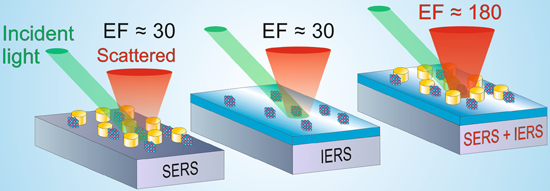
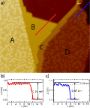
- a size of 1 µm2) in a backscattering geometry at room temperature. He-Cd, Ar+, DPSS Cobolt®, and He–Ne lasers with wavelengths of 325, 514.5, 514.7, and 632.8 nm, respectively, and power below 2 mW were used for excitation. A typical Raman spectrum of the dense ensemble of CuS NCs (about 5–6 MLs) on


Graphene quantum interference photodetector
Beilstein J. Nanotechnol. 2015, 6, 726–735, doi:10.3762/bjnano.6.74
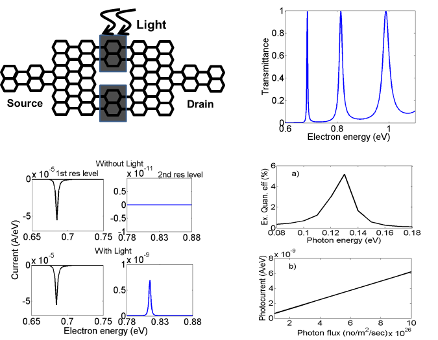
- used Na = 1.136 nm (12 atoms), Nb = 5.396 nm (52 atoms), Nc = 0.986 nm (10 atoms), Nd = 1.968 nm (18 atoms) and Ne = 1.136 nm (12 atoms). For the armchair-type, Na = 0.738 nm (7 atoms), Nb = 2.214 nm (19 atoms), Nc = 0.71 nm (8 atoms), Nd = 4.97 nm (48 atoms) and Ne = 0.738 nm (7 atoms) were used. The




Synthesis of Pt nanoparticles and their burrowing into Si due to synergistic effects of ion beam energy losses
Beilstein J. Nanotechnol. 2014, 5, 1864–1872, doi:10.3762/bjnano.5.197
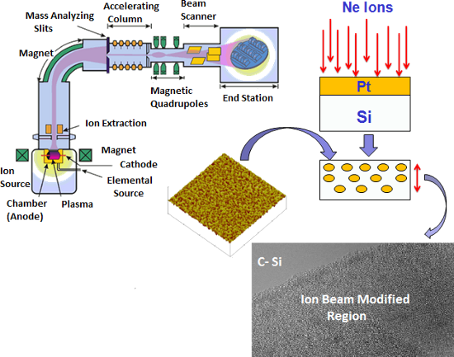
- irradiation were 50, 140, 350 and 600 keV. For 350 keV and 600 keV ion irradiations, Ne+2 and Ne+3 ions were extracted from the ECR plasma and E/q values (the total potential difference including extraction and platform voltages) were set to 175 kV and 200 kV, respectively. The extraction of highly charged
- of silicon vacancies. The 50 keV neon ions were irradiated at normal incidence on 5 nm Pt film deposited on silicon substrate. The distribution of Pt recoils (Pt/cm3 per Ne/cm2). The 50 keV neon ions were irradiated at normal incidence on 5 nm Pt film deposited on the silicon substrate. The XRD



Optical and structural characterization of oleic acid-stabilized CdTe nanocrystals for solution thin film processing
Beilstein J. Nanotechnol. 2014, 5, 881–886, doi:10.3762/bjnano.5.100
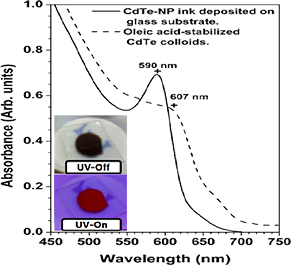
- spectroscopy was carried out also on drop-cast samples by using a Horiba Jobin-Yvon system with an Olympus BX40 microscope, employing the 632 nm He–Ne laser wavelength. a) TEM micrograph of CdTe nanocrystals, the inset shows the indexed electron diffraction pattern, b) TEM image of CdTe nanocrystals used to
- determinate the lattice parameter. The inset shows the 3.23 Å (200) lattice parameter. CdTe deposition with and without UV illumination under ambient conditions. X-ray diffraction pattern of deposited CdTe nanocrystals. Raman spectrum of drop-cast CdTe nanocrystals measured with a 632 nm He–Ne laser


A catechol biosensor based on electrospun carbon nanofibers
Beilstein J. Nanotechnol. 2014, 5, 346–354, doi:10.3762/bjnano.5.39
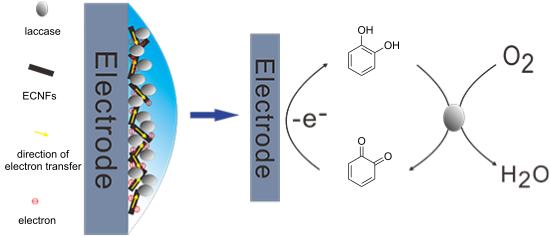
- electron microscope (FE-SEM) was used to examine the surface morphologies of the ECNFs and the laccase–Nafion–ECNFs/GCE. The Raman spectrum analysis was carried out at room temperature using a 3D Nanometer Scale Raman PL Microspectrometer (Tokyo Instruments, Inc., with a 785 nm He–Ne laser). Fourier


Structural, electronic and photovoltaic characterization of multiwalled carbon nanotubes grown directly on stainless steel
Beilstein J. Nanotechnol. 2012, 3, 360–367, doi:10.3762/bjnano.3.42
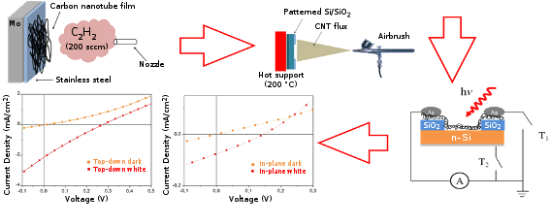
- silicon photodiode and data were collected by a lock-in technique. The external quantum efficiency (EQE) is defined as the fraction of the incident photons, Nph, converted into photocurrent, i.e., the number of the generated electron–hole pairs, Ne–h, multiplied by the electronic charge, e. The number of


Current-induced forces in mesoscopic systems: A scattering-matrix approach
Beilstein J. Nanotechnol. 2012, 3, 144–162, doi:10.3762/bjnano.3.15
- matrix can be split into an “equilibrium” contribution, γs,eq, and a purely nonequilibrium contribution γs,ne, as γs = γs,eq + γs,ne. We first treat γs,eq. By the calculations given in Supporting Information File 1, Section B, we obtain where we have used ∑α′Πα′ = 1, S†S = 1, and Equation 34 in the last
- express γs,ne in terms of S-matrix quantities, we have to make use of the A-matrix defined in Equation 33. Again the details are given in Supporting Information File 1, Section B, where we find, after lengthy manipulations, that This quantity vanishes in equilibrium, as can be shown by using the
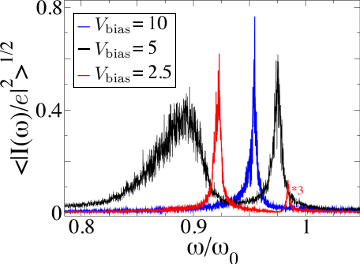
- out-of-equilibrium situations. This is due to a negative contribution of γs,ne to the total damping. This is visualized in Figure 4b and Figure 4d. Negative damping is possible when both dot levels are inside the conduction window, restricting the region in X over which negative damping can occur

![[Graphic 55]](/bjnano/content/inline/2190-4286-3-15-i141.png?max-width=637&scale=1.18182) can be tuned by the bias voltage. We consider...
can be tuned by the bias voltage. We consider...


Towards multiple readout application of plasmonic arrays
Beilstein J. Nanotechnol. 2011, 2, 501–508, doi:10.3762/bjnano.2.54
- setup (HR LabRam invers, Jobin-Yvon-Horiba). The spectrometer has an entrance slit of 100 µm, a focal length of 800 mm, and is equipped with a 300 line mm−1 grating. The 633 nm line of a He–Ne laser (Coherent) with a laser power of ~600 µW incident on the sample was used for excitation. The Raman


Biomimetics inspired surfaces for drag reduction and oleophobicity/philicity
Beilstein J. Nanotechnol. 2011, 2, 66–84, doi:10.3762/bjnano.2.9
- water into the channel in laminar flow, a syringe pump (Model NE-300, New Era Pump Systems Inc., USA) was used at a range of flow rates between 50 μL/s and 400 μL/s (a range of flow velocity between 0.03 m/s and 0.23 m/s). The Reynolds number of the flow applied by the syringe pump was less than 300