Search results
Search for "TEM" in Full Text gives 861 result(s) in Beilstein Journal of Nanotechnology. Showing first 200.
Determination of the radii of coated and uncoated silicon AFM sharp tips using a height calibration standard grating and a nonlinear regression function
Beilstein J. Nanotechnol. 2023, 14, 1200–1207, doi:10.3762/bjnano.14.99
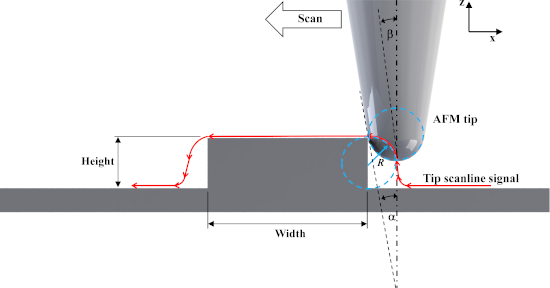
- relation to the PSD were collected to observe the tip blunting behavior. The quantitative determination of the tip radii compared to transmission electron microscopy (TEM) images of the tips showed corresponding results between the blunted tips and the PSD curves, concluding that blunter tips produced a


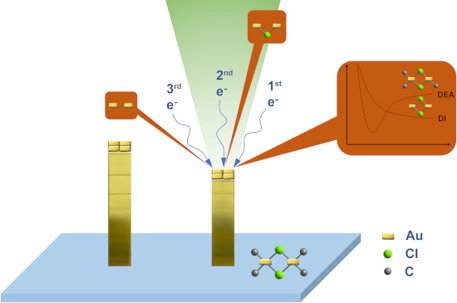
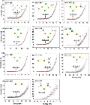
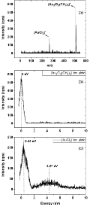
A combined gas-phase dissociative ionization, dissociative electron attachment and deposition study on the potential FEBID precursor [Au(CH3)2Cl]2
Beilstein J. Nanotechnol. 2023, 14, 1178–1199, doi:10.3762/bjnano.14.98



Sulfur nanocomposites with insecticidal effect for the control of Bactericera cockerelli
Beilstein J. Nanotechnol. 2023, 14, 1106–1115, doi:10.3762/bjnano.14.91
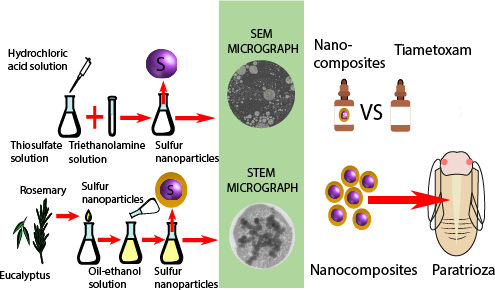
- eucalyptus and rosemary at different concentrations. Characterizations were carried out through UV–visible spectroscopy, energy-dispersive X-ray spectroscopy (EDS), transmission electron microscopy (TEM), and scanning electron microscopy (SEM); also the insecticidal efficacy of the NCMPs for the control of
- , and O, corresponding to the by-products of the reduction of sodium thiosulfate to sulfur (see Experimental section), were found [19][31][34]. Carbon is from the substrate used in the EDS analysis [35][36]. The TEM micrograph in Figure 3a reveals the formation of spherical SNPs that agglomerate into
- distribution were calculated. UV–vis spectrum of SNPs. (a) SEM micrograph and (b) EDS spectrum of synthesized SNPs. (a) TEM micrograph of synthesized SNPs and (b) density function. STEM micrographs (left) and density plots (right) of eucalyptus nanocomposites with oil concentrations of (a) 0.25%, (b) 0.5%, and


Nanoarchitectonics of photothermal materials to enhance the sensitivity of lateral flow assays
Beilstein J. Nanotechnol. 2023, 14, 988–1003, doi:10.3762/bjnano.14.82
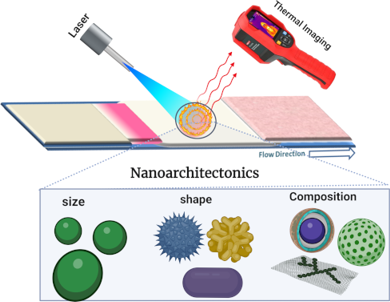
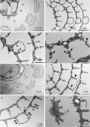
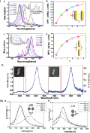
- of the Creative Commons Attribution-NonCommercial-NoDerivatives 4.0 International License, https://creativecommons.org/licenses/by-nc-nd/4.0/). This content is not subject to CC BY 4.0.) Shape-dependent photothermal properties. TEM image of gold nanostructures (A). (Figure 6A was adapted from [61
- Commons Attribution 4.0 International License, https://creativecommons.org/licenses/by/4.0).). TEM images of gold crosses (E). (Figure 6D and E was reprinted with permission from [62], Copyright 2011 American Chemical Society. This content is not subject to CC BY 4.0.). Absorbance and TEM images of


Isolation of cubic Si3P4 in the form of nanocrystals
Beilstein J. Nanotechnol. 2023, 14, 971–979, doi:10.3762/bjnano.14.80
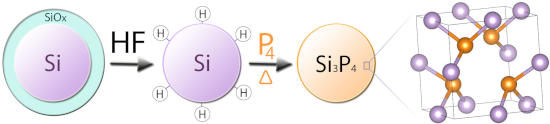
- nanoparticles with a defective zinc blende structure under mild conditions through thermal annealing of hydrogenated silicon nanoparticles with red phosphorus. The synthesized Si3P4 nanoparticles were analyzed using FTIR, XRD, electron diffraction, EDX, TEM, Raman spectroscopy, X-ray fluorescence spectrometry
- Si3P4 decomposition, sample SP670 as well as the freshly prepared sample SP550 were selected for the TEM studies. A typical TEM bright-field image is shown in Figure 6a. The particles show a profound tendency to agglomerate, not unlike the parent oxidized Si NPs [38]. The agglomeration obstructs size
- control over the width of the bandgap through selection of the composition. Conclusion A synthesis of freestanding Si3P4 NPs with cubic crystal structure was successfully carried out and corroborated by XRD, TEM, EDX, electron diffraction, and Raman spectroscopy. The cell parameter of the experimentally


Upscaling the urea method synthesis of CoAl layered double hydroxides
Beilstein J. Nanotechnol. 2023, 14, 927–938, doi:10.3762/bjnano.14.76
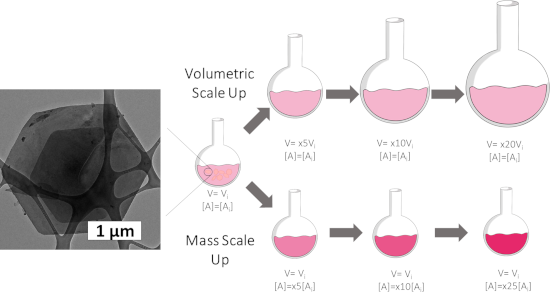
- CoAl-LDH synthesis method. We thoroughly study the effects of the mass scale-up (25-fold: up to 375 mM) and the volumetric scale-up (20-fold: up to 2 L). For this, we use a combination of several structural (XRD, TGA, and N2 and CO2 isotherms), microscopic (SEM, TEM, and AFM), magnetic (SQUID), and
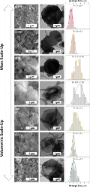
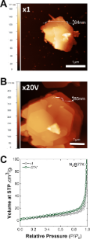
- CoAl-based LDH synthesis through an ARR method had been demonstrated, morphological aspects were addressed by means of scanning electron microscopy (SEM), transmission electron microscopy (TEM), and atomic force microscopy (AFM) (Figure 4 and Figure 5). For reference x1, well-defined hexagonal single
- corresponding structure. Microscopy Sample preparation The dried solids were suspended in ethanol and drop cast onto Au TEM grids covered with a lacy carbon film, and the solvent was left to evaporate. SEM samples were prepared from the same solution after 5 min of ultrasonication. The sonicated suspension was


Green SPIONs as a novel highly selective treatment for leishmaniasis: an in vitro study against Leishmania amazonensis intracellular amastigotes
Beilstein J. Nanotechnol. 2023, 14, 893–903, doi:10.3762/bjnano.14.73
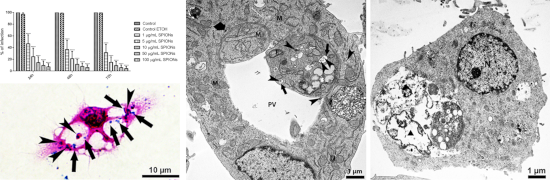
- , arrowheads). The ferrous nature of the observed structures was assessed by chemical element mapping analysis using energy-dispersive X-ray spectroscopy (Figure 2C), confirming that the electron-lucent structures contain iron atoms (Figure 2D). Transmission electron microscopy (TEM) was used to confirm the
- internalization of the SPIONs. First, promastigotes were treated with 100 µg/mL of SPIONs for 24 h (Figure 3A–C). TEM images confirmed the presence of SPION aggregates randomly distributed throughout the cytoplasm of the promastigotes (Figure 3A–C, arrowheads). The images suggest that these aggregates have
- , different from most compounds, drugs, and nanomaterials developed in the last decades. During TEM analyses, we observed that intracellular amastigotes were undergoing substantial ultrastructural alterations (Figure 5) when treated with SPIONs. These alterations include (1) accumulation of lipid bodies, (2


Ultralow-energy amorphization of contaminated silicon samples investigated by molecular dynamics
Beilstein J. Nanotechnol. 2023, 14, 834–849, doi:10.3762/bjnano.14.68
- substantially more controllable at low energies [10][11], which also makes such beams valid candidates for these processes. Another application includes lamella preparation for transmission electron microscopy (TEM). TEM and scanning electron microscopy (SEM) have high constraints regarding cleanliness [12
- ]. TEM samples require a small thickness [13] to be electron transparent and are usually prepared through ion milling processes [14][15], which rely heavily on the precise ablation of materials to preserve the crystalline structure of the analyzed sample. These samples, usually shaped as lamellas, are
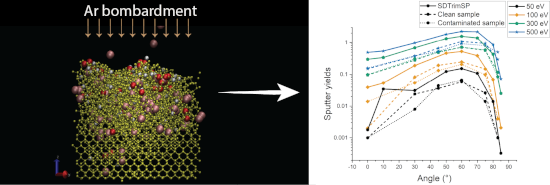
- example, for the preparation of TEM samples. Furthermore, we performed binary collision approximation (BCA) simulations on pristine silicon using the SDTrimSP code [49]. In Figure 10, the sputtering yields are plotted, as well as a comparison between the three sputtering simulations of the silicon sample




Nanostructured lipid carriers containing benznidazole: physicochemical, biopharmaceutical and cellular in vitro studies
Beilstein J. Nanotechnol. 2023, 14, 804–818, doi:10.3762/bjnano.14.66
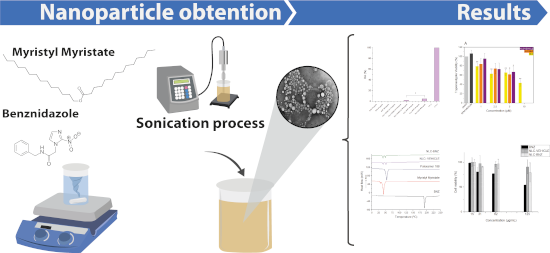
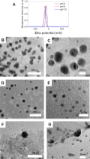
- different types of nanoparticles and BNZ, including SLN and NLC [21]. The NLC-BNZ formulation was analyzed using transmission electron microscopy (TEM) to confirm the presence of nanoparticles showing a spherical morphology and a narrow distribution of sizes (Figure 1). Image analysis through ImageJ [22
- increasing in the third month up to 155 nm. The Z-average parameter was chosen to report the nanoparticles size. The size values were consistent with the TEM image analysis. The zeta potential (ζ) was measured by Doppler anemometry and operated as a report of the formulation surface characteristics. The
- with acceptable particle size, PdI, and EE%. Complementary to these results, TEM images showed a spherical configuration. Thermal and crystallographic experiments indicated that BNZ was dispersed into the lipid matrix. The formulations showed a sustained drug release profile for 24 h, achieving a


Silver nanoparticles loaded on lactose/alginate: in situ synthesis, catalytic degradation, and pH-dependent antibacterial activity
Beilstein J. Nanotechnol. 2023, 14, 781–792, doi:10.3762/bjnano.14.64
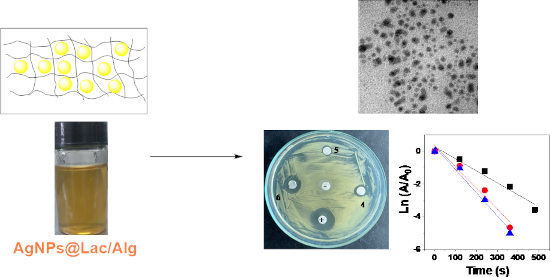
- occurred at 187 and 183 °C, respectively. These results suggest that the nanocomposites should be used in temperature regions below 200 °C. TEM images and size distributions of AgNPs@Lac/Alg are displayed in Figure 5. The TEM images demonstrate the presence of uniformly shaped spherical AgNPs. The size
- 10. The zeta potentials of the nanocomposite were −23.3, −27.5, and −13.3 mV at pH 4, 6, and 12, respectively, indicating that the stability of the nanocomposite was low in highly acidic and basic media, leading to the aggregation of nanoparticles. TEM images demonstrated significant variations in
- morphology of the nanocomposites was investigated using transmission electron microscopy (TEM) with a JEOL JEM-1400 instrument. Thermal analysis, including thermogravimetry analysis (TGA) and differential scanning calorimetry (DSC), was conducted using a LabSys Evo 1600 thermal analyzer (SETARAM, France


Carboxylic acids and light interact to affect nanoceria stability and dissolution in acidic aqueous environments
Beilstein J. Nanotechnol. 2023, 14, 762–780, doi:10.3762/bjnano.14.63
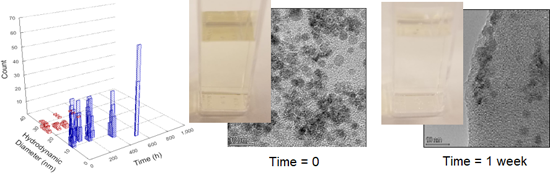
- representative of particle dissolution, due to the valence state change from Ce4+ to Ce3+ during dissolution. The particles in citric acid exposed to light were completely dissolved after four weeks as indicated by DLS and transmission electron microscopy (TEM), shown in Table 1 and Table 2, respectively. In
- aggregation of nanoceria was also shown by Muhammad and co-workers [35]. TEM analysis TEM analysis was conducted on two samples, citric and β-hydroxybutyric acid, to compare to the DLS results. They were chosen to represent samples from groups one and four. In the presence of light, nanoceria exposed to
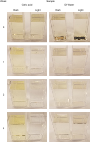
- citric acid did not agglomerate and completely dissolved within two weeks. In contrast, particles exposed to β-hydroxybutyric acid agglomerated within four weeks. Shown in Table 2 are TEM images at varying magnifications of each sample exposed to light or stored in the dark. Nanoceria particles exposed
In situ magnesiothermic reduction synthesis of a Ge@C composite for high-performance lithium-ion batterie anodes
Beilstein J. Nanotechnol. 2023, 14, 751–761, doi:10.3762/bjnano.14.62
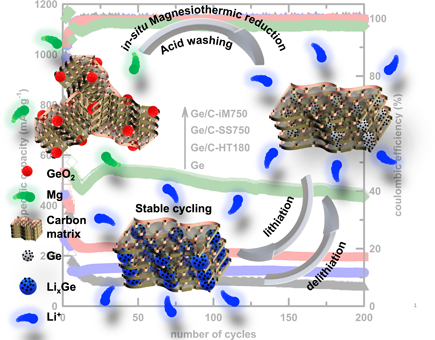
- demonstrate the enhanced contact between the in situ formed Ge and the carbon matrix, which promotes conductivity, accommodates volume variation, and ultimately improves the electrochemical performance of the material. The morphology of the materials was observed using FE-SEM and HR-TEM. As shown in Figure 2a
- , the spherical Ge nanoparticles are quite uniform, with dimensions of several nanometers. In Figure 2b, the composite Ge/C-iM750 combines Ge nanoparticles with porous activated carbon. The texture of Ge@C composites was observed using TEM. According to Figure 2d–f, the Ge nanoparticles in Ge/C-iM750
- microscopy (HR-TEM, JEOL JEM-2100F) were conducted for morphology and particle size investigation. A well-blended mixture of active material, conductive carbon C65, and polyvinylidene fluoride (PVDF) binder with a mass ratio of 75:15:10 in N-methyl-2-pyrrolidone solvent was used for fabricating the working


Control of morphology and crystallinity of CNTs in flame synthesis with one-dimensional reaction zone
Beilstein J. Nanotechnol. 2023, 14, 741–750, doi:10.3762/bjnano.14.61
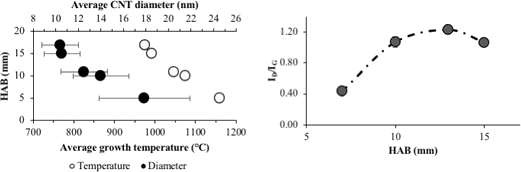
- source, showed that different growth temperatures produce CNTs with similar crystallinity. In a study by Chong et al. [12], the combustion of propane in a premixed flame at varying equivalence ratios yielded similar effects on CNT growth, while transmission electron microscopy (TEM) analysis showed a


A graphene quantum dots–glassy carbon electrode-based electrochemical sensor for monitoring malathion
Beilstein J. Nanotechnol. 2023, 14, 701–710, doi:10.3762/bjnano.14.56
- significantly. Therefore, it can be inferred that not only quantum size effects, but also defects on the surface, contribute to the PL in GQDs. Size and morphology of GQDs were characterized using TEM and AFM. The TEM micrographs shown in Figure 3a confirm the formation of evenly dispersed GQDs with almost
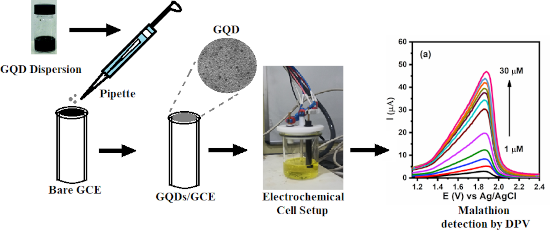
- -based nanosensor described here could be used in future to develop portable monitoring systems for water contamination. Fabrication of the GQDs/GCE electrochemical nanosensor for the detection of malathion. (a) UV–vis absorption spectrum and (b) photoluminescence spectra of GQDs. (a) TEM image, (b) size
- electrode materials.a Acknowledgements The authors would like to thank Mr. Sumit Sharma, Research Scholar, IIT Bombay for XRD and TEM imaging. Author Contributions Sanju Tanwar: conceptualization, research methodology, experimental design, electrochemical investigation, original draft writing and


Titania nanoparticles for photocatalytic degradation of ethanol under simulated solar light
Beilstein J. Nanotechnol. 2023, 14, 616–630, doi:10.3762/bjnano.14.51
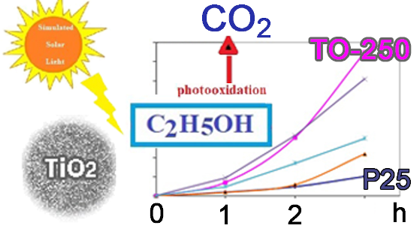
- with high purity, which did not require thermal treatment after synthesis (ca. 1 atom % of impurities). These nanoparticles show an increased anatase phase content (77.33–87.42%) and crystallite sizes of 23–45 nm. The TEM images showed that in both series small crystallites form spheroidal
- , respectively, with increasing pressure in the reaction chamber. The TEM analysis reveals that the TiO2 crystallites tend to arrange in bigger spherical particles (Figure 2a,b). This tendency is more pronounced as the pressure in the reaction chamber increases. The average particles sizes for TO-250-a, TO-450-a
- diffraction (XRD) patterns, measured by an X-ray diffractometer Panalytical X’Pert MPD theta–theta, and the morphological properties were determined by transmission electron microscopy (TEM), high-resolution transmission electron microscopy (HRTEM), and selected-area electron diffraction (SAED) measurements




ZnO-decorated SiC@C hybrids with strong electromagnetic absorption
Beilstein J. Nanotechnol. 2023, 14, 565–573, doi:10.3762/bjnano.14.47
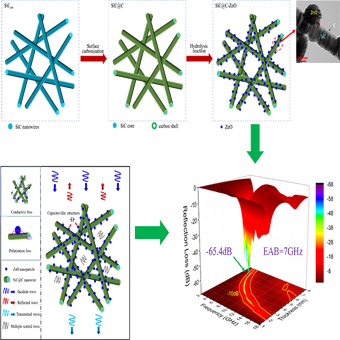
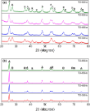
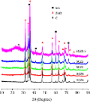
- of SiC nanomaterials through surface carbonization of SiC nanowires and hydrolysis. SiC@C-ZnO composites were synthesized with different dosages of ZnNO3·6H2O. Composition, microstructure, and electromagnetic properties of the composites were characterized and analyzed. Results from TEM and XRD show
- of Si atoms from SiCnw in the carbonization atmosphere containing a low concentration of chlorine gas [24]. Figure 2 shows TEM and HRTEM images of the final SiC@C-ZnO samples. The SCZ samples are composed of SiC, carbon, and ZnO particles. Obviously, the hybrids are characterized by SiC cores and
- Zn 2p1/2, respectively. This proves that Zn exists in the form of Zn2+ [33]. Besides, it is obvious that the relative intensity of the two Zn 2p peaks gradually increases as a function of the ZnNO3·6H2O dosage, suggesting an increasing fraction of ZnO in the samples. This is consistent with the TEM


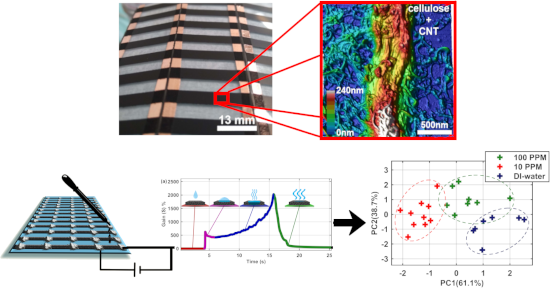
Carbon nanotube-cellulose ink for rapid solvent identification
Beilstein J. Nanotechnol. 2023, 14, 535–543, doi:10.3762/bjnano.14.44
- and Centro de Microscopia-UFMG for providing the SEM and TEM images included in Supporting Information File 1. Funding The authors also would like to thank Fapemig (Rede 2D and individual projects), INCT Nanomateriais de Carbono, CNPq/MCT, Petrobras, BNDES and CAPES for the funding support. APMB


On the use of Raman spectroscopy to characterize mass-produced graphene nanoplatelets
Beilstein J. Nanotechnol. 2023, 14, 509–521, doi:10.3762/bjnano.14.42
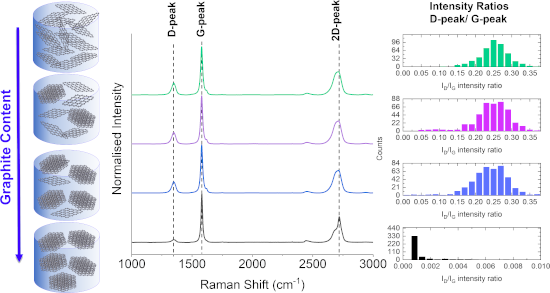
- %), transmission electron microscopy (TEM) (7.2%) or X-ray photoelectron spectroscopy (XPS) (5.6%). It has the advantages of relatively low cost, simple sample preparation, quick measurements, and automated analysis, offering clear benefits for quality control applications. It has been demonstrated in several


The origin of black and white coloration of the Asian tiger mosquito Aedes albopictus (Diptera: Culicidae)
Beilstein J. Nanotechnol. 2023, 14, 496–508, doi:10.3762/bjnano.14.41
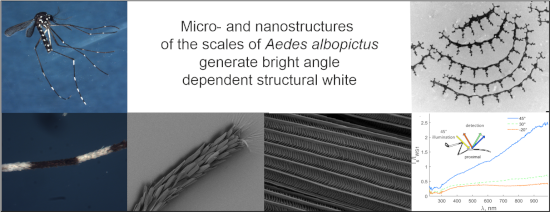
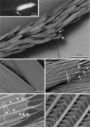
- analysed using scanning electron microscopy, transmission electron microscopy, and fluorescence microscopy. Reflectance spectra of the white areas are measured. No clear difference is present in the morphology of micro- and nanostructures of black and white scales in SEM and TEM, but black scales contain a
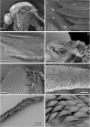
- longitudinal ridges extend beyond the apical portion of the scale, thus forming an apical fringe (Figure 3c). Some details of the nanostructures, characterising the tarsal scales of Ae. albopictus, have been clarified with the aid of TEM (Figure 4). Cross sections of the tarsi in their white (Figure 4a–d) or
- (Figure 4b–d,h). Such nanovoids originate from the rests of epidermal cells and appear in TEM as white or light grey areas inside the scales, together with electron-dense debris (Figure 4h). Their occurrence is higher at the bases of microribs, because the cuticle thickness is higher there (Figure 4h



Plasmonic nanotechnology for photothermal applications – an evaluation
Beilstein J. Nanotechnol. 2023, 14, 380–419, doi:10.3762/bjnano.14.33




Quercetin- and caffeic acid-functionalized chitosan-capped colloidal silver nanoparticles: one-pot synthesis, characterization, and anticancer and antibacterial activities
Beilstein J. Nanotechnol. 2023, 14, 362–376, doi:10.3762/bjnano.14.31
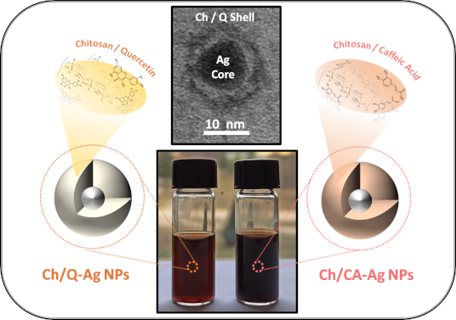
- infrared (FTIR) spectroscopy, and transmission electron microscopy (TEM). The characteristic surface plasmon resonance (SPR) absorption band has been found at 417 and 424 nm for Ch/Q- and Ch/CA-Ag NPs, respectively. The formation of a chitosan shell comprising quercetin and caffeic acid, which surround the
- colloidal core Ag NPs, was confirmed by UV–vis, and FTIR analyses, and monitored by TEM microscopy. The size of nanoparticles has been determined as 11.2 and 10.3 nm for Ch/Q- and Ch/CA-Ag, respectively. The anticancer activity of Ch/Q- and Ch/CA-Ag NPs has been evaluated against U-118 MG (human
- first time the one-pot synthesis of Ch/Q- and Ch/CA-Ag NPs and their biological properties (anticancer and antibacterial). Ag NPs have been prepared and characterized by UV–vis, FTIR, and TEM measurements. In another study of ours, Lomustine, a common drug against glioblastoma cancer, was applied at a


The steep road to nonviral nanomedicines: Frequent challenges and culprits in designing nanoparticles for gene therapy
Beilstein J. Nanotechnol. 2023, 14, 351–361, doi:10.3762/bjnano.14.30

- E2859-11 for AFM analysis, and ISO 21363:2020 for substrate-supported TEM analysis. When at all possible, obtaining the distribution of sizes from these methods with extension to obtain geometric properties (aspect ratio, minimum diameter, circularity, roundness, or sphericity) will allow for the
- comparison within different batches, formulations, particle types, and standards. For particle systems that do not exist in a solid state, cryo-TEM or submersion AFM can offer alternative routes. These measurements will provide high-resolution particle distributions for in-solvent particles, though they may
- ultracentrifugation provide ensemble detection of size distributions with their own issues and complexities (e.g., gradient-induced aggregation and pressure-induced particle reconfiguration) [65]. Determination of size on a per-particle basis, such as that obtained from NTA or the aforementioned cryo-TEM/solution AFM

Polymer nanoparticles from low-energy nanoemulsions for biomedical applications
Beilstein J. Nanotechnol. 2023, 14, 339–350, doi:10.3762/bjnano.14.29
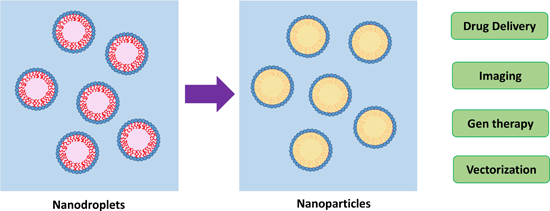
- diameter dE = 50 ± 12 nm (estimated by cryo-TEM), whereas the diameter of the derived PLGA nanoparticles (dP) was 25 ± 7 nm as estimated from TEM [24], which gives a dP/dE ratio of 0.5. Higher dP/dE ratios were found by dynamic light scattering, especially at low polymer concentrations (note that the
- ethyl acetate evaporation showed an average diameter between 29 and 44 nm as determined from TEM images. The diameter appeared to increase with the O/S ratio (in qualitative agreement with Equation 2 and Equation 3), but was much smaller than that of the nanodroplet templates as a result of solvent
- 80/20 and water contents above 87 wt %, with droplet sizes in the 180–190 nm range. The derived ethyl cellulose nanoparticles had a size between 107 and 161 nm as estimated by TEM and SEM (Figure 2). Dexamethasone (DXM), a steroid with potent anti-inflammatory and immunosuppressant activity, was
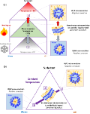


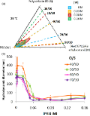


Overview of mechanism and consequences of endothelial leakiness caused by metal and polymeric nanoparticles
Beilstein J. Nanotechnol. 2023, 14, 329–338, doi:10.3762/bjnano.14.28
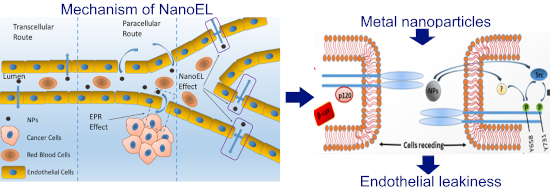
- NP interaction with cell membranes in order to eliminate the participation of transcellular transport was also investigated. In fact, TEM micrographs revealed a small number of 18 nm AuNPs undergoing endocytosis. However, subsequent studies with a cocktail of endocytosis inhibitors confirmed the


A novel approach to pulsed laser deposition of platinum catalyst on carbon particles for use in polymer electrolyte membrane fuel cells
Beilstein J. Nanotechnol. 2023, 14, 190–204, doi:10.3762/bjnano.14.19
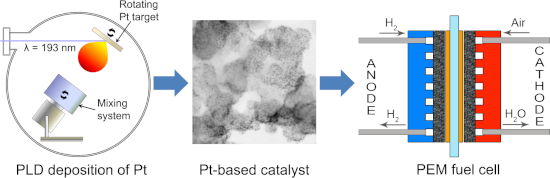
- ; ORR; PEMFCs; PLD deposition; Pt catalyst; rotating ring-disk electrode (RRDE); SEM; TEM; XPS; Introduction Fuel cells, which cleanly and efficiently convert the chemical energy of hydrogen or other fuels to electrical energy, are a good alternative to dirty and wasteful combustion engines for
- , morphology, and chemical composition of the fabricated catalysts were investigated using TEM, SEM, EDX, XPS, and Raman spectroscopy. Electrochemical measurements determined the performance of the fabricated catalysts. Results and Discussion Synthesis of a highly graphitized carbon material The synthesis of
- was conducted with a number of laser pulses varying between 10000 and 60000 to investigate the influence of the amount of deposited platinum on the size of the formed PtNPs and their distribution on carbon supports (Table 1). The results of the TEM and EDX measurements are shown in Figure 3. Based on