


Search results
Search for "battery" in Full Text gives 114 result(s) in Beilstein Journal of Nanotechnology.
Volcano plots in hydrogen electrocatalysis – uses and abuses
Beilstein J. Nanotechnol. 2014, 5, 846–854, doi:10.3762/bjnano.5.96
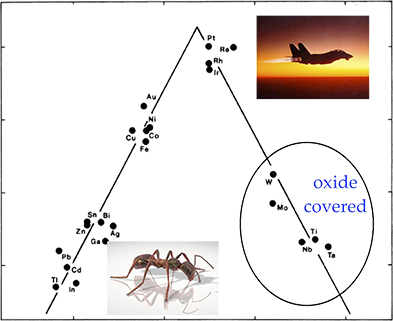
- , even though the most common car battery, the lead battery, only works because lead is such a bad catalyst for hydrogen evolution. Also, mercury once plaid a pivotal role as the electrode material for polarography, which used to be an important analytical technique. In fact, the only Nobel prize that


Applicability and costs of nanofiltration in combination with photocatalysis for the treatment of dye house effluents
Beilstein J. Nanotechnol. 2014, 5, 476–484, doi:10.3762/bjnano.5.55
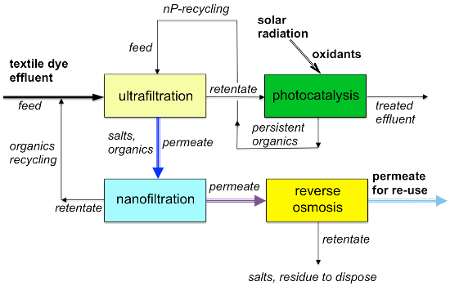
- plants with different module configurations such as tubular, plate and frame, or spiral wound. The given specific equipment costs are the turn-key costs of frame-mounted separation plants, including the CIP system, without the costs for local installation of buffer tanks and all out-side the battery


Atomic layer deposition, a unique method for the preparation of energy conversion devices
Beilstein J. Nanotechnol. 2014, 5, 245–248, doi:10.3762/bjnano.5.26

- semiconductors, molecules and ions in electrolytes. Figure 1 summarizes the particular types of charge and energy carriers in a solar cell (left), an electrode of a lithium ion battery (center), and the water oxidation electrode of an electrolyzer (right). Despite the variety of physical states and chemical
- lithium ion battery (center), and the water oxidation electrode of an electrolyzer (or the oxygen-evolving complex in photosynthesis, right). An example of nanostructured interfaces in an energy conversion device: thylakoids for photosynthesis (micrograph adapted and reproduced with author permission; (c


Modeling and optimization of atomic layer deposition processes on vertically aligned carbon nanotubes
Beilstein J. Nanotechnol. 2014, 5, 234–244, doi:10.3762/bjnano.5.25
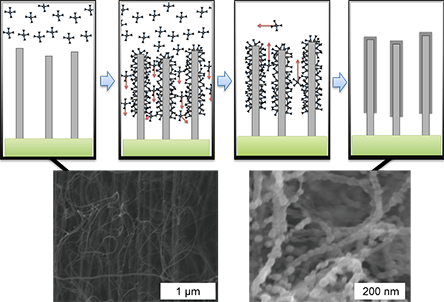
- been applied in battery [2][3][4][5] and supercapacitor electrodes [6][7][8][9][10][11][12], fuel cells [13], and sensors [14][15][16][17]. For many of the proposed applications of these CNT/ceramic hybrids, the performances of the devices depend crucially on the thickness and conformality of the



Adsorption of the ionic liquid [BMP][TFSA] on Au(111) and Ag(111): substrate effects on the structure formation investigated by STM
Beilstein J. Nanotechnol. 2013, 4, 903–918, doi:10.3762/bjnano.4.102
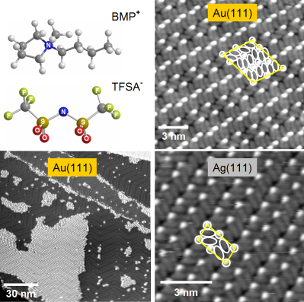
- and the respective electrode surface (solid–liquid interface) is essential for developing improved future battery systems based on ILs. Correspondingly, the interaction between different ILs and various electrode materials was investigated by electrochemical methods, including, e.g., cyclovoltammetry




Influence of particle size and fluorination ratio of CFx precursor compounds on the electrochemical performance of C–FeF2 nanocomposites for reversible lithium storage
Beilstein J. Nanotechnol. 2013, 4, 705–713, doi:10.3762/bjnano.4.80
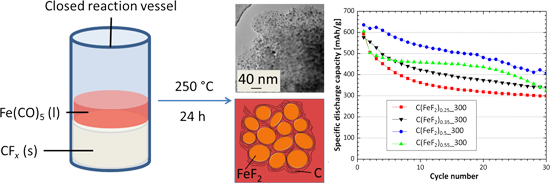
- ; enregy-related; graphite fluoride; lithium battery; iron fluoride; Introduction Lithium-ion batteries are key energy storage systems for portable and mobile electric devices. However, for applications that need high energy densities, current insertion-based lithium-ion batteries do not match the targets
- placed in an incubator (Binder) to maintain a constant temperature of 25 ± 0.1 °C or 40 ± 0.1 °C. The electrochemical studies were carried out using an Arbin battery cycling unit. Results and discussion Optimization of ball milling conditions It was shown that a pretreatment of the CFx precursor directly


A facile synthesis of a carbon-encapsulated Fe3O4 nanocomposite and its performance as anode in lithium-ion batteries
Beilstein J. Nanotechnol. 2013, 4, 699–704, doi:10.3762/bjnano.4.79
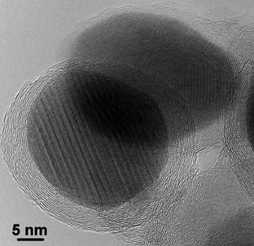
- oxide; lithium-ion battery; nanoparticles; pyrolysis; Findings Due to high energy density and excellent cyclic performance, lithium-ion batteries (LIBs) have become the leading energy storage device for portable electronic markets and for powering upcoming electric vehicles [1][2]. In order to obtain


Energy-related nanomaterials
Beilstein J. Nanotechnol. 2013, 4, 678–679, doi:10.3762/bjnano.4.76
- vehicles can at least contribute to attenuate this emission problem. Electrically powered vehicles strongly rely on fuel cell (FC) or, most importantly, lithium-ion battery (LIB) technology, which is well-known and is already used on a large scale. However, the efficiency and average lifetime of these
Electrochemical and electron microscopic characterization of Super-P based cathodes for Li–O2 batteries
Beilstein J. Nanotechnol. 2013, 4, 665–670, doi:10.3762/bjnano.4.74
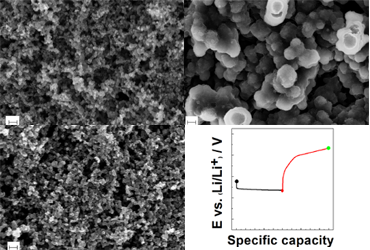
- about this new battery technology is still at an early stage. There are indeed still many open questions that need to be answered before proceeding for further development. One of the main challenges is represented by the choice of a suitable electrolyte, which allows for the formation of the desired
- products during the operation of a typical Li–O2 battery. In this context, recently published literature [1][2][3] gives new insights about the mechanism through which the reduction and the oxidation of oxygen occur in aprotic environments. During discharge, the oxygen reduction reaction (ORR) proceeds in
- kV. The images were acquired using a secondary-electron detector with an in-lens configuration. Results and Discussion The first galvanostatic discharge/charge curve of a typical Li–O2 battery that has a carbon-based cathode, a lithium metal anode and LiTFSI/tetraglyme electrolyte is reported in


Preparation of electrochemically active silicon nanotubes in highly ordered arrays
Beilstein J. Nanotechnol. 2013, 4, 655–664, doi:10.3762/bjnano.4.73
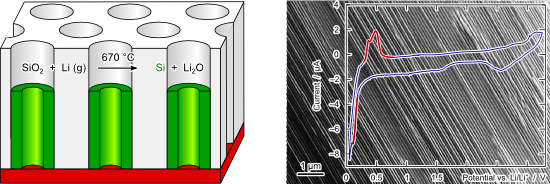
- waves also observed for other bulk or nanostructured silicon systems. The method established here paves the way for systematic investigations of how the electrochemical properties (capacity, charge/discharge rates, cyclability) of nanoporous silicon negative lithium ion battery electrode materials
- depend on the geometry. Keywords: atomic layer deposition; electrochemistry; lithium ion battery electrode; silica thermal reduction; silicon nanotubes; Introduction A significant research and development effort has been dedicated to the positive electrode materials of lithium ion batteries [1]. In






AFM as an analysis tool for high-capacity sulfur cathodes for Li–S batteries
Beilstein J. Nanotechnol. 2013, 4, 611–624, doi:10.3762/bjnano.4.68
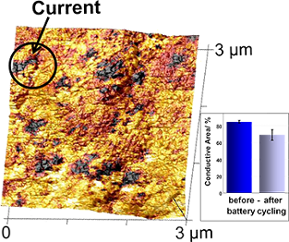
- were prepared by spray-coating exhibited a superior stability of the morphology and the electric network associated with the capacity and cycling stability of these batteries. A reduction of the conductive area determined by conductive AFM was found to correlate to the battery capacity loss for all
- rechargeable batteries with high capacity are a key technology for the widespread implementation of battery-powered cars. The specific energy of existing lithium batteries needs further improvement to enable acceptable driving ranges of electric vehicles. Moreover, this is also important for portable
- battery, which depends mainly on the type of binder that is used [5][6][7]. Related to the morphology and volume changes of the cathodes, it was found that the sulfur cathodes expand while discharging and shrink while charging. The thickness change of the electrode was measured to be approximately 22% [8

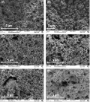


A facile approach to nanoarchitectured three-dimensional graphene-based Li–Mn–O composite as high-power cathodes for Li-ion batteries
Beilstein J. Nanotechnol. 2012, 3, 513–523, doi:10.3762/bjnano.3.59
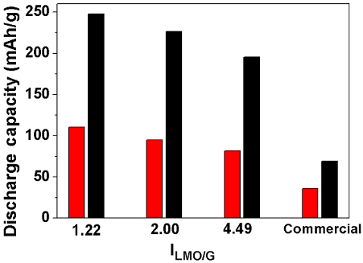
- can help to reduce the dissolution of Mn2+ into the electrolyte, as indicated by the inductively coupled plasma (ICP) measurements, and which is mainly attributed to the large specific surface area of the graphene sheets. Keywords: cathode; graphene; Li-ion battery; lithium manganate; Introduction
- . As a material with high electrical conductivity and large surface area [19][20][21][22], graphene has attracted much attention for battery electrode applications. The hybrids of transition-metal-oxide nanocrystals attached onto graphene sheets have shown much improvement of LIB anode performance [23
- and 17.04 kW·kg−1, respectively, during the 300th cycle. Here, it is worth pointing out that the charge rate is chosen as 19.00 C (2812.5 mA·g−1) to mimic the fast battery charging process. In fact, some reports on the rate capabilities of cathode materials use a high discharge C rate and a low charge




Conducting composite materials from the biopolymer kappa-carrageenan and carbon nanotubes
Beilstein J. Nanotechnol. 2012, 3, 415–427, doi:10.3762/bjnano.3.48
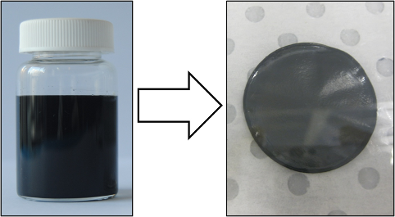
- investigated with a custom-built system [52]. The films are connected in series to a known resister (909 Ω) and a battery (4.91 V) to form a voltage–current–resistor (V–I–R) electrical circuit as a prototype sensor. The sensitivity of the sensors was characterised by using measurements of the voltage drop


Nonconservative current-induced forces: A physical interpretation
Beilstein J. Nanotechnol. 2011, 2, 727–733, doi:10.3762/bjnano.2.79
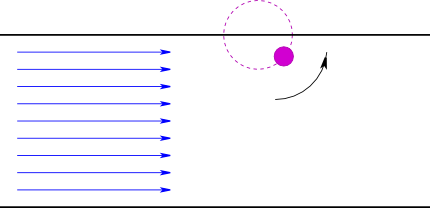
- preferentially emit phonons with momentum parallel to the electron flow. This becomes evident, when we consider the setup in Figure 1. A nanostructure is connected to two electrodes, each in turn connected to its own battery terminal serving as a particle reservoir. The left reservoir injects right-travelling




