


Search results
Search for "cell lines" in Full Text gives 141 result(s) in Beilstein Journal of Nanotechnology.
Uptake of the proteins HTRA1 and HTRA2 by cells mediated by calcium phosphate nanoparticles
Beilstein J. Nanotechnol. 2017, 8, 381–393, doi:10.3762/bjnano.8.40
- functionalized nanoparticles per cell in the cell culture experiments was calculated accordingly. Cell line culture and imaging Human epithelial cervical cancer cells (HeLa) and human osteosarcoma cells (MG-63) cell lines were cultured in DMEM, supplemented with 10% fetal calf serum (FCS) under 37 °C, 5% CO2 and
- -myristate-13α-acetate, Sigma-Aldrich, USA) solution per well, and finally incubated for three days. Afterwards, the cell medium was changed, and the cells were then treated like the other cell lines. Light and fluorescence microscopy were performed on a Zeiss Axiovert 40 CFL instrument (Carl Zeiss
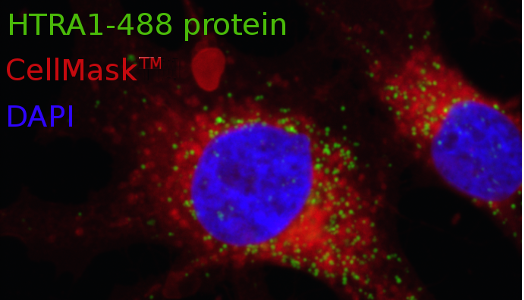
- fluorescently labelled proteins HTRA1-488, HTRA2-488 and BSA-FITC alone by two cell lines: HeLa and MG-63. The cells were incubated with the dissolved proteins for 3 h at 168 µg mL−1 for HTRA1-488, 255 µg mL−1 for HTRA2-488 and 229 µg mL−1 for BSA-FITC. Subsequently, the cells were washed three times with PBS


Association of aescin with β- and γ-cyclodextrins studied by DFT calculations and spectroscopic methods
Beilstein J. Nanotechnol. 2017, 8, 348–357, doi:10.3762/bjnano.8.37
- ]. In vitro incubation with cells of the C6 (glioma) and A549 (lung adenocarcinoma) tumoural lines showed that aescin has potent dose- and time-dependent antiproliferative effects [8]. Studies with human castration-resistant prostate cancer, both in vitro, using the cell lines PC-3 and DU-145, and in


Facile fabrication of luminescent organic dots by thermolysis of citric acid in urea melt, and their use for cell staining and polyelectrolyte microcapsule labelling
Beilstein J. Nanotechnol. 2016, 7, 1905–1917, doi:10.3762/bjnano.7.182
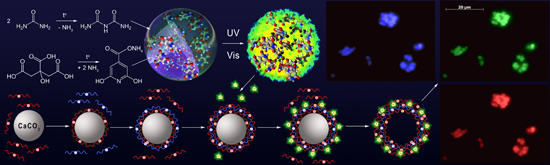
- two cell lines. MNNG/HOS human osteosarcoma cells and RAW 264.7 murine macrophages were cultured as monolayers in a minimal essential medium supplemented with 10% fetal bovine serum and antibiotics (100 U/mL penicillin/streptomycin). All culture medium components were purchased from PanEco (PanEco




Chitosan-based nanoparticles for improved anticancer efficacy and bioavailability of mifepristone
Beilstein J. Nanotechnol. 2016, 7, 1861–1870, doi:10.3762/bjnano.7.178
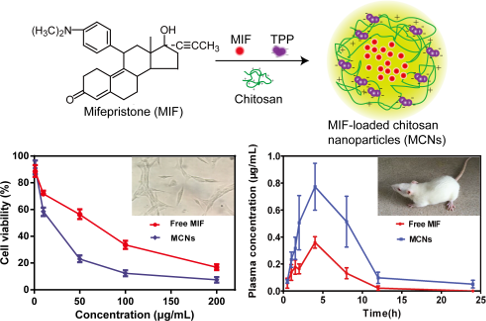
- kinetics demonstrated that MIF was released from CNs in a sustained-release manner. Compared with free MIF, MCNs demonstrated increased anticancer activity in several cancer cell lines. Pharmacokinetic studies in male rats that were orally administered MCNs showed a 3.2-fold increase in the area under the
- Cushing’s syndrome [3]. Besides its antiglucocorticoid and antiprogestogen activity, MIF has been shown to promote anticancer activity in cancer cell lines and in clinical trials [4][5]. However, some side effects of MIF including nausea, vomiting, and bleeding are still observed in the clinic trails [6
- MCNs was determined. Finally, the anticancer activity of MCNs was studied in several cancer cell lines and the pharmacokinetic studies of MCNs were performed in male rats. Results and Discussion Preparation and optimization of MCNs In this study, MIF-loaded CNs were prepared by a convenient ionic


On the pathway of cellular uptake: new insight into the interaction between the cell membrane and very small nanoparticles
Beilstein J. Nanotechnol. 2016, 7, 1296–1311, doi:10.3762/bjnano.7.121
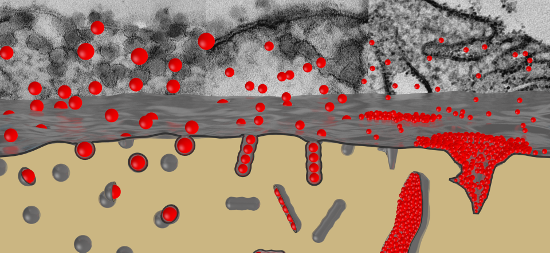
- . As model cell systems we chose different epithelial and non-epithelial cell lines of carcinoma and primary origin which were exposed to silica NPs. This variety of model cell lines was deliberately selected to check for the universality of our observations. Using electron microscopic methods, we aim
- limited to HeLa cells only or if this is a universal mechanism with which a cell and its membrane will react upon treatment with small silica NPs. Accordingly, we tested another 4 cell lines for the uptake morphologies: primary human mesenchymal stem cells (hMSC), human bone osteosarcoma cells (U2OS
- ), human epithelial colorectal adenocarcinoma cells (Caco-2) and mouse melanoma (B16-F10) cells. Caco-2 cells are very often used as model of the human intestinal barrier. Furthermore we investigated HeLa and U2OS cells. These cell lines were not derived from directly relevant tissues but can serve as




Improved biocompatibility and efficient labeling of neural stem cells with poly(L-lysine)-coated maghemite nanoparticles
Beilstein J. Nanotechnol. 2016, 7, 926–936, doi:10.3762/bjnano.7.84
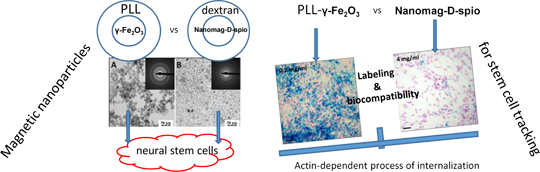
- neural stem cells, after 48 h of post-labeling proliferation. Control cells were not labeled with any nanoparticles. Nuclear marker DAPI was stained in blue. Scale bars: 10 µm. NSCs labeled with PLL-γ-Fe2O3 and nanomag®-D-spio nanoparticles differentiate into all three major neural cell lines. Following




Tight junction between endothelial cells: the interaction between nanoparticles and blood vessels
Beilstein J. Nanotechnol. 2016, 7, 675–684, doi:10.3762/bjnano.7.60
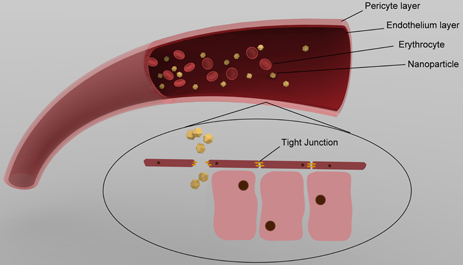
- shall consider the effects NPs may induce besides the disruption of the endothelial function. For this purpose we will compare the damage NPs cause in other cell lines with the potential risk for cells and tissues beneath the endothelial layer (e.g., pericytes) to be attacked by NPs. Again, oxidative

Unraveling the neurotoxicity of titanium dioxide nanoparticles: focusing on molecular mechanisms
Beilstein J. Nanotechnol. 2016, 7, 645–654, doi:10.3762/bjnano.7.57
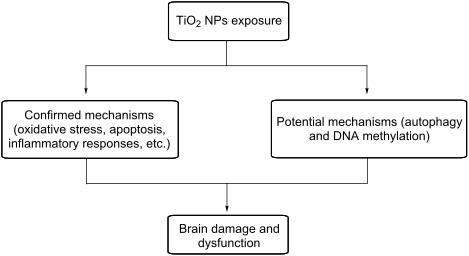
- -2 levels, indicated that mitochondria- and endoplasmic reticulum-mediated signaling pathways were involved in the apoptotic process. TiO2 NPs were also shown to decrease cell viability by inducing apoptosis in the microglia N9 [36] and human astrocytes-like astrocytoma U87 cell lines [37]. Direct
Comparison of the interactions of daunorubicin in a free form and attached to single-walled carbon nanotubes with model lipid membranes
Beilstein J. Nanotechnol. 2016, 7, 524–532, doi:10.3762/bjnano.7.46
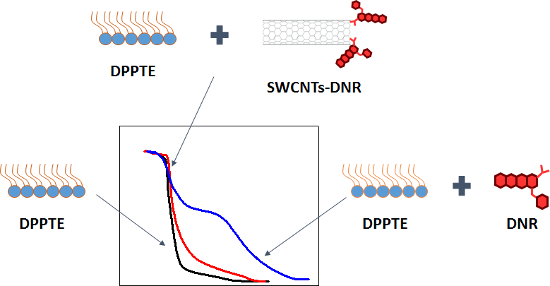
- fields. Such magnetic nanoparticles conjugated with DNR were reported to induce apoptosis of cancer cell lines [11][12]. Other examples of nanoparticles include titanium dioxide (TiO2) and gold nanoparticles (AuNPs) [13][14]. In the latter case the nanoparticles were also modified with aptamer – single
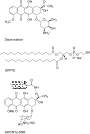
- conjugated to either polyethylene glycol (PEG) functionalized single-walled carbon nanotubes (SWCNTs) [20] or to aptamer-wrapped SWCNTs via π–π interactions. In both cases the cytotoxicity of the conjugates was verified on the selected cancer cell lines. In this study the influence of both free daunorubicin
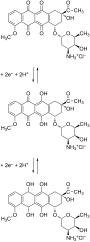
- to the concentrations used in the in vitro studies. The IC50 value, which is defined as the concentration of a drug that inhibits cell growth by 50%, given in the literature usually varies from 10−6 M to 10−5 M depending on the type of cell lines [32][33][34]. In the next step, voltammograms obtained




Chemiresistive/SERS dual sensor based on densely packed gold nanoparticles
Beilstein J. Nanotechnol. 2015, 6, 2498–2503, doi:10.3762/bjnano.6.259
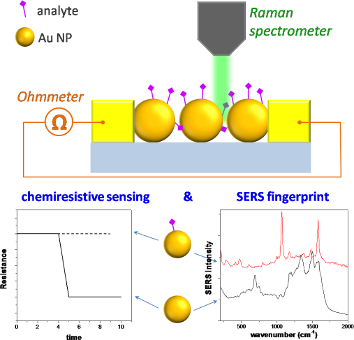
- folic acid molecules. Folic acid is a low molecular weight vitamin compound, which has been shown to be an effective targeting vector of various cancer cell lines which over-express folate receptors [7]. It also proved to be an effective capping ligand for linking onto various polymer backbones or


Predicting cytotoxicity of PAMAM dendrimers using molecular descriptors
Beilstein J. Nanotechnol. 2015, 6, 1886–1896, doi:10.3762/bjnano.6.192
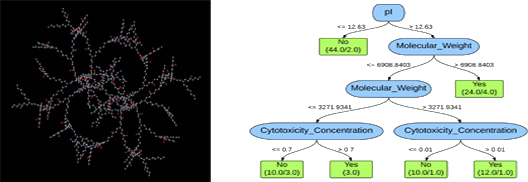
- viability of seven different cell lines [4]. Sayes and Ivanov used machine learning to predict the induced cellular membrane damage of immortalized human lung epithelial cells caused by metal oxide nanomaterials [5]. As discussed in a previous paper [6], there are a very limited number of databases


The eNanoMapper database for nanomaterial safety information
Beilstein J. Nanotechnol. 2015, 6, 1609–1634, doi:10.3762/bjnano.6.165
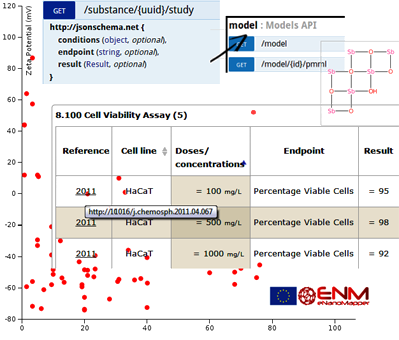
- , modes of action), interactions (cell lines, assays) and a wide variety of measurements. A number of analytic techniques have been proposed and developed to characterise the physicochemical properties of nanomaterials, including the commonly used dynamic light scattering to measure the particle size


PLGA nanoparticles as a platform for vitamin D-based cancer therapy
Beilstein J. Nanotechnol. 2015, 6, 1306–1318, doi:10.3762/bjnano.6.135
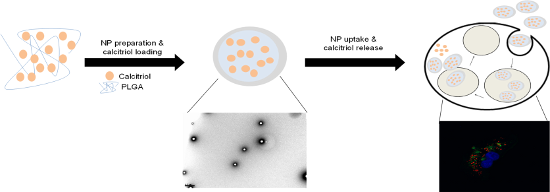
- acid) (PLGA) nanoparticles were studied as drug delivery vehicles for calcitriol, the active form of vitamin D3. In vitro effects of calcitriol encapsulated in PLGA nanoparticles were evaluated with respect to free calcitriol on human pancreatic cell lines, S2-013 and hTERT-HPNE, and the lung cancer
- for lysosomes, despite not having been treated with C6. This fact is justified because both cell lines exhibited autofluorescence in the same emission spectrum as C6 and lysotracker. Lung carcinoma cells did not exhibit this intense autofluorescence, therefore allowing the visualization of the NP
- , with most of the PLGA NPs localized in the cytoplasm after 72 h, as exhibited in Figure 3I. Due to the intense cell autofluorescence, it was not possible to determine the Pearson coefficient for both pancreatic cell lines. However it was possible to observe yellow dots in the S2-013 and hTERT-HPNE


Tattoo ink nanoparticles in skin tissue and fibroblasts
Beilstein J. Nanotechnol. 2015, 6, 1183–1191, doi:10.3762/bjnano.6.120

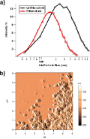
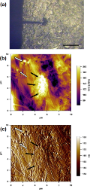
- , as the AFM technique can only probe surfaces. The MTT (3-[4,5-dimethylthiazol-2-yl]-2,5-diphenyltetrazolium bromide) assay is a commonly used biological test on living cells, which broadly measures the in vitro cytotoxic effects of drugs on cell lines or primary patient cells [36]. Recently, an MTT


Novel ZnO:Ag nanocomposites induce significant oxidative stress in human fibroblast malignant melanoma (Ht144) cells
Beilstein J. Nanotechnol. 2015, 6, 570–582, doi:10.3762/bjnano.6.59
- activity against different cancer cell lines in vitro [1][9][10]. ZnO NPs have a vast range of biological applications because they are biocompatible, considered to be safe [11] with a survival lifetime of a few hours in the body, and they can be dissociated and absorbed quickly. ZnO NPs exhibit
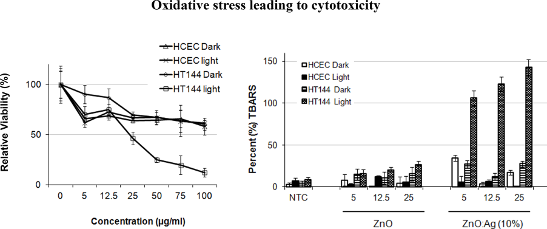
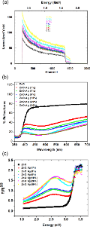
- , 10, 20, and 30% Ag). Silver resulted in a band structure in visible region in all the ZnO:Ag nanocomposites (Figure 3c). Screening of NPs for cytotoxicity The ZnO:Ag nanocomposites were screened for cytotoxicity against two cell lines, HT144 (human malignant melanoma) and HCEC (normal cell line). The
- significant effect (p ≤ 0.0001) on the cancer cell line when compared to the normal cells. Whereas ZnO, ZnO:Ag (1%), ZnO:Ag (3%), had no effect on the two cell lines. At 125 μg/mL, all the NPs were significantly toxic (p ≤ 0.01) to HT144 as well as HECE cells when compared to the untreated cells (NTC). Hence




Silica micro/nanospheres for theranostics: from bimodal MRI and fluorescent imaging probes to cancer therapy
Beilstein J. Nanotechnol. 2015, 6, 546–558, doi:10.3762/bjnano.6.57
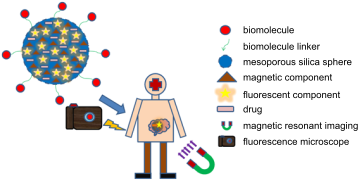
- absorption and emission spectra suggested that the QDs retained their fluorescent properties even after silica coating. The heterodimer structure of MQD was confirmed by HRTEM studies. Finally, the fluorescence properties of these composites were tested with three different cell lines, namely HepG2 human
- with folic acid for targeting two different pancreatic cancer cell lines, namely PANC-1 and BxPC3. The confocal microscopy studies suggested that the nanocomposites were indeed internalized by the cells and not simply bound on the surface membrane. The T2-weighted images suggested that the NPs can be


Hematopoietic and mesenchymal stem cells: polymeric nanoparticle uptake and lineage differentiation
Beilstein J. Nanotechnol. 2015, 6, 383–395, doi:10.3762/bjnano.6.38
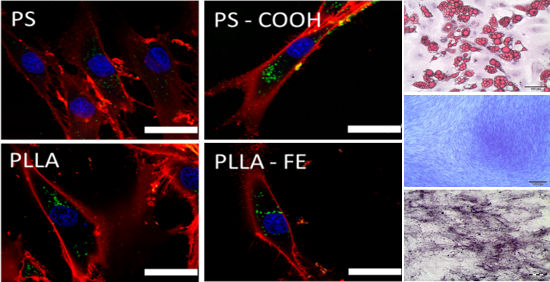
- interaction in malignant cell lines. Here, we report on the influence of polymeric nanoparticles on human hematopoietic stem cells (hHSCs) and mesenchymal stem cells (hMSCs). In this study we systematically investigated the influence of polymeric nanoparticles on the cell functionality and differentiation


Comparative evaluation of the impact on endothelial cells induced by different nanoparticle structures and functionalization
Beilstein J. Nanotechnol. 2015, 6, 300–312, doi:10.3762/bjnano.6.28
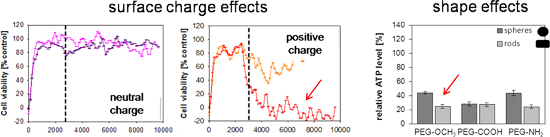
- , was cytotoxic to many cell lines [11][12][13][14], rendering an appropriate coating of gold nanoparticles indispensable for biocompatibility. Metal oxide based nanoparticles such as iron oxide and manganese oxide are ideal tools for MRI applications. They are easy to synthesize and they showed
- conditions as described above for the SVEC4-10 cells. All used cell lines were cultured at 37 °C in a 5% CO2 humidified environment. For experimentation, all cells were plated onto a plastic matrix at a density of 1.2 × 10⁴ cells/cm2 (endothelial cells HMEC-1), 4.4 × 10³ cells/cm2 (endothelial cells SVEC4-10




Overview about the localization of nanoparticles in tissue and cellular context by different imaging techniques
Beilstein J. Nanotechnol. 2015, 6, 263–280, doi:10.3762/bjnano.6.25
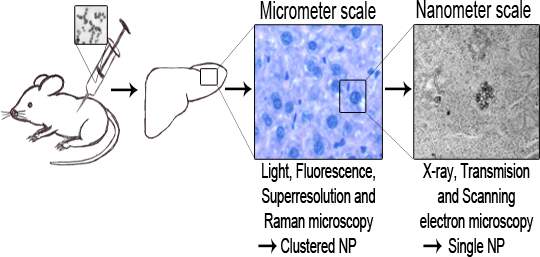
- are available on NP pharmacology and toxicology in humans and animals [8][9]. However, despite all advancements in in vitro testing including permanent or primary cell lines and ex vivo organ cultures, the complexity of a living organism cannot be modeled in a test tube or culture dish. In this regard

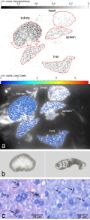
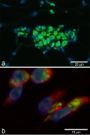


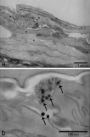
Release behaviour and toxicity evaluation of levodopa from carboxylated single-walled carbon nanotubes
Beilstein J. Nanotechnol. 2015, 6, 243–253, doi:10.3762/bjnano.6.23
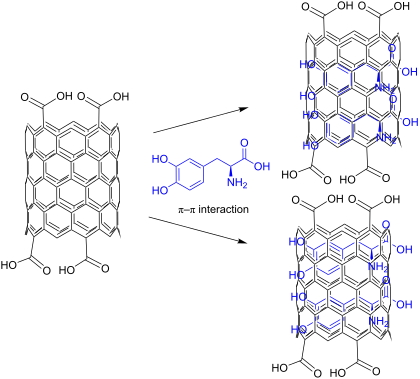
- well-described by a pseudo-second-order kinetic model. A cytotoxicity assay of the synthesized nanohybrid was also carried out in PC12 cell lines (a widely used, in vitro Parkinson’s model for neurotoxicity studies) using 3-(4,5-dimethylthiazol-2-yl)-2,5-diphenyltetrazolium bromide (MTT) assay in order
- carried out in PC12 cell lines in order to evaluate their possible effects in normal neuronal cells in vitro. The results obtained from this preliminary study are expected to provide a theoretical basis and understanding for preparation of efficient drug carriers in the future. Results and Discussion
- nanohybrid possessed favourable sustained and controlled release properties as a drug carrier. In vitro bioassay PC12 cell lines PC12 is one of the most widely applied neuronal cell lines and can be used as a model to study secretory activity and catecholamine metabolism and regulation. In this study, we




Caveolin-1 and CDC42 mediated endocytosis of silica-coated iron oxide nanoparticles in HeLa cells
Beilstein J. Nanotechnol. 2015, 6, 167–176, doi:10.3762/bjnano.6.16
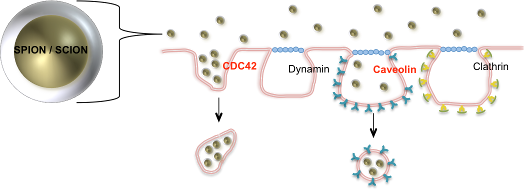
- experiments should be carried out with different cell lines and other well-defined nanoparticle species to elucidate possible general principles. Keywords: Caveolin-1; CDC42; endocytosis inhibition; iron oxide nanoparticles; nanoparticle uptake; Introduction Nanotechnology is expected to be a very powerful
- of the endocytotic machinery in fluorescence and electron microscopy or overexpression and dominant negative mutants of key-proteins would be very useful. General tendencies could be deduced, if these findings are transferable to other human cancer cell lines. But preliminary experiments with the


Increasing throughput of AFM-based single cell adhesion measurements through multisubstrate surfaces
Beilstein J. Nanotechnol. 2015, 6, 157–166, doi:10.3762/bjnano.6.15
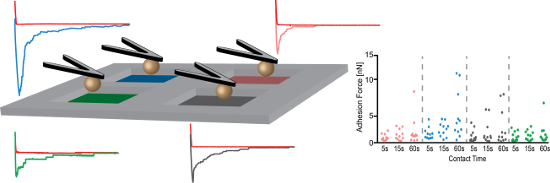
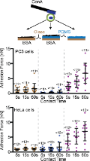
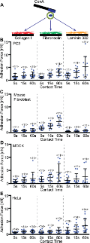
- limitation, segmented polydimethylsiloxane (PDMS) masks were developed, allowing the measurement of cell adhesion to multiple substrates. To verify the utility of the masks, the adhesion of four different cell lines, HeLa (Kyoto), prostate cancer (PC), mouse kidney fibroblast and MDCK, to three extracellular
- matrix proteins, fibronectin, collagen I and laminin 332, was examined. The adhesion of each cell line to different matrix proteins was found to be distinct; no two cell lines adhered equally to each of the proteins. The PDMS masks improved the throughput limitation of single-cell force spectroscopy and
- efficiency. We implemented the masks to characterize the adhesion of different cell lines to collagen I, fibronectin and laminin 332 and found that the cell lines had unique adhesion profiles, which likely reflect differences in the CAMs they expressed. Results PDMS masks for single-cell force spectroscopy


Functionalization of α-synuclein fibrils
Beilstein J. Nanotechnol. 2015, 6, 124–133, doi:10.3762/bjnano.6.12
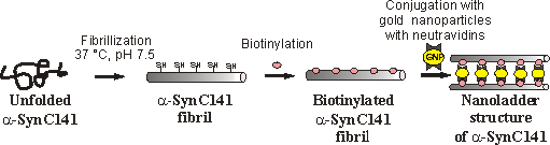
- and non-neuronal cell lines, brain tissue and living human cells, and analyzed under non-denaturing conditions [49]. The purified protein was used to study the modification and fibrillization of α-SynC141. According to the literature, one of the main factors which induces fibrillization is low pH [50


Synthesis of boron nitride nanotubes and their applications
Beilstein J. Nanotechnol. 2015, 6, 84–102, doi:10.3762/bjnano.6.9
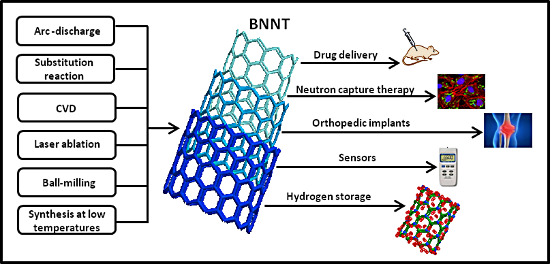
- studied and found that the BNNTs were significantly toxic at 200 µg/mL. The biocompatibility tests indicated that the pure BNNTs were good candidates at nontoxic concentrations for pharmacological applications [76]. The cell lines A549, RAW264.7, 3T3-L1 and HEK293 were exposed to BNNTs. The authors




Synthesis and characterization of fluorescence-labelled silica core-shell and noble metal-decorated ceria nanoparticles
Beilstein J. Nanotechnol. 2014, 5, 2413–2423, doi:10.3762/bjnano.5.251
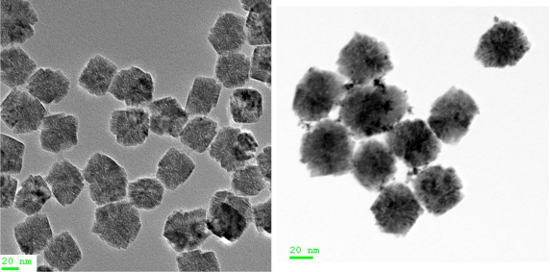
- titania NP and their interaction with human cell lines [1] and pointed out that the determination of the biological effects of zinc oxide NP is problematic since they are sensitive towards phosphate ions [2]. This work will not be included in this article. The fluorescence dyes and the labelling process
- species (ROS) in living cell lines and thus a beneficial effect [61]. If platinum group metals-decorated ceria NP do the same or even more is under investigation. Fluorescent dyes used for labelling. Fluorescence emission spectra in ethanol of MPD (excitation 488 nm, left) and ATTO 647N-APS (excitation





