


Search results
Search for "exciton" in Full Text gives 106 result(s) in Beilstein Journal of Nanotechnology.
Highly efficient ZnO/Au Schottky barrier dye-sensitized solar cells: Role of gold nanoparticles on the charge-transfer process
Beilstein J. Nanotechnol. 2011, 2, 681–690, doi:10.3762/bjnano.2.73
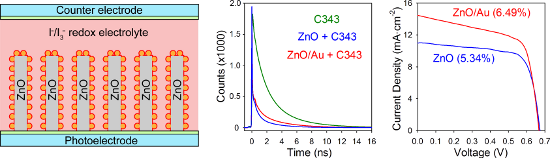
- into the photoelectrode. Both, ZnO and TiO2, are wide-band-gap semiconductors with almost comparable band gap (3.37 eV and 3.2 eV, respectively). Due to the direct band gap, higher exciton energy (60 meV compared to 4 meV for TiO2) [6][7], higher electron mobility (200 cm2·V−1·s−1) [8] and its ease of



Distance dependence of near-field fluorescence enhancement and quenching of single quantum dots
Beilstein J. Nanotechnol. 2011, 2, 645–652, doi:10.3762/bjnano.2.68
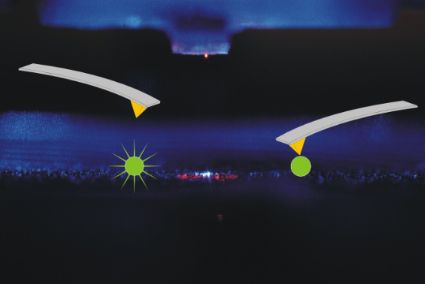
- partial fluorescence quenching at a gap size of about 50–60 nm. Both effects become less pronounced for larger cone angles. Equally, fluorescence enhancement as well as quenching can be attributed to (resonant) exciton–plasmon coupling. To obtain the observable fluorescence emission I, we now consider the


Schottky junction/ohmic contact behavior of a nanoporous TiO2 thin film photoanode in contact with redox electrolyte solutions
Beilstein J. Nanotechnol. 2011, 2, 127–134, doi:10.3762/bjnano.2.15
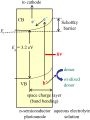
- the VB. The electron and the hole form an exciton (excited electron–hole pair), which is usually short-lived and recombines if there is no driving force to separate them. However, when the band structure is bent as in Figure 3 for an n-SC, the hole can migrate towards the SC interface, and the
- when the applied potential is shifted from cathodic polarization towards the anodic direction thus preventing electron–hole recombination of the exciton. If such a space charge layer of a Schottky junction does not exist, the holes and the electrons present as an exciton formed by photoirradiation
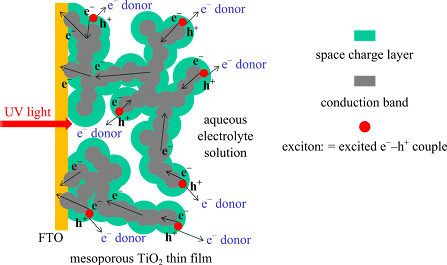
- layer holes (h+) of the excitons (excited e−–h+ couples, red circle) migrate in the VB onto the TiO2 surface reacting with the e− donor, and electrons (e−) of the exciton migrate into the bulk CB where e− then migrate through TiO2 grain boundaries and finally into the conductive layer on FTO. It should




Low-temperature solution growth of ZnO nanotube arrays
Beilstein J. Nanotechnol. 2010, 1, 128–134, doi:10.3762/bjnano.1.15
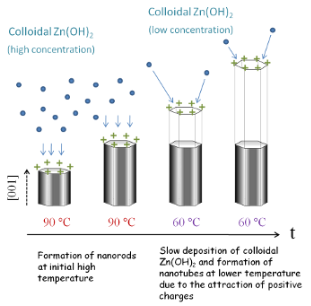
- a more comprehensive understanding of the growth of tube-shaped ZnO in aqueous solution at low temperature. Keywords: growth from solutions; nanorods; nanotubes; supersaturation; ZnO; Introduction ZnO is a type of semiconductor with a wide band gap (3.37 eV) and a large exciton binding energy (~60


Fabrication and spectroscopic studies on highly luminescent CdSe/CdS nanorod polymer composites
Beilstein J. Nanotechnol. 2010, 1, 94–100, doi:10.3762/bjnano.1.11
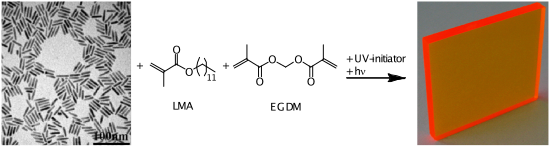
- , aggregation of nanoparticles, loss of transparency and luminescence quenching due to exciton energy transfer [2][7]. Several methods have been described to overcome these problems for quantum dot polymer composites. For example, Bawendi and coworkers incorporated trioctylphosphine oxide covered CdSe/ZnS QDs
- aspect ratio of 6 and shorter bullet shaped rods with an aspect ratio of 3. Results and Discussion Nanorods Figure 2a shows the absorption maxima corresponding to the first exciton peaks for different aspect 3 NR concentrations (0.008–0.2 wt %) in chloroform. From the linear correlation between NR
- absorption at shorter wavelengths (400–500 nm) and the first exciton peak at 619 nm. The nanorods are well dispersed in the polymer matrix, as shown by the lack of scattering in the absorption spectra at wavelengths much larger than that of the first exciton peak (Figure 6a). Figure 5c illustrates that we


Aerosol assisted fabrication of two dimensional ZnO island arrays and honeycomb patterns with identical lattice structures
Beilstein J. Nanotechnol. 2010, 1, 71–74, doi:10.3762/bjnano.1.9
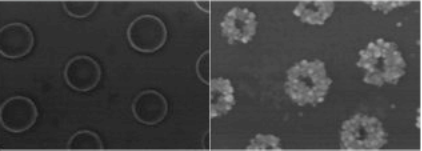
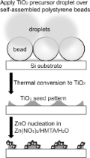
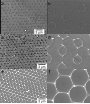
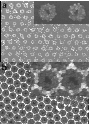
- with contrasting fill fractions of the materials. Keywords: aerosol; photonic crystal; polystyrene bead; TiO2; ZnO; Findings The wide bandgap (3.37 eV) and large exciton-binding energy (60 meV) of ZnO renders it a promising candidate for inexpensive transparent conductors and for optical applications

Other Beilstein-Institut Open Science Activities



