


Search results
Search for "impedance spectroscopy" in Full Text gives 108 result(s) in Beilstein Journal of Nanotechnology.
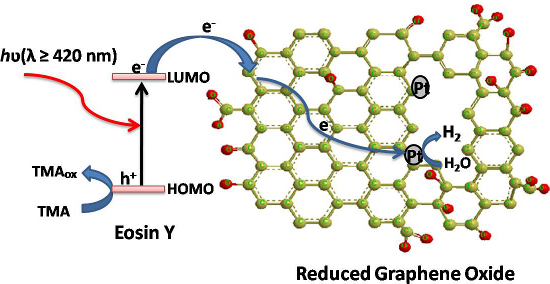
Enhancement of photocatalytic H2 evolution of eosin Y-sensitized reduced graphene oxide through a simple photoreaction
Beilstein J. Nanotechnol. 2014, 5, 801–811, doi:10.3762/bjnano.5.92
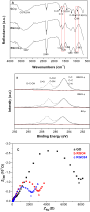
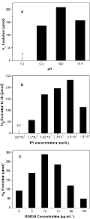
- photoreaction. This further indicates the restoration of the sp2 π-conjugated network for RGO after the photoreaction. Due to restoration of the sp2 π-conjugated network in RGOx, its conductivity is expected to increase [42]. To verify this enhancement, the electrochemical impedance spectroscopy (EIS) of GO
- -resolution TEM (HRTEM) images were taken on a JEOL JEM-2010 (TEM) equipped with an energy dispersive spectrometer (EDS). Electrochemical impedance spectroscopy (EIS) was measured on an IVIUMSTAT electrochemical workstation (Netherlands). The electrochemical experiments were performed in a 3-compartment cell





Electrochemical and electron microscopic characterization of Super-P based cathodes for Li–O2 batteries
Beilstein J. Nanotechnol. 2013, 4, 665–670, doi:10.3762/bjnano.4.74
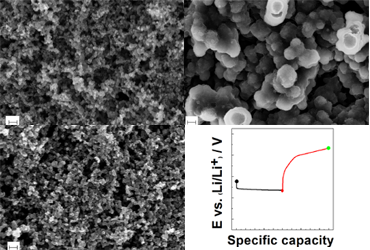
- (trifluoromethane)sulfonimide lithium salt (LiTFSI)/tetraglyme electrolyte were investigated by galvanostatic cycling and electrochemical impedance spectroscopy measurements. Ex-situ X-ray diffraction and scanning electron microscopy were used to evaluate the formation/dissolution of Li2O2 particles at the cathode
- side during the operation of Li–O2 cells. Keywords: aprotic electrolyte; impedance spectroscopy; Li–O2 batteries; scanning electron microscopy; Introduction The development of new types of electrochemical power sources is nowadays considered a key factor for further development of hybrid and fully
- electrolyte. The electrochemical behaviors of the batteries were investigated by galvanostatic cycling and electrochemical impedance spectroscopy. The physico–chemical investigation of the lithium-oxide phases that form and dissolve at the cathode side upon discharge and charge of Li–O2 batteries has been


Novel composite Zr/PBI-O-PhT membranes for HT-PEFC applications
Beilstein J. Nanotechnol. 2013, 4, 481–492, doi:10.3762/bjnano.4.57
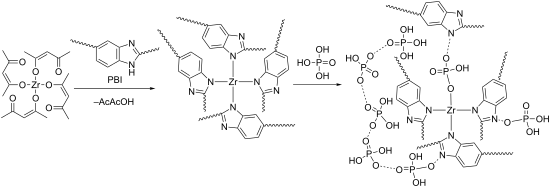
- were examined by means of SAXS, thermomechanical analysis (TMA), and were tested in operating fuel cells by means of stationary voltammetry and impedance spectroscopy. The new membranes showed excellent stability in a 2000-hour fuel cell (FC) durability test. The modification of the PBI-O-PhT films
- reduced conductivity due to an excessively high degree of crosslinking. Keywords: composite; high temperature polymer-electrolyte fuel cells (HT-PEFC); impedance spectroscopy; polybenzimidazole (PBI); zirconium; Introduction Polymer-electrolyte fuel cells (PEFC) based on polybenzimidazole (PBI
- the membranes is also confirmed by the double-layer capacitance data presented in Figure 12. The capacitance values, which can be measured by means of impedance spectroscopy, depend on the boundary area between the proton- (PA) and electron- (Pt and carbon support) conducting phases and serve as a


Zeolites as nanoporous, gas-sensitive materials for in situ monitoring of DeNOx-SCR
Beilstein J. Nanotechnol. 2012, 3, 667–673, doi:10.3762/bjnano.3.76
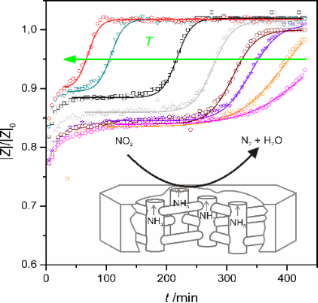
- sensor at the same time. By means of temperature-dependent impedance spectroscopy we found that the thermally induced NH3 desorption in H-form and in Fe-loaded zeolite H-ZSM-5 follow the same process, while a remarkable difference under DeNOx-SCR reaction conditions was found. The Fe-loaded catalyst
- elementary catalytic process promoting a full description of the NH3-SCR reaction system. Keywords: DeNOx-SCR; gas sensing; in situ; impedance spectroscopy; zeolite; Introduction Zeolites are crystalline, nanoporous aluminosilicates composed of [TO4] tetrahedra (T = Si, Al). In H-form zeolites protons
- also applied in gas sensors [12][13][14][15][16][17]. They are proton conductors due to the mobility of the charge-compensating protons. By means of impedance spectroscopy (IS) [18][19][20][21] and quantum chemical calculations on H-ZSM-5 [22][23], we showed in previous works that protons can move


A facile approach to nanoarchitectured three-dimensional graphene-based Li–Mn–O composite as high-power cathodes for Li-ion batteries
Beilstein J. Nanotechnol. 2012, 3, 513–523, doi:10.3762/bjnano.3.59
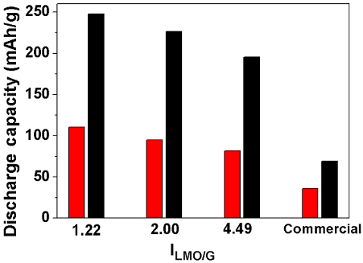
- hybrid sample helps to reduce the dissolution of Mn into the electrolyte further. The superior electrochemical performance of LMO/G electrodes is ascribed to three aspects. First, the LMO/G exhibits fast kinetics of Li-ion and electron diffusion, as examined by the electrochemical impedance spectroscopy




Reduced electron recombination of dye-sensitized solar cells based on TiO2 spheres consisting of ultrathin nanosheets with [001] facet exposed
Beilstein J. Nanotechnol. 2012, 3, 378–387, doi:10.3762/bjnano.3.44
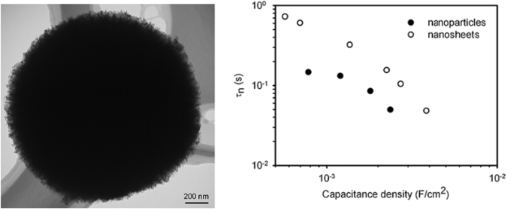
- consisting of ultrathin nanosheets with 100% of the [001] facet exposed was employed to fabricate dye-sensitized solar cells (DSCs). Investigation of the electron transport and back reaction of the DSCs by electrochemical impedance spectroscopy showed that the spheres had a threefold lower electron
- also observed after TiCl4 treatment. The synergistic effect of the variation of the TiO2 conduction band and the electron recombination determined the open-circuit voltage of the DSC. Keywords: dye-sensitized solar cells; electrochemical impedance spectroscopy; electron recombination; TiO2 [001] facet
- transport and back reaction of the DSCs with the spheres were investigated by electrochemical impedance spectroscopy. In addition, the effect of treatment by an aqueous solution of TiCl4 on the performance of the DSCs with the TiO2 spheres was discussed. Experimental Synthesis of TiO2 nanosheet particles


Schottky junction/ohmic contact behavior of a nanoporous TiO2 thin film photoanode in contact with redox electrolyte solutions
Beilstein J. Nanotechnol. 2011, 2, 127–134, doi:10.3762/bjnano.2.15
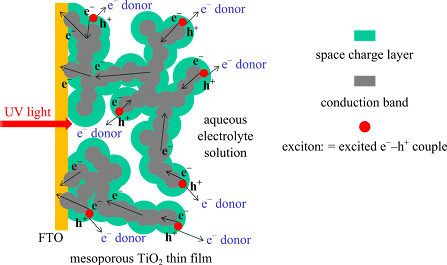
- are low for such mesoporous TiO2 thin film as investigated by an alternating current impedance spectroscopy. The electron conductivity of TiO2 itself is not high. However, the carrier density N of 6.96 × 1019 cm−3 obtained from Figure 4 was high, in the order as that of graphite, indicating that the




Microfluidic anodization of aluminum films for the fabrication of nanoporous lipid bilayer support structures
Beilstein J. Nanotechnol. 2011, 2, 104–109, doi:10.3762/bjnano.2.12
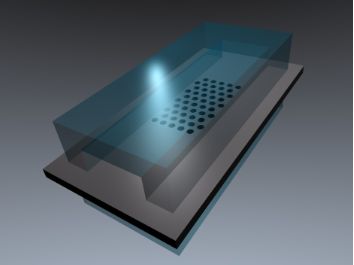
- monitored by impedance spectroscopy across the nanoporous alumina membrane in real-time. Our approach offers a simple and efficient methodology to investigate the activity of transmembrane proteins or ion diffusion across membrane bilayers. Keywords: anodization; lipid bilayer; microfluidics
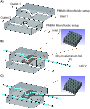
- formation of lipid bilayers on top of the nanoporous membrane which is monitored using impedance spectroscopy. Experimental The experimental setup for the microfluidic anodization approach is shown schematically in Figure 1. The aluminum substrate, either a 30 µm thick aluminum foil or a thin aluminum film
- the nanoporous membrane. The dissolution of the barrier layer was monitored via impedance spectroscopy (10 Hz to 10 kHz) across the nanoporous alumina membrane by a modular electrochemical system [Autolab (PGSTAT 100/FRA2), Eco Chemie Utrecht, The Netherlands] using silver/silver chloride electrodes


Other Beilstein-Institut Open Science Activities



