Search results
Search for "photothermal" in Full Text gives 112 result(s) in Beilstein Journal of Nanotechnology.
Influence of spurious resonances on the interaction force in dynamic AFM
Beilstein J. Nanotechnol. 2015, 6, 420–427, doi:10.3762/bjnano.6.42
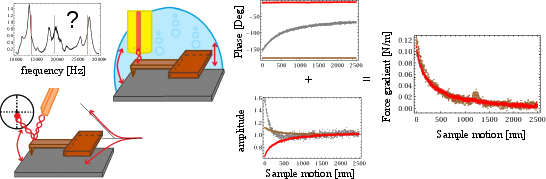
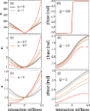
- piezoelectric excitation. In particular, in the last decade magnetic [8][9], capacitive [10] and photothermal [11][12] actuation schemes have been introduced. The differences between the direct excitation of the tip and the conventional dither excitation have already been studied and reported [13][14


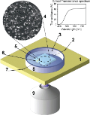
Mechanical properties of MDCK II cells exposed to gold nanorods
Beilstein J. Nanotechnol. 2015, 6, 223–231, doi:10.3762/bjnano.6.21
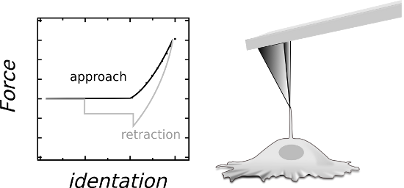
- membrane rendering them prime candidates for multifunctional carriers [6][7][8]. Potential applications encompass selective drug delivery, photothermal therapy, reporters for biosensors and the use as contrast agents [5][9]. Targets can be addressed specifically by functionalization of the particle surface


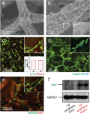
Mammalian cell growth on gold nanoparticle-decorated substrates is influenced by the nanoparticle coating
Beilstein J. Nanotechnol. 2014, 5, 2479–2488, doi:10.3762/bjnano.5.257
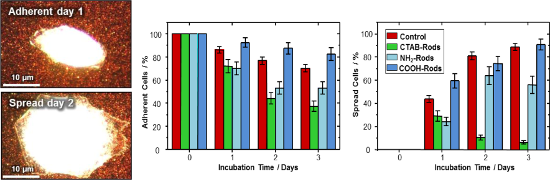
- tools for photothermal therapy [2][10]. However, the impact of functionalized nanomaterials on living organisms is still not fully understood and the number of studies on this topic are few compared to the number of nanoparticle types and applications [11]. To date, the studies are focused on


High-frequency multimodal atomic force microscopy
Beilstein J. Nanotechnol. 2014, 5, 2459–2467, doi:10.3762/bjnano.5.255
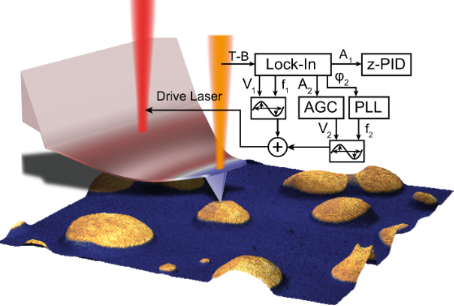
- bandwidth of 20 MHz, enabling multifrequency techniques extended beyond 2 MHz for obtaining materials contrast in liquid and air, as well as soft imaging of delicate biological samples. Keywords: atomic force microscopy; multifrequency imaging; nanomechanical characterization; photothermal excitation
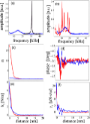
- including magnetic [20], resistive thermal [21], integrated piezotransducer [22] or photothermal [23][24] excitation, eliminating this effect. Of the direct drive techniques, photothermal-based excitation has the benefit that it is compatible with most standard AFM cantilevers and, although long-established
- , has recently gained renewed interest [25][26][27][28][29][30]. Although the efficiency of photothermal excitation varies with different coatings, even uncoated cantilevers have been shown to work [31]. Furthermore, photodiode readout electronics in the OBD system typically have been restricted to


Hybrid spin-crossover nanostructures
Beilstein J. Nanotechnol. 2014, 5, 2230–2239, doi:10.3762/bjnano.5.232
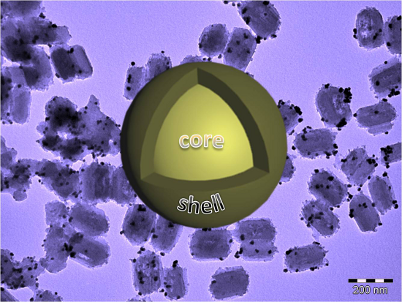
- silica sources, respectively. The SCO nano-composite particles were combined with gold NPs with the aim of using the properties of the gold to absorb light and convert it to heat (via a strong photothermal effect). Despite the small volume fraction of gold NPs within the nanocomposite (around 0.5%), the
- . Furthermore, the spin-state switching behavior was also observed due to plasmonic heating. Such devices that display synergy between plasmon resonance and molecular spin states may be of great interest for implementing detection or self-regulation strategies on-chip for the photothermal effect or, with an



Properties of plasmonic arrays produced by pulsed-laser nanostructuring of thin Au films
Beilstein J. Nanotechnol. 2014, 5, 2102–2112, doi:10.3762/bjnano.5.219
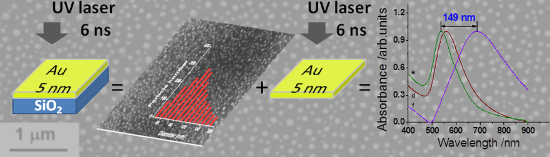
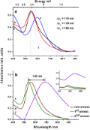
- the particle shape variations which range from partially spherical to cup-like to partial spheroids. Nanostructuring via the photothermal effect associated with strong plasmonic absorption (i.e., collective oscillation of the free electrons between the metal and dielectric when excited around the
- resonant frequency) was reported by Hubenthal and coworkers who obtained controlled rearrangement of the NP population and morphology using laser pulses of energy tunable in the range of 0.7–4 eV (1771–310 nm) [13]. For thin, granular Au films, the photothermal effect at a wavelength corresponding to the
- laser pulses of duration longer than 50 ps, the interaction effect is photothermal in nature, while for shorter pulses, the ballistic energy transfer dominates [22][23]. In a recent paper on the nanosecond laser effect, Kneier et al. reported time-resolved data from interferometric measurements and


Carbon-based smart nanomaterials in biomedicine and neuroengineering
Beilstein J. Nanotechnol. 2014, 5, 1849–1863, doi:10.3762/bjnano.5.196
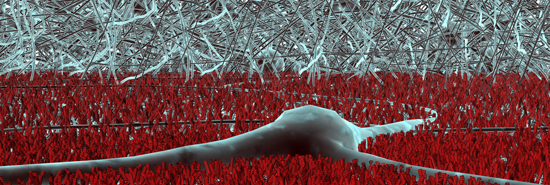
- size of the nanomaterial itself [87][88][89], as well as on the presence of metal contaminants and the residues of the GO preparation method in graphene samples [90]. Biomedical applications of graphene and its derivatives range from photothermal tumour ablation therapy to biosensors, from gene therapy
- near-infrared region as a photothermal agent for in vivo cancer treatment, while scrutinising the effects originating from different graphene sizes and coatings [97]. Several research groups have focused on graphene as biosensors. Dey et al. [98] developed an amperometric cholesterol biosensor; Tang


In vitro interaction of colloidal nanoparticles with mammalian cells: What have we learned thus far?
Beilstein J. Nanotechnol. 2014, 5, 1477–1490, doi:10.3762/bjnano.5.161
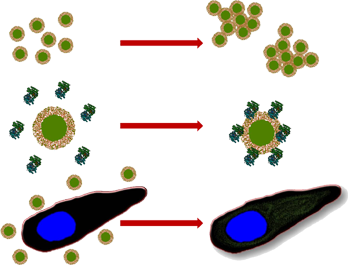
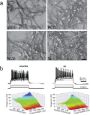
- fluorescence. b) After release of the pH-sensitive fluorophore linked to dextran to the cytosol (by photothermal heating), the fluorophore–dextran conjugates are freely dispersed, without any visible granular structure. Due to the neutral pH in the cytosol the fluorescence of the fluorophore–dextran conjugates


In vitro toxicity and bioimaging studies of gold nanorods formulations coated with biofunctional thiol-PEG molecules and Pluronic block copolymers
Beilstein J. Nanotechnol. 2014, 5, 546–553, doi:10.3762/bjnano.5.64
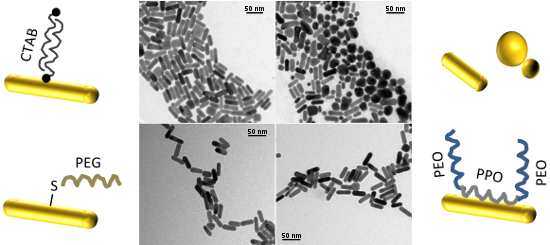
- the NIR region so that heat is generated to damage cells and tissues. This property renders them useful for photothermal therapy and imaging of cancer [7][8]. In addition, the AuNRs surface can be functionalized with ligands for targeted drug delivery to support cancer therapy in vitro and in vivo [9


Near-infrared dye loaded polymeric nanoparticles for cancer imaging and therapy and cellular response after laser-induced heating
Beilstein J. Nanotechnol. 2014, 5, 313–322, doi:10.3762/bjnano.5.35
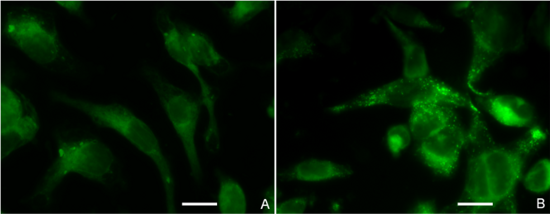
- (wavelength 700–900 nm) are promising for in vivo imaging because light at these wavelengths has minimal absorption by tissue [6][7]. Moreover, some NIR dyes such as indocyanine green (ICG) can be used as both imaging agents and heat generators due to their unique photothermal properties. However, ICG has a
- , which normalizes the thermal dose to cumulative equivalent minutes at 43 °C [26], the temperature and the duration of heating can be used to define thermal damage. Our previous paper and other groups’ reports indicate that the rate of photothermal treatment might also affect the HT outcome, because


Peak forces and lateral resolution in amplitude modulation force microscopy in liquid
Beilstein J. Nanotechnol. 2013, 4, 852–859, doi:10.3762/bjnano.4.96
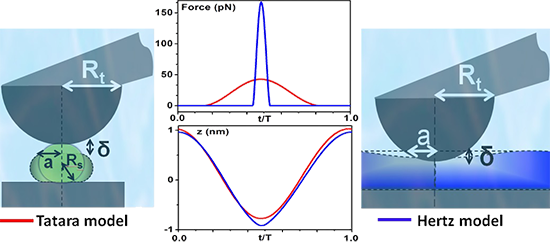
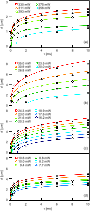
- low Q are valid for directly excited cantilevers, such as magnetic [41][42][43] or photothermal excitations [44][45]. The tip–sample interaction forces are modelled by using two different contact mechanics models, Hertz [29] and Tatara [30][31][32]. The widely used Hertz model gives the force as The


Substrate-mediated effects in photothermal patterning of alkanethiol self-assembled monolayers with microfocused continuous-wave lasers
Beilstein J. Nanotechnol. 2012, 3, 65–74, doi:10.3762/bjnano.3.8
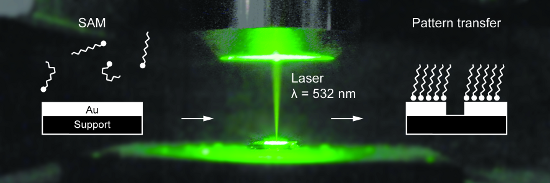
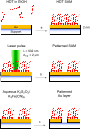
- been demonstrated to provide promising new approaches to nonlinear laser processing. Most notably, because of their ultrathin nature, indirect excitation mechanisms can be exploited in order to fabricate subwavelength structures. In photothermal processing, for example, microfocused lasers are used to
- continuous-wave lasers. The lateral resolution, generally, depends on both the type of the organic monolayer and the nature of the substrate. In previous studies we reported on photothermal patterning of distinct types of SAMs on Si supports. In this contribution, a systematic study on the impact of the
- substrate on the overall patterning process and provide new perspectives in photothermal laser patterning of ultrathin organic coatings. Keywords: femtosecond lasers; nonlinear laser processing; self-assembled monolayers; subwavelength patterning; ultrathin resists; Introduction In the past decades, self