


Search results
Search for "quantum dot" in Full Text gives 103 result(s) in Beilstein Journal of Nanotechnology.
Simple theoretical analysis of the photoemission from quantum confined effective mass superlattices of optoelectronic materials
Beilstein J. Nanotechnol. 2011, 2, 339–362, doi:10.3762/bjnano.2.40
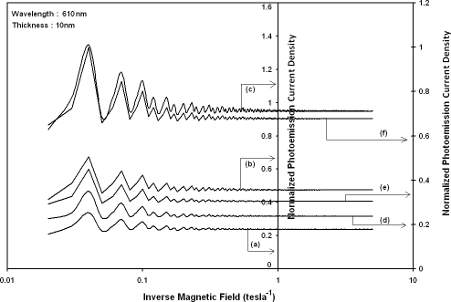
- intensity reflects the direct signature of light waves on the carrier energy spectra. The content of this paper finds six different applications in the fields of low dimensional systems in general. Keywords: magnetic quantization; photoemission; quantum dot effective mass superlattices; quantum well
- cases defined by the perturbed two band model of Kane or a parabolic energy band, β0(E, λ, Eg0i, Δi) should be replaced by τ0(E, λ, Eg0i) and ρ0(E, λ, Eg0i) respectively. The basic forms of Equation 12 and Equation 13 remain unchanged. 3 Photoemission from quantum dot effective mass superlattices The
- . In this paper, we have studied the photoemission from quantum wire and quantum dot effective mass superlattices of optoelectronic materials, on the basis of newly formulated electron dispersion relations, in the presence of external photo-excitation. In addition, the influence of magnetic field on


Dense lying self-organized GaAsSb quantum dots on GaAs for efficient lasers
Beilstein J. Nanotechnol. 2011, 2, 333–338, doi:10.3762/bjnano.2.39
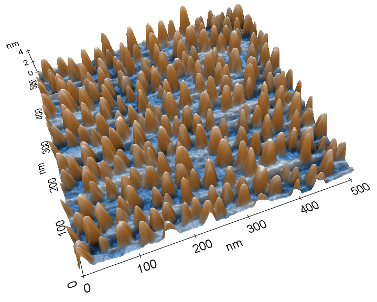
- . Apparently, a V/III ratio of 1/1 is optimal for high quantum dot density. Compared to the highest QD density previously reported, our results reveal a two times higher density. Figure 2 shows the PL spectra of two QD samples grown at a V/III ratio of 1/1 (so-called smaller dots) and 1.5/1 (larger dots
- compared to our work. According to Figure 2 an increase in the dot volume should lead to a redshift of the PL peak. However, the blueshift induced by the decreased Sb concentration in the QDs overcompensates for the volume dependent redshift, leading to the net blueshift observed in Figure 4. Quantum dot
- × 1010 cm−2 was achieved in the SK epitaxial growth mode, with a V/III flux ratio of 1/1 at a growth temperature of T = 527 °C and nominal coverage of 3 ML. With increasing V/III ratio the dot size also increased. Only one PL peak was detected, attributable to the quantum dot nature; no further peak


Fabrication and spectroscopic studies on highly luminescent CdSe/CdS nanorod polymer composites
Beilstein J. Nanotechnol. 2010, 1, 94–100, doi:10.3762/bjnano.1.11
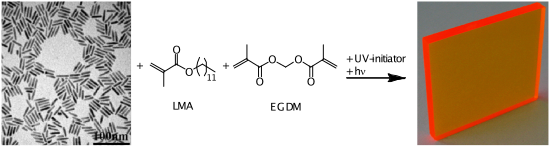
- , aggregation of nanoparticles, loss of transparency and luminescence quenching due to exciton energy transfer [2][7]. Several methods have been described to overcome these problems for quantum dot polymer composites. For example, Bawendi and coworkers incorporated trioctylphosphine oxide covered CdSe/ZnS QDs


Other Beilstein-Institut Open Science Activities



