Search results
Search for "reflectance" in Full Text gives 228 result(s) in Beilstein Journal of Nanotechnology. Showing first 200.
Synthesis of novel C-doped g-C3N4 nanosheets coupled with CdIn2S4 for enhanced photocatalytic hydrogen evolution
Beilstein J. Nanotechnol. 2019, 10, 912–921, doi:10.3762/bjnano.10.92
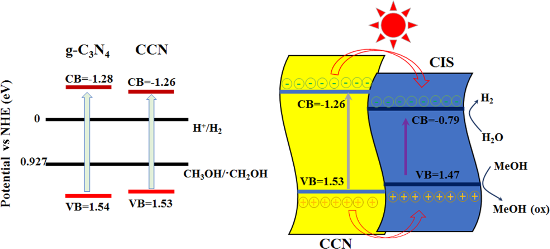
- preparation process. UV–vis diffuse reflectance spectroscopy (DRS) was used to investigate the optical absorption properties of g-C3N4, CCN and the series of CISCCN composites. As shown in Figure 6a, g-C3N4 exhibits an absorption edge at approximately 426 nm. For the CCN sample, however, the light absorption
- , NEXUS-870, Nicolet Instrument Co. USA), X-ray diffraction (XRD, XD-3, Purkinje General, China, Cu Kα radiation), X-ray photoelectron spectroscopy (XPS, Escalab 250Xi, America), UV–vis diffuse reflectance spectroscopy (DRS, Hitachi U-4100) at a wavelength range of 200–800 nm, and fluorescence


Fabrication of silver nanoisland films by pulsed laser deposition for surface-enhanced Raman spectroscopy
Beilstein J. Nanotechnol. 2019, 10, 882–893, doi:10.3762/bjnano.10.89
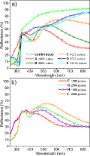
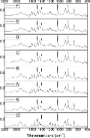
- ), the monotonically increase of the reflectance is visible as the wavelength increases. Samples D and E, with the thickest layers of Ag, show similar shapes of the UV–vis spectra. These samples, however, have a lower reflectance in the range of 350 to 850 nm and local minima at around 540 nm and 370 nm
- ,respectively. The samples with the smallest dimensions of silver nanoislands (samples A, B, F, G, H, and I) have completely different shapes of spectra. These samples have a much lower reflectance in the range of 350 to 850 nm with one characteristic minimum between 400 and 430 nm, which corresponds to plasmon
- resonance of Ag NPs. The small shift of the plasmon resonance peak may be related to rather small variations of the size of particles between samples obtained using various deposition process parameters. Then reflectance increases and reaches a maximum in the range of 450 to 520 nm and decreases again




Outstanding chain-extension effect and high UV resistance of polybutylene succinate containing amino-acid-modified layered double hydroxides
Beilstein J. Nanotechnol. 2019, 10, 684–695, doi:10.3762/bjnano.10.68
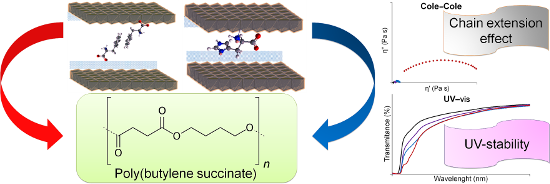
- PC spectrophotometer. Kubelka–Munk theory was applied to the LDH filler data to transform the diffuse reflectance spectra into absorption spectra. The fluorescence spectra of PBS–LDH nanocomposites were recorded with a Perkin-Elmer LS-55 luminescence spectrophotometer equipped with a front surface
- considering a rectangular parallelepiped shape. FTIR spectra of organo-modified Mg2Al hybrids: (a) LDH/HIS, (c) LDH/PHE and pristine amino acids: (b) L-HIS, (d) L-PHE (left side), zoom region on the right side. Diffuse reflectance UV–vis spectra (Kubelka–Munk functions) of Mg2Al LDHs. XRD patterns of PBS


Ultrathin hydrophobic films based on the metal organic framework UiO-66-COOH(Zr)
Beilstein J. Nanotechnol. 2019, 10, 654–665, doi:10.3762/bjnano.10.65
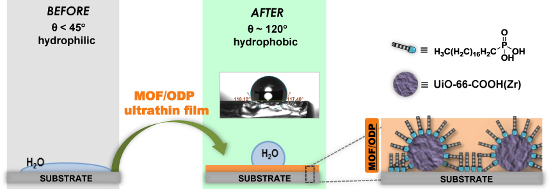
- inspection. IR spectra were obtained using a Perking Elmer Spectrum 100 spectrometer operated in transmission mode for films and in attenuated total reflectance (ATR) mode for powder samples. The films were deposited onto calcium fluoride windows. Water contact angle measurements were performed on different


Topochemical engineering of composite hybrid fibers using layered double hydroxides and abietic acid
Beilstein J. Nanotechnol. 2019, 10, 589–605, doi:10.3762/bjnano.10.60

- (λ = 0.15415 nm). Patterns were recorded in the 2θ range of 5–70° in steps of 0.04° with a counting time per step of 8 s. The modified fibers were analyzed by pressing them gently onto a copper sample holder. ATR-FTIR analysis: Attenuated total reflectance Fourier transform infrared (ATR-FTIR
- the refined fibers have more empty spaces and pores than unrefined fibers, which might reduce light scattering and reflectance. The brightness of unbleached pulps (UBKP, UBKPR) was markedly lower. UBKPR shows a very poor ISO brightness which sometimes could not be determined due the very weak
- reflectance (Table S2, Supporting Information File 1). C-F fibers exhibit a lower brightness than the reference fibers (REF, Table S2, Supporting Information File 1). Again, the difference was huge with unbleached fibers for the reasons discussed above. AA, which is a resin acid with dull brown color




Direct observation of the CVD growth of monolayer MoS2 using in situ optical spectroscopy
Beilstein J. Nanotechnol. 2019, 10, 557–564, doi:10.3762/bjnano.10.57
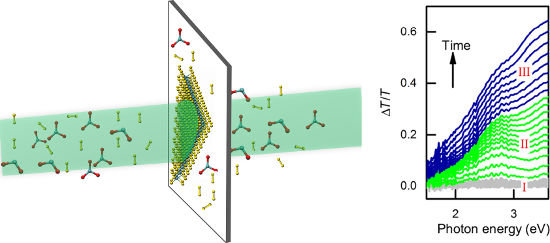
- reflectance spectroscopy (DRS), which measures the normalized difference between the reflectance of the bare surface and the surface covered by thin films, possesses an enhanced sensitivity to the surface modification and ultrathin film growth [25][26]. This technique has been successfully applied to reveal
- properties associated with the MoS2 layer can be revealed spectroscopically. Furthermore, since the sapphire substrate is transparent in the visible range, the change of the reflectance upon the growth of an ultrathin MoS2 layer is directly proportional to its absorption [25]. Assuming the scattering effect
- of the sapphire substrate. This conclusion is based on a thorough ex situ characterization after CVD growth using differential reflectance spectroscopy (DRS), Raman spectroscopy, photoluminescent spectroscopy (PL), optical microscopy (OM), and atomic force microscopy (AFM). Actually, from the first


Ultraviolet patterns of flowers revealed in polymer replica – caused by surface architecture
Beilstein J. Nanotechnol. 2019, 10, 459–466, doi:10.3762/bjnano.10.45
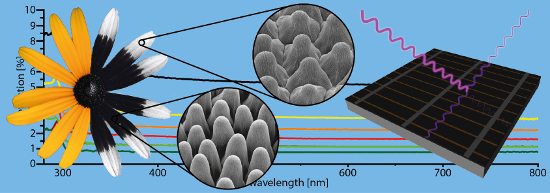
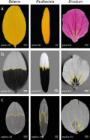
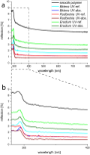
- studies, the statements about the influence of the surface structure on the UV-reflectance are contrary [12][31] – Some postulated an influence while others doubt that there is any influence on the UV-pattern by the surface structure. Furthermore, there are hardly any studies were the structure was
- the infrared and visible spectrum. Spectral reflectance measurements using a spectrometer with an integrating sphere Diffuse reflectance measurements were acquired throughout the 280 nm to 800 nm spectrum using a commercially available double-beam spectrometer (Lambda 1050, Perkin Elmer, Massachusets
- , USA) with an internal integrating sphere (Labsphere RSA-PE-20, 600 mm), whereby the total reflectance (r) was measured. The reference beam irradiates a Spectralon™ surface, which was calibrated as a 100% (r = 100%) reflective surface. The samples were attached to an opening in the surface of the


Reduced graphene oxide supported C3N4 nanoflakes and quantum dots as metal-free catalysts for visible light assisted CO2 reduction
Beilstein J. Nanotechnol. 2019, 10, 448–458, doi:10.3762/bjnano.10.44
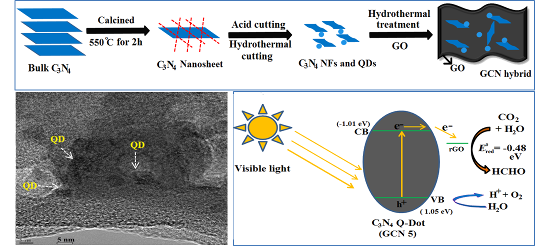
- NFs and QDs are also calculated from UV–visible diffuse reflectance spectra (Supporting Information File 1, Figure S5), which are found to be 2.06, 2.15, 2.20, 2.22, 2.32 and 2.41 eV for the GCN-5, GCN-20, GCN-10, CN-5, CN-20 and CN-10 samples, respectively. The conduction and valence band potential






Gold nanoparticles embedded in a polymer as a 3D-printable dichroic nanocomposite material
Beilstein J. Nanotechnol. 2019, 10, 442–447, doi:10.3762/bjnano.10.43
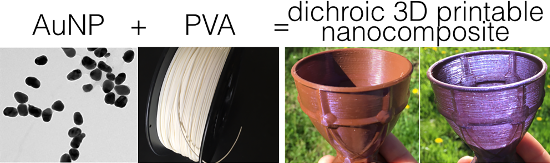
- 4th century puzzled scientists for long time: The Lycurgus cup [7]. This cup has a very peculiar dichroic filter property [8], as its color is dependent on the illumination angle, changing from clear red (transmittance) to opaque green (reflectance). It was later found that this optical property was



Nanocomposite–parylene C thin films with high dielectric constant and low losses for future organic electronic devices
Beilstein J. Nanotechnol. 2019, 10, 428–441, doi:10.3762/bjnano.10.42
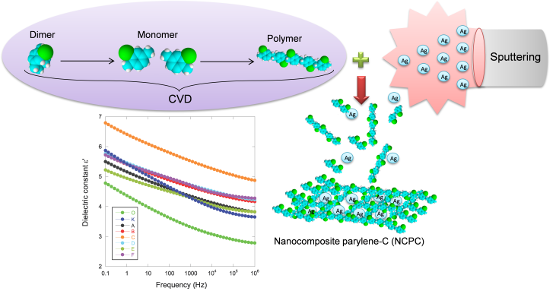
- transform infrared spectrometer (FTIR, Nicolet 380) in reflectance mode at a resolution of 4 cm−1 in a wave number range from 400 to 3200 cm−1. The spectra were obtained after a previous background subtraction with 32 scans for each sample to remove the contribution of H2O and CO2 molecules. Dielectric




Geometrical optimisation of core–shell nanowire arrays for enhanced absorption in thin crystalline silicon heterojunction solar cells
Beilstein J. Nanotechnol. 2019, 10, 322–331, doi:10.3762/bjnano.10.31
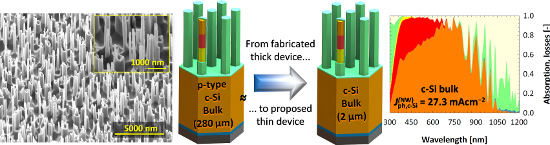
- reflectance measured by means of a Perkin Elmer LAMBDA 950 UV–vis–NIR spectrophotometer. Modelling approach Simulations of the radial heterojunction c-Si nanowire solar cell were carried out by means of a 3D Maxwell equation solver, based on the finite element method (FEM). The “High Frequency Structure
- Information File 1, the implied photocurrent density losses, due to reflection and parasitic absorption in supporting layers, are included. It can be observed that an increase in NW height reduces reflectance. This can be expected since (in general) taller nanostructures exhibit better anti-reflection
- other hand, reflectance losses are significant for narrow nanowires (d < 200 nm), decreasing sharply until reaching a minimum between 400 and 500 nm. For larger values of the cross section (d > 500 nm), reflection losses become larger again. This behaviour can be explained as follows: When d is too


Uniform Sb2S3 optical coatings by chemical spray method
Beilstein J. Nanotechnol. 2019, 10, 198–210, doi:10.3762/bjnano.10.18
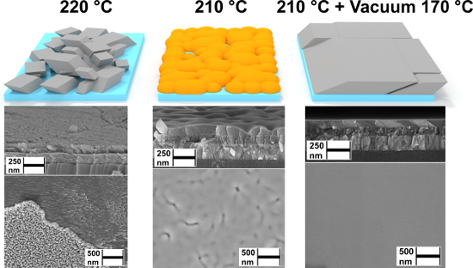
- thickness of 100 nm derived from SEM images (Table 3). The absorption coefficient α was determined as where d is the layer thickness, R is the total reflectance, included to compensate for thin film interference, and T is the total transmittance. The band gap of Sb2S3 layers was determined by plotting (αhν
- accounting for reflectance in α calculations. Thus, the absolute values of α may deviate from the expected values with the uncertainty introduced by using a constant layer thickness in calculations. The α vs wavelength plots of samples, which contain as-deposited or vacuum-treated Sb2S3 layers deposited from
- 0.02°, 5°/min, silicon strip detector D/teX Ultra). The crystal structure and phase composition were analyzed using Rigaku PDXL 2 software. Optical total transmittance and total reflectance spectra of glass/ITO/TiO2 reference and glass/ITO/TiO2/Sb2S3 samples were measured in the 250–1600 nm range vs





Amorphous NixCoyP-supported TiO2 nanotube arrays as an efficient hydrogen evolution reaction electrocatalyst in acidic solution
Beilstein J. Nanotechnol. 2019, 10, 62–70, doi:10.3762/bjnano.10.6
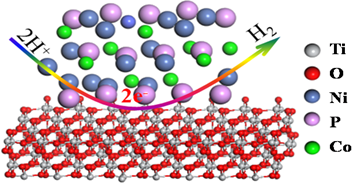
- crystallographic texture, scanning electron microscopy (SEM, JSM-5900 LV, JEOV) for micro-morphology, transmission electron microscopy (TEM, Tecnai G2 F20 S-TWIN) for microstructure, UV–vis diffuse reflectance spectroscopy (UV2100) for photoabsorption properties, X-ray photoelectron spectroscopy (XPS, Escalab




Zn/F-doped tin oxide nanoparticles synthesized by laser pyrolysis: structural and optical properties
Beilstein J. Nanotechnol. 2019, 10, 9–21, doi:10.3762/bjnano.10.2
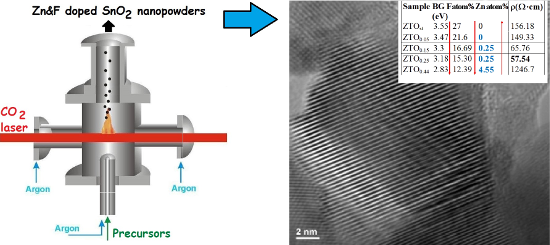
- valuable from a technological point of view are its electrical conductivity, which is strongly affected by the surface states and the presence of dopants, transparency in the visible light range, high reflectance in the infrared range, and its classification as not potentially toxic or harmful [2][3]. The
- samples, yet in our case, the UV–vis absorption in this region seems to be considerably lower. Unfortunately, in the methods employed to extract the absorbance (diffuse reflectance spectroscopy using BaSO4 reflectance standard in [53] vs direct absorption from ethanolic suspensions in our study), the



Colloidal chemistry with patchy silica nanoparticles
Beilstein J. Nanotechnol. 2018, 9, 2989–2998, doi:10.3762/bjnano.9.278
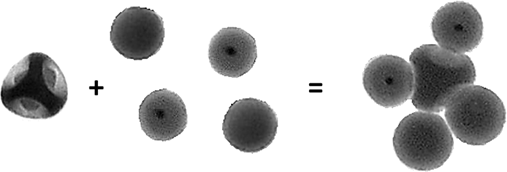
- carboxylic acid groups. The grafting efficiency was evidenced by zeta potential measurements and diffuse reflectance infrared Fourier-transform (DRIFT) spectroscopy. Figure 2b shows that after treatment of the silica surface by APTES, the so-aminated nanoparticles display a quite high zeta potential value of
- -resolution SEM experiments with a JSM 6700F microscope at the Plateforme de Caractérisation des Matériaux d’Aquitaine (PLACAMAT). One drop of the CMs suspension was deposited on a glass slide. It was then dried in the open air, metalized, and placed in a box away from dust. Diffuse reflectance infrared


Optimization of Mo/Cr bilayer back contacts for thin-film solar cells
Beilstein J. Nanotechnol. 2018, 9, 2700–2707, doi:10.3762/bjnano.9.252
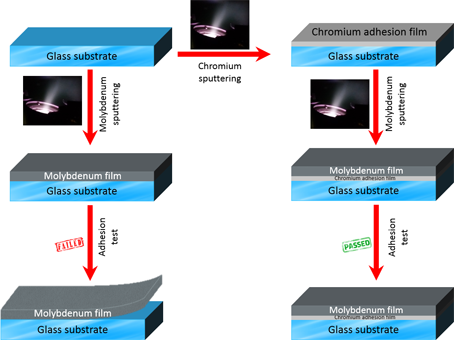
- different deposition powers and working pressures. Good adhesion to the SLG substrate has been achieved by means of an ultra-thin Cr layer under the Mo layer. By optimizing the deposition conditions we achieved low surface roughness, high optical reflectance and low sheet resistivity while we could decrease
- ; bilayer; chromium; DC sputtering; molybdenum; optical reflectance; Introduction Molybdenum (Mo) thin films are widely used as a back contact for photovoltaic devices such as Cu(In1−xGax)S2 (CIGS) and Cu2ZnSnS4 (CZTS) thin-film solar cells. The back contact is the first layer to be deposited and its
- a functions of the sputtering power and pressure [8][9]. The most successful approach suggested so far to improve the adhesion of Mo back contact layer to the glass substrate (while retaining its conductivity and optical reflectance) is through the deposition of a Mo bilayer rather than a single


Au–Si plasmonic platforms: synthesis, structure and FDTD simulations
Beilstein J. Nanotechnol. 2018, 9, 2599–2608, doi:10.3762/bjnano.9.241
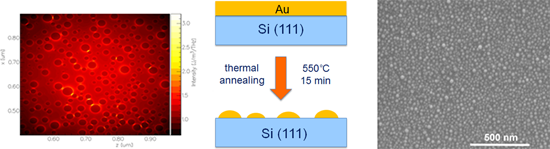
- ). XPS spectra were analyzed with the Casa-XPS software using a Shirley background subtraction and Gaussian–Lorentzian curves for fitting. UV–vis spectra were recorded by a double-beam Thermo Fisher Scientific Evolution 220 spectrophotometer in reflectance mode. The spectra were recorded in a range of



Non-agglomerated silicon–organic nanoparticles and their nanocomplexes with oligonucleotides: synthesis and properties
Beilstein J. Nanotechnol. 2018, 9, 2516–2525, doi:10.3762/bjnano.9.234
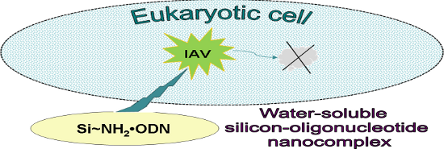
- Si–NH2 solution was recorded on a Cary 660 FTIR spectrometer (Agilent Technologies, USA) within the range of 4000–500 cm−1 at 4 cm−1 resolution, and 100 scans were accumulated in the attenuated total reflectance (ATR) mode using a GladiATR unit (Pike Technologies). The spectrum of the substance is


Thickness-dependent photoelectrochemical properties of a semitransparent Co3O4 photocathode
Beilstein J. Nanotechnol. 2018, 9, 2432–2442, doi:10.3762/bjnano.9.228
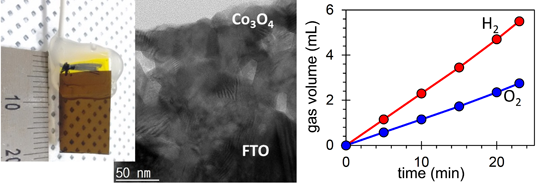
- layer and the reflectance, respectively. Figure 2b shows α estimated as a function of photon energy (hν). The influence of the Co3O4 morphology on α is interesting. Except for the 70 nm film, α increases with thickness, suggesting an increase in porosity as well. A higher porosity led to higher α values



Performance analysis of rigorous coupled-wave analysis and its integration in a coupled modeling approach for optical simulation of complete heterojunction silicon solar cells
Beilstein J. Nanotechnol. 2018, 9, 2315–2329, doi:10.3762/bjnano.9.216
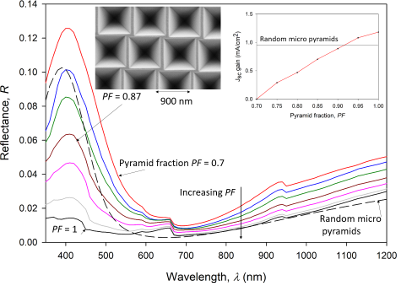
- (feature sizes of a few micrometers), this is not the case. Small textures were optimized to decrease the reflectance, and consequently, increase the absorption in the active layers of the solar cell. Decreasing the flat parts of the texture was shown to improve performance. For simulations of structures
- efficient simulation and optimization of solar cell structures. On the other hand, smaller number of sublayers and modes may lead to inaccuracies of results. In next subsections we present simulation results on total reflectance, R, in the EVA medium of the analyzed partial structure. Besides comparison of
- calculated an absolute difference (error) in JSC reflectance loss, |ΔJSC|, from deviations in R, as given in Equation 1 as where q is the elementary charge, is the reduced Planck constant and c is the speed of light. This parameter is defined as the absolute value of the reflectance difference, which is


Two-dimensional photonic crystals increasing vertical light emission from Si nanocrystal-rich thin layers
Beilstein J. Nanotechnol. 2018, 9, 2287–2296, doi:10.3762/bjnano.9.213
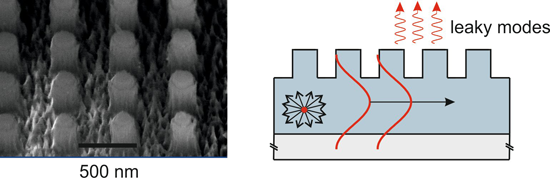
- reflectance spectra. The extraction enhancement within different spatial angles was evaluated by means of micro-photoluminescence spectroscopy. More than 18-fold extraction enhancement was achieved for light propagating in the normal direction and up to 22% increase in overall intensity was obtained at the
- spectral resolution was therefore used only for the simulation of the normal-incidence spectra, which reveals leaky modes at the Γ−point. For the case of angle-resolved reflectance simulations, which will also be presented in this paper, the spectral resolution was decreased to 10−4 nm. By this, even
- though the intensity values of the calculated resonances are not correct, their spectral position could be used for obtaining a qualitative information about the dispersion of photonic bands. As it will be shown later, the angle-resolved reflectance spectra calculated using the lower resolution are in



Electrospun one-dimensional nanostructures: a new horizon for gas sensing materials
Beilstein J. Nanotechnol. 2018, 9, 2128–2170, doi:10.3762/bjnano.9.202



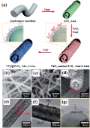


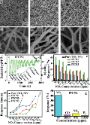


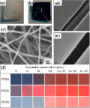
Sulfur-, nitrogen- and platinum-doped titania thin films with high catalytic efficiency under visible-light illumination
Beilstein J. Nanotechnol. 2018, 9, 1629–1640, doi:10.3762/bjnano.9.155
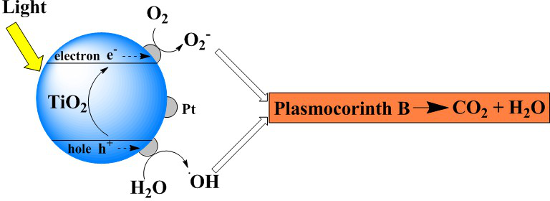
- distribution (≈10 nm), whereas S3 has a multimodal pore size distribution. The distributions of pores in other samples synthesized with HCl (Urea_15, Thiourea_15) and H2SO4 (S3_N0.5, S3_N0.5+1% Pt) are similar to the distributions shown in Figure 3. Band gap measurements The diffuse reflectance, R, of the
- measured samples as a function of the wavelength λ is shown in the Figure 4a, and in Figure 4b, one can see the modified Kubelka–Munk function, (F(R)hν)n, vs energy, Eg, where F is the Kubelka–Munk function of the measured diffuse reflectance R as follows: F(R) = (1 − R)2 / 2R. The band gap energy was
- emission scanning electron microscope (FEI Inspect™ F50 and Ultra Plus Zeiss). The band gap measurements were performed by measuring the reflectance of the samples using a UV–vis spectrophotometer (Evolution 600, Thermo Scientific), using the diffuse reflectance accessory (DRA-EV-600) integrating sphere


Nanocomposites comprised of homogeneously dispersed magnetic iron-oxide nanoparticles and poly(methyl methacrylate)
Beilstein J. Nanotechnol. 2018, 9, 1613–1622, doi:10.3762/bjnano.9.153
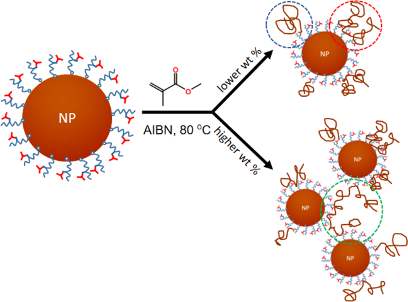
- -shift standard. The diffuse reflectance infrared Fourier transform spectra (DRIFT, Perkin Elmer Spectrum 400 equipped with DRIFT accessory) were recorded in KBr. The weight fraction of nanoparticles in the nanocomposites was determined with a Mettler Toledo thermogravimetric analysis (TGA) instrument


Sheet-on-belt branched TiO2(B)/rGO powders with enhanced photocatalytic activity
Beilstein J. Nanotechnol. 2018, 9, 1550–1557, doi:10.3762/bjnano.9.146
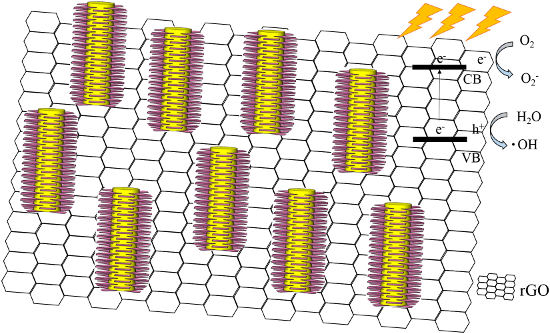
- 10 mW. The X-ray photoelectron spectra (XPS) characterization was tested on an ESCA spectrometer (S-Probe ESCA SSX-100S, Fisons Instrument) and monochromatized Al Kα X-ray irradiation. The binding energy was calibrated by using the containment carbon (C 1s = 284.6 eV). The UV–vis diffuse reflectance
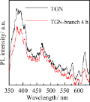
- , and (d) O 1s for sample TGN-branch 4 h. (a) UV–vis diffuse reflectance spectra of TGN and TGN-branch 4 h. (b) Re-plotting of (a) in the α1/2 ~ hν coordinate to evaluate the corresponding band gap, assuming an indirect transition between bands for TiO2. Photodegradation of phenol in the presence of