Search results
Search for "tapping mode" in Full Text gives 188 result(s) in Beilstein Journal of Nanotechnology.
High-speed dynamic-mode atomic force microscopy imaging of polymers: an adaptive multiloop-mode approach
Beilstein J. Nanotechnol. 2017, 8, 1563–1570, doi:10.3762/bjnano.8.158
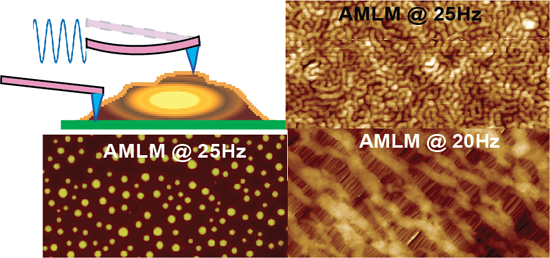
- ) imaging to substantially increase (over an order of magnitude) the speed of tapping-mode (TM) imaging is tested and evaluated through imaging three largely different heterogeneous polymer samples in experiments. It has been demonstrated that AMLM imaging, through the combination of a suite of advanced
- quality of the 25 Hz and 20 Hz AMLM imaging is at the same level of that of the 1 Hz TM imaging, while the tip–sample interaction force is substantially smaller than that of the 2 Hz TM imaging. Keywords: adaptive multiloop mode; atomic force microscopy (AFM); heterogeneous polymer sample; tapping-mode
- imaging; Introduction In this paper, the adaptive-multiloop imaging mode of atomic force microscopy (AFM) is tested and evaluated by imaging three largely different heterogeneous polymer samples. AMLM imaging substantially increases the speed of tapping mode (TM) imaging (by over an order of magnitude




A nanocomplex of C60 fullerene with cisplatin: design, characterization and toxicity
Beilstein J. Nanotechnol. 2017, 8, 1494–1501, doi:10.3762/bjnano.8.149
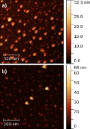
- , Russia) in the “light” tapping mode according to the well-established procedure. For the sample preparation, a drop of solution was placed onto a pre-cleaned microscope glass slide and dried in air prior to AFM imaging. Cell isolation and cultivation Human peripheral blood from healthy donors was



A review of demodulation techniques for amplitude-modulation atomic force microscopy
Beilstein J. Nanotechnol. 2017, 8, 1407–1426, doi:10.3762/bjnano.8.142
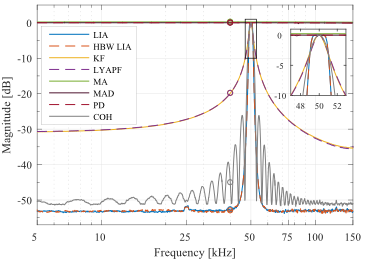
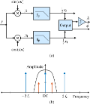
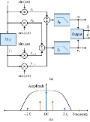
- performance metrics tracking bandwidth, implementation complexity and sensitivity to other frequency components are experimentally evaluated for each method. Finally, the significance of an adequate demodulator bandwidth is highlighted during high-speed tapping-mode atomic force microscopy experiments in
- amplitude estimate as a function of the tracking bandwidth. The experimental analysis is concluded by high-speed constant-height tapping-mode AFM experiments which highlight the case where the demodulator is the bandwidth bottleneck in the z-axis feedback loop. Fundamentals of amplitude modulation and
- RMS-to-DC converter, the output needs to be scaled by to obtain the amplitude as evident from Equation 15. This method has increasing latency for decreasing tracking bandwidth. Mean absolute deviation In tapping-mode AFM, RMS-to-DC conversion was typically performed using a precision rectifier




Deposition of exchange-coupled dinickel complexes on gold substrates utilizing ambidentate mercapto-carboxylato ligands
Beilstein J. Nanotechnol. 2017, 8, 1375–1387, doi:10.3762/bjnano.8.139
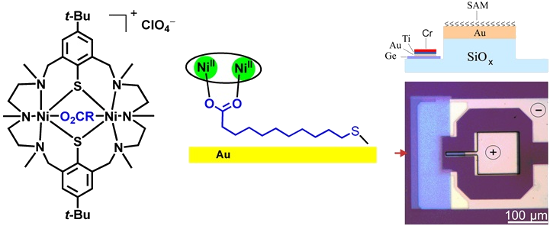
- . Atomic force microscopy An Agilent 5600LS AFM system was used to collect topography data under Ar and ambient conditions in order to keep the integrity of the organic system. Measurements were performed in tapping mode in order to minimize the contact between the AFM probe and the sample surface and


Preparation of thick silica coatings on carbon fibers with fine-structured silica nanotubes induced by a self-assembly process
Beilstein J. Nanotechnol. 2017, 8, 1145–1155, doi:10.3762/bjnano.8.116
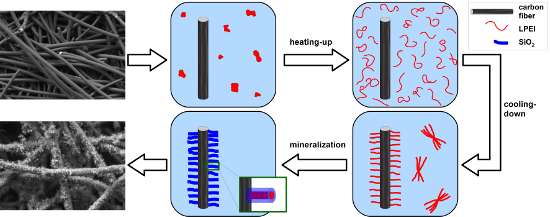
- equipped with a Gatan image filter. Holey carbon-coated copper grids were used for sample preparation. Atomic force topographic images were sampled by means of an Agilent 5500 AFM with MAC III controller operating in tapping mode. A polynomial background subtraction was applied for image processing


Growth, structure and stability of sputter-deposited MoS2 thin films
Beilstein J. Nanotechnol. 2017, 8, 1115–1126, doi:10.3762/bjnano.8.113
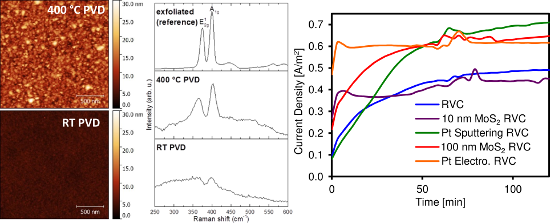
- spectrometer [55] was used for AFM imaging in tapping mode. For Raman spectroscopy an excitation wavelength of 473 nm was employed. For modification-free measurements on the MoS2 films a low laser power of 0.75 µW was employed while for in situ modifications to the film a higher laser power of 3.5 mW was used


Scaling law to determine peak forces in tapping-mode AFM experiments on finite elastic soft matter systems
Beilstein J. Nanotechnol. 2017, 8, 968–974, doi:10.3762/bjnano.8.98
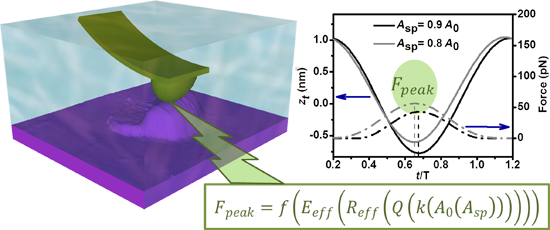
- Horacio V. Guzman Max Planck Institute for Polymer Research, Ackermannweg 10, 55128 Mainz, Germany 10.3762/bjnano.8.98 Abstract Analytical equations to estimate the peak force will facilitate the interpretation and the planning of amplitude-modulation force microscopy (tapping mode) experiments
- bidimensional deformation contact mechanics model. The equation enables to estimate the peak force based on the tapping mode observables, probe characteristics and the material properties of the sample. The accuracy of the equation has been verified by comparing it to numerical simulations for the archetypical
- operating conditions to image soft matter with high spatial resolution in tapping-mode AFM. Keywords: AFM in liquid; AFM theory; bidimensional elastic models; multivariate regression; neuronal networks; operational AFM parameters; parametrical equation; peak forces; soft matter; Introduction Amplitude


Analysis and modification of defective surface aggregates on PCDTBT:PCBM solar cell blends using combined Kelvin probe, conductive and bimodal atomic force microscopy
Beilstein J. Nanotechnol. 2017, 8, 579–589, doi:10.3762/bjnano.8.62
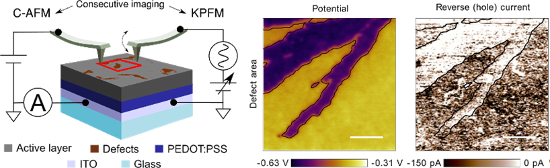
- implemented to break and remove the surface aggregates. As shown in Figure 6, four sets of images containing the topography and the third eigenmode amplitude are consecutively obtained with tapping-mode bimodal AFM. The surface aggregates are visualized as dark regions in the amplitude image and completely
- of the surface aggregates disappeared during C-AFM imaging, due to the use of the stiffer cantilever Multi75E-G (Budget Sensors, force constant k ≈ 2 N/m, setpoint: 10–20 nN) to perform tapping-mode bimodal AFM sequentially with contact-mode C-AFM and noncontact-mode KPFM. The cantilever used for
- correlating the potential and currents in Figure 4 (PPP-CONTSCPt, NanoSensors) has a smaller spring constant (k = 0.5–1.0 N/m) and thus also a weaker torsional stiffness. In general, it is not possible to sustain a repulsive tapping-mode imaging process for the softer cantilever on polymer samples. On the


Advances in the fabrication of graphene transistors on flexible substrates
Beilstein J. Nanotechnol. 2017, 8, 467–474, doi:10.3762/bjnano.8.50
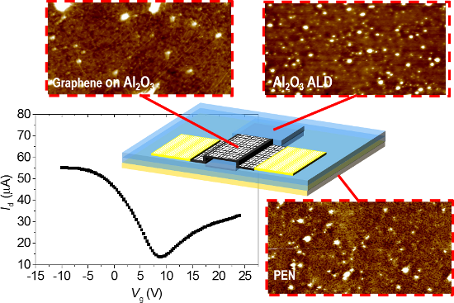
- collected by tapping mode atomic force microscopy (tAFM) for the LT growth (Figure 1a left) is comparable to the morphology obtained by the ST growth (Figure 1a right). The dielectric thickness and the consequent growth per cycle was determined by spectroscopic ellipsometry measurements performed on an
- conductance, graphene doping and electron and hole mobility. The fabricated devices will represent the platform for the implementation of solid IS-FETs that can be part of a fully flexible, integrated system for sensing and signal processing. a) Comparison between tapping mode atomic force microscopy (tAFM
- material deposited on an Al coated Si wafer; and d) current density leakage through low temperature and standard temperature dielectric materials. a) Tapping mode atomic force microscopy (tAFM) morphology of the PEN surface and b) a schematic representation of the PEN starting substrate. c) tAFM morphology



In-situ monitoring by Raman spectroscopy of the thermal doping of graphene and MoS2 in O2-controlled atmosphere
Beilstein J. Nanotechnol. 2017, 8, 418–424, doi:10.3762/bjnano.8.44
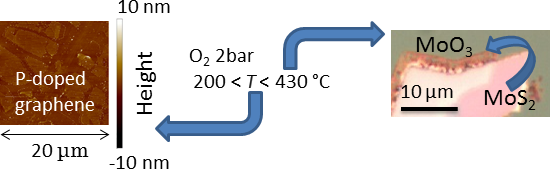
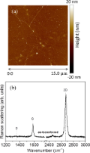
- DI3100 atomic force microscope with Nanoscope V controller working in tapping mode and employing a commercial silicon probe with spring constants of k = 20–80 N·m−1 and oscillation frequencies from 332 to 375 kHz. (a) AFM morphology image and (b) micro-Raman spectra of the as transferred graphene on SiO2


Colorimetric gas detection by the varying thickness of a thin film of ultrasmall PTSA-coated TiO2 nanoparticles on a Si substrate
Beilstein J. Nanotechnol. 2017, 8, 229–236, doi:10.3762/bjnano.8.25
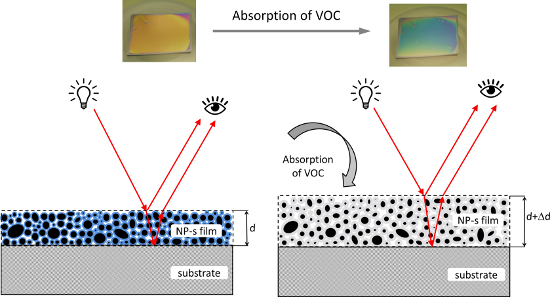
- swelling is related to the absorption of VOCs (not adsorption). Since AFM is used in tapping mode, it would not be able to show an adsorption layer of gas on the top of sample. However, beside absorption also adsorption of VOCs can take place and the coexistence of adsorption and absorption in our NP-based
- Renishaw micro-Raman set-up equipped with a 514 nm continuous mode argon ion laser, of approximate spectral resolution 1.5 cm−1. The AFM measurements, with the purpose of investigating the thickness of the films before and after exposure to VOCs, were conducted using a Veeco AFM. Typically, the tapping
- mode was utilized in order to provide an optimal performance. OTESPA AFM tips (manufactured by Bruker) were used. To measure thickness of films, they were scratched with stainless steel tweezers and the step height of the scratch was measured. To ensure that only the film was scratched away (and not


Influence of hydrofluoric acid treatment on electroless deposition of Au clusters
Beilstein J. Nanotechnol. 2017, 8, 183–189, doi:10.3762/bjnano.8.19
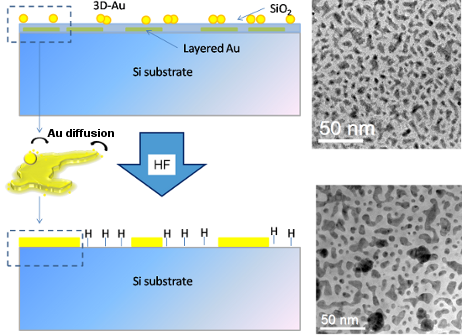
- Si, we expect a more complex scenario due to the stronger interaction between gold and silicon with the formation of quasi-heteroepitaxial layers. Figure 3 reports the morphologies observed by AFM (in tapping mode with a silicon tip of 10–15 nm curvature radius) of Si samples with AuNPs before


Impact of surface wettability on S-layer recrystallization: a real-time characterization by QCM-D
Beilstein J. Nanotechnol. 2017, 8, 91–98, doi:10.3762/bjnano.8.10
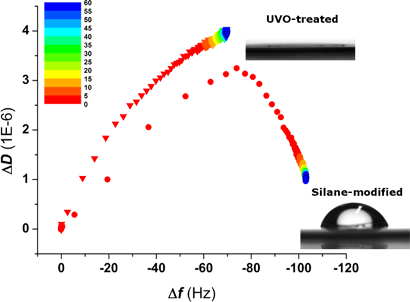
- using the thermal method. Prior to its use in the AFM fluid cell, the cantilever was cleaned with UV/ozone for 20 min. Once mounted, the system was kept immersed in ultrapure water until stabilization of the deflection signal. Data acquisition was carried out in tapping mode, in order to not disturb the


Surface roughness rather than surface chemistry essentially affects insect adhesion
Beilstein J. Nanotechnol. 2016, 7, 1471–1479, doi:10.3762/bjnano.7.139
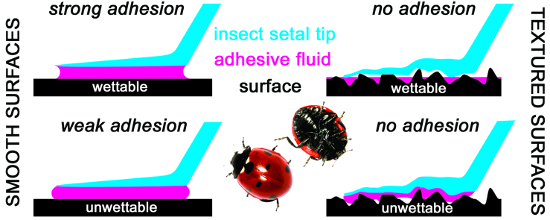
- (Soot-TMOS-FAS17Cl) were estimated from cross-sectional images acquired by a scanning electron microscope (SEM, Phenom Pro Scanning Electron Microscope, Phenom World). The surface morphologies of the samples were either observed using the same SEM system or by atomic force microscope in a tapping mode



Experimental and simulation-based investigation of He, Ne and Ar irradiation of polymers for ion microscopy
Beilstein J. Nanotechnol. 2016, 7, 1113–1128, doi:10.3762/bjnano.7.104
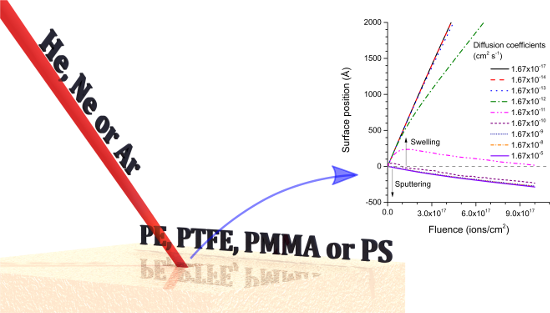
- can be reached for multi-frame secondary ion images. Thereafter, AFM measurements in tapping mode (AFM probe type: ACST soft tapping mode tips without coating from Appnano) on an Agilent 5100 Surface Probe Microscope [51] were carried out inside the different post-bombardment craters in order to


Generalized Hertz model for bimodal nanomechanical mapping
Beilstein J. Nanotechnol. 2016, 7, 970–982, doi:10.3762/bjnano.7.89
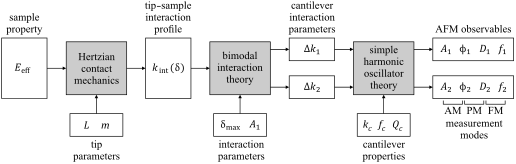
- ” or “spectroscopic” techniques. In parametric nanomechanical techniques, the sample properties are deduced from changes in the parameters of a driven cantilever that is oscillating in a (quasi) steady state while interacting with the sample surface. For example, tapping-mode AFM [16][17] (also known
- for the cantilever to reach a steady state defines the acquisition speed, allowing tapping-mode imaging to achieve very high speeds ultimately only limited by the cantilever bandwidth. However, the small number of tapping-mode observables (amplitude and phase) limits the extraction of absolute storage
- and loss moduli, as they cannot be distinguished from changes in indentation depth. In tapping mode, only the ratio of the storage to loss modulus can be measured [10][21][22]. The same limitation applies to many other parametric techniques, such as force modulation [6][7] and other single-frequency


![[Graphic 4]](/bjnano/content/inline/2190-4286-7-89-i40.png?max-width=637&scale=1.18182) approximation applied to Equation 6 i...
approximation applied to Equation 6 i...


Assembling semiconducting molecules by covalent attachment to a lamellar crystalline polymer substrate
Beilstein J. Nanotechnol. 2016, 7, 784–798, doi:10.3762/bjnano.7.70
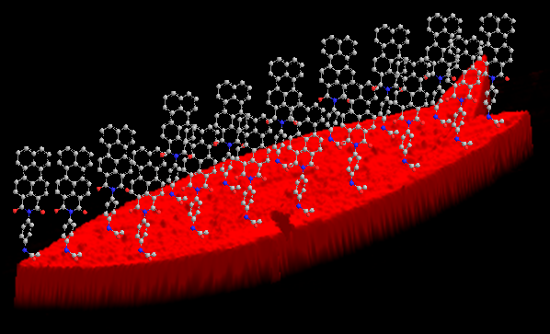
- reagent (1-[bis(dimethylamino)methylene]-1H-1,2,3-triazolo[4,5-b]pyridinium-3-oxid hexafluorophosphate) and N,N-diisopropylethylamine. Analysis of CPE45 single crystals and nanocrystals by AFM All AFM images of CPE45 nanocrystals and single crystals were recorded in tapping mode on a JPK Nano wizard II


Orientation of FePt nanoparticles on top of a-SiO2/Si(001), MgO(001) and sapphire(0001): effect of thermal treatments and influence of substrate and particle size
Beilstein J. Nanotechnol. 2016, 7, 591–604, doi:10.3762/bjnano.7.52
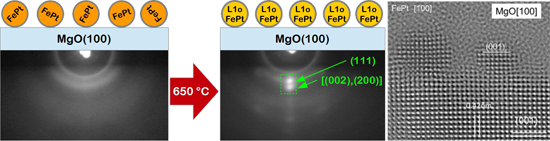
- background subtraction using a reference pattern taken with a blanked electron beam, so that only features caused by the light emitted from the filament of the electron gun are visible on the RHEED fluorescent screen. Following the in situ investigations, ex situ atomic force microscopy (AFM) in tapping mode


Characterization of spherical domains at the polystyrene thin film–water interface
Beilstein J. Nanotechnol. 2016, 7, 581–590, doi:10.3762/bjnano.7.51
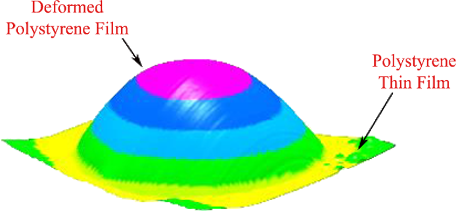
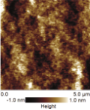
- at 50 °C. The surfaces were rinsed with DI water and dried with clean, compressed air. In certain cases, the surfaces were not rinsed before scanning with AFM. The CA of the water on the PS-coated surfaces was 85 ± 4°. The surfaces were scanned in air using tapping mode atomic force microscopy (TM
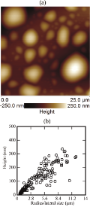
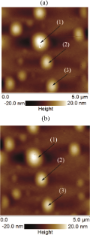
- Information File 1, Figure S2 and Figure S3. Height images of spherical objects on PS-coated surfaces obtained using (a) contact mode (b) tapping mode at 90% set point ratio. Section analysis of spherical domains imaged in contact mode and tapping mode (shown in Figure 5). (a) Section of spherical domain (1
- ). (b) Section of spherical domain (2). (c) Section of spherical domain (3). The circles show the section of the spherical domain imaged in contact mode while the squares show the section of the spherical domains imaged in tapping mode. (a) Approach and retraction curves for a spherical object. (b




Nanoscale effects in the characterization of viscoelastic materials with atomic force microscopy: coupling of a quasi-three-dimensional standard linear solid model with in-plane surface interactions
Beilstein J. Nanotechnol. 2016, 7, 554–571, doi:10.3762/bjnano.7.49
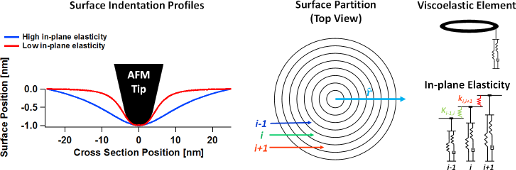
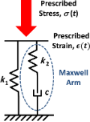
- materials, all the analyses are based on linear material behaviors that may fall short in the treatment of specific problems. Consider, for example, a tapping-mode experiment, which may involve local stresses and strains that are too large to be treated linearly, or local heating and melting of the sample
- frequency of the periodic sinusoidal sample deformation, which is not well defined in a tapping-mode experiment (see [26] for a discussion of discrepancies between intermittent-contact and contact-resonance viscoelasticity measurements). Furthermore, the spectrum of the force (stress) and displacement
- material is that the interaction of the surface with specific tip geometries becomes more complex. This is illustrated in Figure 10 for an irregular tip with a protrusion interacting in tapping mode with four surfaces having different values of the 2D surface modulus of elasticity. The force curves (Figure


High-bandwidth multimode self-sensing in bimodal atomic force microscopy
Beilstein J. Nanotechnol. 2016, 7, 284–295, doi:10.3762/bjnano.7.26
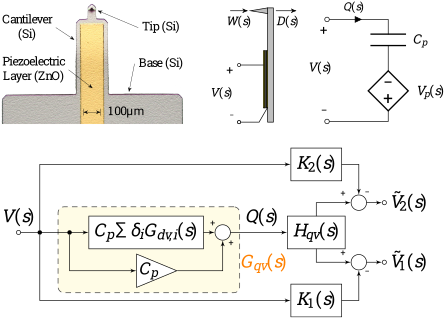
- principle is used for both actuation and sensing. Recently, the authors proposed two reciprocal self-sensing schemes for tapping-mode atomic force microscopy (TM-AFM) utilizing charge sensing and charge actuation respectively [18][19], using a single piezoelectric layer. The proposed techniques enable the
- mount components. In this approach, due to small circuit mismatches, the feedthrough has to be canceled for each mode separately to achieve the best dynamic range which is necessary for tapping-mode AFM. The inherent self-sensing capability of a single piezoelectric layer enables the omission of the


Characterisation of thin films of graphene–surfactant composites produced through a novel semi-automated method
Beilstein J. Nanotechnol. 2016, 7, 209–219, doi:10.3762/bjnano.7.19
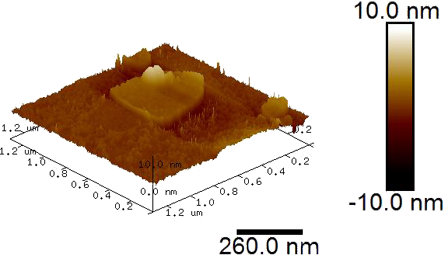
- surface. Organised monolayer films obtained in this fashion were then characterised by AFM (Nanoscope III) operating in tapping mode using Veeco cantilevers with silicon nitride tips having a radius of less than 10 nm. Electrostatic LbL deposition Much better results (in terms of adhesion and surface
- in tapping mode using Veeco cantilevers with silicon nitride tips having a radius of less than 10 nm. A typical AFM image of graphene(+)CTAB flakes deposited onto a piece of silicon wafer using LS method is shown in Figure 6. The larger scale image (a) shows a number of irregularly shaped graphene
- image 5 μm; (b) pseudo-3D image of individual graphene flake. (c) Sectional analysis of the image in (a). (a) SEM image of PAH/graphene(−)SDS layer on a silicon surface; (b) EDX spectra recorded on a graphene flake, and (c) an empty space. (a) AFM image (tapping mode) of a PEI/graphene(−)SDS film, and




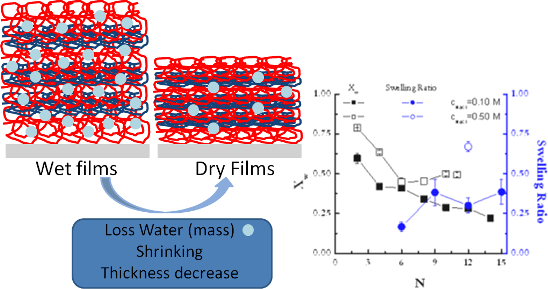
3D solid supported inter-polyelectrolyte complexes obtained by the alternate deposition of poly(diallyldimethylammonium chloride) and poly(sodium 4-styrenesulfonate)
Beilstein J. Nanotechnol. 2016, 7, 197–208, doi:10.3762/bjnano.7.18
- ΔV of the bare solid–air interface. Atomic force microscopy AFM measurements were performed in air at room temperature using a Nanoscope III (Digital Instruments, USA) in the tapping mode. A silicon tip, model RTESP (Veeco Instrument Inc, USA), was used for the measurements. The AFM images were



Synthesis and applications of carbon nanomaterials for energy generation and storage
Beilstein J. Nanotechnol. 2016, 7, 149–196, doi:10.3762/bjnano.7.17















Counterion effects on nano-confined metal–drug–DNA complexes
Beilstein J. Nanotechnol. 2016, 7, 62–67, doi:10.3762/bjnano.7.7
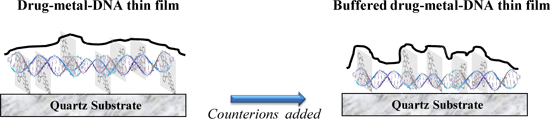
- functions of several variables. Here an iterative process continues and termination occurs when the relative error between two consecutive iterates is below 10−9. Atomic force microscope (AFM) images recorded in tapping mode using Nanonics MultiView1000 with glass tips of about 20 nm diameter, provides in