


Search results
Search for "ultra high vacuum" in Full Text gives 103 result(s) in Beilstein Journal of Nanotechnology.
Terthiophene on Au(111): A scanning tunneling microscopy and spectroscopy study
Beilstein J. Nanotechnol. 2011, 2, 561–568, doi:10.3762/bjnano.2.60
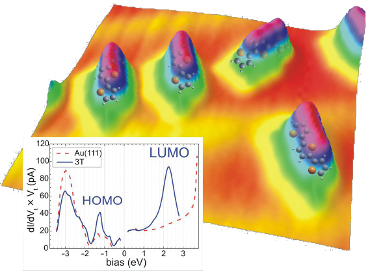
- Abstract Terthiophene (3T) molecules adsorbed on herringbone (HB) reconstructed Au(111) surfaces in the low coverage regime were investigated by means of low-temperature scanning tunneling microscopy (STM) and spectroscopy (STS) under ultra-high vacuum conditions. The 3T molecules adsorb preferentially in
- 250 nm, Arrandee, Germany) on glass were flame annealed in a butane flame to develop extended (111) facets. After introduction into ultra-high vacuum (UHV), these films were further annealed at temperatures up to 700 °C to remove contaminants from the surface. After a routine check of the gold surface
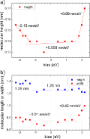
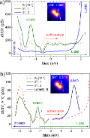
- be principal limits to the WKB approximation. Conclusion Low-temperature scanning tunneling microscopy and spectroscopies (STM, STS) under ultra-high vacuum conditions were applied to investigate the structural and electronic properties of terthiophene molecules (3T) adsorbed on Au(111) in the



The role of the cantilever in Kelvin probe force microscopy measurements
Beilstein J. Nanotechnol. 2011, 2, 252–260, doi:10.3762/bjnano.2.29
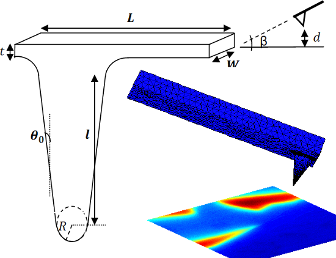
- measured contact potential difference even under ultra-high vacuum conditions, and we demonstrate a good agreement between our model and KPFM measurements in ultra-high vacuum of NaCl monolayers grown on Cu(111). The effect of the oscillating cantilever shape on the KPFM resolution and sensitivity has been
- cantilever in general, and in high resolution ultra-high vacuum (UHV) KPFM measurements in particular, has not been reported. In this work we use the boundary element method (BEM) [7] to calculate the point spread function (PSF) of the measuring probe: Tip and cantilever. The probe PSF analysis shows that
- showed that at smaller probe sample distances the homogenous force contribution of the tip apex is higher. At a probe–sample distance of 1.2 nm (a typical distance in ultra-high vacuum measurements) the tip apex contributes 83% to the homogenous force, the cone lower segment contributes 7.3%, and the


Manipulation of gold colloidal nanoparticles with atomic force microscopy in dynamic mode: influence of particle–substrate chemistry and morphology, and of operating conditions
Beilstein J. Nanotechnol. 2011, 2, 85–98, doi:10.3762/bjnano.2.10
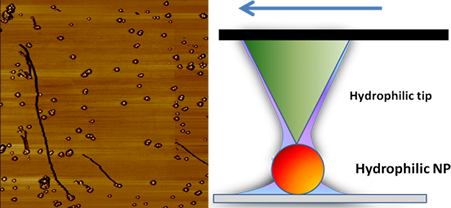
- humidity), we have investigated how the nanomanipulation process is affected in ultra high vacuum (UHV) environment. The topography image in Figure 7 shows the gold particles on a silicon substrate after the sample was transferred into UHV without any further treatment, which could have changed the
- deposited onto a silicon wafer. (a) Ordered organization as described in the Experimental section, (b) random distribution. Frame sizes: 3 µm and 1 µm, respectively. As-synthesized Au particles on silicon in ultra-high vacuum. Frame size: 3 µm. AFM image of nanopatterned surface exhibiting Si pits: Frame


Other Beilstein-Institut Open Science Activities



