


Search results
Search for "Fe3O4" in Full Text gives 132 result(s) in Beilstein Journal of Nanotechnology.
A facile synthesis of a carbon-encapsulated Fe3O4 nanocomposite and its performance as anode in lithium-ion batteries
Beilstein J. Nanotechnol. 2013, 4, 699–704, doi:10.3762/bjnano.4.79
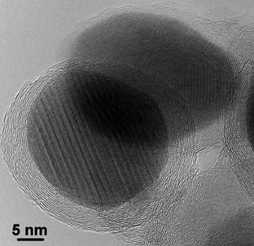
- -von-Helmholtz-Platz 1, Karlsruhe, 76344, Germany Helmholtz Institute Ulm (HIU), Albert-Einstein-Allee 11, Ulm, 89081, Germany 10.3762/bjnano.4.79 Abstract A carbon-encapsulated Fe3O4 nanocomposite was prepared by a simple one-step pyrolysis of iron pentacarbonyl without using any templates, solvents
- or surfactants. The structure and morphology of the nanocomposite was investigated by X-ray diffraction, scanning electron microscopy, transmission electron microscopy, Brunauer–Emmett–Teller analysis and Raman spectroscopy. Fe3O4 nanoparticles are dispersed intimately in a carbon framework. The
- nanocomposite exhibits well constructed core–shell and nanotube structures, with Fe3O4 cores and graphitic shells/tubes. The as-synthesized material could be used directly as anode in a lithium-ion cell and demonstrated a stable capacity, and good cyclic and rate performances. Keywords: electrochemistry; iron


Magnetic-Fe/Fe3O4-nanoparticle-bound SN38 as carboxylesterase-cleavable prodrug for the delivery to tumors within monocytes/macrophages
Beilstein J. Nanotechnol. 2012, 3, 444–455, doi:10.3762/bjnano.3.51
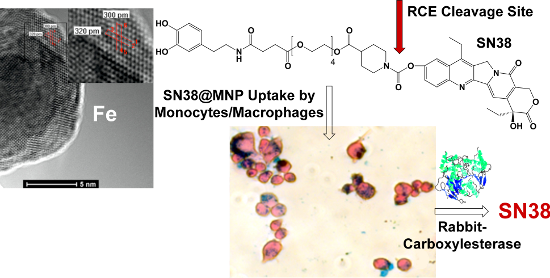
- to the tumor site is highly desirable in cancer treatment, because it is capable of minimizing collateral damage. Herein, we report the synthesis of a nanoplatform, which is composed of a 15 ± 1 nm diameter core/shell Fe/Fe3O4 magnetic nanoparticles (MNPs) and the topoisomerase I blocker SN38 bound
- and by activating the immune system. Keywords: cell-based delivery; chemotherapeutic prodrug; magnetic Fe/Fe3O4 nanoparticles; SN38; Introduction Irinotecan (CPT-11) is a potent chemotherapeutic prodrug against various types of cancer, such as colorectal, lung, and ovarian cancer [1][2][3][4][5]. It
- , biocompatibility, and potential for targeted accumulation at the tumor site, ultra-small magnetic nanoparticles are the prime candidates for application in magnetic hyperthermia [32][33][34]. We have developed a magnetic core/shell Fe/Fe3O4 nanoparticle platform, which can generate substantial heat within a


Structure, morphology, and magnetic properties of Fe nanoparticles deposited onto single-crystalline surfaces
Beilstein J. Nanotechnol. 2011, 2, 47–56, doi:10.3762/bjnano.2.6
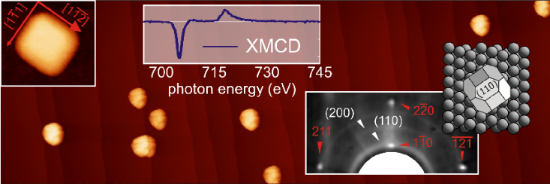
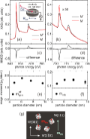
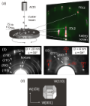
- 1b. The side view in the inset shows compact particles with mostly cubic shapes due to the partial oxidation. Electron diffraction reveals the presence of metallic bcc Fe and Fe oxides as, e.g., Fe3O4 [27]. A size distribution of the oxidized Fe particles displayed in Figure 1b is given in Figure 1c

Magnetic interactions between nanoparticles
Beilstein J. Nanotechnol. 2010, 1, 182–190, doi:10.3762/bjnano.1.22
- ferromagnetic cobalt covered by a shell of antiferromagnetic CoO [4]: This effect is nowadays utilized in read heads in computer hard disk drives. In a neutron study of Fe3O4/CoO multilayers, van der Zaag et al. [5] found that the Néel temperature of CoO was enhanced due to the exchange interaction with
- ferrimagnetic Fe3O4 layers with a Curie temperature of about 850 K. Similarly, an increase of the Curie temperature of ferrimagnetic γ-Mn2O3 due to interaction with antiferromagnetic MnO has been found in MnO/γ-Mn2O3 core–shell particles [6]. The magnetic properties of non-interacting magnetic nanoparticles are
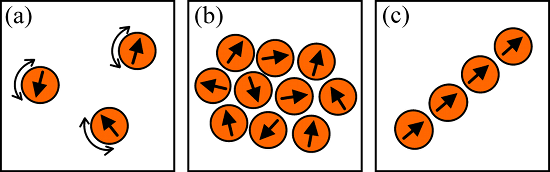
- , including Fe100−xCx [10], ε-Fe3N [11], γ-Fe2O3 [12][13][14] and Fe3O4 [15] have been investigated. If the particles are randomly distributed and have a random orientation of the easy axes, the magnetic properties can have similarities to those of spin glasses [10][11][14], and therefore these interacting



Magnetic nanoparticles for biomedical NMR-based diagnostics
Beilstein J. Nanotechnol. 2010, 1, 142–154, doi:10.3762/bjnano.1.17
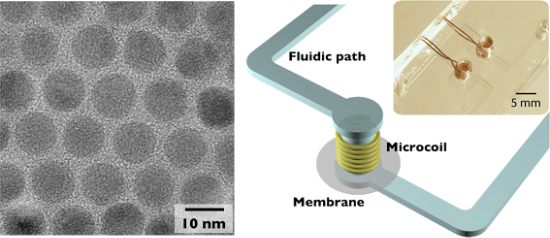
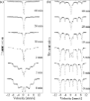
- ][37][38][39][40][41][42]. CLIO nanoparticles contain a superparamagnetic iron oxide core (3–5 nm monocrystalline iron oxide) composed of ferrimagnetic magnetite (Fe3O4) and/or maghemite (γ-Fe2O3). The metallic core is subsequently coated with biocompatible dextran, before being cross-linked with


Magnetic coupling mechanisms in particle/thin film composite systems
Beilstein J. Nanotechnol. 2010, 1, 101–107, doi:10.3762/bjnano.1.12
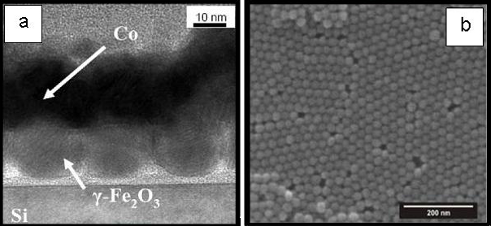
- coupled Fe3O4/CoO [38] and Fe/CoO [39] thin film systems, that the blocking temperature, in this case the temperature at which exchange bias between a FM and an AF thin film disappears, can occur at temperatures below the Néel temperature of CoO (~290 K), in the case of ultra thin films of CoO (less than


Uniform excitations in magnetic nanoparticles
Beilstein J. Nanotechnol. 2010, 1, 48–54, doi:10.3762/bjnano.1.6
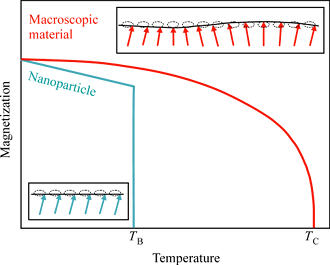
- Equation 1, and the latter approximation is valid at low temperatures. The linear temperature dependence of the magnetization in nanoparticles was first observed by Mössbauer spectroscopy studies of magnetite (Fe3O4) nanoparticles [3], but it has later been studied in nanoparticles of several other
- the relaxation is fast compared to the timescale of Mössbauer spectroscopy, and the observed magnetic hyperfine field is then given by where B0 is the saturation hyperfine field. Figure 3 shows the temperature dependence of the magnetic hyperfine field of three samples of magnetite (Fe3O4


![[Graphic 3]](/bjnano/content/inline/2190-4286-1-6-i22.png?max-width=637&scale=1.18182) as a function of temperature for particles of magneti...
as a function of temperature for particles of magneti...


Other Beilstein-Institut Open Science Activities



