


Search results
Search for "TGA" in Full Text gives 149 result(s) in Beilstein Journal of Nanotechnology.
Multifunctional layered magnetic composites
Beilstein J. Nanotechnol. 2015, 6, 134–148, doi:10.3762/bjnano.6.13
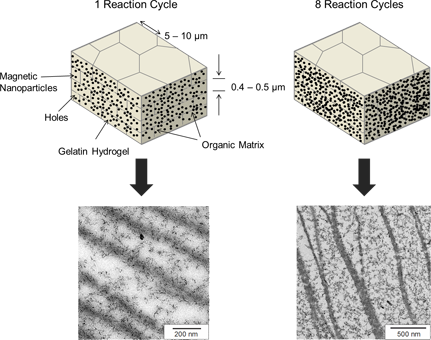
- confirmed by TGA measurements, and that the structure of the demineralized nacre organic matrix has not significantly changed compared with the original nacre. Nacre organic matrix – Light microscopy and fluorescence microscopy Original nacre (Haliotis laevigata) used for materials synthesis was analyzed by
- cycles, which is in agreement with TGA studies of the hybrid materials. The studies show that the particles are in the size range of 10 ± 5 nm and do exist at the chitin surface as well as in between the chitin layers due to the presence of the carrying media gelatin. It is also worth to mention that
- Garching, Germany [62]. Some of the SANS data at large Q range is based on experiments performed at the SANS II, Swiss spallation neutron source SINQ, Paul Scherrer Institute, Villigen, Switzerland. The mineral content of the multifunctional hybrid material was determined by means of TGA (Netzsch, Selb





Synthesis of boron nitride nanotubes and their applications
Beilstein J. Nanotechnol. 2015, 6, 84–102, doi:10.3762/bjnano.6.9
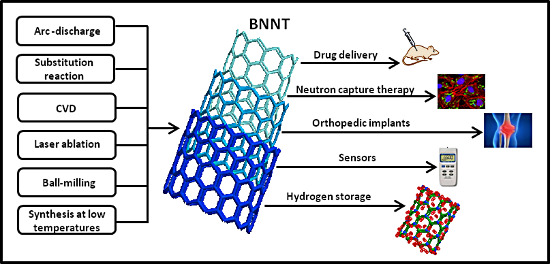
- and it might be worthwhile to further investigate it [71]. BNNT-grafted, poly(glycidyl methacrylate) and polystyrene brushes were prepared via atom transfer radical polymerization [72]. The resulting nanocomposite material was characterized using FTIR, TGA, SEM and TEM. The TEM images clearly show the




Manganese oxide phases and morphologies: A study on calcination temperature and atmospheric dependence
Beilstein J. Nanotechnol. 2015, 6, 47–59, doi:10.3762/bjnano.6.6
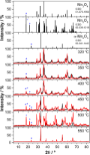
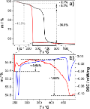
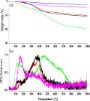
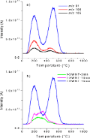
- oxidation process of Mn(II) glycolate to the manganese oxide species observed in the XRD patterns (see Figure 3 and Figure 4) was also investigated by thermogravimetric analysis (TGA). TGA measurements were recorded while heating the Mn(II) glycolate samples up to 700 °C with a heating rate of 2 K/min in an
- ligands (tetraethylene glycol and ethylene glycol), whose boiling points are in the temperature range of 150 °C to 320 °C. Subsequently, a mass loss of about 37% is detected up to 450 °C, which was also observed in TGA measurements of Ti(IV) glycolate by Jiang et al. [38] and was explained as a complete
- 3. In the TGA measurement, however, a mass loss of 44% attributed to this process is detected between 150 and 250 °C. Hence, the observed mass loss includes the decomposition of organic species as well as the oxidation to Mn3O4. The temperature delay of the processes can be explained by considering





Carbon nano-onions (multi-layer fullerenes): chemistry and applications
Beilstein J. Nanotechnol. 2014, 5, 1980–1998, doi:10.3762/bjnano.5.207
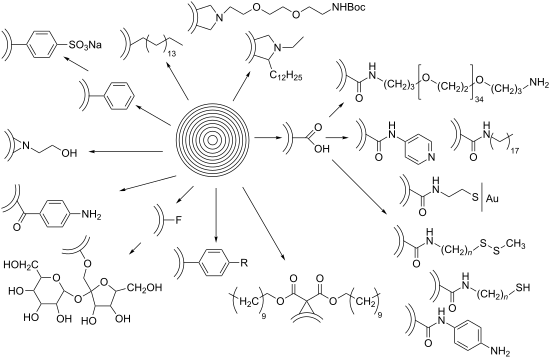
- spectroscopy, SEM/EDX, XRD, XPS, TGA and TEM. In addition, the authors reported that the fluorination of the F-CNOs was reversible upon treatment with hydrazine, which interestingly led also to a regeneration of the “broken” graphene layers of the CNO. Some years later, based on the F-CNO material, the same
- (Figure 3). Characterization was carried out by a multitude of different techniques, such as GPC, TEM, TGA, XPS and Raman spectroscopy. In 2008, Echegoyen et al. reported a first supramolecular CNO/Zn-porphyrin complex [32] (Scheme 5). In this set up, acid-treated CNOs bearing carboxylic acid
- functionalities, which were prepared by the oxidation of CNOs (diameter approx. 6 nm) with conc. HNO3/H2SO4 (3:1, v/v), were reacted with 4-aminopyridine in an amidation reaction. The synthesized water-soluble CNO material was characterized by using TEM, NMR, UV–vis and Raman spectroscopy. Based on TGA studies


Ionic liquid-assisted formation of cellulose/calcium phosphate hybrid materials
Beilstein J. Nanotechnol. 2014, 5, 1553–1568, doi:10.3762/bjnano.5.167
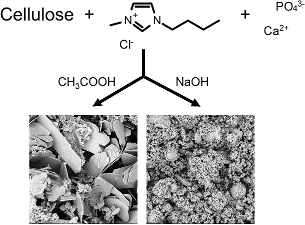
- especially the intensity of the phosphate vibration bands is fairly low in the samples prepared at higher cellulose concentrations. Figure 10 shows thermogravimetric analysis/differential thermal analysis (TGA/DTA) data. Table 5 summarizes the results from elemental analysis (CHN analysis) and TGA/DTA. TGA
- of the neat cellulose finds a weight loss of 96.1%, indicating that even the neat cellulose contains some fraction of non-volatile components. Overall the TGA curve is consistent with earlier data [65] on cellulose decomposition, where a first weight loss of ca. 4.5% is assigned to water desorption
- . The same general observation can be made from the TGA/DTA data of all hybrid materials, Table 5. The samples exhibit a first weight loss of a few % assigned to water desorption and drying processes, followed by a two-step, thermally induced and exothermic, decomposition of the organic fraction. The


Mimicking exposures to acute and lifetime concentrations of inhaled silver nanoparticles by two different in vitro approaches
Beilstein J. Nanotechnol. 2014, 5, 1357–1370, doi:10.3762/bjnano.5.149

- dismutase 1 (SOD1) [GenBank: NM_000454], interleukin-8 (IL8) [GenBank: NM_000584] and tumor necrosis factor alpha (TNFA) [GenBank: NM_000594] were determined. Primer sequences (Microsynth AG, Balgach, Switzerland) were the following: GAPDH: forward 5’- AAC AGC CTC AAG ATC ATC AGC-3’, reverse 5’- GGA TGA TGT

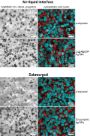


Nanoporous composites prepared by a combination of SBA-15 with Mg–Al mixed oxides. Water vapor sorption properties
Beilstein J. Nanotechnol. 2014, 5, 1226–1234, doi:10.3762/bjnano.5.136

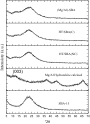
- samples.a Supporting Information Supporting Information File 154: Additional characterization of materials by XRD, TGA and SEM-TEM analysis. Acknowledgements The financial support of CONACYT (project 180166) is gratefully acknowledged. The authors thank Adriana Tejeda, Omar Novelo and Carlos Flores for



Characterization and photocatalytic study of tantalum oxide nanoparticles prepared by the hydrolysis of tantalum oxo-ethoxide Ta8(μ3-O)2(μ-O)8(μ-OEt)6(OEt)14
Beilstein J. Nanotechnol. 2014, 5, 1082–1090, doi:10.3762/bjnano.5.121
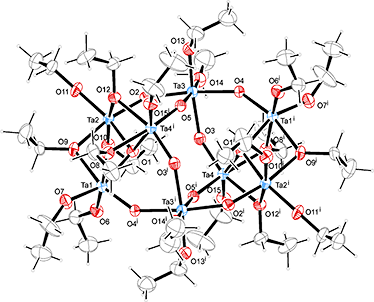
- characterized by various techniques such as TGA-DTA-DSC, UV–vis DRS, XRD, SEM, TEM, particle size analyzer (DLS) and the Brunauer–Emmett–Teller (BET) method. The band gap of the particles was calculated by using the Tauc plot. The photocatalytic activity of Ta2O5 nanoparticles was tested by the degradation of
- thermal stability of the as-prepared (dried) photocatalyst with α-Al2O3 as the reference. Figure 6 shows the TG/DTA/DSC curves obtained from the dried gel of Ta2O5. The TGA graph shows a weight loss up to a temperature of 200 °C that is essentially attributed to dehydration. The decomposition of organic
- , fused calcium chloride and aluminum isopropoxide, then it was passed into the distilled water through a tube with a diameter of 7 mm. 1H NMR spectra were recorded in C6D6 on a Bruker Biospin ARX spectrometer with TMS as internal reference. TGA/DTA/DSC was recorded by using a Diamond TG/DTAN instrument


A visible-light-driven composite photocatalyst of TiO2 nanotube arrays and graphene quantum dots
Beilstein J. Nanotechnol. 2014, 5, 689–695, doi:10.3762/bjnano.5.81
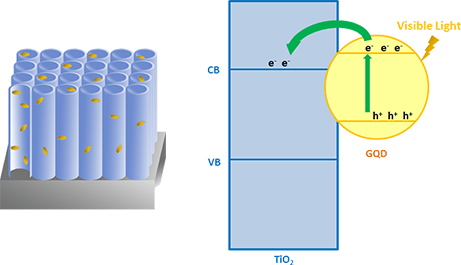
- ), scanning electron microscopy (SEM), transmission electron microscopy (TEM), X-ray diffraction (XRD), thermogravimetric analysis (TGA) and UV–vis absorption spectroscopy. The product exhibited high photocatalytic performance in the photodegradation of methylene blue and enhanced photocurrent under visible
- ). Thermogravimetric analysis was performed in air using a thermogravimetric analyzer (Perkin Elmer, TGA 6). The samples were heated from 50 °C to 800 °C at a rate of 10 °C·min−1. Photocatalytic activity measurements: The photocatalytic activities of catalysts were evaluated by measuring the photodegradation of
- light irradiation. Photocurrent responses of (a) TNAs and (b) GQDs/TNAs under visible-light irradiation. The potential bias was 0.417 V. Reaction scheme for the loading of GQDs onto TNAs via covalent bonding. Supporting Information Supporting information features FTIR spectra, TGA profiles of the


Artificial sunlight and ultraviolet light induced photo-epoxidation of propylene over V-Ti/MCM-41 photocatalyst
Beilstein J. Nanotechnol. 2014, 5, 566–576, doi:10.3762/bjnano.5.67
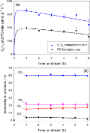
- condensation of AA molecules may lead to larger and heavier species such as hexa-2,4-dienal and 3-methylpentanedial [40]. The TGA weight loss curves of the spent and the fresh V-Ti/MCM-41 are compared in Figure 10. The weight loss below 400 K is attributed to the removal of adsorbed water while that above 400
- performed with a JEOL JEM-2100 instrument operating at 200 kV. Thermal gravimetric analysis (TGA, PYRIS Diamond TG-DTA, high temperature 115V) was carried out in the range of 300–773 K. About 30 mg samples were placed in an alumina sample holder and heated under air (20 mL·min−1) with a heating rate of 3
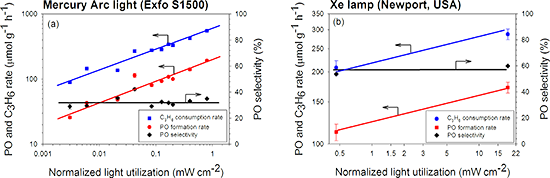
- arc lamp and (b) a xenon lamp (see Table 2). Lines are presented for guiding and are not based on a kinetic model. The TGA weight loss curves V-Ti/MCM-41 photocatalyst using O2 as the sweep gas: (a) fresh catalyst and (b) catalyst deactivated by the photo-epoxidation of propylene. Overview of the




Chemi- vs physisorption in the radical functionalization of single-walled carbon nanotubes under microwaves
Beilstein J. Nanotechnol. 2014, 5, 537–545, doi:10.3762/bjnano.5.63
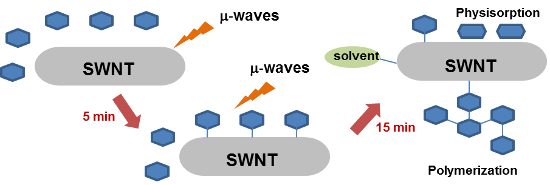
- microwave-assisted diazonium chemistry [31][32], chlorophenyl groups were grafted at the CNT surface and the functionalization level was followed by thermogravimetric analysis coupled with mass spectrometry (TGA–MS) (Scheme 1). The present work highlights the importance of controlling the reaction times
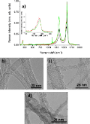
- min, 10 min and 15 min (Scheme 1). After treatment, the obtained functionalized samples (f-SWNT-5min, f-SWNT-10min and f-SWNT-15min) were analyzed by dispersion tests, high resolution transmission electron microscopy (HRTEM), Raman spectroscopy, and TGA–MS. Figure 1 shows photographs of the
- a weight loss of 10.1 and 10.7 wt % centered at 380 and 360 °C as the reaction time is increased from 5 to 10 min. The difference between the two samples is a marginal loss (about 1.0 wt %) between 100 and 200 °C only visible for f-SWNT-10min. The TGA profile of f-SWNT-15min is different from the




One-step synthesis of high quality kesterite Cu2ZnSnS4 nanocrystals – a hydrothermal approach
Beilstein J. Nanotechnol. 2014, 5, 438–446, doi:10.3762/bjnano.5.51
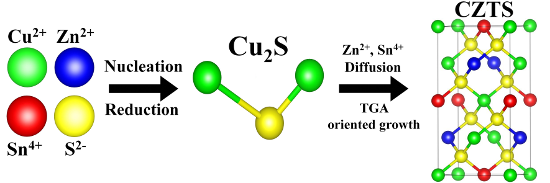
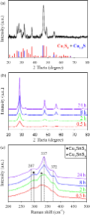
- synthesis of pure kesterite-phase Cu2ZnSnS4 (CZTS) nanocrystals with a uniform size distribution by a one-step, thioglycolic acid (TGA)-assisted hydrothermal route. The formation mechanism and the role of TGA in the formation of CZTS compound were thoroughly studied. It has been found that TGA interacted
- procedure. Through thoroughly investigating the factors that influence the morphology, crystal size, and growth of CZTS nanocrystals, a mechanism that depicts the formation process of CZTS compound is proposed. It is found that the tiny amount of thioglycolic acid (TGA) used in the precursor is crucial for
- the formation of pure kesterite CZTS nanocrystals. The roles of TGA in the hydrothermal synthesis are discussed. Experimental Materials: All the materials were provided by Sigma Aldrich unless otherwise stated. Chemicals of copper(II) chloride dehydrate (CuCl2·2H2O), zinc chloride (ZnCl2) product of




Thermal stability and reduction of iron oxide nanowires at moderate temperatures
Beilstein J. Nanotechnol. 2014, 5, 323–328, doi:10.3762/bjnano.5.36
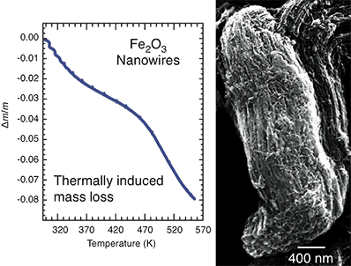
- (above 440 K). Experimental Thermogravimetry (TGA) measurements were performed by means of a Setaram Setsys Evolution 1200 apparatus, equipped with a mass spectrometer Pfeiffer Vacuum Quadstar QMS200. To identify all possible gaseous products, survey scans in the mass range between 1 and 100 amu were
- recorded. The TGA measurements were performed by heating in vacuum (approx. 10−4 mbar) at 0.5 K/min. Infrared spectra were collected by means of an Agilent Cary 660 spectrometer with a resolution of 1 cm−1 in the frequency range between 430 and 1100 cm−1. The spectra were the mean of at least 100 scans for
- solution, deposited onto Si and Cu substrates, and dried in vacuum before analysis. Results and Discussion TGA measurements were performed both on the as-produced nanowire sample (sample 1) and on a nanowire specimen heated in vacuum (p < 10−4 mbar) for 24 h at 350 K (sample 2), in order to clean the


En route to controlled catalytic CVD synthesis of densely packed and vertically aligned nitrogen-doped carbon nanotube arrays
Beilstein J. Nanotechnol. 2014, 5, 219–233, doi:10.3762/bjnano.5.24
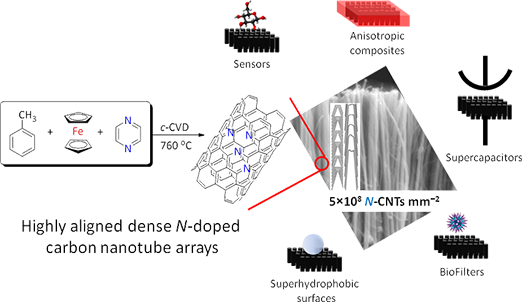
- the growth rate of nanotube arrays. The linear fit function passes through the point of origin, which suggests a short time of nucleation. Thermal stability. Thermogravimetric analysis (TGA) showed that all N-CNTs (for the sake of clarity, only Synthesis V and VII are presented here) were less
- = 514.5 nm) was used in all cases. FT-IR analyses were performed by using a Perkin Elmer spectrometer in the range from 0.44 eV (2778 nm, 3600 cm−1) to 0.1 eV (12500 nm, 800 cm−1) from KBr pellets. TGA analyses were carried out in air at a heating rate of 10 °C·min−1 by using a TGA Q500. XRD studies were
- : top – ‘bamboo’-like (Synthesis VII) and bottom – ‘membrane’-like (Synthesis VIII); and (B) graphical representations thereof. The height of the N-CNTs array vs time of growth. Overlaid TGA curves recorded in air for N-CNTs (Synthesis V and VII) and MWCNTs (Ref. Synthesis). FT-IR spectra of CNTs and N


Controlled synthesis and tunable properties of ultrathin silica nanotubes through spontaneous polycondensation on polyamine fibrils
Beilstein J. Nanotechnol. 2013, 4, 793–804, doi:10.3762/bjnano.4.90
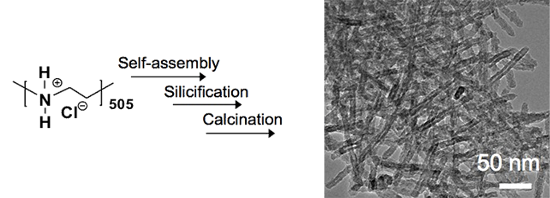
- inner hollow that would be in favor of generating geometrically stable photoactive sites, and the other one is the existence of trace carbon in the silica nanotubes (less than 0.9 wt % estimated by TGA) which would be doped into the silica frame to compose the photoactive sites. Probably, these two
- stirring for 1 h at room temperature. Phosphorescence emission spectra (λEx = 320 nm) of silica nanotubes and nanoribbons that were synthesized by calcining the corresponding LPEI@silica hybrid nanotubes (Figure 1A–C) and nanoribbons (Figure 1D–F) under N2 atmosphere at 1000 °C. TGA (A) and Raman spectra
- formed by the alkali-induced self-assembly of LPEI. Summary of the molar ratios of [OH]/[EI] for the synthesis of the LPEI templates, the TGA analysis of the composition of LPEI@silica hybrid nanostructures and BET data of the silica nanostructures obtained by calcination of LPEI@silica hybrid at 800 °C


Electrospinning preparation and electrical and biological properties of ferrocene/poly(vinylpyrrolidone) composite nanofibers
Beilstein J. Nanotechnol. 2013, 4, 189–197, doi:10.3762/bjnano.4.19

- could be controlled through adjusting solvents and Fc concentration. Scanning electron microscopy (SEM) showed that the diameters of the obtained composite fibers were about 30–200 nm at different Fc concentrations. Thermogravimetric analysis (TGA) results confirmed the presence of ferrocene within the
- Fc in the PVP polymer is in the amorphous form with a poor degree of crystallization. The degradation process of products was investigated using thermogravimetric analysis (TGA) from 20 to 600 °C in nitrogen gas. Figure 3a represents the TG curve of the pure Fc. It was found that the TGA data of Fc
- were determined with an X-ray diffractometer with Cu Kα radiation (k = 0.15405 nm, 40 kV, 100 mA) over the 2-theta angle range of 10–70 °C with a scanning rate of 10 °C/min. The TGA data was obtained by a DSC-STA 449C Jupiter thermal analysis instrument. About 4 mg sample in an aluminium pan was heated


A facile approach to nanoarchitectured three-dimensional graphene-based Li–Mn–O composite as high-power cathodes for Li-ion batteries
Beilstein J. Nanotechnol. 2012, 3, 513–523, doi:10.3762/bjnano.3.59
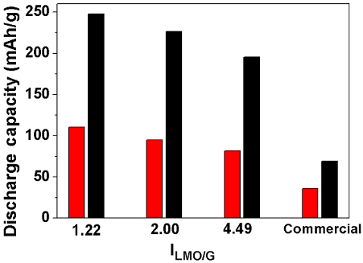
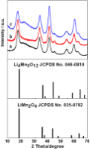
- precursors. The thermal gravimetric analysis (TGA) results (see Supporting Information File 1, Figure S2a) show that the IMO:G are 0.82, 1.34 and 2.57 for samples prepared with MnSO4 molar concentrations of 0.15, 0.3 and 0.6 M, respectively. For Mn2O3/graphene samples with higher IMO:G values, the shape of
- diffraction peaks using Scherrer’s equation. This grain size is much smaller than that of Mn2O3, which is possibly due to a recrystallization process. No impurity phase is detectable using XRD. After the lithiation process, the TGA results (see Supporting Information File 1, Figure S2b) indicate that the
- JEOL JEM-2100 operating at 200 kV. Raman spectra were obtained on a WITec CRM 200 with a wavelength of 488 nm and a spot size of 0.5 mm. Thermogravimetry analyses were carried out on TGA Q500 from 298–1073 K at a heating rate of 10 K·min−1 in air. The analyses of Li/Mn ratio was performed on




Surface functionalization of aluminosilicate nanotubes with organic molecules
Beilstein J. Nanotechnol. 2012, 3, 82–100, doi:10.3762/bjnano.3.10
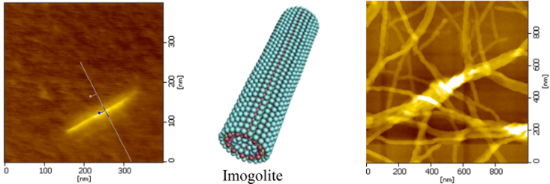
- thermogravimetric analysis (TGA) [40]. The subsequent ARGET ATRP was carried out by using ascorbic acid (AA) as the reducing agent and anisole as the solvent. Ascorbic acid is insoluble in anisole, hence, the reduction of the Cu(II) complex takes place at the surface of solid ascorbic acid. The slow reaction rate


Template-assisted formation of microsized nanocrystalline CeO2 tubes and their catalytic performance in the carboxylation of methanol
Beilstein J. Nanotechnol. 2011, 2, 776–784, doi:10.3762/bjnano.2.86

- spectroscopy (PL), as well as thermogravimetric analysis (TGA). Its catalytic performance was studied in the direct carboxylation of methanol with carbon dioxide leading to dimethyl carbonate [(CH3O)2CO, DMC], which is widely employed as a phosgene and dimethyl sulfate substitute, and as well as a fuel
- Kα1) instruments. Thermogravimetric analysis (TGA) was performed on a Netzsch TG 209 F1 instrument coupled with a QMS 403 C mass spectrometer. For BET measurements a NOVA 3000e (Quantachrome) was used. For PLE measurements, Horiba, Fluorog-3 (Xe, excitation wavelength 325 nm) was used. For UV–vis
- nanostructured ceria (obtained with addition of Pluronic P123® to the sol). TGA measurements of bare PMMA fibres (PMMA, solid line), a PMMA/sol without Pluronic P123® (PMMA/sol, dashed-dotted line) and a PMMA/sol containing Pluronic P123® (PMMA/sol + P123, dotted line). PL spectrum of microsized ceria tubes


Investigation on structural, thermal, optical and sensing properties of meta-stable hexagonal MoO3 nanocrystals of one dimensional structure
Beilstein J. Nanotechnol. 2011, 2, 585–592, doi:10.3762/bjnano.2.62
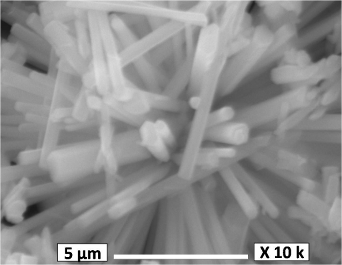
- crystallite size and one dimensional growth. Usually, the α-MoO3 is a stable structure formed at a higher temperature relative to the metastable h-MoO3. Thus, there is a phase transformation from h-MoO3 to α-MoO3 at 400 °C, which is inferred from TGA/DTA studies [14][16]. With an increase in temperature, the
- coordinated water and ammonia molecules from the internal structure of the MoO3 material, which promotes an irreversible phase transformation from the hexagonal to the orthorhombic structure [14][16]. The powder subjected to TGA measurements was subjected to XRD analysis, and the result confirmed that above


Towards multiple readout application of plasmonic arrays
Beilstein J. Nanotechnol. 2011, 2, 501–508, doi:10.3762/bjnano.2.54
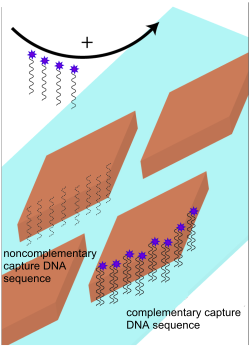
- sequence NS151: amino-link-5'-TTT TTT CAG CAT GGG CTC CTT GAT TCT ATG-3'; three mismatch sequence NS153: amino-link-5'-TTT TTT CAG CAT TAT CTC CTT GAT TCT ATG-3'; negative control N7 5'-ACT GAC TGA CTG ACT GAC TGA CTG GGC GGC GAC CT-3'-amino-link) was prepared as a 1 µM solution in 5× phosphate buffered


Dynamics of capillary infiltration of liquids into a highly aligned multi-walled carbon nanotube film
Beilstein J. Nanotechnol. 2011, 2, 311–317, doi:10.3762/bjnano.2.36
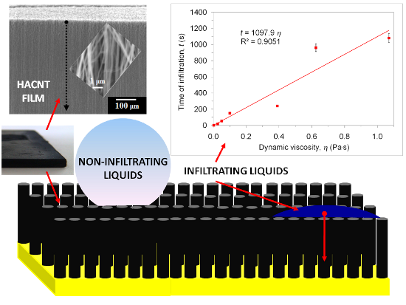
- without further treatment. The nanotube density in the HACNT film was measured using ImageJ® on an SEM image (sample with 100 nanotubes). The average diameters of MWCNTs were measured on TEM images of 100 nanotubes. Free volume of the HACNT film was measured via TGA experiment performed on a completely


Studies towards synthesis, evolution and alignment characteristics of dense, millimeter long multiwalled carbon nanotube arrays
Beilstein J. Nanotechnol. 2011, 2, 293–301, doi:10.3762/bjnano.2.34
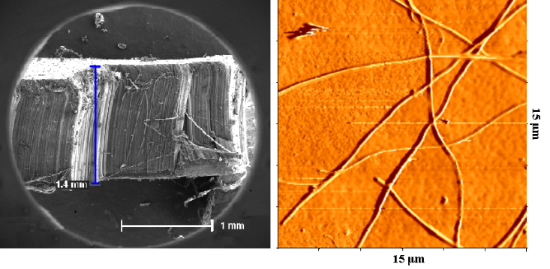
- -graphitic carbon) in the samples prepared at 1100 °C. Thermogravimetric analysis (TGA) measurements were carried out for the synthesized CNT material grown at 650 and 1100 °C in a dry air atmosphere with a heating rate of 10 °C/min and show the typical temperature behavior of high quality CNTs (Figure 8b
- microscopy TEM, AFM, EDS, TGA and Raman spectroscopy. SEM images of aligned CNTs prepared at different temperatures (a) 650 °C, (b) 750 °C, (c) 850 °C, (d) 950 °C, (e) 1050 °C, and (f) 1100 °C. (a) SEM image of aligned CNTs on a quartz substrate. (b) SEM image of an isolated mat collected from the inner wall
- °C. (a) Raman spectra and (b) TGA curves of aligned CNTs prepared at 650 and 1100 °C.


Pore structure and surface area of silica SBA-15: influence of washing and scale-up
Beilstein J. Nanotechnol. 2011, 2, 110–118, doi:10.3762/bjnano.2.13
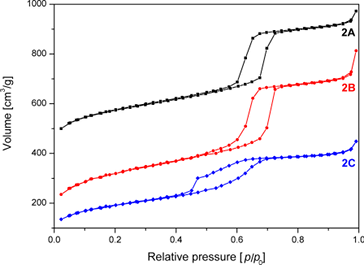
- more effective in removing the template from the SBA-15 framework, although the Pluronic 123 cannot be removed completely from the SBA-15 by washing, as shown by thermogravimetric analysis (TGA) [22]. Also the more effective template removal by ethanol is connected with shrinkage of the SBA-15





