


Search results
Search for "antimicrobial" in Full Text gives 133 result(s) in Beilstein Journal of Nanotechnology.
Antimicrobial properties of CuO nanorods and multi-armed nanoparticles against B. anthracis vegetative cells and endospores
Beilstein J. Nanotechnol. 2014, 5, 789–800, doi:10.3762/bjnano.5.91
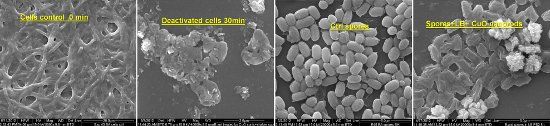
- carcinogenicity and the corrosive nature limits their use for personal decontamination and decontamination of sensitive equipment [7]. This scenario makes it imperative to evaluate antimicrobial potential of the robust nanoparticles. Active noncorrosive nanoparticles can be used for disinfection of equipment and
- surfaces for example, in air filters and respirators and also, in paints and coatings for hospitals and strategic buildings. Antimicrobial formulations comprising inorganic nanoparticles could be effective bactericidal materials. They have the additional advantage of improved safety and stability of
- inorganic agents compared to organic antimicrobial agents [8]. The safe and efficient decontamination of civilian water resources and facilities after an attack with B. anthracis is a potential application for nanomaterials. A considerable amount of research was published recently in the field of


Injection of ligand-free gold and silver nanoparticles into murine embryos does not impact pre-implantation development
Beilstein J. Nanotechnol. 2014, 5, 677–688, doi:10.3762/bjnano.5.80
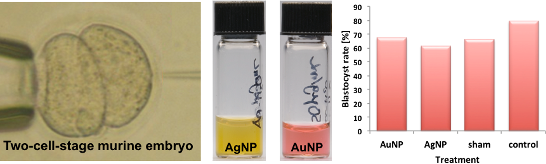
- are currently viewed as promising agents for in vivo imaging purposes and might therefore be in frequent use in the near future. AgNP are already abundantly employed in applications for their antimicrobial properties. Both particle types also represent good models for exploring the extent to which


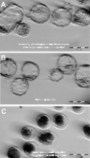


Cyclodextrin-poly(ε-caprolactone) based nanoparticles able to complex phenolphthalein and adamantyl carboxylate
Beilstein J. Nanotechnol. 2014, 5, 651–657, doi:10.3762/bjnano.5.76
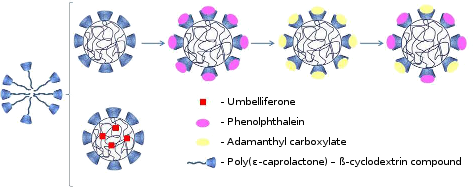
- potential application for antimicrobial delivery have been described [16]. The aim of this study was to develop a β-CD-poly-ε-caprolactone compound by click chemistry, which is able to form nanoparticles in water. Once obtained, the nanoparticles were used for host–guest behavior studies with different


An ultrasonic technology for production of antibacterial nanomaterials and their coating on textiles
Beilstein J. Nanotechnol. 2014, 5, 532–536, doi:10.3762/bjnano.5.62
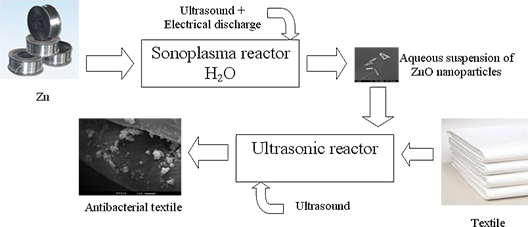
- after washing. Antimicrobial textiles can be produced by coating textiles with antibacterial nanoparticles (NPs). NPs such as zinc oxide NPs are known to have antibacterial properties due to OH• radicals, which result from defects in their crystal structure [2]. In the case of power ultrasound
- used the reactor described in [7] to produce antimicrobial textiles coated with nanoparticles. Ultrasonic vibrations were introduced into the reactor through two magnetostrictive transducers with an operating frequency of 19 kHz, one of which was located above the moving fabric, and the other one below


Cytotoxic and proinflammatory effects of PVP-coated silver nanoparticles after intratracheal instillation in rats
Beilstein J. Nanotechnol. 2013, 4, 933–940, doi:10.3762/bjnano.4.105
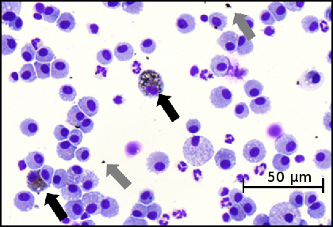
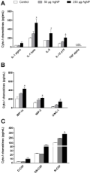
- consumer products is growing rapidly [1]. The antimicrobial properties of AgNP render them useful as a component in wound dressings or as coatings for catheters [2][3][4][5]. In addition, they are used in deodorants or applied in textiles as a protection against odor [6][7]. With regard to the use in




Photocatalytic antibacterial performance of TiO2 and Ag-doped TiO2 against S. aureus. P. aeruginosa and E. coli
Beilstein J. Nanotechnol. 2013, 4, 345–351, doi:10.3762/bjnano.4.40
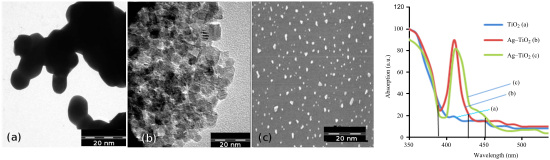
- and transfer behaviour of the photoexcited electron–hole pairs in the semiconductors was recorded by photoluminescence. The antimicrobial activity of TiO2 and Ag-doped TiO2 nanoparticles (3% and 7%) was investigated against both gram positive (Staphylococcus aureus) and gram negative (Pseudomonas
- zero viability at 40 mg/30 mL culture in the case of P. aeruginosa only. Keywords: Ag-doped TiO2; antimicrobial activity; sol–gel; Introduction The photocatalytic agent TiO2, known for its chemical stability and optical competency, has been used extensively for killing different groups of
- photocatalytic efficiency [8][9]. However, silver nanoparticles have prospective applications including biosensing, biodiagnostics, optical fibers, and antimicrobial and photocatalytic uses. Silver ions are known to cause denaturation of proteins present in bacterial cell walls and slow down bacterial growth [5


Electrospinning preparation and electrical and biological properties of ferrocene/poly(vinylpyrrolidone) composite nanofibers
Beilstein J. Nanotechnol. 2013, 4, 189–197, doi:10.3762/bjnano.4.19

- PVP nanofibers. X-ray diffraction (XRD) results showed that the crystalline structure of Fc in the fibers was amorphous after the electrospinning process. A biological evaluation of the antimicrobial activity of Fc/PVP nanofibers was carried out by using Gram-negative Escherichia coli (E. coli) as
- agent. In the case of Fc/PVP nanofibers, water-soluble polymer PVP, as a carrier, not only provides good dispersion for Fc, but also can release Fc quickly upon encountering a small amount of water. The antimicrobial activity of composite Fc/PVP nanofibers is explored in this article. Common E.coli was
- counter electrode, and a saturated calomel electrode (SCE) as the reference electrode. Antimicrobial activity testing of Fc/PVP nanofibers The sample containing 45 wt % Fc was tested for antibacterial activity against the Gram-negative E. coli. Samples were prepared in the form of discs with a diameter of


Paper modified with ZnO nanorods – antimicrobial studies
Beilstein J. Nanotechnol. 2012, 3, 684–691, doi:10.3762/bjnano.3.78
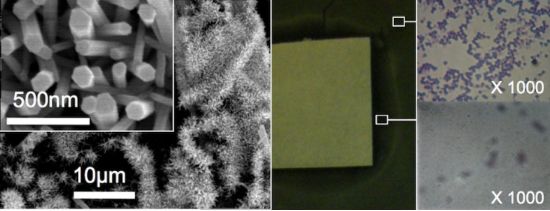
- , Postal Code 123, Al Khoud, Oman 10.3762/bjnano.3.78 Abstract Paper with antimicrobial properties was developed through in situ growth of ZnO nanorods. The targeted application for this type of paper is in health centers as wallpaper, writing paper, facemasks, tissue paper, etc. The paper was tested on
- three model microbes, Gram-positive bacteria Staphylococcus aureus, Gram-negative bacteria Escherichia coli and common airborne fungus Aspergillus niger. No viable bacterial colonies or fungal spores could be detected in the areas surrounding test samples of the antimicrobial paper. Gram-negative
- the paper samples are 102% and 70%, and for Aspergillus niger, 224% and 183% of the sample area, under similar lighting conditions. Keywords: antimicrobial; nanorod; paper; photocatalysis; zinc oxide; Introduction Deterioration of library materials due to fungal growth is a worldwide problem and a


Other Beilstein-Institut Open Science Activities



