


Search results
Search for "carbon nanotubes (CNTs)" in Full Text gives 139 result(s) in Beilstein Journal of Nanotechnology.
Size-dependent characteristics of electrostatically actuated fluid-conveying carbon nanotubes based on modified couple stress theory
Beilstein J. Nanotechnol. 2013, 4, 771–780, doi:10.3762/bjnano.4.88
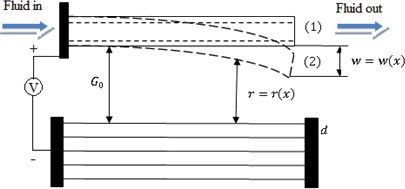
- and structures made from different metallic and non-metallic materials, carbon nanomaterials play a special role. For instance, carbon nanotubes (CNTs) possess extraordinary chemical, physical, mechanical and electrical properties. Thus, since their discovery in 1991 by Iijima [13], they have


AFM as an analysis tool for high-capacity sulfur cathodes for Li–S batteries
Beilstein J. Nanotechnol. 2013, 4, 611–624, doi:10.3762/bjnano.4.68
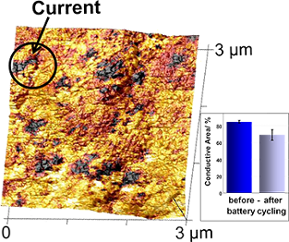
- capacity of approximately 1000 mA·g(sulfur)−1 [19][20]. Another approach is based on vertically aligned carbon nanotubes (CNTs) grown on a nickel foil without any binder. To date, these binder-free CNT cathodes contain the highest published total ratio of sulfur (90%) in an electrode [21]. The advantage of

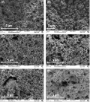


Functionalization of vertically aligned carbon nanotubes
Beilstein J. Nanotechnol. 2013, 4, 129–152, doi:10.3762/bjnano.4.14
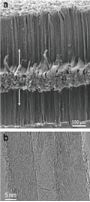
- ; functionalization; graphene; nitration; oxidation; Introduction Carbon nanotubes (CNTs) have stirred the curiosity of the scientific community for two decades now. They consist of layers of graphene rolled up on themselves in order to form cylinders often closed at the two ends by fullerenic caps. Either they are








Electronic and transport properties of kinked graphene
Beilstein J. Nanotechnol. 2013, 4, 103–110, doi:10.3762/bjnano.4.12
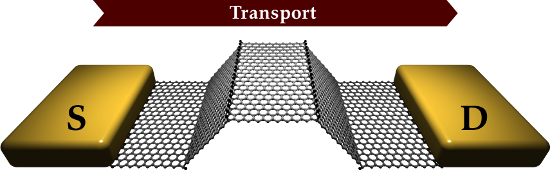
- nanoribbons (GNR) [2]. The electronic structure of GNRs depends on width, direction and edge structure – all parameters that to some degree can be controlled. GNRs can be formed by etching [2], by unzipping carbon nanotubes (CNTs) [3], or ultimately be grown with atomic-scale precision by using self-assembly


Low-dose patterning of platinum nanoclusters on carbon nanotubes by focused-electron-beam-induced deposition as studied by TEM
Beilstein J. Nanotechnol. 2013, 4, 77–86, doi:10.3762/bjnano.4.9
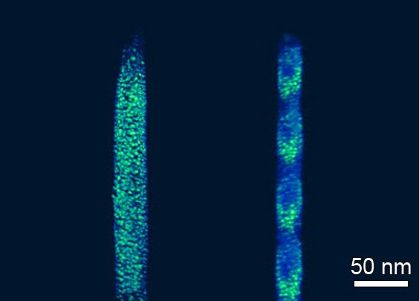
- nanotubes; FEBID; nanocluster; platinum; patterning; radiation-induced nanostructures; TEM; Introduction Hybrid nanostructures consisting of carbon nanotubes (CNTs) decorated with metal nanoclusters enable access to various electrical and catalytic properties. Therefore, they are considered as building
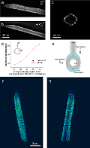


Low-temperature synthesis of carbon nanotubes on indium tin oxide electrodes for organic solar cells
Beilstein J. Nanotechnol. 2012, 3, 524–532, doi:10.3762/bjnano.3.60
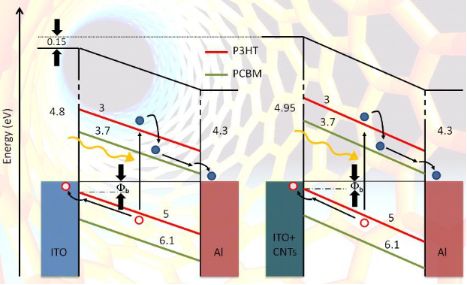
- , such as thermal [8] and solvent annealing [9], or the use of additives in the blend preparation [10]. Along with fullerenes, carbon nanotubes (CNTs) have also been suggested as promising materials to boost solar cell PCE, thanks to their excellent electrical properties and to a favorable aspect ratio


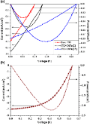


Conducting composite materials from the biopolymer kappa-carrageenan and carbon nanotubes
Beilstein J. Nanotechnol. 2012, 3, 415–427, doi:10.3762/bjnano.3.48
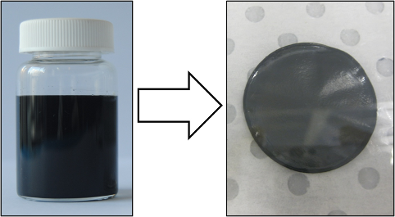
- Rico, San Juan, Puerto Rico 00931, USA 10.3762/bjnano.3.48 Abstract Conducting composite films containing carbon nanotubes (CNTs) were prepared by using the biopolymer kappa-carrageenan (KC) as a dispersant. Rheological studies indicated that 0.5% w/v was the appropriate KC concentration for
- prepared by evaporative casting. All composite films displayed sensitivity to water vapour, but MWNT films were more sensitive than SWNT films. Keywords: biopolymers; carbon nanotubes; carrageenan; composite materials; conductivity; mechanical; rheology; Introduction Carbon nanotubes (CNTs) have


Glassy carbon electrodes modified with multiwalled carbon nanotubes for the determination of ascorbic acid by square-wave voltammetry
Beilstein J. Nanotechnol. 2012, 3, 388–396, doi:10.3762/bjnano.3.45
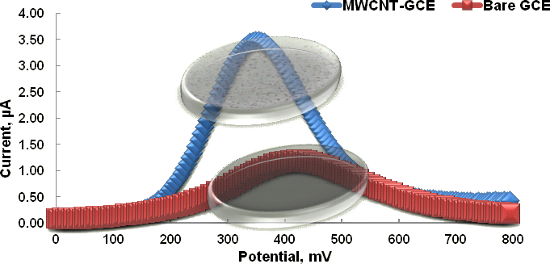
- , which results in poor selectivity and reproducibility, thus limiting the use of bare GCEs in quantitative measurements. Presently there are increasing reports on the use of carbon nanotubes (CNTs) in electroanalysis [10]. CNTs may be multiwalled or single-walled depending on the number of layers of


Structural, electronic and photovoltaic characterization of multiwalled carbon nanotubes grown directly on stainless steel
Beilstein J. Nanotechnol. 2012, 3, 360–367, doi:10.3762/bjnano.3.42
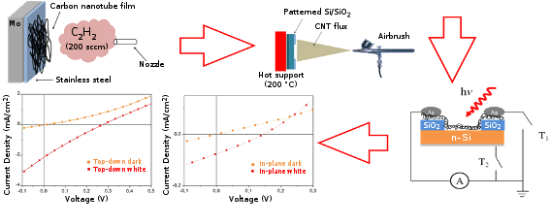
- silicon substrate plays an important role in the production of electron–hole pairs. Keywords: carbon nanotubes; electronic properties; heterojunction; photovoltaic; stainless steel; Introduction Carbon nanotubes (CNTs) possess unique electronic, mechanical and optical properties that make them


Surface functionalization of aluminosilicate nanotubes with organic molecules
Beilstein J. Nanotechnol. 2012, 3, 82–100, doi:10.3762/bjnano.3.10
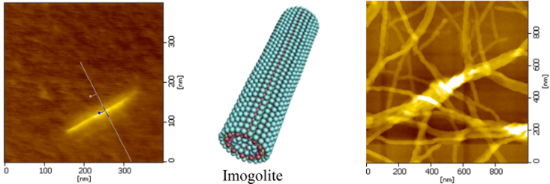
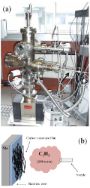
- ratios and ability to form network structures. It is no doubt that nanotubes with reactive surfaces and a reliable supply are preferred for the application as scaffold of organic molecules. Carbon nanotubes (CNTs) play an important role in the nanotube family. However, the surface of CNTs is inert for


Generation and agglomeration behaviour of size-selected sub-nm iron clusters as catalysts for the growth of carbon nanotubes
Beilstein J. Nanotechnol. 2011, 2, 734–739, doi:10.3762/bjnano.2.80
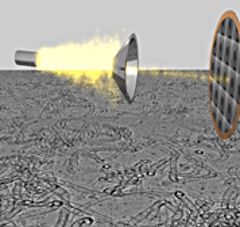
- °C, no CNT growth is observed. Keywords: carbon nanotubes; CNT growth; metal clusters; size selected clusters; Introduction Controlling the individual diameters of carbon nanotubes (CNTs) is still one of the major challenges in current CNT research, and it is particularly important as it determines


Dynamics of capillary infiltration of liquids into a highly aligned multi-walled carbon nanotube film
Beilstein J. Nanotechnol. 2011, 2, 311–317, doi:10.3762/bjnano.2.36
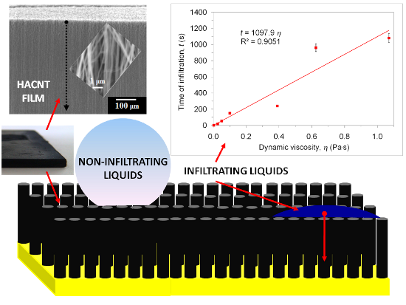
- ; Introduction Wettability of carbon nanotubes (CNTs) and highly aligned carbon nanotube (HACNT) films is an important aspect in numerous technologies including manufacture of composites [1], fabrication of constantly/interchangeably hydrophobic or hydrophilic materials [2][3], nanofluidic devices [4] or sponges


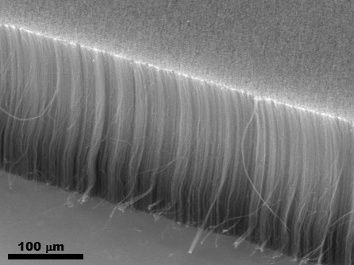
Studies towards synthesis, evolution and alignment characteristics of dense, millimeter long multiwalled carbon nanotube arrays
Beilstein J. Nanotechnol. 2011, 2, 293–301, doi:10.3762/bjnano.2.34
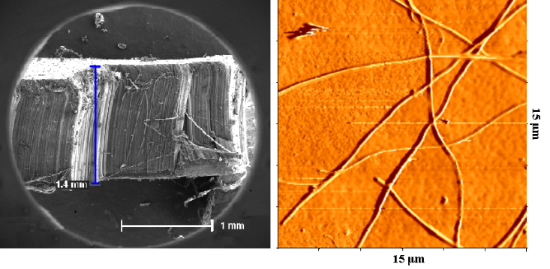
- , India 10.3762/bjnano.2.34 Abstract We report the synthesis of aligned arrays of millimeter long carbon nanotubes (CNTs), from benzene and ferrocene as the molecular precursor and catalyst respectively, by a one-step chemical vapor deposition technique. The length of the grown CNTs depends on the


Electrochemical behavior of dye-linked L-proline dehydrogenase on glassy carbon electrodes modified by multi-walled carbon nanotubes
Beilstein J. Nanotechnol. 2010, 1, 135–141, doi:10.3762/bjnano.1.16
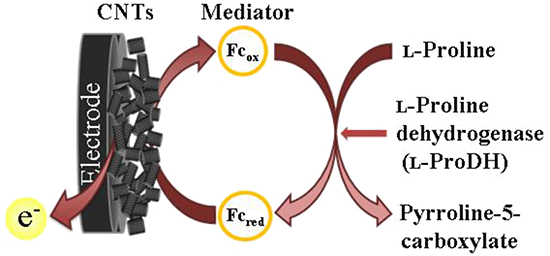
- enzyme, specific immobilization strategies, including electron mediators, should be considered [10][11][12]. In the last decade, the use of nano materials, especially carbon nanotubes (CNTs), in the construction of enzyme biosensors has received considerable attention. Because of their excellent





