


Search results
Search for "cross-linking" in Full Text gives 133 result(s) in Beilstein Journal of Nanotechnology.
Analysis of fluid flow around a beating artificial cilium
Beilstein J. Nanotechnol. 2012, 3, 163–171, doi:10.3762/bjnano.3.16
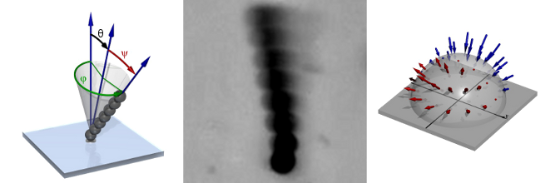
- substrate. Direct illumination of the photoresist with an UV laser (Omikron Laserage GmbH, Bluephoton LDM375.20.CWA.L, 375 nm, Zeiss LD Plan-neofluar 10x/0.4 Korr objective) caused cross-linking of SU-8 molecules in the desired pattern [25]. The position of the laser beam was steered by acousto-optic



Self-assembly of octadecyltrichlorosilane: Surface structures formed using different protocols of particle lithography
Beilstein J. Nanotechnol. 2012, 3, 114–122, doi:10.3762/bjnano.3.12
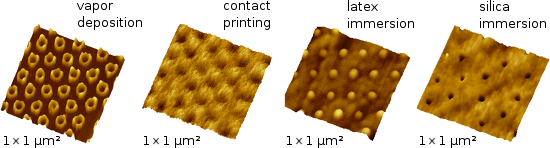
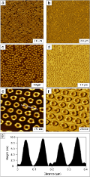
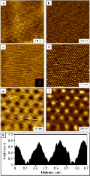
- ][8][9]. The surface self-assembly of organosilanes such as octadecyltrichlorosilane (OTS) is complicated, with multiple steps of hydrolysis, cross-linking and silanation [10][11][12][13]. To develop robust and reproducible lithography procedures with OTS, parameters, such as temperature, humidity




Electron-beam patterned self-assembled monolayers as templates for Cu electrodeposition and lift-off
Beilstein J. Nanotechnol. 2012, 3, 101–113, doi:10.3762/bjnano.3.11
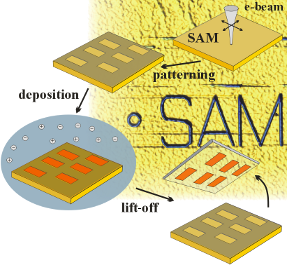
- exposure to electrons (positive-resist behaviour), in contrast to aromatic SAMs in which the molecular structure of the SAM is essentially preserved [40] apart from the cross-linking of the aromatic moieties. The rather ill-defined electron-induced degradation of aliphatic SAMs makes it very difficult to
- irradiation is a cross-linking of the aromatic units, which results in the elimination of defects through which metal ions can penetrate the SAM and be reduced at the SAM–substrate interface. In contrast to a scheme that involves complexation of metal ions with the SAM [41][42][43] and in which the metal is
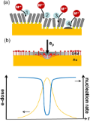
- patterned SAM, Z0 becomes a function of the exposed topology. For aromatic SAMs, such as MBP0, which exhibit negative-resist behaviour, the density of nucleation sites Z0 is determined by the extent of cross-linking of the molecules. While the exact relationship between the defect size in the SAM and the





Self-assembled monolayers and titanium dioxide: From surface patterning to potential applications
Beilstein J. Nanotechnol. 2011, 2, 845–861, doi:10.3762/bjnano.2.94
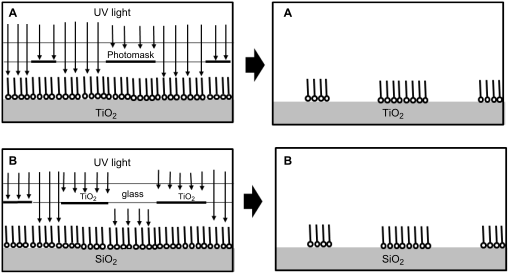
- ]. Generally speaking, a comprehensive comparison between SAMs on silica and SAMs on titanium dioxide is somehow problematic as the latter were by far less-extensively studied than the former. It is commonly claimed that silanes capable of cross linking (i.e., having at least three leaving groups) grow by an
- islandlike growth mechanism, whereas SAMs that are not capable of cross linking grow by a uniform growth mechanism [15]. While this is well-established for SAMs on Si, results for organosilanes SAMs on titanium dioxide are much more ambiguous. The lower electronegativity of titanium suggests that the



Mechanical characterization of carbon nanomembranes from self-assembled monolayers
Beilstein J. Nanotechnol. 2011, 2, 826–833, doi:10.3762/bjnano.2.92
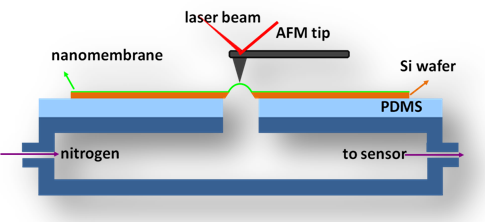
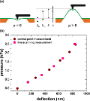
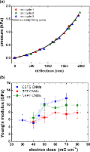
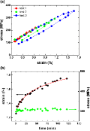
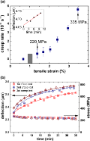
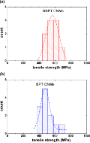
- nanodevices from freestanding nanomembranes. A variety of approaches to fabricate nanomembranes has been tested: Spin-assisted layer-by-layer (LBL) assembly [3][4]; spin-coating of organic–inorganic hybrid films with an interpenetrating network (IPN) structure [5][6]; cross-linking of ligand-stabilized
- nanoparticle assemblies at the fluid interfaces [7][8]. Freestanding nanomembranes with thicknesses from 20 to 70 nm were achieved by these approaches. Eck et al. reported the fabrication of carbon nanomembranes (CNMs) with a thickness of 1 nm by electron-induced cross-linking of aromatic self-assembled
- by X-ray photoelectron spectroscopy (XPS) to be ~1.6 nm for CBPS SAMs, which was larger than that of NBPT SAMs (~1.2 nm) and BPT SAMs (~0.9 nm) [9][18][19]. As cross-linking occurs between the phenyl rings, a comparable thickness is expected for the corresponding CNMs. The CNM can be modeled as a

Magnetic nanoparticles for biomedical NMR-based diagnostics
Beilstein J. Nanotechnol. 2010, 1, 142–154, doi:10.3762/bjnano.1.17
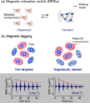
- relaxation switching. As indicated in Figure 1a, MRSw assays can be designed to cause forward switching: a process whereby molecular targets are used as cross-linking agents to assemble MNPs into clusters, thus effecting a corresponding decrease in T2. Alternatively, the assays can cause reverse switching


Electrochemical behavior of dye-linked L-proline dehydrogenase on glassy carbon electrodes modified by multi-walled carbon nanotubes
Beilstein J. Nanotechnol. 2010, 1, 135–141, doi:10.3762/bjnano.1.16
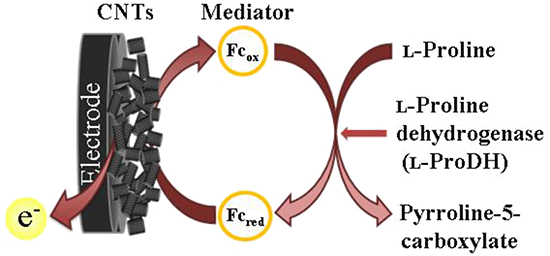
- cross-linking method using glutaraldehyde as the linking agent [35][36]. A 300 μL L-proDH solution and 200 μL glutaraldehyde solution (0.5%, w/w) were mixed. A 12 μL of the above mixture was coated onto the bare GC electrode and dried in a N2 stream at room temperature. The electrode so obtained is


Fabrication and spectroscopic studies on highly luminescent CdSe/CdS nanorod polymer composites
Beilstein J. Nanotechnol. 2010, 1, 94–100, doi:10.3762/bjnano.1.11
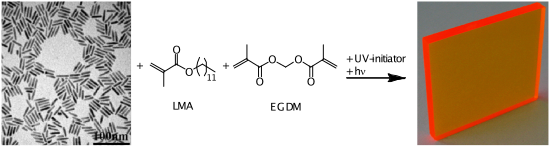
- present, the NRs were dispersed at several concentrations in a monomer mixture of lauryl methacrylate (LMA) with the cross-linking agent ethylene glycol dimethacrylate (EGDM) and the liquid UV-initiator Darocure® 4265. LMA provides the hydrophobicity required preventing agglomeration, and by changing the
- octadecylphosphonic acid (ODPA). Various amounts of NRs (0.008–0.32 wt %) were dispersed in a monomer mixture of LMA (Fluka, 98%) with 20 wt % of the cross-linking agent EGDM (Fluka, ≥97%) and 0.1–0.5 wt % of the liquid UV-initiator Darocure® 4265 (Ciba) by ultrasound treatment. The reaction mixtures were transferred


Other Beilstein-Institut Open Science Activities



