


Search results
Search for "current" in Full Text gives 1463 result(s) in Beilstein Journal of Nanotechnology. Showing first 200.
Quantification of lead through rod-shaped silver-doped zinc oxide nanoparticles using an electrochemical approach
Beilstein J. Nanotechnol. 2025, 16, 422–434, doi:10.3762/bjnano.16.33
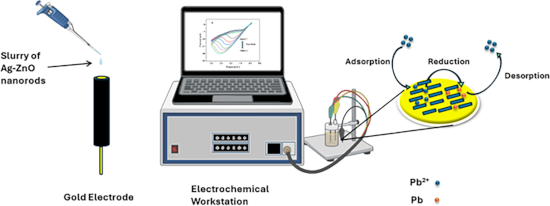
- uncomplicated method for producing Ag@ZnO NRs. These fabricated Ag@ZnO NRs play an effective role as an electron mediator in the development of lead chemical sensors which are both highly sensitive and robust in nature. Based on our current understanding, the lead sensor we developed exhibits the most notable
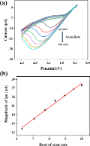
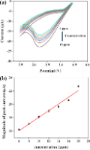
- of lead chemical sensors. The significant rise in peak height is indicative of a faster electron-transfer event because it causes a sharper, more defined peak. Furthermore, the absence of a cathodic current in the reverse cycle indicates the irreversibility of the electrochemical response that was
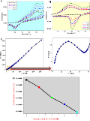
- with the scan rate, indicates that the current values proportionally increase with higher scan rates, indicating that the reduction process is controlled by diffusion. Figure 11b displays a graph illustrating the relationship between Ipc (cathodic current) and v1/2 (square root of the scan rate





ReactorAFM/STM – dynamic reactions on surfaces at elevated temperature and atmospheric pressure
Beilstein J. Nanotechnol. 2025, 16, 397–406, doi:10.3762/bjnano.16.30
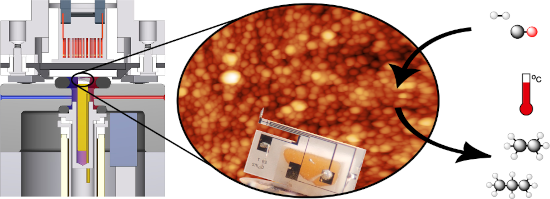
- , capable of studying materials under industrially relevant conditions. Here we show current developments of the ReactorAFM/STM, implementing a qPlus sensor to add the ability of combining atomic force microscopy (AFM) and scanning tunneling microscopy (STM) techniques to study the geometric and electronic
- structure of materials under reaction conditions. We demonstrate this by imaging a Pd(100) single crystal at 450 K with combined AFM/STM. The surface is compared under ultrahigh vacuum and under 0.5 bar O2 pressure showing a notable increase in RMS current, which we attribute to oxidation. Also, we study
- cobalt nanoparticle catalysts on an aluminum oxide support, industrially relevant in the Fischer–Tropsch synthesis. The catalysts are imaged before and after reaction at 430 K as the current maximum temperature of the qPlus sensor used falls just below the reaction temperature. Quadrupole mass


Engineered PEG–PCL nanoparticles enable sensitive and selective detection of sodium dodecyl sulfate: a qualitative and quantitative analysis
Beilstein J. Nanotechnol. 2025, 16, 385–396, doi:10.3762/bjnano.16.29
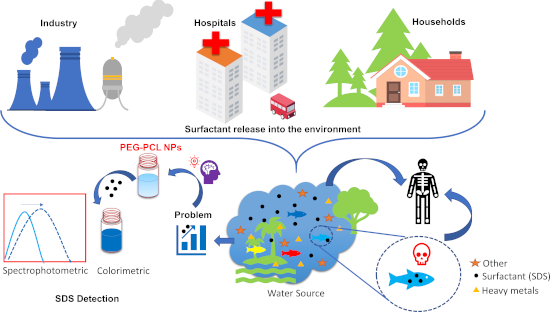
- hypothesize that PEG–PCL NPs can serve as effective colorimetric probes for SDS detection, addressing the need for a rapid, nontoxic, selective, and cost-effective environmental and human health protection sensor. The current study is based on developing a colorimetric/spectrometric sensing probe for SDS
- a plasmon resonance peak around 595 nm, forming a blue form of the dye–protein complex [37]. Furthermore, the quantification of SDS is not possible with a dye, only without involving protein. Therefore, the current study utilized NPs with PEG–PCL to detect SDS in the presence of the Bradford reagent


Development of a mucoadhesive drug delivery system and its interaction with gastric cells
Beilstein J. Nanotechnol. 2025, 16, 371–384, doi:10.3762/bjnano.16.28

- within the mucus because of stronger interaction [29], and better and uniform distribution throughout the gastric mucosa [2]. The motivation behind the current study, therefore, was to synthesize a nanoscale drug delivery system with mucoadhesive properties in an attempt to achieve improved gastric


Pulsed laser in liquid grafting of gold nanoparticle–carbon support composites
Beilstein J. Nanotechnol. 2025, 16, 349–361, doi:10.3762/bjnano.16.26
- , evident from electrochemical impedance spectroscopy (EIS) data (Figure 5B). Impedance, measured in an electrochemical setup, is the time-dependent opposition to alternating current stemming from the combined effect of ohmic resistance, capacitance, and phase elements in an electronic circuit. Impedance is
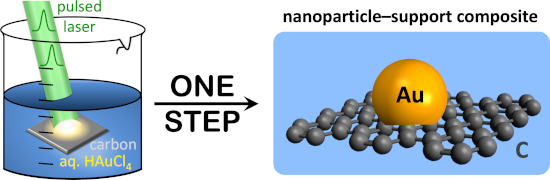
- paper composite fabrication. The mass activity of pulsed laser-grafted cathodes was a factor of 1.65 higher than that of conventionally prepared electrodes (Figure 6A). Chronopotentiometry data, collected in an H-cell at a constant current density of −10 mA·cm−2, corroborated the exceptional stability
- circuit potential, where no faradaic current flows [2], did not show product generation. This demonstrates that the gold nanoparticle–carbon fiber paper composite cathode electrocatalyzed hydrogen evolution in aqueous bicarbonate reduction (Figure 6C,D). Hydrogen can arise from the reduction of water


Tailoring of physical properties of RF-sputtered ZnTe films: role of substrate temperature
Beilstein J. Nanotechnol. 2025, 16, 333–348, doi:10.3762/bjnano.16.25
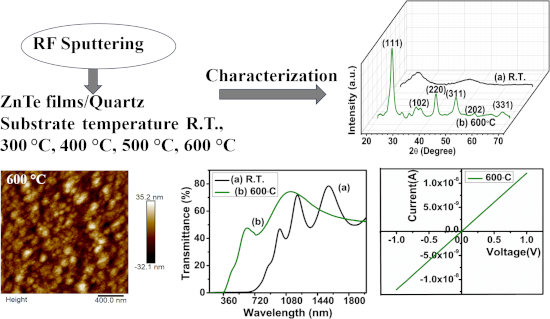
- , skewness, and kurtosis were determined. Current–voltage characteristics indicate that the conductivity of the films increased with substrate temperature. The observed variations in structural, morphological, and optical parameters have been discussed and correlated. The wide bandgap (3.11 eV), high
- energy-dispersive X-ray spectroscopy (EDS) operated at 10 keV. The current–voltage (I–V) characteristics of the films were measured in the voltage range from −1 V to 1 V using a two-probe Keithley 4200 A-SCS parametric analyser available at Ion Beam Centre, Kurukshetra University. Results and Discussion
- particle density decrease with increasing substrate temperature [40]. Electrical studies Figure 9 depicts the current–voltage (I–V) characteristics of ZnTe films deposited at different substrate temperatures. The I–V characteristics were recorded using a two-probe arrangement provided with a Keithley 4200




Graphene oxide–chloroquine conjugate induces DNA damage in A549 lung cancer cells through autophagy modulation
Beilstein J. Nanotechnol. 2025, 16, 316–332, doi:10.3762/bjnano.16.24
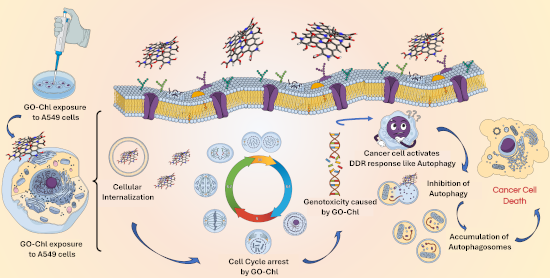
- electrophoresis tank containing freshly prepared chilled electrophoresis solution (1 mM of EDTA, 300 mM of NaOH, pH > 13) for 20 min for DNA unwinding and subsequently subjected to electrophoresis with a 300 mA current, 0.7 V/cm at 4 °C under dimmed light for 30 min. After electrophoresis, the slides were treated



Fabrication and evaluation of BerNPs regarding the growth and development of Streptococcus mutans
Beilstein J. Nanotechnol. 2025, 16, 308–315, doi:10.3762/bjnano.16.23
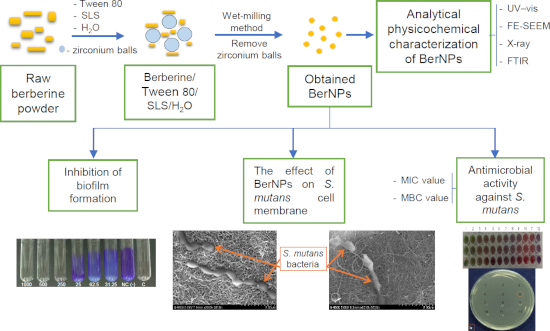
- materials with novel properties. The development of substances and methods with enhanced water dispersibility and bioavailability from materials such as berberine and curcumin is a current trend. Several studies on the nanofabrication of berberine aimed at improving its bioavailability and evaluating its




Enhancing mechanical properties of chitosan/PVA electrospun nanofibers: a comprehensive review
Beilstein J. Nanotechnol. 2025, 16, 286–307, doi:10.3762/bjnano.16.22

- evaluate mechanical properties and provides a comparative analysis of different enhancement approaches. Applications in biomedical and industrial contexts are explored, showcasing the versatility and innovation potential of these nanofibers. Finally, current challenges are addressed, and future research
- current techniques and methods for improving the mechanical properties of electrospun nanofibers, thereby enhancing their application in various fields. Materials composition Chitosan is an intriguing material derived from chitin. Because of its promising properties, it has attracted significant attention
- approaches with distinct fiber-producing capabilities such as centrifugal electrospinning, alternating current electrospinning, near-field electrospinning, multinozzle electrospinning, and needleless electrospinning. Other improvement efforts include modifications on the solution or melts used for


Radiosensitizing properties of dual-functionalized carbon nanostructures loaded with temozolomide
Beilstein J. Nanotechnol. 2025, 16, 229–251, doi:10.3762/bjnano.16.18
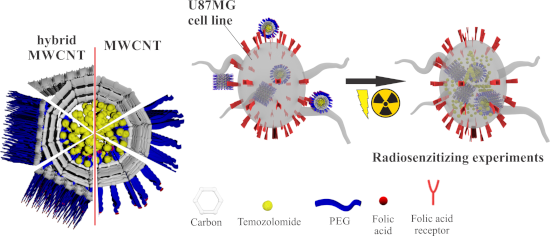
- the same TMZ-loaded CNs was performed using PEG1500, PEG4000, and PEG6000, sustained release over extended periods of time was also observed, with no significant difference in the drug release profile between the different PEGylated formulations. Therefore, in the current study, PEG6000 was used for




Recent advances in photothermal nanomaterials for ophthalmic applications
Beilstein J. Nanotechnol. 2025, 16, 195–215, doi:10.3762/bjnano.16.16
- Abstract The human eye, with its remarkable resolution of up to 576 million pixels, grants us the ability to perceive the world with astonishing accuracy. Despite this, over 2 billion people globally suffer from visual impairments or blindness, primarily because of the limitations of current ophthalmic
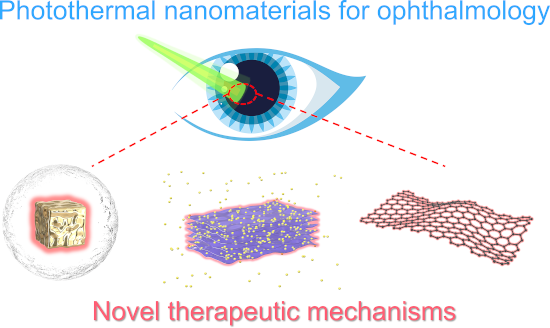
- the photothermal properties of these nanomaterials and their innovative therapeutic mechanisms. We review the latest research on photothermal nanomaterial-based treatments for various eye diseases. Additionally, we discuss the current challenges and future perspectives in this field, with a focus on
- (Figure 1). In addition, the application progress of photothermal nanomaterials in promoting retinal drug delivery and enhancing photoacoustic imaging was also discussed. Finally, we address the current challenges and prospects in ophthalmic treatment technologies based on photothermal nanomaterials, with


A review of metal-organic frameworks and polymers in mixed matrix membranes for CO2 capture
Beilstein J. Nanotechnol. 2025, 16, 155–186, doi:10.3762/bjnano.16.14
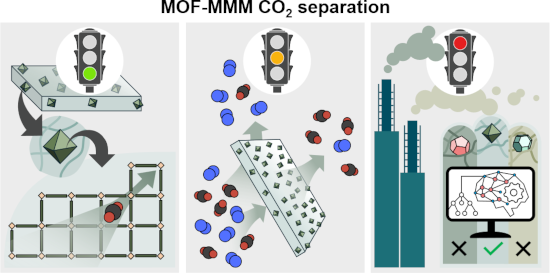
- frameworks (MOFs) have gained recognition as MMM fillers for CO2 capture. Here, a review of the current state, recent advancements, and challenges in the fabrication and engineering of MMMs with MOFs for selective CO2 capture is proposed. Key considerations and promising research directions to fully exploit
- opportunities encountered in the development and fabrication of MOF-based MMMs for CO2 capture. An account of current trends in the field is given, while gaps and further areas of investigation are identified and highlighted. Specifically, the review intends to convey a broad yet comprehensive understanding of
- –3.6 Å), the majority of MOFs exhibiting high adsorption capacities for CO2 have pore openings that largely surpass the dimensions of the CO2 molecule [26]. Consequently, most current MOF-related studies rely on the separation of the molecules based on the adsorptive interactions between the MOF




Comparison of organic and inorganic hole transport layers in double perovskite material-based solar cell
Beilstein J. Nanotechnol. 2025, 16, 119–127, doi:10.3762/bjnano.16.11
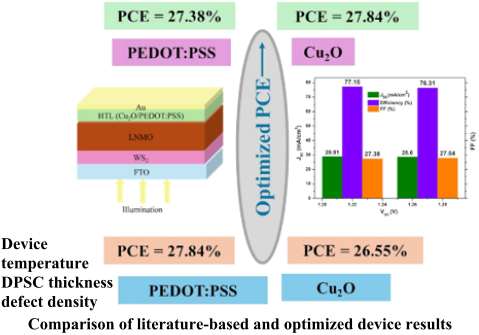
- 27.84% and 27.38% for Cu2O and PEDOT:PSS, respectively, with corresponding open-circuit voltages of 1.27 and 1.22 V, short-circuit current densities of 28.60 and 28.91 mA/cm2, and fill factors of 76.31% and 77.15%, respectively. These results highlight the potential of these HTLs for enhanced device
- -circuit current density (JSC) of 13.26 mA/cm2, and a fill factor (FF) of 66%. The PCE is close to that of the Pt-based counter electrode (PCE = 6.86%). Akman [3] used hydrothermal methods to synthesize the photoanodes with different doping sources to further improve the stability of DSSCs. For 1.0 mol


Nanocarriers and macrophage interaction: from a potential hurdle to an alternative therapeutic strategy
Beilstein J. Nanotechnol. 2025, 16, 97–118, doi:10.3762/bjnano.16.10
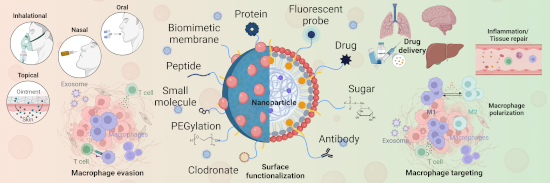
- transport across membranes, and extend circulation times. These advantages could reduce the negative effects of off-target drug accumulation and improve the release to the disease sites compared to current delivery systems [6]. Despite the expected applications in the biomedical field, the journey of NPs


Characterization of ZnO nanoparticles synthesized using probiotic Lactiplantibacillus plantarum GP258
Beilstein J. Nanotechnol. 2025, 16, 78–89, doi:10.3762/bjnano.16.8
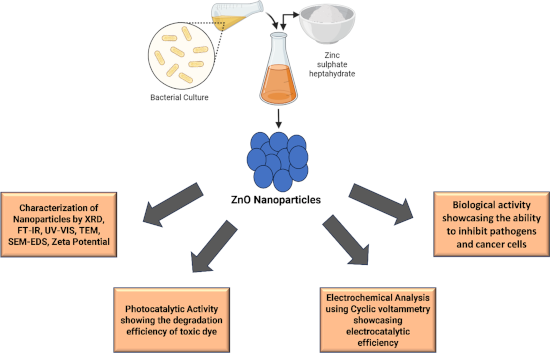
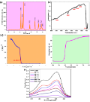
- peak current, though a steady addition led to decreased currents, possibly due to surface accumulation. The Nyquist plots display a larger impedance for ZnO electrodes. To fit the data into an analogous circuit, an uninterrupted phase element (Q1) was introduced with the adjustable parameters angular
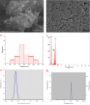
- ) Nyquist plots representing impedance spectra from electrochemical impedance spectroscopy. (d) Concentration vs peak current graph derived from CV studies. (a) Antibacterial activity assessment against human pathogens showing the zone of inhibition in millimeters. (b) Visual representation of an



Instance maps as an organising concept for complex experimental workflows as demonstrated for (nano)material safety research
Beilstein J. Nanotechnol. 2025, 16, 57–77, doi:10.3762/bjnano.16.7

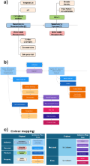
- and bottom-up and evolved based on real applications by the nanosafety research community. Instance maps for on-the-fly data FAIRification Much of the potential benefit provided by instance maps arises from removing the current separation of data production from data curation, harmonisation, reporting
- still limited in the current version of the tool but will be improved in the future to support the harmonised and interoperable on-the-fly data management concept envisioned in the introduction and described in [3]. Users can provide further information such as descriptions, keywords, version numbers


Advanced atomic force microscopy techniques V
Beilstein J. Nanotechnol. 2025, 16, 54–56, doi:10.3762/bjnano.16.6

- microscope over a wide current range. A central zone of the sample offers several contact pads, each addressable by the tip of a conductive atomic force microscopy probe, and each connected to a different calibrated resistor. Thus, calibrated current measurements over a large current range become possible
Theoretical study of the electronic and optical properties of a composite formed by the zeolite NaA and a magnetite cluster
Beilstein J. Nanotechnol. 2025, 16, 44–53, doi:10.3762/bjnano.16.5
- magnetic materials. Computational Details In the current study, the dehydrated sodium LTA zeolite, commonly denoted as NaA in the literature, with a ratio of Si/Al = 1 was considered. For this purpose, we adopted the trigonal cell proposed by Antúnez-García et al. [54], for which the lattice parameters are
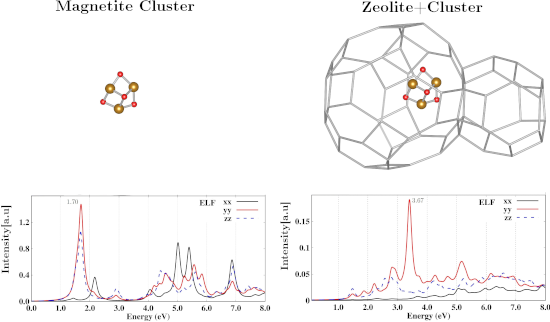
- ε2 and the ELF of the composite (as shown in Figure 7a), which indicates that, unfortunately, the primary peak occurs outside the visible range. However, considering that the current results highlight the modification of the cluster’s optical properties when introduced into the zeolite, there is




Precursor sticking coefficient determination from indented deposits fabricated by electron beam induced deposition
Beilstein J. Nanotechnol. 2025, 16, 35–43, doi:10.3762/bjnano.16.4

- region has two conditions: 1) The beam current has to be high enough to cause significant depletion and thus induce diffusion. Low irradiative depletion would shift the balance towards the RRL regime. 2) The precursor has to exhibit a certain degree of diffusivity in order to guarantee a noticeable mass
- certain conditions. The beam size has to be large enough for all mass transport to be consumed by the beam before it reaches the beam center area. To fulfill this condition in practice, the beam size and current have to be chosen such that a well-defined plateau shape is formed. This precaution is taken
- . Nevertheless, the cause could also be the presence of a process that influences precursor coverage but is not considered in the model. In this case, the difference is revealed by slightly different deposition conditions (current density). In particular, the model does not take into account the possibility of


Bioinspired nanofilament coatings for scale reduction on steel
Beilstein J. Nanotechnol. 2025, 16, 25–34, doi:10.3762/bjnano.16.3

- current of 300 pA, and a working distance of ≈10 mm and ≈7 mm in high-vacuum mode (pressure < 0.04 Pa). The SEM images were collected using an in-chamber Everhart−Thornley detector which identifies secondary electrons. Contact angle measurements The measurements were performed by the sessile drop method


Orientation-dependent photonic bandgaps in gold-dust weevil scales and their titania bioreplicates
Beilstein J. Nanotechnol. 2025, 16, 1–10, doi:10.3762/bjnano.16.1
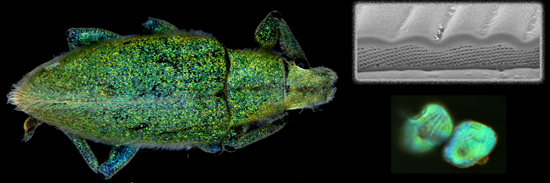
- Norma Salvadores Farran Limin Wang Primoz Pirih Bodo D. Wilts Department for Chemistry and Physics of Materials, University of Salzburg, Jakob-Haringer-Str. 2a, 5020 Salzburg, Austria Current address: Institute of Materials Science and Technology, Vienna Technical University, 1060 Vienna, Austria
- , Watford, UK). The settings were: sputter time 120 s, current 40 mA, and background pressure 0.08 mbar. Cross-sectional images of single scales were recorded using a focused ion beam scanning electron microscope (Scios2, Thermo Fisher Scientific, Waltham, MA, USA) using an Everhart–Thornley detector and an


Mechanistic insights into endosomal escape by sodium oleate-modified liposomes
Beilstein J. Nanotechnol. 2024, 15, 1667–1685, doi:10.3762/bjnano.15.131
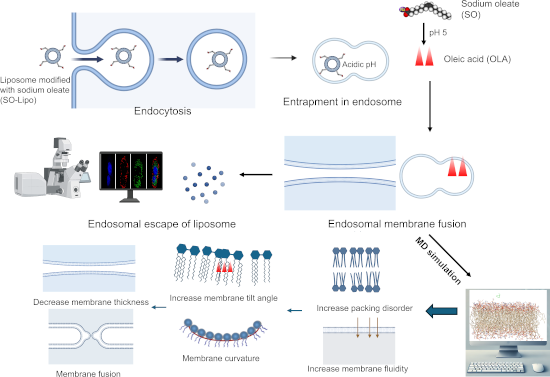
- limitations of current endosomal escape strategies, innovative approaches are urgently needed. Unraveling the mechanisms underpinning endosomal escape is pivotal for the development of novel, safe, and effective agents capable of overcoming these formidable barriers. Recent studies have highlighted the




Fabrication of hafnium-based nanoparticles and nanostructures using picosecond laser ablation
Beilstein J. Nanotechnol. 2024, 15, 1639–1653, doi:10.3762/bjnano.15.129
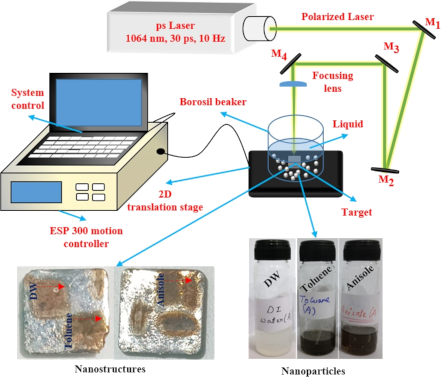
- and hexagonal phases were observed at higher input pulse energies. We believe these correspond to HfO2 and Hf6O, respectively. Further, in [10], we did not explore the formation of surface nanostructures on Hf after ablation. Therefore, the current study intends to understand the role of input pulse
- potential material for sophisticated design patterning [66]. Conclusion The current study shows the successful single-step fabrication of HfO2 NPs and nanofibres in DW and HfC core–shell NPs with multilayered graphitic shells in toluene and anisole via LAL of Hf metal. The obtained NPs exhibit a broad size




Heterogeneous reactions in a HFCVD reactor: simulation using a 2D model
Beilstein J. Nanotechnol. 2024, 15, 1627–1638, doi:10.3762/bjnano.15.128
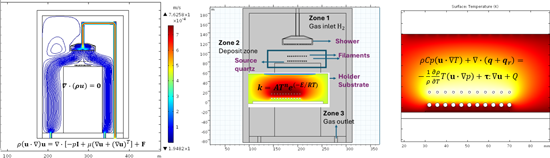
- , which are activated by an externally applied voltage generating a current; these filaments have a temperature of approximately 2300 K. The second zone includes the region where the chemical reactions takes place. Here, molecular hydrogen, exposed to the high temperature of the filaments, dissociates to


Biomimetic nanocarriers: integrating natural functions for advanced therapeutic applications
Beilstein J. Nanotechnol. 2024, 15, 1619–1626, doi:10.3762/bjnano.15.127

- employed in treating other diseases, such as Alzheimer's disease. Current medications for Alzheimer's face the challenge of the blood–brain barrier (BBB), which includes the blood–brain, cerebrospinal fluid–brain, and blood–cerebrospinal fluid barriers. These barriers exhibit high selectivity in drug





