Search results
Search for "electronic structure" in Full Text gives 249 result(s) in Beilstein Journal of Nanotechnology. Showing first 200.
Fluorination of vertically aligned carbon nanotubes: from CF4 plasma chemistry to surface functionalization
Beilstein J. Nanotechnol. 2017, 8, 1723–1733, doi:10.3762/bjnano.8.173
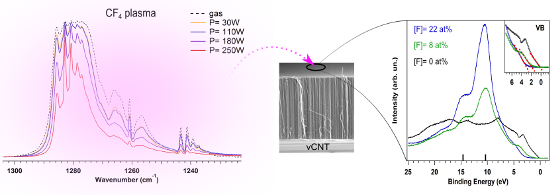
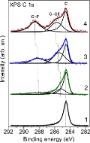
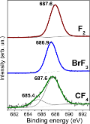
- higher binding energy values. The valence band spectra of highly fluorinated sample are conversely dominated by the high cross section of the F 2p valence states, whose contribution strongly attenuates the pristine electronic structure from the Fermi level up to 20 eV. In particular, we can assign the




Transport characteristics of a silicene nanoribbon on Ag(110)
Beilstein J. Nanotechnol. 2017, 8, 1699–1704, doi:10.3762/bjnano.8.170
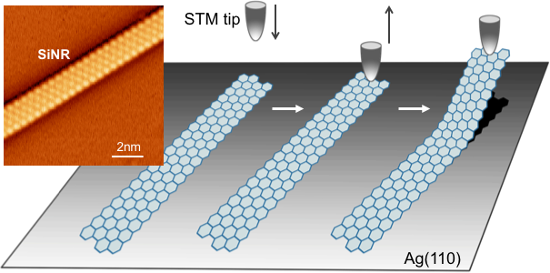
- preserves the electronic states localized at the edges near the Fermi level similar to the graphene nanoribbon with zigzag edges [29][30][31][32][33]. Although the electronic structure of SiNR has been studied experimentally [34][35][36], the existence of edge states remains an open question. The
- pentagonal chain models proposed very recently for SiNRs on Ag(110) [27][28]. Cerdá et al. [27] calculated the energy band structures of various pentagonal chains; some of the pentagonal chains host electronic structure around the Fermi level, which may explain the peak structure observed in our conductance
- investigated the geometric and electronic structure of SiNRs grown on Ag(110) using STM and STM junction measurements. We found that the dI/dV spectra of SiNRs on Ag(110) and the bare Ag(110) regions are essentially identical, indicating strong interfacial coupling between the SiNR and the Ag(110) substrate


Effect of the fluorination technique on the surface-fluorination patterning of double-walled carbon nanotubes
Beilstein J. Nanotechnol. 2017, 8, 1688–1698, doi:10.3762/bjnano.8.169
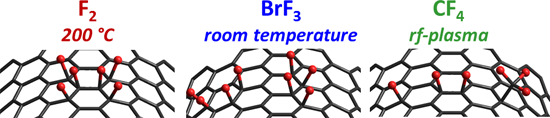
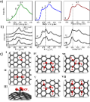
- fluorine addition on the DWCNT surface during a particular fluorination procedure, we carried out simulations of the NEXAFS spectra of the fluorinated samples. NEXAFS spectroscopy is widely used for probing the surface chemical functionalities and the electronic structure of CNTs and related nanomaterials



Oxidative stabilization of polyacrylonitrile nanofibers and carbon nanofibers containing graphene oxide (GO): a spectroscopic and electrochemical study
Beilstein J. Nanotechnol. 2017, 8, 1616–1628, doi:10.3762/bjnano.8.161
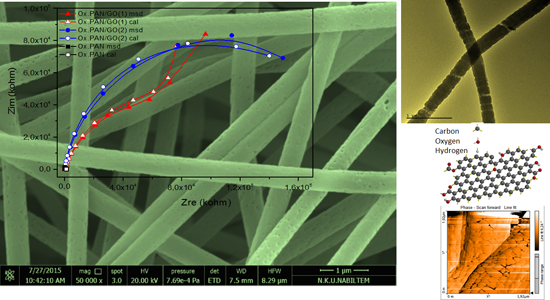
- ratio between D band and G band (R = ID/IG) indicates structurally ordered graphite crystallites [30][54]. The R value of CNF is around 0.9. A lower R value means a more crystalline material with higher conductivity [56]. Position and intensity of D and G band demonstrate the electronic structure and


Two-dimensional carbon-based nanocomposites for photocatalytic energy generation and environmental remediation applications
Beilstein J. Nanotechnol. 2017, 8, 1571–1600, doi:10.3762/bjnano.8.159
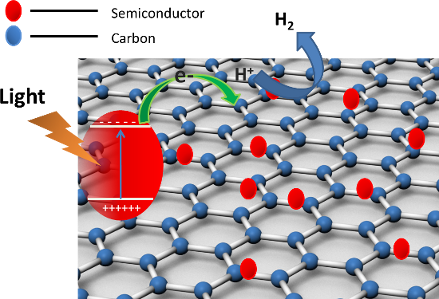
- Photocatalytic H2 production through solar water splitting has been widely explored as it has several advantages like easy and abundant availability of raw materials, tunable electronic structure and the fact that combustion of hydrogen in air produces water; hence, this method is ecologically-friendly [96


Parylene C as a versatile dielectric material for organic field-effect transistors
Beilstein J. Nanotechnol. 2017, 8, 1532–1545, doi:10.3762/bjnano.8.155
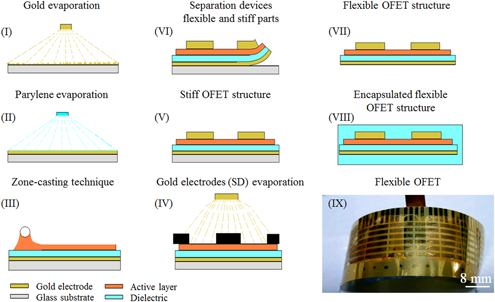
- of organic electronics. One of the early applications of Parylene C encapsulation layer in an electronic structure was that of a microelectrode insulator [65]. The Parylene C-covered iridium and tungsten microelectrodes were investigated by means of in vivo and in vitro impedance tests. In vitro


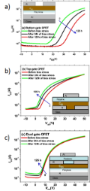


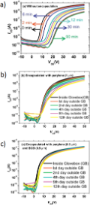
Adsorption and electronic properties of pentacene on thin dielectric decoupling layers
Beilstein J. Nanotechnol. 2017, 8, 1388–1395, doi:10.3762/bjnano.8.140
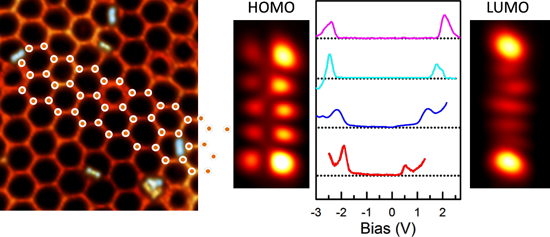
- without [5] a chemical reaction between the metal surface and the adsorbed molecule and thus to a hybridization of the molecule with the underlying electron bath of the metal surface. To access the intrinsic electronic structure of molecules using STM, it has been shown that it is in most cases mandatory


Two-dimensional silicon and carbon monochalcogenides with the structure of phosphorene
Beilstein J. Nanotechnol. 2017, 8, 1338–1344, doi:10.3762/bjnano.8.135
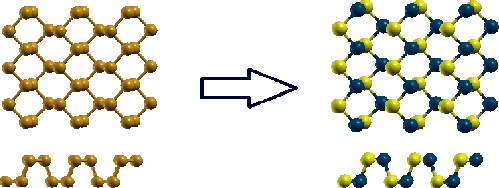
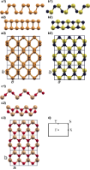
- carrier mobilities. The variety of electronic properties carried by these compounds have the potential to broaden the technological applicability of two-dimensional materials. Keywords: electronic structure; phosphorene; two-dimensional materials; Introduction Over the last ten years, the interest in
- electronic structure that are markedly different from those of graphene, with, for instance, the existence of a finite bandgap in the band structure [5]. One of the latest newcomers in the family of two-dimensional materials is phosphorene [6][7][8][9], which corresponds to a single layer of black phosphorus


Adsorption characteristics of Er3N@C80on W(110) and Au(111) studied via scanning tunneling microscopy and spectroscopy
Beilstein J. Nanotechnol. 2017, 8, 1127–1134, doi:10.3762/bjnano.8.114
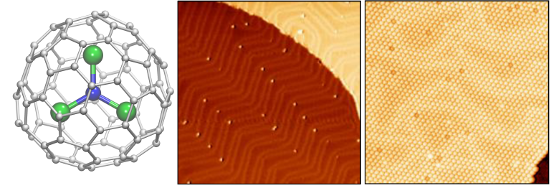
- herringbone reconstruction indicating that the molecule–substrate interaction is of considerable extent. Investigations concerning the electronic structure of Er3N@C80/Au(111) reveals spatial variations dependent on the termination of the Au(111) at the interface. Keywords: adsorption; Au(111); Er3N@C80
- knowledge about the molecules’ behavior in interaction with possible electrode surfaces. One aspect regards the formation of one respectively two dimensional and addressable arrays. Another important issue concerns the elucidation of the system’s electronic structure and adsorption site dependent effects on
- it. In order to examine the adsorption characteristics and the electronic structure of Er3N@C80 in consideration of adsorbate–substrate interaction, we performed scanning tunneling microscopy (STM) and scanning tunneling spectroscopy (STS) investigations on sub-monolayer covered W(110) and Au(111


Growth, structure and stability of sputter-deposited MoS2 thin films
Beilstein J. Nanotechnol. 2017, 8, 1115–1126, doi:10.3762/bjnano.8.113
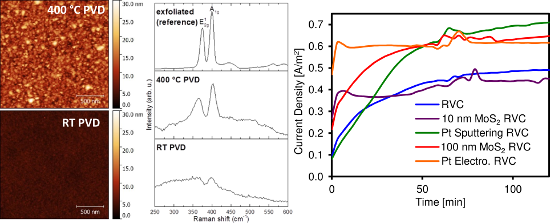
- synthesized through reduction and microwave heating [18]. The expanded interlayer distance with modified electronic structure is also responsible for the observed catalytic improvement, which suggests a potential way to design newly advanced molybdenum disulfide catalysts through modulating the interlayer
- work for instance reported significant oxygen and carbon incorporation during typical PVD conditions, where substitutional doping of MoS2 with oxygen recently was shown to drastically alter its electronic structure [37][38][50]. Also key effects of, e.g., Nb or Na contamination on electronic properties
- partly linked with add-atom incorporation or intercalation, also local variations in the structure of MoS2 layers could affect conduction: An expanded interlayer distance of 9.4 Å from molecular intercalation was previously shown to modify the electronic structure of layered MoS2 and to improve catalytic


Stable Au–C bonds to the substrate for fullerene-based nanostructures
Beilstein J. Nanotechnol. 2017, 8, 1073–1079, doi:10.3762/bjnano.8.109
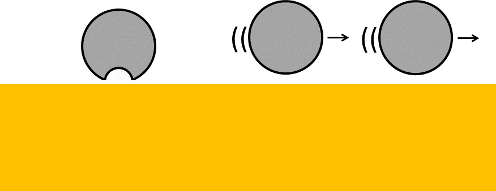
- electronic-structure calculations based on DFT, focusing on fullerene molecules with vacancy defects where the missing C atoms result in increased reactivity and stronger binding with the substrate. We consider C59 molecules, resulting from the removal of a single C atom. While high-energy collisions can
- energies of these two structures is (in the absence of van der Waals forces) close to zero. This indicates that changes in the electronic structure arising from the vacancy when it is oriented towards vacuum do not significantly affect the metal–molecule contact. In contrast to the value of the defect-down


Energy-level alignment at interfaces between manganese phthalocyanine and C60
Beilstein J. Nanotechnol. 2017, 8, 927–932, doi:10.3762/bjnano.8.94
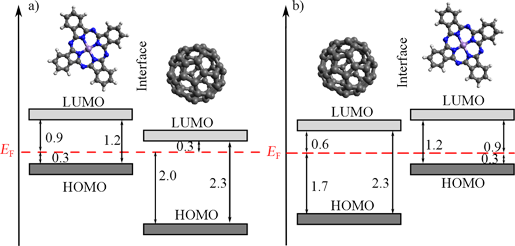
- on C60 and vice versa. After each MnPc or C60 deposition step C1s, N1s, Mn2p and Au4f core-level and valence-band photoelectron spectra were measured in order to follow changes of the electronic structure and to determine the energy level alignment at the interfaces. Results and Discussion In Figure


Synthesis of coaxial nanotubes of polyaniline and poly(hydroxyethyl methacrylate) by oxidative/initiated chemical vapor deposition
Beilstein J. Nanotechnol. 2017, 8, 872–882, doi:10.3762/bjnano.8.89
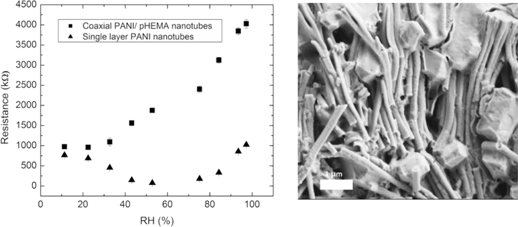
- coaxial nanotubes. As stated earlier, pHEMA is sensitive to humidity and swells or shrinks in response to the water level in the ambient. As humidity increases, pHEMA swells which results in an increased distance between each polymer chain, affecting the electronic structure of the nanotubes. The swelling


Investigation of growth dynamics of carbon nanotubes
Beilstein J. Nanotechnol. 2017, 8, 826–856, doi:10.3762/bjnano.8.85
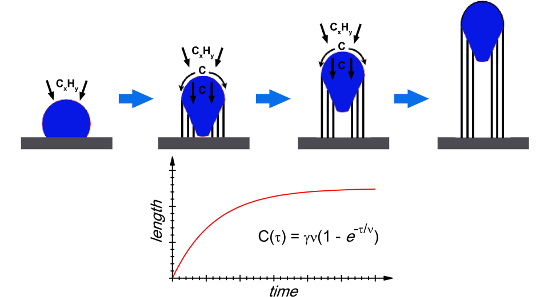
- ] possess extraordinary physical, chemical and mechanical properties [3]. They are unique nanoscale objects, because their electronic structure (metallic or semiconducting) is solely dependent on the atomic structure [3][4]. Since the discovery of SWCNTs, attempts of many researchers have been aimed at


3D Nanoprinting via laser-assisted electron beam induced deposition: growth kinetics, enhanced purity, and electrical resistivity
Beilstein J. Nanotechnol. 2017, 8, 801–812, doi:10.3762/bjnano.8.83
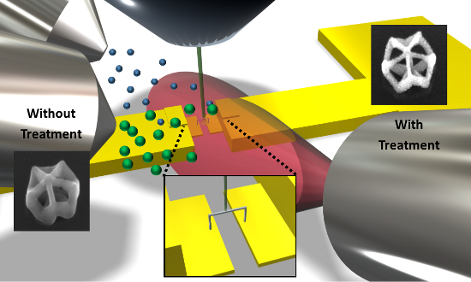
- the deposited pillar. The carbon K-edge provides information on the electronic structure of carbon and analysis of characteristic features contained within the energy loss near edge structure (ELNES) indicates whether carbon is amorphous, graphitic or diamond. Figure 3e shows the corresponding


First examples of organosilica-based ionogels: synthesis and electrochemical behavior
Beilstein J. Nanotechnol. 2017, 8, 736–751, doi:10.3762/bjnano.8.77
- molecular dynamics (AIMD) simulations in which the forces are calculated from the electronic structure on the fly were carried out as described previously [41] using the cp2k program packages [42]. AIMD simulation was started from a classical molecular dynamics simulation snapshot of 32 ion pairs of








Gas sensing properties of MWCNT layers electrochemically decorated with Au and Pd nanoparticles
Beilstein J. Nanotechnol. 2017, 8, 592–603, doi:10.3762/bjnano.8.64
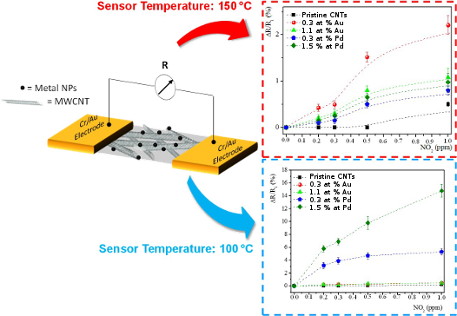
- accelerate the surface reaction and the electron exchange between analyte and CNTs. Moreover, small gas molecules can strongly bond to transition metals thanks to their electronic structure and empty orbitals [17]. Therefore, CNTs decorated with metal NPs can improve the electrical properties and sensitivity


Graphene functionalised by laser-ablated V2O5 for a highly sensitive NH3 sensor
Beilstein J. Nanotechnol. 2017, 8, 571–578, doi:10.3762/bjnano.8.61
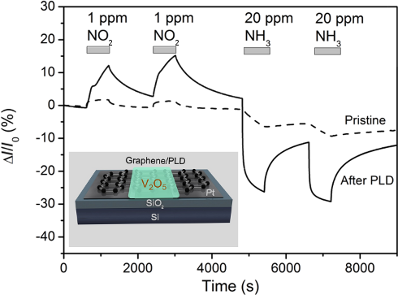
- increased charge transfer and formation of chemical bonds between the dopant and adsorbate [6][32]. Moreover, changes in the electronic structure induced by adsorption of molecules are likely to modulate the conductivity of graphene [32]. According to the Raman analysis shown in Figure 1, the PLD process


Impact of air exposure and annealing on the chemical and electronic properties of the surface of SnO2 nanolayers deposited by rheotaxial growth and vacuum oxidation
Beilstein J. Nanotechnol. 2017, 8, 514–521, doi:10.3762/bjnano.8.55
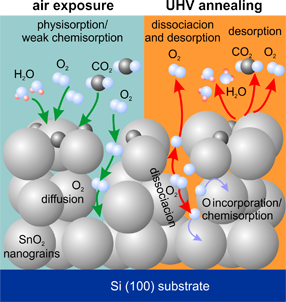
- detected and may cause an alteration in local subsurface electronic structure of the material. This is why there is natural tendency to search completely new or to modify recently developed technological methods. The preparation of novel SnO2 thin films with properties tuned to a particular application
- . This water splitting was theoretically predicted by Xu at al. [29] to have an impact on both the chemical and electronic structure of the examined films. (This is to be discussed below). Of course one can state that the irreversibility of contamination is only a matter of annealing temperature but we
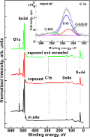
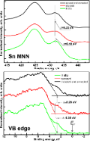
- UHV annealing (outgassing) for verification of their behavior under real working conditions of a semiconductor-based device. Further, the reversibility of the exposure effects is carefully analyzed. The impact of the exposure is being scrutinized on the basis of the changes in the chemical/electronic



Tailoring bifunctional hybrid organic–inorganic nanoadsorbents by the choice of functional layer composition probed by adsorption of Cu2+ ions
Beilstein J. Nanotechnol. 2017, 8, 334–347, doi:10.3762/bjnano.8.36
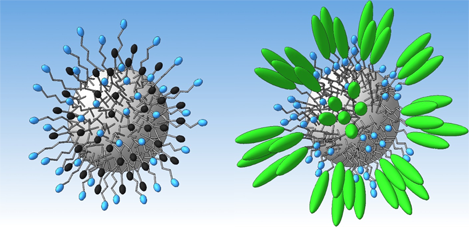
- the presence of different functional groups, arranged either as a “random forest” in the samples bearing methyl group, or as islands with distinctly different properties and structures. Therefore, such a surface is predisposed for specific adsorption interactions with molecules of different electronic
- structure and especially different polarity. The molecules of n-hexane are capable of adsorption interactions due to dispersion forces, whereas interaction of acetonitrile with the surface is dominated by the basic properties of the nitrogen atom. Obviously, acetonitrile (as well as n-hexane) interacts with


Selective photodissociation of tailored molecular tags as a tool for quantum optics
Beilstein J. Nanotechnol. 2017, 8, 325–333, doi:10.3762/bjnano.8.35
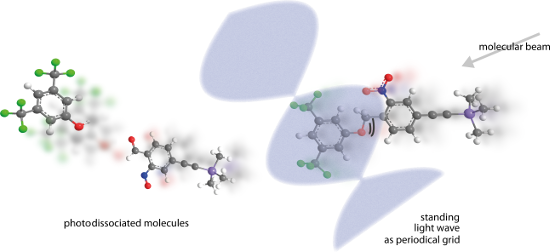
- ; photodissociation; synthetic photo-tags; Introduction Chemistry builds on the fact that the electronic structure, dynamics and properties of molecules are determined or influenced by quantum effects. However, it has only recently been experimentally verified that also the translational motion of an entire complex


Tunable plasmons in regular planar arrays of graphene nanoribbons with armchair and zigzag-shaped edges
Beilstein J. Nanotechnol. 2017, 8, 172–182, doi:10.3762/bjnano.8.18
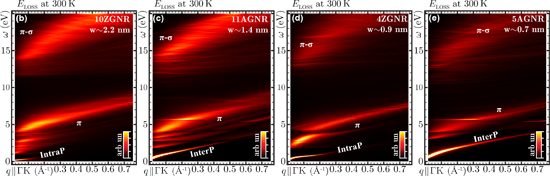
- incident momentum q below 0.8 Å−1. For comparison purposes, the well-known intrinsic plasmonics of graphene are also reported. In the following, we briefly account for the theoretical tools that we have used to explore the electronic structure and dielectric properties of 5AGNR, 11AGNR and 4ZGNR, 10ZGNR
- Figure 1). The converged electron densities are subsequently used to compute the Kohn–Sham (KS) electronic structure on a denser MP-mesh of 180 × 1 × 1 k-points, including up to 120 bands, which is enough to explore the dielectric properties of the GNRs at probing energies below ≈20 eV. The IR to THz


![[Graphic 8]](/bjnano/content/inline/2190-4286-8-18-i16.png?max-width=637&scale=1.18182) , Equation 6) and EL function (ELOSS, Equation 8) at room temperature for the GNR arrays of Figure 1 ...
, Equation 6) and EL function (ELOSS, Equation 8) at room temperature for the GNR arrays of Figure 1 ...


Nitrogen-doped twisted graphene grown on copper by atmospheric pressure CVD from a decane precursor
Beilstein J. Nanotechnol. 2017, 8, 145–158, doi:10.3762/bjnano.8.15
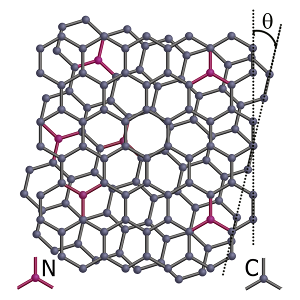
- be an ideal platform for the realization of the high-temperature zero-field quantum valley Hall effect [7]. From a practical point of view, the band gap opening in the electronic structure of graphene is quite attractive. It is expected that this will result in a new approach for application of
- feature of the TG electronic structure is presence of the vHs. In Raman spectroscopy, the presence of the vHs yields the G-resonance [48]. It consists of a more than one order of magnitude enhancement of the G-band intensity when the excitation energy fits the vHs energy difference. Indeed, the domains


Nanocrystalline TiO2/SnO2 heterostructures for gas sensing
Beilstein J. Nanotechnol. 2017, 8, 108–122, doi:10.3762/bjnano.8.12
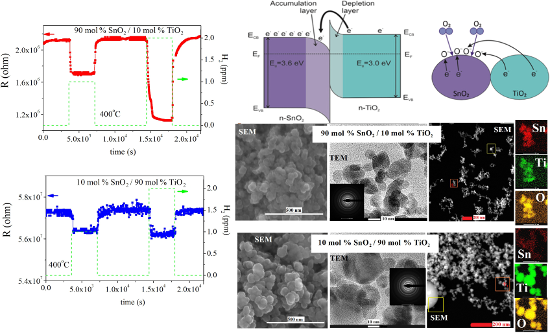
- ) while changes of the morphological and the electronic structure dominate in the case of B) and D). Surface phenomena determine the gas-sensor response in the case of decorated nano-heterostructures, D). As shown in [6], electron transfer over n–n-type heterojunctions can account for sensor sensitization




Zigzag phosphorene nanoribbons: one-dimensional resonant channels in two-dimensional atomic crystals
Beilstein J. Nanotechnol. 2016, 7, 1983–1990, doi:10.3762/bjnano.7.189

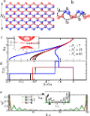
- infinite zigzag edged phosphorene nanoribbon of width NZ = 8, which is the number of zigzag chains along the ribbon. The tight-binding hopping parameters considered, as discussed below, are indicated in Figure 1b. The quite complex electronic structure of phosphorene, already at energy ranges rather close
- to the Fermi energy, hinders a wider use of single-orbital tight-binding models in chasing the alluded electronic and transport properties of systems based on this new material. Nevertheless, the use of such model is well validated, by means of comparisons with first-principle electronic structure