Search results
Search for "gold Nanoparticles" in Full Text gives 248 result(s) in Beilstein Journal of Nanotechnology. Showing first 200.
Self-assembled quasi-hexagonal arrays of gold nanoparticles with small gaps for surface-enhanced Raman spectroscopy
Beilstein J. Nanotechnol. 2018, 9, 1977–1985, doi:10.3762/bjnano.9.188
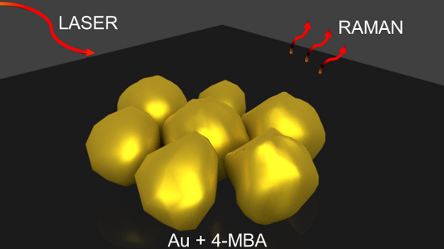
- University of Tübingen, Auf der Morgenstelle 15, 72076 Tübingen, Germany 10.3762/bjnano.9.188 Abstract The fabrication and optical characterization of self-assembled arrangements of rough gold nanoparticles with a high area coverage and narrow gaps for surface-enhanced Raman spectroscopy (SERS) are reported
- . A combination of micellar nanolithography and electroless deposition (ED) enables the tuning of the spacing and size of the noble metal nanoparticles. Long-range ordered quasi-hexagonal arrays of gold nanoparticles on silicon substrates with a variation of the particle sizes from about 20 nm to 120
- near-field-enhanced bio-analytics of molecules. SERS was demonstrated by measuring Raman spectra of 4-MBA on the gold nanoparticles. It was verified that a smaller inter-particle distance leads to an increased SERS signal. Keywords: block copolymer; electroless deposition; gold nanoparticles; micelle



Friction force microscopy of tribochemistry and interfacial ageing for the SiOx/Si/Au system
Beilstein J. Nanotechnol. 2018, 9, 1647–1658, doi:10.3762/bjnano.9.157
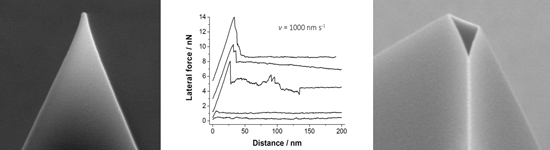
- slide–hold–slide experiments on the time scale of seconds, similar to the development of grain boundaries in the fusion of gold nanoparticles [16]. In our experiments, the holding time before sliding was varied between 252 μs (v = 3.1 μm·s−1) and 100 s. As our system was drifting by only one atomic




Surface-plasmon-enhanced ultraviolet emission of Au-decorated ZnO structures for gas sensing and photocatalytic devices
Beilstein J. Nanotechnol. 2018, 9, 771–779, doi:10.3762/bjnano.9.70
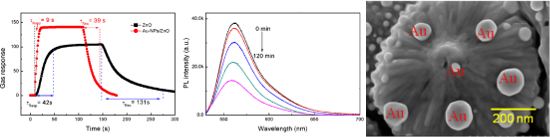
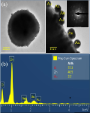
- response/recovery times. The various origins of these properties are commonly assigned to the following two phenomena: (i) a surface plasmon resonance (SPR) effect of plasmonic gold nanoparticles (Au NPs) could certainly take place and contribute to the electrical transport behavior for Au-decorated ZnO
- -micrometer ZnO spheres on the glass substrates were washed several times with deionized water, ethanol and dried at 80 °C. For incorporation of gold nanoparticles, a 0.025 mM aqueous solution of HAuCl4 was used. The ZnO films were immersed into this precursor solution. The reaction mixture was constantly




Dynamic behavior of nematic liquid crystal mixtures with quantum dots in electric fields
Beilstein J. Nanotechnol. 2018, 9, 399–406, doi:10.3762/bjnano.9.39

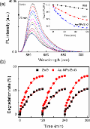
- well as science and engineering, requires improved technologies and new materials. Materials science provides great opportunities to these technologies by synthesizing new nanoparticles that can be mixed with liquid crystals: carbon nanotubes [1][2][3], graphene, magnetic nanoparticles [4][5], gold
- nanoparticles [6], quantum dots (QDs) [7][8][9][10][11][12] or other nanomaterials [13][14][15][16][17] that can be effectively used in electro-optical devices. When added to liquid crystals, quantum dots may seriously influence their behavior under an electric field due to the anchoring forces acting on the


Thermo- and electro-optical properties of photonic liquid crystal fibers doped with gold nanoparticles
Beilstein J. Nanotechnol. 2017, 8, 2790–2801, doi:10.3762/bjnano.8.278
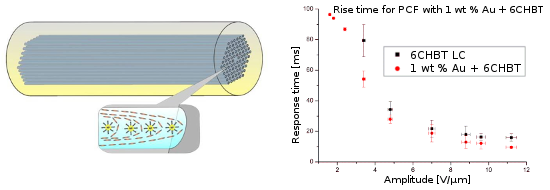
- , Warsaw, Poland 10.3762/bjnano.8.278 Abstract Thermo- and electro-optical properties of a photonic liquid crystal fiber (PLCF) enhanced by the use of dopants have been investigated. A 6CHBT nematic liquid crystal was doped with four different concentrations of gold nanoparticles (NPs), 0.1, 0.3, 0.5 and


The role of ligands in coinage-metal nanoparticles for electronics
Beilstein J. Nanotechnol. 2017, 8, 2625–2639, doi:10.3762/bjnano.8.263
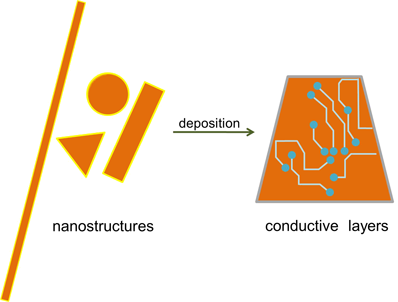
- , requires temperatures that depend on the particle size and binding strength of the ligand [44]. For example, short alkanethiols allowed for the sintering of gold nanoparticles (Au NPs) at temperatures smaller than 150 °C [45], far below the typical gold sintering temperatures of 200–350 °C [35][36]. It is
- thiolates increased when decreasing the number of saturated units [58]. A different study found that π–π-stacking of phenyl groups in films of phenylethylthiolate-stabilized gold nanoparticles determined the interparticle separation and regulated charge transfer. The short ligand chain and the aromatic
- particles and the aliphatic chains stabilize the particles sterically; steric repulsion was strong enough only for chains above twelve carbon atoms to prevent rapid coalescence of the nanoparticles [28]. Karg et al. prepared gold nanoparticles in aqueous solutions and transferred them to chloroform and


Laser-assisted fabrication of gold nanoparticle-composed structures embedded in borosilicate glass
Beilstein J. Nanotechnol. 2017, 8, 2454–2463, doi:10.3762/bjnano.8.244
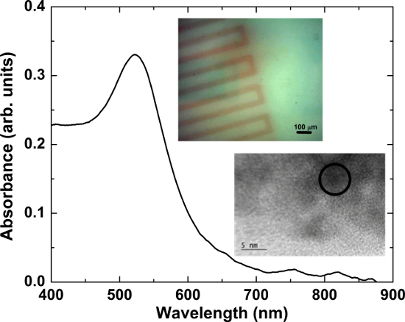
- -dimensional structures comprised of gold nanoparticles in glass. The sample material was gold-ion-doped borosilicate glass prepared by conventional melt quenching. The nanoparticle growth technique consisted of two steps – laser-induced defect formation and annealing. The first step was realized by
- , the color of the irradiated areas changed to pink, with a corresponding well-defined peak in the absorbance spectrum. We relate this effect to the formation of gold nanoparticles with optical properties defined by plasmon excitation. Their presence was confirmed by high-resolution TEM analysis. No
- glass sample. This technique can be used for the preparation of 3D nanoparticle systems embedded in transparent materials with potential applications in the design of new optical components, such as metamaterials and in plasmonics. Keywords: 2D and 3D nanoparticle fabrication; gold nanoparticles in


Increasing the stability of DNA nanostructure templates by atomic layer deposition of Al2O3 and its application in imprinting lithography
Beilstein J. Nanotechnol. 2017, 8, 2363–2375, doi:10.3762/bjnano.8.236
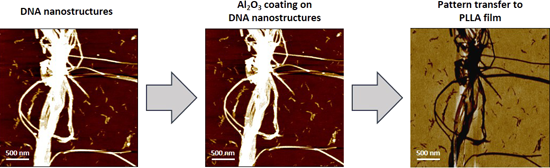
- Al2O3 onto the nanostructures followed by thermal annealing [36]. In addition to the 2D pattern transfer processes, gold nanoparticles with specified 3D shapes were synthesized by growing seed particles in the internal cavities of 3D DNA nanostructures [37][38]. Compared to the above developments, there




Fabrication of gold-coated PDMS surfaces with arrayed triangular micro/nanopyramids for use as SERS substrates
Beilstein J. Nanotechnol. 2017, 8, 2271–2282, doi:10.3762/bjnano.8.227
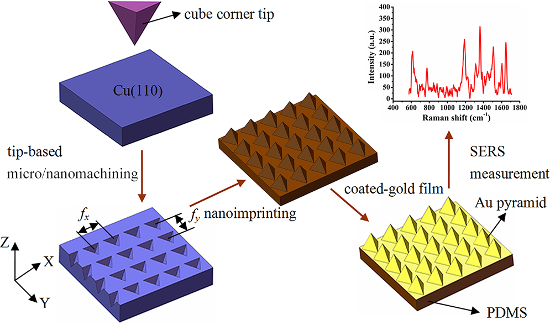
- intensity of probe molecules can be enhanced by employing a thinner gold film. Figure 10 shows AFM images of PDMS substrates coated 10 and 50 nm thick gold films. Compared to the gold film thickness of 50 nm, more gold nanoparticles are generated on the PDMS surface with a gold film thickness of 10 nm, as
- addition, the local EM field can be enhanced further by reducing the gap between adjacent nanoparticles and the largest enhancement was observed with a dense surface of nanoparticles. Figure 11 shows an AFM image of the commercial Q-SERS substrate (gold nanoparticles coated on a 5 × 5 mm2 silicon wafer
- glass. A further advantage is that laser light can pass through the polymer substrate and reach the nanoparticle layer to activate the plasmon resonance, which generates the enormous SERS enhancement. A SERS substrate with good transparency and flexibility was prepared as a self-assembly of gold





Synthesis and characterization of noble metal–titania core–shell nanostructures with tunable shell thickness
Beilstein J. Nanotechnol. 2017, 8, 2083–2093, doi:10.3762/bjnano.8.208
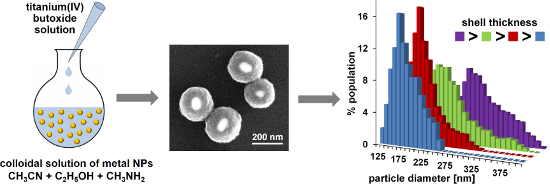
- approximately 5 min the color suddenly changed into red, indicating the formation of spherical gold nanoparticles. After cooling down to room temperature the reaction mixture was centrifuged and 3 mL of concentrated colloidal gold solution were collected from the bottom of the tube. Silver colloids 90 mL of


Preparation and characterization of polycarbonate/multiwalled carbon nanotube nanocomposites
Beilstein J. Nanotechnol. 2017, 8, 2026–2031, doi:10.3762/bjnano.8.203
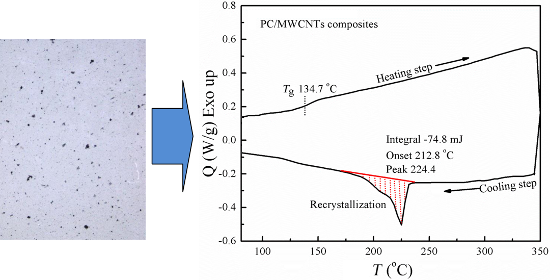
- serious thermal stability issues at the hot embossing temperature of PC. It has been suggested that the addition of MWCNTs can significantly change the mechanical properties of PC, as well as affect the crystallization behavior [5]. In former work, the effect of adding gold nanoparticles on the optical


Optical techniques for cervical neoplasia detection
Beilstein J. Nanotechnol. 2017, 8, 1844–1862, doi:10.3762/bjnano.8.186

- discriminate between HSIL and LSIL/normal tissues at various imaging depths was confirmed [80][81]. Nanotheranostics The rapid progress of nanotechnology had an important impact on cancer management research. The variety of new nanoscale platforms (gold nanoparticles, quantum dots, nanocages, carbon nanotubes
- unique molecular tumor marker [88]. The contrast agents consisting of a targeting agent conjugated with optically active labels (metal nanoparticles, quantum dots) can be used for in vivo imaging of this biomarker. Sokolov et al [89] reported the use of gold nanoparticles for the molecular targeted
- imaging of the specific biomarker of cervical cancer. The bioconjugates of gold nanoparticles (approximately 12 nm in diameter) with antibodies against EGFR have been used to increase the contrast during in vitro confocal reflectance and confocal fluorescence imaging of normal and abnormal cervical cells



Methionine-mediated synthesis of magnetic nanoparticles and functionalization with gold quantum dots for theranostic applications
Beilstein J. Nanotechnol. 2017, 8, 1734–1741, doi:10.3762/bjnano.8.174
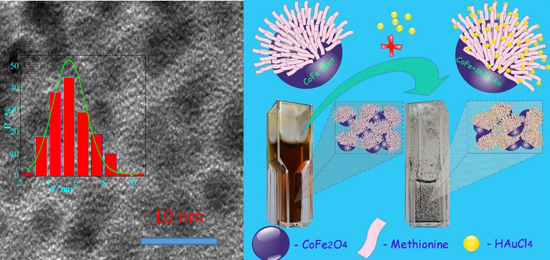
- ) was used to take three-dimensional (3D) images of gold nanoparticles. TESPA-V2 cantilevers (Veeco Instruments Inc., USA) with a tip curvature of 8 nm were used. Measurements were performed in the tapping mode in air. Images were acquired at the scan rate of 1 Hz per line with the 512 × 512 pixel image


Near-infrared-responsive, superparamagnetic Au@Co nanochains
Beilstein J. Nanotechnol. 2017, 8, 1680–1687, doi:10.3762/bjnano.8.168
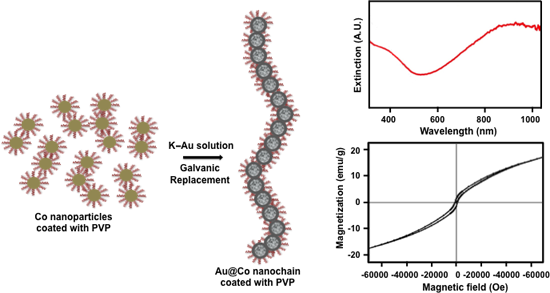
- of K–gold solution, a plasmon resonance appeared as a strong peak at ca. 900 nm; importantly, the nanochains possess no extinction bands characteristic of either bare gold nanoparticles or pure gold nanochains [68][69][70]. As mentioned above, Au-coated hollow nanospheres using Co nanoparticles as a


Nanostructures for sensors, electronics, energy and environment III
Beilstein J. Nanotechnol. 2017, 8, 1530–1531, doi:10.3762/bjnano.8.154

- interaction between light and plasma electrons generated by gold nanoparticles is critical for the development of biosensing platforms [2] and for sensors based on surface enhanced Raman scattering [3]. New methods for creating thin films are expected to provide enhanced efficiency in solar cells [4] at a
Fixation mechanisms of nanoparticles on substrates by electron beam irradiation
Beilstein J. Nanotechnol. 2017, 8, 1523–1529, doi:10.3762/bjnano.8.153
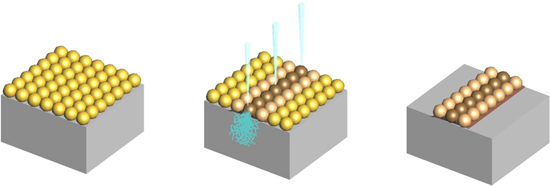
- , and several steps of chemical treatments. Noriki et al. [8] combined electron beam irradiation with a chemical reaction to pattern gold nanoparticles onto substrates. This technique consists of three steps: Firstly, gold nanoparticles are placed over the entire surface of a substrate. Secondly, the
- gold nanoparticles are fixed on the substrate by electron beam irradiation. Finally, the unfixed nanoparticles are removed. In the second step, the organic molecules (e.g. citrate) surrounding the nanoparticles are decomposed to amorphous carbon, and this amorphous carbon existing in the gap between
- the particle and the substrate fixes the particles. However, in this original technique, the area of fixed gold nanoparticles was wider than the electron-probe size of a few nanometers [8]. To understand the mechanisms of this widening, the effects of accelerating voltage, particle size and substrate


Bright fluorescent silica-nanoparticle probes for high-resolution STED and confocal microscopy
Beilstein J. Nanotechnol. 2017, 8, 1283–1296, doi:10.3762/bjnano.8.130
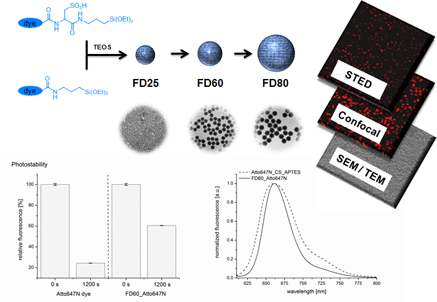
- ]. All in all, STED microscopy requires fluorescently labelled markers with high photostability to identify relevant interactions between nanoparticles and cellular structures. In the last years different types of markers have been used for fluorescence-based microscopy, such as modified inorganic gold
- nanoparticles [24][25], silica nanoparticles [26] or quantum dots [27][28]. These fluorescent nanoparticles fulfil some of the specific requirements and overcome disadvantages of common organic fluorescent dyes [29]. Especially silica nanoparticles have proven useful, since silicon chemistry provides a


Functional dependence of resonant harmonics on nanomechanical parameters in dynamic mode atomic force microscopy
Beilstein J. Nanotechnol. 2017, 8, 883–891, doi:10.3762/bjnano.8.90
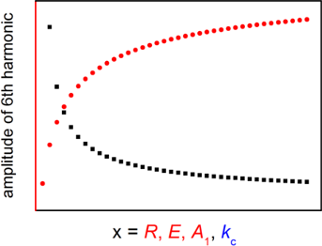
- a function of R obtained from commercial gold nanoparticles (5.5 ± 0.7 nm diameters) dispersed on a thin poly-lysine film grown on mica. From the figure we can observe the increase of A6 for increasing R values. Dependence of the amplitude of the 6th harmonic on bulk modulus Figure 6 shows the
- Information File 86: Simulated evolution of the phase of the 6th harmonic as a function of tip radius. Correlation between the amplitude of the 6th harmonic and the tip radius obtained from gold nanoparticles dispersed on mica. Simulated evolution of the amplitude of the 6th harmonic as a function of the z


Selective detection of Mg2+ ions via enhanced fluorescence emission using Au–DNA nanocomposites
Beilstein J. Nanotechnol. 2017, 8, 762–771, doi:10.3762/bjnano.8.79
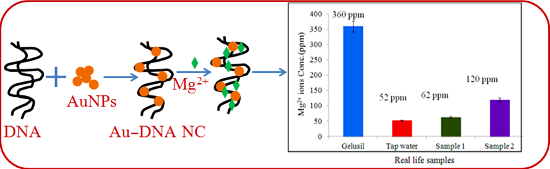
- with the data obtained from literature, they show the change in position of the AuNSs and AuNRs [32]. Figure 5 clearly shows the even distribution of gold nanoparticles in the solution. The AFM images in Figure 5a show the distribution of AuNSs on the silicon wafer which indicates the proper dispersion
- phosphate buffer) was added to the above solution and again incubated at room temperature for 1 h to cleave the disulfide bonds formed by the oligonucleotides upon addition of MPA. DNA functionalized gold nanoparticles were then washed twice by centrifugation (13,000 rpm, 15 min) to remove all unbound




Comparison of four methods for the biofunctionalization of gold nanorods by the introduction of sulfhydryl groups to antibodies
Beilstein J. Nanotechnol. 2017, 8, 372–380, doi:10.3762/bjnano.8.39
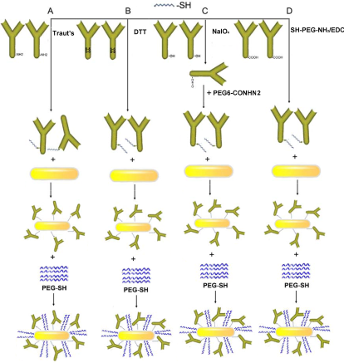
- modified GNRs through an EDC/NHS coupling reaction [15][16]. Nevertheless, this ligand exchange method easily causes aggregation of GNRs because the amino and carboxyl groups of biomolecules can cross-link well with gold nanoparticles. Thus, an effective method should be developed to functionalize GNRs for
- ]. Apart from Traut’s reagent, several different methods, such as DTT reduction, can be applied to anchor thiol groups into antibodies. DTT can partially reduce the disulfide bonds of the IgG antibody in the hinge region, and the resulting thiol groups can bind biomolecules to gold nanoparticles. Therefore
- dithiolaromatic PEG6-CONHNH2 by specifically reacting with the carbohydrate moiety in the Fc portion of the antibody can direct the conjugating orientation. The compound has a hydrazide and dithiol group at opposite ends, which react with aldylated antibodies by NaIO4 modification and gold nanoparticles via Au–S


Comparison of four functionalization methods of gold nanoparticles for enhancing the enzyme-linked immunosorbent assay (ELISA)
Beilstein J. Nanotechnol. 2017, 8, 244–253, doi:10.3762/bjnano.8.27
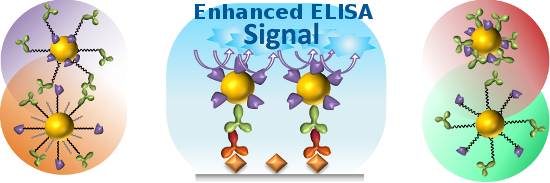
- functionalization for ELISA enhancement. In this work, we use 20 nm gold nanoparticles (AuNPs) as a vehicle for secondary antibodies and peroxidase (HRP). The design of experiments technique (DOE) and four different methods for biomolecule loading were compared using a rabbit IgG/goat anti-rabbit IgG ELISA model
- protein by functionalized multiwalled carbon nanotubes was observed by Zhang et al. [7]. However, the most significant improvements in signal have been rendered by gold nanoparticles (AuNPs), presenting promising unique chemical and physical properties, as well as biological compatibility [5][14][15


Microfluidic setup for on-line SERS monitoring using laser induced nanoparticle spots as SERS active substrate
Beilstein J. Nanotechnol. 2017, 8, 237–243, doi:10.3762/bjnano.8.26
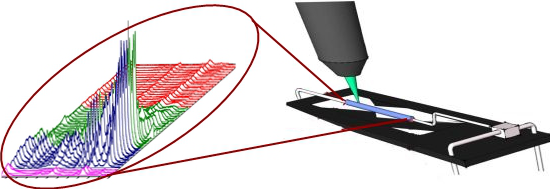
- of residues of malachite green (MG) using surface-enhanced Raman scattering (SERS) is reported. The SERS active substrate was prepared via laser induced synthesis of silver or gold nanoparticles spot on the bottom of a 200 μm inner dimension glass capillary, by focusing the laser beam during a
- substrate. Keywords: gold nanoparticles; malachite green; microfluidic setup; SERS; silver nanoparticles; Introduction Over the past decade special attention has been given to the investigation of hazardous environmental chemicals with impact on human health [1][2][3][4]. Surface-enhanced Raman scattering
- efficacy and residues of MG in farmed fish from several countries were reported [22][23]. Results and Discussion The SERS detection approach consisted in two sequential processes, both performed in situ: the synthesis of the SERS active spot, formed by silver or gold nanoparticles, followed by SERS


Influence of hydrofluoric acid treatment on electroless deposition of Au clusters
Beilstein J. Nanotechnol. 2017, 8, 183–189, doi:10.3762/bjnano.8.19
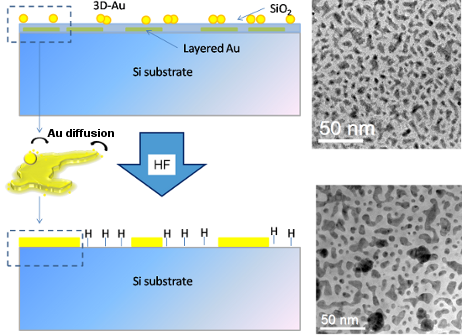
- Astronomy, v. S. Sofia 64, I-95123, Catania, Italy 10.3762/bjnano.8.19 Abstract The morphology of gold nanoparticles (AuNPs) deposited on a (100) silicon wafer by simple immersion in a solution containing a metal salt and hydrofluoric acid (HF) is altered by HF treatment both before and after deposition
- nanoparticle arrays and to improve the conversion efficiency of hybrid photovoltaic devices. Keywords: electroless deposition; galvanic deposition; gold nanoparticles; HF acid treatment; HF-propelled motion; hydrogen termination; silicon surfaces; Introduction Gold nanoparticles on silicon substrates have
- gold nanoparticles depends on their geometry and it is higher for well-shaped spherical particles than for flat islands [22]. Generally, an additional postdeposition annealing step is usually required to improve the spectral response. In our previous study on the GD of Au+ ions onto silicon substrates


Streptavidin-coated gold nanoparticles: critical role of oligonucleotides on stability and fractal aggregation
Beilstein J. Nanotechnol. 2017, 8, 1–11, doi:10.3762/bjnano.8.1
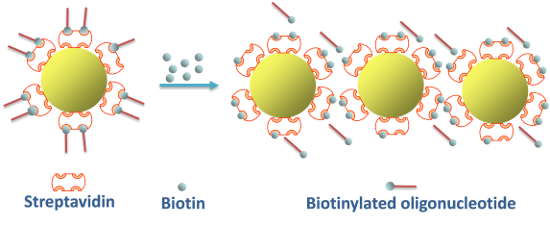
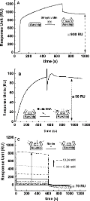
- Andrea Doria 6, I-95125, Catania, Italy 10.3762/bjnano.8.1 Abstract Gold nanoparticles (AuNPs) exhibit unique properties that can be modulated through a tailored surface functionalization, enabling their targeted use in biochemical sensing and medical diagnostics. In particular, streptavidin-modified
- thorough understanding of the fundamental properties of bioconjugated AuNPs is of great importance for the design of highly sensitive and reliable functionalized AuNP-based assays. Keywords: biosensors; DNA; gold nanoparticles; nanoparticles aggregation; plasmonics; streptavidin; Introduction Gold
- colloids have been the focus of research for many decades because of their intriguing electronic and optical properties, depending on the size and shape of gold nanoparticles (AuNPs) [1], which support several biomedical and pharmaceutical applications [2]. The functionalization of AuNPs with biologically




Solvent-mediated conductance increase of dodecanethiol-stabilized gold nanoparticle monolayers
Beilstein J. Nanotechnol. 2016, 7, 2057–2064, doi:10.3762/bjnano.7.196
- networks; Self-assembly; Introduction Ordered gold nanoparticle monolayers are increasingly applied as templates for molecular resistor networks [1][2][3][4][5][6][7][8]. Gold nanoparticles serve as conducting nodes and different molecules can bind to the gold nanoparticle using anchoring groups such as
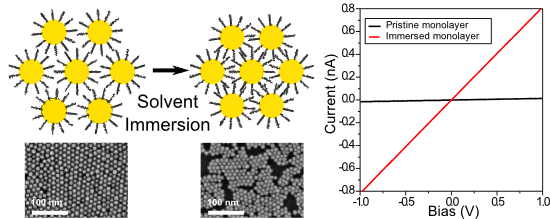
- further depends on the percolation of charge carriers [11][12]. Initially, gold nanoparticles are typically stabilized by alkanethiol ligands, which are poor conductors. As reported, the conductivity of nanoparticle networks can be increased by immersing the substrate with the nanoparticle monolayer in a
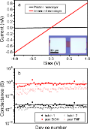
- alone can induce a structural transition responsible for a large portion of the observed increase in conductivity of micro-contact printed self-assembled gold nanoparticle monolayers. Results and Discussion Gold nanoparticles with an average diameter of 10.6 nm measured by small-angle X-ray scattering