Search results
Search for "highly sensitive" in Full Text gives 169 result(s) in Beilstein Journal of Nanotechnology.
Highly compact refractive index sensor based on stripe waveguides for lab-on-a-chip sensing applications
Beilstein J. Nanotechnol. 2016, 7, 751–757, doi:10.3762/bjnano.7.66
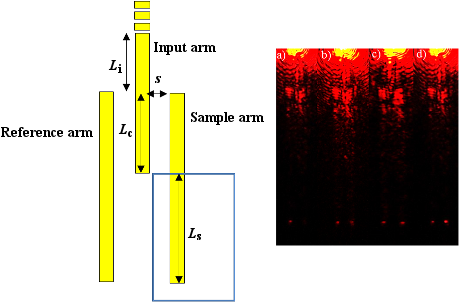
- outcome of this paper will prove beneficial in highly compact, label-free and highly sensitive refractive index analysis. Keywords: interferometer; sensing; surface plasmons; waveguides; Introduction Plasmons are coherent oscillations of free electrons existing on metal dielectric interfaces and are
- highly sensitive to the surrounding dielectric environment. This unique property is incredibly useful in sensing applications. Mach–Zehnder (MZ) interferometry [1][2][3][4][5], surface enhanced Raman spectroscopy (SERS) [6][7][8][9], ring resonators [10] and surface plasmon resonance (SPR) [11][12][13



Investigating organic multilayers by spectroscopic ellipsometry: specific and non-specific interactions of polyhistidine with NTA self-assembled monolayers
Beilstein J. Nanotechnol. 2016, 7, 544–553, doi:10.3762/bjnano.7.48
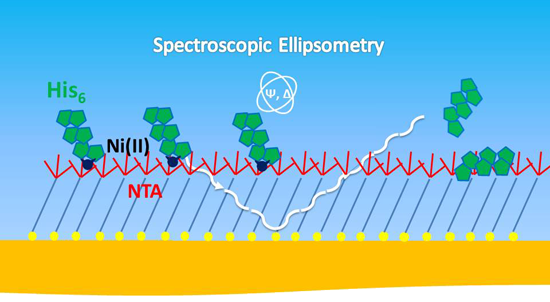
- ligands [32] makes this strategy a versatile system for the development of highly sensitive, specific and renewable sensing devices [33]. A high-performance sensor needs to integrate a specific binding scheme with a sensitive, non-destructive transduction of the binding event into a measurable signal



Early breast cancer screening using iron/iron oxide-based nanoplatforms with sub-femtomolar limits of detection
Beilstein J. Nanotechnol. 2016, 7, 364–373, doi:10.3762/bjnano.7.33
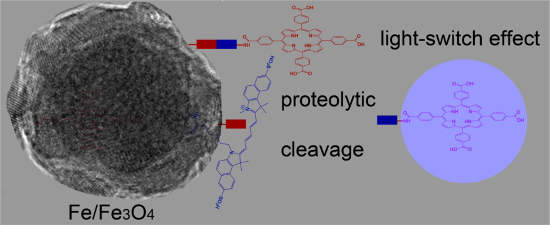
- GAGSGR-SAG for uPA and GAGVPLS-LYSGAG for MMP 9, an increase in TCPP fluorescence is observed upon enzymatic cleavage. This “light switch effect” [20] enables highly sensitive detection of protease activity by quantitative fluorescence measurements. In an earlier paper, we have discussed in detail why
- like to discuss this approach. In 2014, we published the synthesis and calibration of Fe/Fe3O4-based nanoplatforms for accurate and highly sensitive detection of 12 proteases (Figure 1) [20]. The calibration and validation experiments were performed with commercially available proteases in PBS
- . Keywords: biophotonics; breast cancer; iron/iron oxide nanoparticle; liquid biopsy; nanodiagnostics detection; nanomedicine; sub-femtomolar limit of detection; Introduction We have detected stage I breast cancer in human patients with statistical significance by means of a simple serum test using highly


Plasticity-mediated collapse and recrystallization in hollow copper nanowires: a molecular dynamics simulation
Beilstein J. Nanotechnol. 2016, 7, 228–235, doi:10.3762/bjnano.7.21
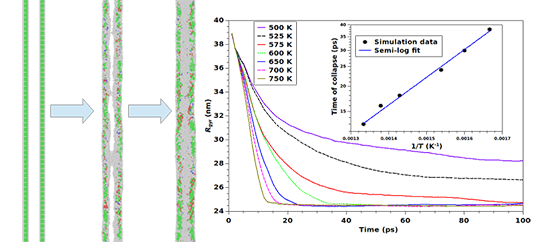
- presence of an additional surface. Hollow nanostructures are being used industrially as fillers for the manufacturing of lightweight composite materials. Besides this structural function, they have also been demonstrated to function as the active elements of recoverable catalysts and highly sensitive


Simulation of thermal stress and buckling instability in Si/Ge and Ge/Si core/shell nanowires
Beilstein J. Nanotechnol. 2015, 6, 1970–1977, doi:10.3762/bjnano.6.201
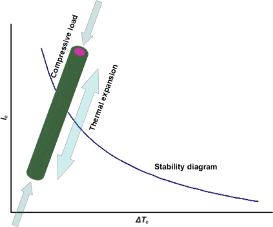
- the CTE as constant over the entire range of operating temperatures. This may be a reasonable assumption when ΔTc remains within a few tens of Kelvin. However, if the temperature varies over a much wider range, or the CTE is highly sensitive to temperature, the temperature dependence, α(T), can be


Electromagnetic enhancement of ordered silver nanorod arrays evaluated by discrete dipole approximation
Beilstein J. Nanotechnol. 2015, 6, 686–696, doi:10.3762/bjnano.6.69
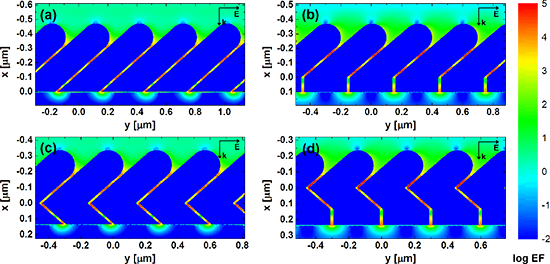
- this simulation result. The simulation result also suggests that the absorption rather than the extinction or scattering could be an indicator of EM enhancement in SERS performance, in line with the observation in Section “Effect of excitation wavelength”. Effect of lateral gap size EFavg is highly
- sensitive to gap size, especially to small gap sizes below 15 nm, as shown in Figure 10. There is a dramatic decrease of EFavg with the increase of gap size from 9 to 18 nm, and a much slower decrease with further increase of gap size. The gap size has been a crucial parameter of the SERS substrates because


In situ observation of biotite (001) surface dissolution at pH 1 and 9.5 by advanced optical microscopy
Beilstein J. Nanotechnol. 2015, 6, 665–673, doi:10.3762/bjnano.6.67
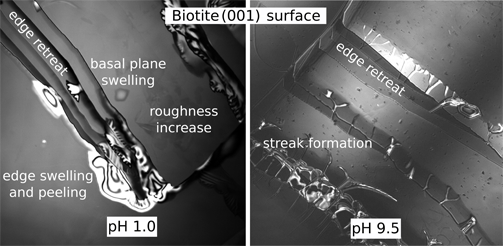
- , the field of view is wider and long in situ observations are possible. However, measurements are highly sensitive to small fluctuations of temperature and air bubbles. Instead, in situ measurements under different solution pH, temperature, flow rate, and pressure by using flow-through cells can be


Novel ZnO:Ag nanocomposites induce significant oxidative stress in human fibroblast malignant melanoma (Ht144) cells
Beilstein J. Nanotechnol. 2015, 6, 570–582, doi:10.3762/bjnano.6.59
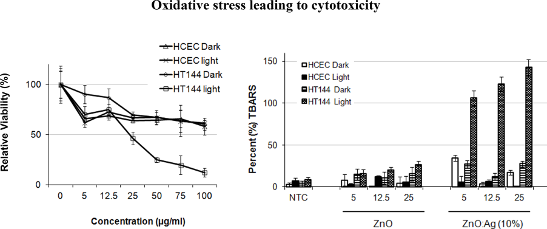
- highly sensitive to the NPs under both light and dark conditions, with an IC50 of 15.78 and 23.34 μg/mL, respectively. Complete cell death was observed at 50, 75 and 100 μg/mL under light exposure. However, it did not kill more than 50% of the HCEC cells (IC50 ≥ 100 μg/mL) at the concentrations tested




Hollow plasmonic antennas for broadband SERS spectroscopy
Beilstein J. Nanotechnol. 2015, 6, 492–498, doi:10.3762/bjnano.6.50
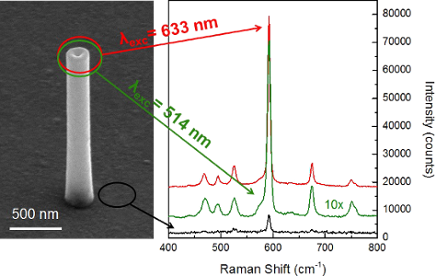
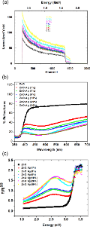
- complex and multifaceted system that includes many types of proteins, lipids, nucleic acids and various other components. With the final aim of studying these components in detail, we have developed multiband plasmonic antennas, which are suitable for highly sensitive surface enhanced Raman spectroscopy
- perform highly sensitive SERS spectroscopy on all cell features using various excitation wavelengths. In a recent paper it was demonstrated that 3D hollow nanoantennas are capable of broadband absorption in the visible range of radiation [23]. In this work an experimental determination of the field
- behavior exhibited by these hollow nanoantennas may be a key factor for highly sensitive Raman measurements on the various components of the whole cell using an extended range of excitation light sources. Moreover, the 3D nature of these nanostructures allows them to be connected to electric power sources


Synthesis of boron nitride nanotubes and their applications
Beilstein J. Nanotechnol. 2015, 6, 84–102, doi:10.3762/bjnano.6.9
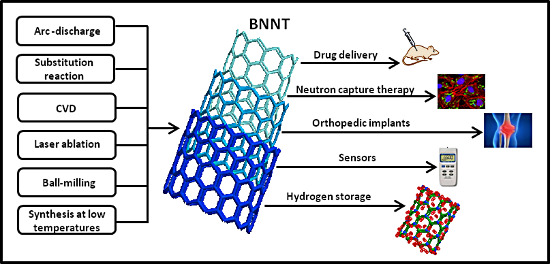
- combined with the properties of other nanomaterials to construct novel sensor devices for humidity, carbon dioxide detection, and clinical diagnostics. A highly sensitive humidity sensor using BNNTs and silver nanoparticles (AgNPs) for the rapid detection of humidity was fabricated [90]. Figure 8 shows the




Materials and characterization techniques for high-temperature polymer electrolyte membrane fuel cells
Beilstein J. Nanotechnol. 2015, 6, 68–83, doi:10.3762/bjnano.6.8
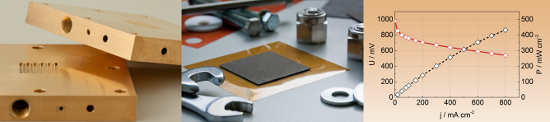
- study the effects of acid-doping on PBI-type polymers because they are highly sensitive to molecular structural changes that occur during the acid–base proton exchange reaction between PBI and phosphoric acid as shown in Figure 5 They are also sensitive to molecular interactions between membrane




Interaction of dermatologically relevant nanoparticles with skin cells and skin
Beilstein J. Nanotechnol. 2014, 5, 2363–2373, doi:10.3762/bjnano.5.245
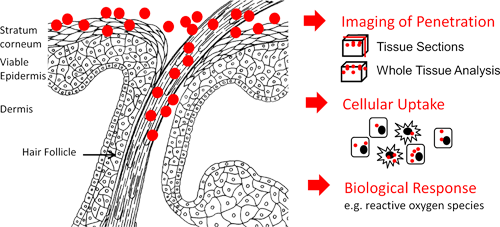
- by the highly sensitive tracking of the surface enhanced Raman scattering (SERS) signal of single AgNP. Here, the penetration depth was found to be 19 ± 10 µm for intact skin, compared to 22 ± 5 µm for skin pre-treated with 20 tape stripes. This effect is well known for AgNP of this type and size [20


Gas sensing properties of nanocrystalline diamond at room temperature
Beilstein J. Nanotechnol. 2014, 5, 2339–2345, doi:10.3762/bjnano.5.243
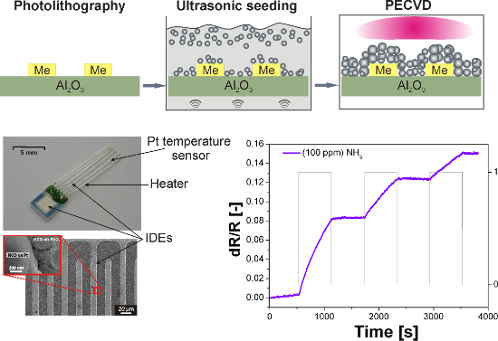
- can be deposited on the existing sensor elements. Undoped diamond is an extremely good insulator and upon the formation of a covalent bond with hydrogen, exhibits semiconducting properties [8]. This conductivity arises from free positive charge carriers (holes) in the sub-surface region and is highly
- sensitive to surrounding gases and/or liquids. Our previous works have shown that interdigitated electrodes (IDEs) capped with nanostructured, hydrogen-terminated, nanocrystalline diamond (NCD) were very sensitive and selective, especially towards phosgene gas [9][10]. In addition, we observed that the


Advances in NO2 sensing with individual single-walled carbon nanotube transistors
Beilstein J. Nanotechnol. 2014, 5, 2179–2191, doi:10.3762/bjnano.5.227
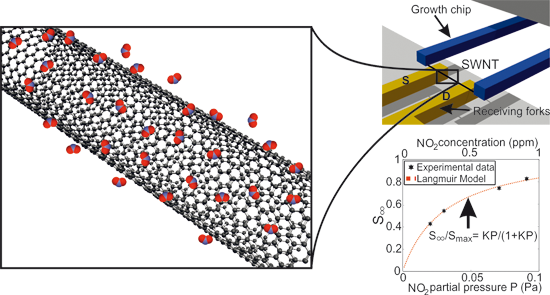
- Kiran Chikkadi Matthias Muoth Cosmin Roman Miroslav Haluska Christofer Hierold Micro and Nanosystems, Department of Mechanical and Process Engineering, ETH Zurich, Switzerland 10.3762/bjnano.5.227 Abstract The charge carrier transport in carbon nanotubes is highly sensitive to certain molecules
- nanotube properties into functional ultra-low power, highly sensitive gas sensors. Keywords: carbon nanotube field-effect transistors (CNFETs); cross-sensitivity; functionalization; gas sensors; hysteresis; low power; selectivity; self-heating; single walled carbon nanotubes; Introduction New materials
- monitoring its concentration is crucial for applications such as air quality monitoring. Leveraging the NO2 sensitivity of carbon nanotubes to build highly sensitive, low-power gas sensors is therefore not only of academic, but also of great commercial interest. As such, we will focus on the NO2-SWNT system


Rapid degradation of zinc oxide nanoparticles by phosphate ions
Beilstein J. Nanotechnol. 2014, 5, 2007–2015, doi:10.3762/bjnano.5.209
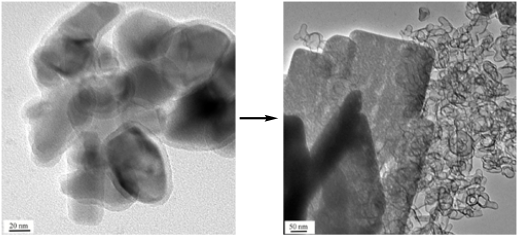
- nanoparticles are highly sensitive towards phosphate ions even at pH 7. Buffer solutions and cell culture media containing phosphate ions are able to destroy ZnO nanoparticles within a time span from less than one hour to one day. The driving force of the reaction is the formation of zinc phosphate of very low


Dynamic calibration of higher eigenmode parameters of a cantilever in atomic force microscopy by using tip–surface interactions
Beilstein J. Nanotechnol. 2014, 5, 1899–1904, doi:10.3762/bjnano.5.200

- , [Amin,e; Amax,e], where Amax = max A(t) = max z(t). As numerical simulations have shown, the error function does not have a well-defined global minimum and it is highly sensitive to reconstruction errors. An alternative approach is to minimize a mean square error function in real space which in most


![[Graphic 25]](/bjnano/content/inline/2190-4286-5-200-i35.png?max-width=637&scale=1.18182) , using Equation 9 for two different cantilevers: ...
, using Equation 9 for two different cantilevers: ...
Synthesis of Pt nanoparticles and their burrowing into Si due to synergistic effects of ion beam energy losses
Beilstein J. Nanotechnol. 2014, 5, 1864–1872, doi:10.3762/bjnano.5.197
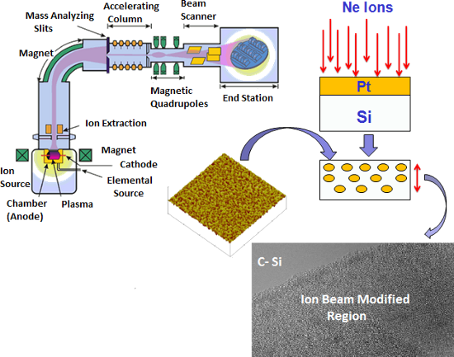
- ions in the Pt–Si system as a function of the depth, ≈2 nm of burrowing was calculated in the irradiated film. If the elemental concentration is less than 1014 ions/cm2, detection with conventional RBS is difficult. In such a case, high-resolution, highly sensitive RBS measurements would be needed for



Room temperature, ppb-level NO2 gas sensing of multiple-networked ZnSe nanowire sensors under UV illumination
Beilstein J. Nanotechnol. 2014, 5, 1836–1841, doi:10.3762/bjnano.5.194
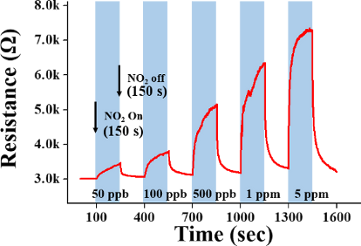
- temperatures because gas sensitivity tends to increase with increasing temperature. On the other hand, the development of highly sensitive and selective sensors at room temperature is still a challenge. Several techniques including the doping [12][14][15] or surface functionalization [16][17][18] of metal



Numerical investigation of the effect of substrate surface roughness on the performance of zigzag graphene nanoribbon field effect transistors symmetrically doped with BN
Beilstein J. Nanotechnol. 2014, 5, 1569–1574, doi:10.3762/bjnano.5.168
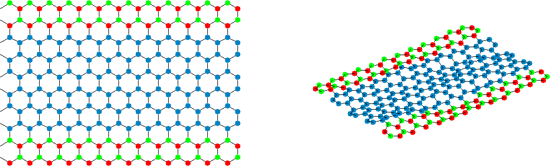
- -lattices [25]. BN-doped ZGNRs may be used as a channel material for nanometer-sized conventional field effect transistors. Although the one-atom thick nature of GNRs makes them highly sensitive to their environmental surroundings, for example, the substrate material, phonons from the substrate and charged


Current state of laser synthesis of metal and alloy nanoparticles as ligand-free reference materials for nano-toxicological assays
Beilstein J. Nanotechnol. 2014, 5, 1523–1541, doi:10.3762/bjnano.5.165
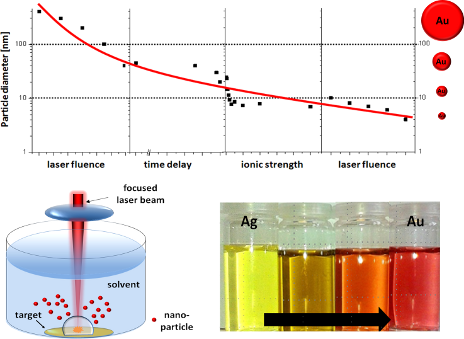
- reference materials is of paramount importance in reproduction biology, as fertilization is a highly sensitive process where a single cell counts. Influence of laser pulse length on particle size distribution. A) Representative normalized weight frequency of nanoparticle diameter of gold nanoparticles


Synthesis of hydrophobic photoluminescent carbon nanodots by using L-tyrosine and citric acid through a thermal oxidation route
Beilstein J. Nanotechnol. 2014, 5, 1513–1522, doi:10.3762/bjnano.5.164
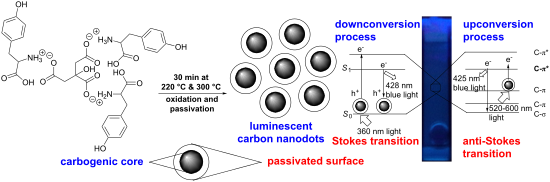
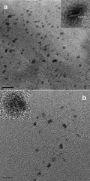
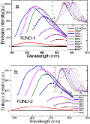
- candidates to replace the hydrophobic fluorescent probes because they are resistant to photobleaching and exhibit strong fluorescence [33]. Excellent fluorescent probes based on CNDs were fabricated for a highly sensitive and selective detection of DNA molecules [24], Cu2+ ions [25] and dopamine [26]. The






Protein-coated pH-responsive gold nanoparticles: Microwave-assisted synthesis and surface charge-dependent anticancer activity
Beilstein J. Nanotechnol. 2014, 5, 1452–1462, doi:10.3762/bjnano.5.158
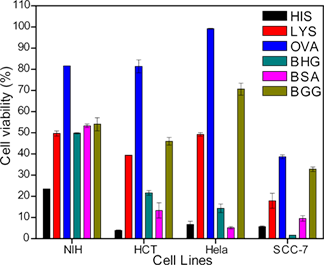
- lower costs and minimal side effects [24]. Because of their biocompatibility, noble metal nanoparticles, particularly AuNPs, are more preferable in various biomedical applications, including highly sensitive diagnostic assays [25], thermal ablation, radiotherapy enhancement [26][27][28], as well as for


Effects of palladium on the optical and hydrogen sensing characteristics of Pd-doped ZnO nanoparticles
Beilstein J. Nanotechnol. 2014, 5, 1261–1267, doi:10.3762/bjnano.5.140
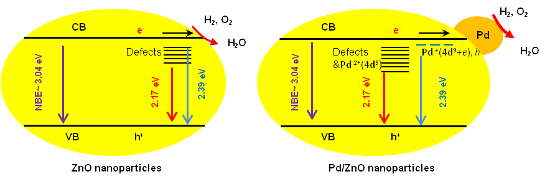
- sensitivity of the ZnO– 0.5 wt % Pd sensor depends on the operating temperature. This is shown in Figure 5 for 1 vol % of hydrogen, H2, carbon monoxide, CO, and for propane, C3H8. The comparison of the specificity of the sensor for the studied gases at 250 °C shows that the sensor is highly sensitive to H2


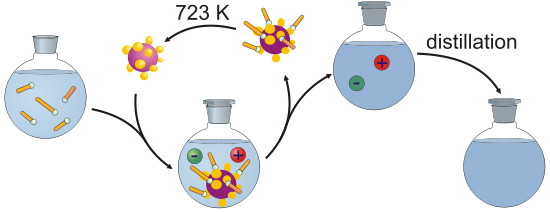
Purification of ethanol for highly sensitive self-assembly experiments
Beilstein J. Nanotechnol. 2014, 5, 1254–1260, doi:10.3762/bjnano.5.139

Highly NO2 sensitive caesium doped graphene oxide conductometric sensors
Beilstein J. Nanotechnol. 2014, 5, 1073–1081, doi:10.3762/bjnano.5.120
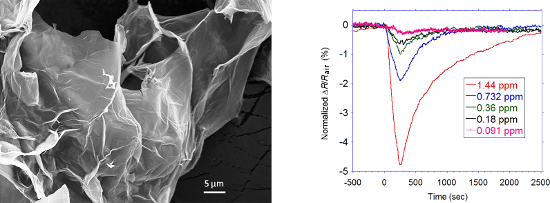
- ; graphene oxide; highly sensitive; nitrogen dioxide; Introduction Graphene is a single layer of carbon atoms arranged in a honeycomb lattice [1][2]. Intrinsic low noise structure, large specific surface area and extraordinary mobility of carriers are the unique properties that make graphene-based materials
- using sputtering or by alternating current dielectrophoresis has shown an improvement in the sensitivity to NO by a factor of 5 (down to 2 ppb at room temperature) [15] as well as selectivity to hydrogen [18]. Increasing air pollution and global warming raised the demand for highly sensitive and
- sample is highly sensitive to NO2. On the contrary, no appreciable response has been recorded for GO sensor in the presence of concentrations below 3 ppm, while a relative increase in the response (RGO) of 18, 41, 65% was recorded for 3, 6.1 and 12.2 ppm NO2, respectively. Table 1 summarises the response