Search results
Search for "molecular structure" in Full Text gives 150 result(s) in Beilstein Journal of Nanotechnology.
Observation and analysis of structural changes in fused silica by continuous irradiation with femtosecond laser light having an energy density below the laser-induced damage threshold
Beilstein J. Nanotechnol. 2014, 5, 1334–1340, doi:10.3762/bjnano.5.146
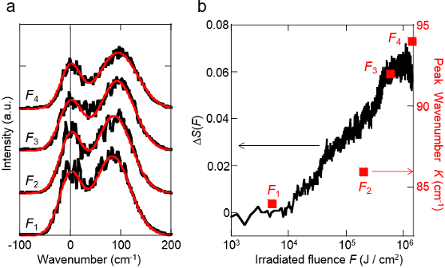
- photogenerated carriers in a degraded silica substrate and a damaged silica substrate and observed a Raman signal originating from a specific molecular structure of silica. From these findings, we concluded that compositional changes in the molecular structure occurred during degradation due to femtosecond laser
- relaxation lifetime, we found that compositional changes in the molecular structure occurred as laser-induced degradation proceeded. Results and Discussion 1 Evaluation of laser-induced degradation of fused silica 1.1 Surface roughness dependence of threshold fluence in laser-induced degradation First, to
- the Raman signal from silica with a specific molecular structure is increased by irradiation with fs laser light having an energy density above the LIDT [19], and sample E is also thought to be mainly formed of six-membered rings in a similar fashion. Although there is no molecular structure of silica


PEGylated versus non-PEGylated magnetic nanoparticles as camptothecin delivery system
Beilstein J. Nanotechnol. 2014, 5, 1312–1319, doi:10.3762/bjnano.5.144
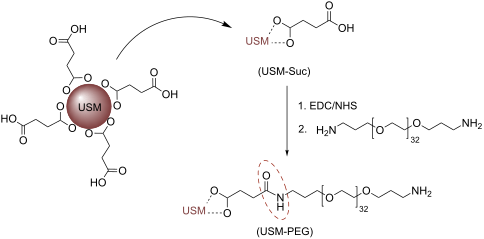
- covalent attachment of targeting cargoes such as antibodies. Molecular structure of (S)-(+)-camptothecin (1) and its inactive form (2) through lactone ring hydrolysis at physiological pH. Bright field (a) and dark field (b) transmission electron microscopy (TEM) images and diffraction pattern (c) of USM


Model systems for studying cell adhesion and biomimetic actin networks
Beilstein J. Nanotechnol. 2014, 5, 1193–1202, doi:10.3762/bjnano.5.131
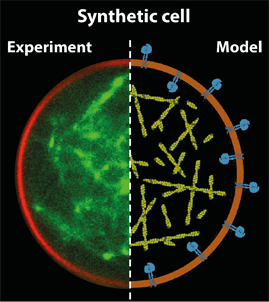
- understanding the basic functions of living cells including signalling pathways, gene regulation and the molecular structure of cellular components. However, with each new discovery it becomes clearer that cells are very complex, active systems with many parts interlinked to each other. This complexity makes it
- Geiger and co-workers [24][25]. Further fundamental roles of integrin molecules in signalling and other cellular functions have been studied by using various knockdown animal models [7][26][27][28]. Studies on the molecular structure of integrins over the past 28 years have revealed that these adhesion


Characterization and photocatalytic study of tantalum oxide nanoparticles prepared by the hydrolysis of tantalum oxo-ethoxide Ta8(μ3-O)2(μ-O)8(μ-OEt)6(OEt)14
Beilstein J. Nanotechnol. 2014, 5, 1082–1090, doi:10.3762/bjnano.5.121
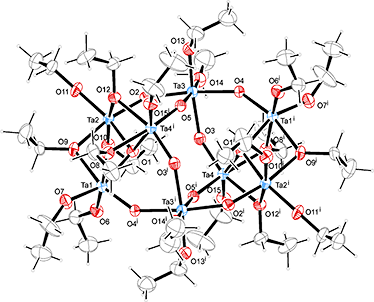
- cis pairs of terminal OEt ligands, single terminal OEt ligands and μ-OEt groups. Crystal structure Compound 1 was found in the monoclinic space group P21/n with Z = 2. The molecular structure (Figure 1) consists of a centrosymmetric unit of formula Ta8(μ3-O)2(μ-O)8(μ-OEt)6(OEt)14 (1). Each molecule
- remaining dye. ORTEP representation of the molecular structure of 1 in the crystal (hydrogen atoms are omitted for clarity). XRD pattern of Ta2O5 nanoparticles calcined at 750 °C for 4 h. SEM image of Ta2O5 nanoparticles calcined at 750 °C for 4 h. Size and distribution of TOPO-coated Ta2O5 nanoparticles in


En route to controlled catalytic CVD synthesis of densely packed and vertically aligned nitrogen-doped carbon nanotube arrays
Beilstein J. Nanotechnol. 2014, 5, 219–233, doi:10.3762/bjnano.5.24
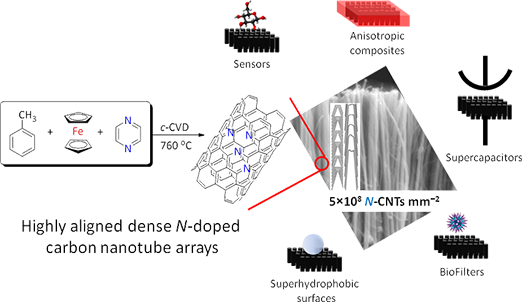
- tip and at the bottom of the nanotube are witnesses and remains of the growth process. It must be also emphasized here that catalyst particles were absent in the MWCNT tips. Based on results from FT-IR and Raman spectroscopy, and TG measurements, some important premises on the molecular structure of N


Spin relaxation in antiferromagnetic Fe–Fe dimers slowed down by anisotropic DyIII ions
Beilstein J. Nanotechnol. 2013, 4, 807–814, doi:10.3762/bjnano.4.92
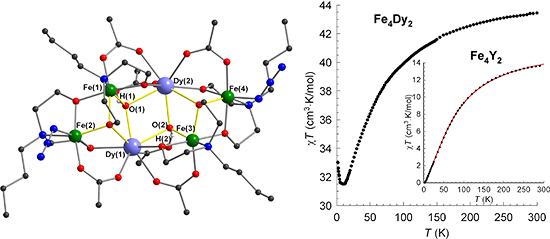
- described as distorted bicapped trigonal prisms. The molecular structure of the Fe4Y2 aggregate in 2 is very similar to that of the Fe4Dy2 in 1, and differs only in the replacement of the n-butyl groups in 1 by methyl groups and the replacement of DyIII by YIII. At temperatures higher than 20 K the
- other relevant model compounds [16][17][18]. The presence of two doublets with different quadrupole splittings (ΔEQ) indicates two Fe sites with different coordination spheres, in agreement with both the molecular structure and bond length distortion (BLD) calculations: Fe(1) and Fe(3) = 3.95 and 3.82
- , Cambridge CB2 1EZ, UK: e-mail: data_request@ccdc.cam.ac.uk, fax: +44 1223 336033 or http://www.ccdc.cam.ac.uk/cgi-bin/catreq.cgi. Molecular structure of [Fe4Dy2(OH)2(N-nbdea)4((CH3)3CCOO)6(N3)2] and its core. Solvent molecules, disordered atoms and organic H atoms have been omitted for clarity. Dy blue; Fe



Optimization of solution-processed oligothiophene:fullerene based organic solar cells by using solvent additives
Beilstein J. Nanotechnol. 2013, 4, 680–689, doi:10.3762/bjnano.4.77
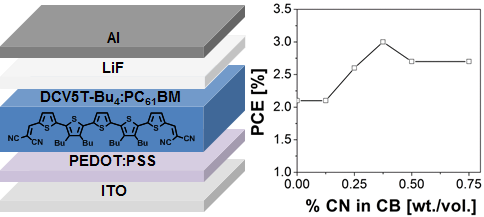
- , “small” molecules, have the advantage of possessing a defined molecular structure that is monodisperse in nature and allows for purification and characterization, which leads to the derivation of valuable structure–property relationships. Problems with respect to reproducibility of solar cell results due


New hybrid materials based on poly(ethyleneoxide)-grafted polysilazane by hydrosilylation and their anti-fouling activities
Beilstein J. Nanotechnol. 2013, 4, 671–677, doi:10.3762/bjnano.4.75
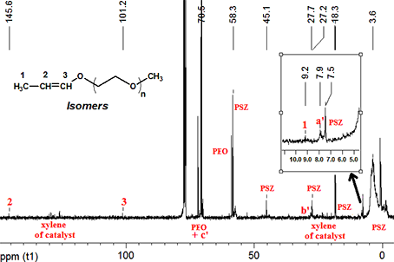
- dried under vacuum before usage. The polysilazane precursor, polylmethyhydrosilazane containing triethoxysilanes, was provided by the Clariant Company. The molecular structure of the polysilazane precursor is described on Figure 1. PSZ was used as received without any further purification. Allyl bromide
- indispensable to find the optimal conditions for grafting allyl-PEO2000 on the PSZ chain in order to improve the degree of hydrosilylation and to increase the density of grafted allyl-PEO2000 molecules in PSZ-PEO anti-fouling surfaces. Molecular structure and distribution of the functional groups of the





Large-scale atomistic and quantum-mechanical simulations of a Nafion membrane: Morphology, proton solvation and charge transport
Beilstein J. Nanotechnol. 2013, 4, 567–587, doi:10.3762/bjnano.4.65
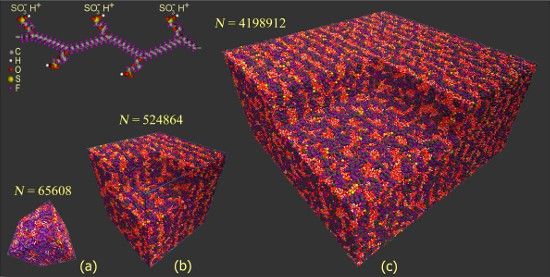
- current literature (see, for example [5][6][7][8][9][10][11][12]). The importance of optimizing the morphology becomes clear in the following example. In order to achieve high proton conductivity, the molecular structure should be such that the hydrated membrane contains wide interconnected water channels


Selective surface modification of lithographic silicon oxide nanostructures by organofunctional silanes
Beilstein J. Nanotechnol. 2013, 4, 218–226, doi:10.3762/bjnano.4.22
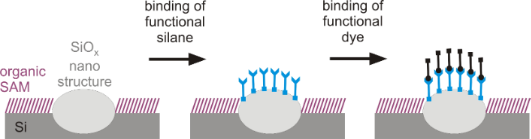
- to steric reasons as well as the molecular structure and would also be contradictory to the AFM-investigations. It may also be possible that the fluorescence is quenched by an efficient energy transfer between densely packed FITC molecules on the structure. However, such an effect can be excluded by


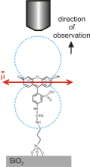
![[Graphic 2]](/bjnano/content/inline/2190-4286-4-22-i2.png?max-width=637&scale=1.18182) (red arrow) of FITC bound to a SiO2 surface.
(red arrow) of FITC bound to a SiO2 surface.
Electrospinning preparation and electrical and biological properties of ferrocene/poly(vinylpyrrolidone) composite nanofibers
Beilstein J. Nanotechnol. 2013, 4, 189–197, doi:10.3762/bjnano.4.19

- scientists because of its unique molecular structure and fascinating electronic properties and its potential applications in catalysis in organic synthesis, as functional materials, photosensitizers, stabilizers and conditioners, and in biochemistry and pharmaceuticals [13]. Fc decorated or incorporated into
- . Nevertheless, electrical communication was achieved between the electrode and the redox-active Fc molecules encapsulated inside the PVP nanofibers. It indicated that the molecular structure of Fc was not destroyed during the electrospinning process. In contrast, no redox peaks were observed on bare electrodes


Nanostructure-directed chemical sensing: The IHSAB principle and the dynamics of acid/base-interface interaction
Beilstein J. Nanotechnol. 2013, 4, 20–31, doi:10.3762/bjnano.4.3
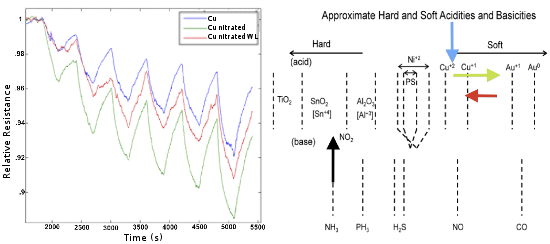
- nanostructure surfaces but that it modifies the molecular structure and interaction as the metal-oxide deposited surface has gained considerable basic character. Initial results suggest that the nitridation process does not simply increase the basic character of the nanostructure surfaces but that it modifies
- the molecular structure and interaction, consistent with the IHSAB principle. This means that the sensitivity of the weaker metal oxides is enhanced by nitridation. Further, this process can be applied to create several potential visible-light-absorbing photocatalysts similar to TiO2−xNx [9][10]. We


Diamond nanophotonics
Beilstein J. Nanotechnol. 2012, 3, 895–908, doi:10.3762/bjnano.3.100
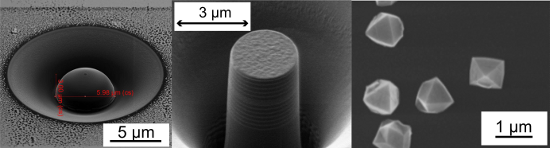
- corresponds to the resonant optical transition (ZPL). The broad band at longer wavelength corresponds to phonon-broadened emission. The inset shows the molecular structure of the NV center in diamond consisting of a substitutional nitrogen atom with an adjacent vacancy. Plasmonic resonator geometries, field I







Dimer/tetramer motifs determine amphiphilic hydrazine fibril structures on graphite
Beilstein J. Nanotechnol. 2012, 3, 658–666, doi:10.3762/bjnano.3.75
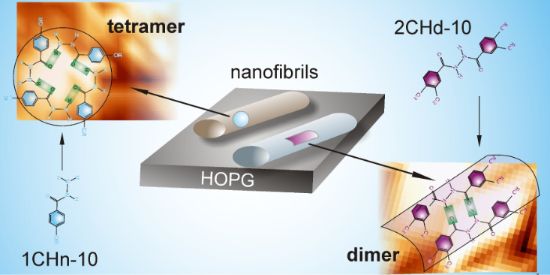
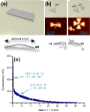
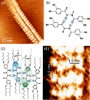
- Experimental section). As the alkyl chain length is known to influence column formation in the bulk, the length of alkyl chains for both molecules is kept identical such that the focus of the study is solely on the geometry/symmetry aspect [6]. In Figure 1, a wedge shape is shown superimposed on the molecular
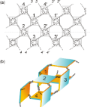
- structure, where the amide moieties are at the tip of the wedge and the alkoxy chains at the tail. In general, the molecular geometry of the mesogens is decisive for the generation of columnar mesophases in the bulk, i.e., the mesogens should be wedge-shaped. The wedges can form a disc with their tips all




Distribution of functional groups in periodic mesoporous organosilica materials studied by small-angle neutron scattering with in situ adsorption of nitrogen
Beilstein J. Nanotechnol. 2012, 3, 428–437, doi:10.3762/bjnano.3.49
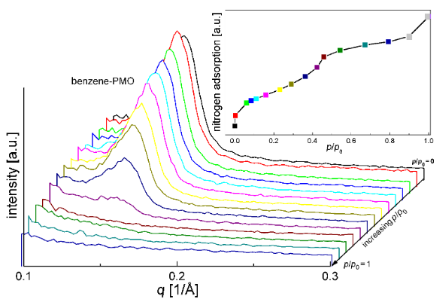
- by the scattering length b indicating neutron–nucleus interaction. The scattering length density ρSLD is defined by the sum of the scattering lengths of all atoms that are involved in the molecular structure, divided by the molecular volume: NA is the Avogadro constant, M is the mass of the used


An NC-AFM and KPFM study of the adsorption of a triphenylene derivative on KBr(001)
Beilstein J. Nanotechnol. 2012, 3, 221–229, doi:10.3762/bjnano.3.25
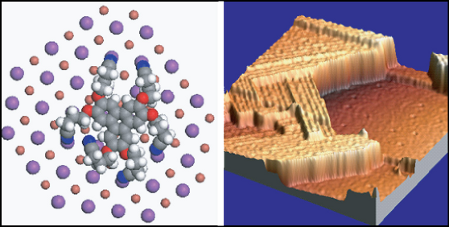
- adsorption. The mechanisms at work during this transformation could be of the same nature as those discussed recently in the study of the restructuring of KBr(001) steps by truxene molecules [11]. Finally, we note that when the molecular structure crosses portions of steps that are not aligned in these




Molecular-resolution imaging of pentacene on KCl(001)
Beilstein J. Nanotechnol. 2012, 3, 186–191, doi:10.3762/bjnano.3.20
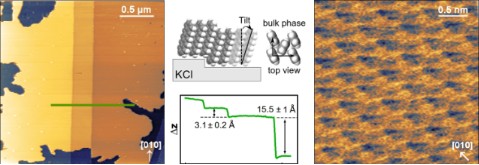
- surfaces, molecular growth is usually governed by strong adsorbate–substrate interactions. However, for some applications in the field of thin-film electronic devices, insulating substrates are required in order to decouple the molecular structure from the substrate. On insulators the interaction of the


Electron-beam patterned self-assembled monolayers as templates for Cu electrodeposition and lift-off
Beilstein J. Nanotechnol. 2012, 3, 101–113, doi:10.3762/bjnano.3.11
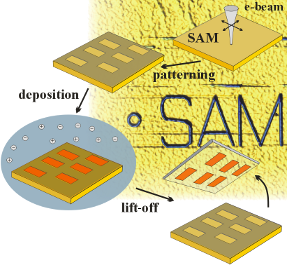
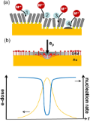
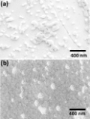
- exposure to electrons (positive-resist behaviour), in contrast to aromatic SAMs in which the molecular structure of the SAM is essentially preserved [40] apart from the cross-linking of the aromatic moieties. The rather ill-defined electron-induced degradation of aliphatic SAMs makes it very difficult to





Direct-write polymer nanolithography in ultra-high vacuum
Beilstein J. Nanotechnol. 2012, 3, 52–56, doi:10.3762/bjnano.3.6
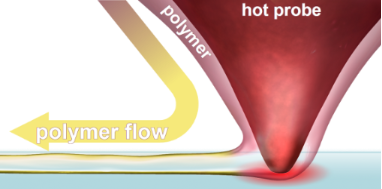
- impact on the observed molecular film thickness. Conclusion In conclusion, we have developed a method for direct, additive deposition of polymer in UHV using thermal dip-pen nanolithography. The molecular structure of the written PDDT monolayer nanostructure films depends on the chemistry of the silicon


When “small” terms matter: Coupled interference features in the transport properties of cross-conjugated molecules
Beilstein J. Nanotechnol. 2011, 2, 862–871, doi:10.3762/bjnano.2.95
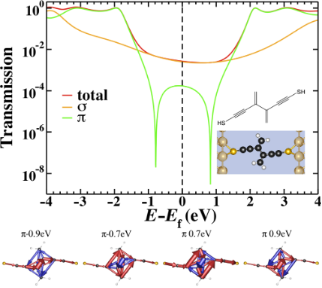
- nonzero, and obviously these through-space terms will change if the molecular structure is varied in such a way that modifies these distances. The transmission through the smallest system (1cc) was published previously [19] and agrees well with the Hückel model calculations [44]. When we consider 2cc




An MCBJ case study: The influence of π-conjugation on the single-molecule conductance at a solid/liquid interface
Beilstein J. Nanotechnol. 2011, 2, 699–713, doi:10.3762/bjnano.2.76
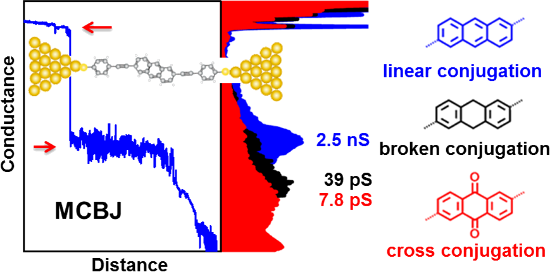
- molecular conformation [13][16] and as well as of the anchoring group and of the contacting leads [17][18] was studied to develop correlations between charge-transport characteristics and molecular structure. Furthermore, π-conjugation plays an essential role in charge transport through single molecular
- a molecular junction, we calculated the junction formation probability from the plateau-length analysis and obtained the following values: 33% out of all traces for AC, 32% for AH and 14% for AQ. Clearly, the molecular structure of each of the three OPE-type species influences the bonding of the





Self-organizing bioinspired oligothiophene–oligopeptide hybrids
Beilstein J. Nanotechnol. 2011, 2, 525–544, doi:10.3762/bjnano.2.57
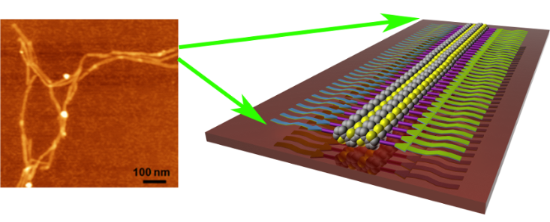
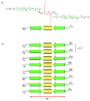
- theoretical considerations of the experimentally observed nanofibers, the molecular structure of the molecule was constructed. Our theoretical research methodology consists of four main steps schematically depicted in Figure 11. First, the available experimental data, including available X-ray structural data




Towards a scalable and accurate quantum approach for describing vibrations of molecule–metal interfaces
Beilstein J. Nanotechnol. 2011, 2, 427–447, doi:10.3762/bjnano.2.48
- ; vibrational theory; Introduction The study of molecular vibrations has been a topic of continued interest in chemistry for over a century, starting with the work of William Coblenz in 1905. The main driving force behind these studies has been the correlation that exists between molecular structure and


Characterization of protein adsorption onto FePt nanoparticles using dual-focus fluorescence correlation spectroscopy
Beilstein J. Nanotechnol. 2011, 2, 374–383, doi:10.3762/bjnano.2.43
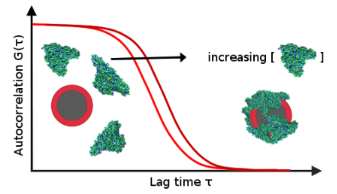
- three proteins gave rise to a well-defined increase in NP size upon binding. The thickness of the protein corona can be related to a particular orientation of the protein, based on the knowledge of its molecular structure. For apolipoproteins, this result is rather intriguing because they are very
- charge on the protein that preferentially interact with the negatively charged NP surface. In this subsection, we discuss the thickness of the corona in relation to the molecular shapes and electrostatic properties of the adsorbed proteins. Figure 3a (left) shows a cartoon representation of the molecular
- structure of HSA, a protein with a molecular mass of 67 kDa [18]. It can be approximated by an equilateral triangular prism, with sides of ~8 nm and a height of ~3 nm (Figure 3a, middle). The ~3 nm radius increase upon adsorption of HSA, observed with 2fFCS (Figure 2a), completely agrees with our previous



Superhydrophobicity in perfection: the outstanding properties of the lotus leaf
Beilstein J. Nanotechnol. 2011, 2, 152–161, doi:10.3762/bjnano.2.19

- contact with water [20] and to prove the theories such as those of Wenzel or Cassie and Baxter. For precise modelling of the behaviour of natural water repellent surfaces, an exact knowledge of the chemical composition and molecular structure are essential. Resistance against environmental stress The